Quick answer
Yes, a hair transplant can be successful without finasteride. Transplanted follicles from a suitable donor area can grow without the medication. The concern is the hair left behind: if male pattern hair loss continues, native hair around the transplant may gradually disappear. This can change the result’s appearance years after surgery. Age, hair-loss progression, donor capacity and surgical design all matter when deciding whether transplantation without medication is a reasonable option.
A patient may arrive for a consultation having already decided on two things. He wants his hair restored, and he doesn't want finasteride.
I take both decisions seriously.
For some men, the concern is sexual side effects. Others have tried the medication and found it difficult to tolerate. Some prefer to avoid prescription treatment altogether, particularly when they understand that maintaining the benefit may mean taking it for years.
The question I want to answer is whether we can plan a transplant that makes sense under those circumstances.
Sometimes we can. We have patients who have undergone transplantation without finasteride or minoxidil and achieved good visible results during their first postoperative year. Three of those cases are documented below.
But there is another part of the conversation that matters just as much as the photographs: what happens when the remaining natural hair continues to thin?
A transplant restores hair to a particular area. It does not stop the biological process responsible for male pattern baldness.
That distinction becomes especially important when the patient is young, the crown is involved, or a large number of grafts are being considered.
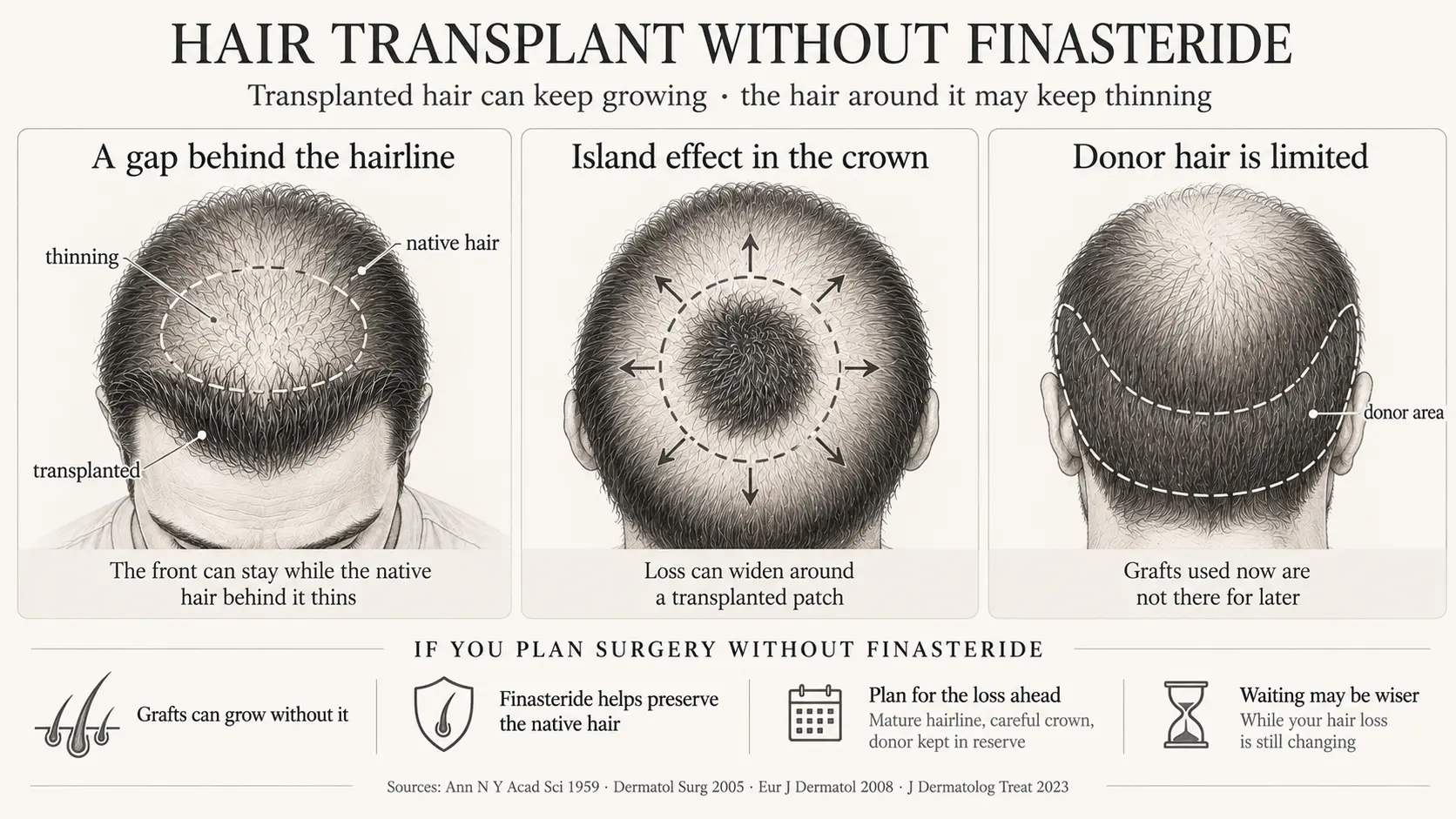
A transplant replaces hair. Finasteride helps preserve it.
Male pattern hair loss, medically known as androgenetic alopecia, involves the gradual miniaturization of genetically susceptible hair follicles. Dihydrotestosterone (DHT) contributes to this process. Over time, affected follicles produce thinner, shorter hairs, and scalp coverage decreases.
Finasteride reduces DHT by inhibiting 5-alpha-reductase. For men who respond, it can slow further loss and sometimes improve density. Read more about how finasteride works.
Hair transplantation addresses the problem differently. We move follicular units from the donor region, usually at the back and sides of the scalp, to areas where coverage has been lost.[14]
The difference between donor and recipient hair is fundamental to transplantation.
In 1959, dermatologist Norman Orentreich described the principle that became known as donor dominance. Hair-bearing tissue moved from an area with different characteristics can retain important features of its donor origin. This helped establish the biological reasoning behind modern hair restoration surgery.[1]
For androgenetic alopecia, follicles taken from a suitably selected donor region are generally more resistant to DHT-related miniaturization than those from the balding scalp.
That resistance is valuable, although it shouldn't be mistaken for an absolute guarantee of lifelong survival. Donor areas vary between patients, and hair can change with age or other scalp conditions.
The practical implication is straightforward. Transplanted follicles may continue growing for years while the original, susceptible hair around them becomes progressively thinner.
If someone asks whether finasteride is required to keep transplanted grafts alive, my answer is no. If they ask whether it could help preserve the overall appearance of their transplant, the answer is different.
There is evidence that it can.
What happens one, five or ten years after surgery without finasteride?
I find it helpful to separate the normal development of transplanted hair from the longer-term progression of male pattern baldness.
The first year is largely about recovery and growth. Later years bring a different question: whether the transplanted areas continue to blend naturally with the hair that was already there.
| Time after surgery | What to understand |
|---|---|
| First 12 months | Transplanted hair initially sheds and gradually regrows. Visible coverage commonly improves over six to twelve months, with further maturation possible. |
| Years 1–3 | A mature surgical result may be established. Native hair can remain stable or continue thinning, depending on the individual. |
| Years 3–5 | Continued loss may become more noticeable behind the hairline or around the crown. Some patients remain satisfied; others may consider further treatment. |
| Years 5–10 and beyond | The original pattern of baldness may have extended substantially. The transplanted hair can remain present while the surrounding appearance changes. Donor reserves and the initial design become increasingly important. |
These are assessment periods and possible developments, not a forecast that hair loss will occur at any particular year.
There is a useful five-year study that helps explain why we have to consider this longer timescale.
Researchers analyzed men with androgenetic alopecia who received placebo during controlled finasteride trials. At five years, 75% were rated as having visibly worsened hair loss compared with baseline. Hair density in the measured target area had declined by 26.3%, equivalent to a reduction of 239 hairs in that area.[3]
That is substantial progression, and it occurred over a period during which many transplant patients would still expect their surgical result to look good.
The study does have an important limitation for our question: these were not patients being followed after hair transplantation without finasteride. The results describe untreated male pattern hair loss within a defined research population, predominantly involving vertex-pattern loss. We cannot apply the 26.3% figure to a transplant recipient or assume that three-quarters of untreated transplant patients will experience a particular cosmetic outcome.
It does, however, demonstrate that native hair loss can continue meaningfully over five years.
Research specifically comparing ten-year outcomes in transplanted patients who use finasteride with those who do not remains much less informative than the short-term studies discussed here. The evidence cited in this article does not provide a reliable ten-year graft-survival percentage for medication-free transplantation.
This is why I am cautious about promises of permanent density. Even when transplanted follicles remain healthy, the surrounding scalp can look very different a decade later.
The five-year analysis was authored by researchers affiliated with Merck Research Laboratories. That industry connection is relevant when interpreting the evidence, alongside the study's controlled design and clearly reported outcomes.[3]
The hairline can survive while the original hair disappears
Imagine a man in his late twenties with recession at both temples. He still has reasonable density through the middle of his scalp and wants a low, well-defined hairline.
We could place grafts into the recessed areas, and the first-year result might look excellent.
Ten years later, however, suppose he has lost a substantial amount of his original frontal and mid-scalp hair. The transplanted hairline may still be present, but now there is less natural hair behind it.
The result can develop an isolated band of transplanted hair with thinning scalp further back.
This is the sort of problem I want to avoid during the initial consultation, rather than trying to repair it later.
An aggressive hairline uses more grafts. It also creates an obligation to maintain a natural relationship between the front and the rest of the scalp as the patient ages.
A mature, conservative design may be less dramatic in the first postoperative photographs, but it can leave more flexibility if hair loss continues.
The same principle applies when someone wants extremely high density in the front while the mid-scalp is already showing signs of miniaturization.
The grafts need to be distributed according to the likely future pattern, not simply the area the patient finds most frustrating today.
Why the crown creates an additional risk: the island effect
The crown deserves particular attention in patients who decline medical treatment.
A thinning crown may initially appear to be a small circular area. But as androgenetic alopecia progresses, that circle can widen and extend toward the mid-scalp and sides.
If a large number of grafts are placed into the original area, the transplanted hair may eventually remain as an isolated patch while the surrounding scalp continues to lose coverage.
People sometimes describe this appearance as an island effect: a relatively dense central area bordered by thinning or bald scalp. It is a descriptive term, rather than a separate medical diagnosis.
Crown transplantation also brings practical limitations. The whorl pattern requires careful attention to hair direction, and a broad crown can absorb a considerable number of grafts without producing the same framing effect as frontal restoration.
For these reasons, I am often more conservative about crown treatment when the patient is young and medical stabilization is not part of the plan.
A man who is 25 with newly developing crown loss and diffuse mid-scalp thinning may have many more years of progression ahead. A man who is 55 with a long-established pattern and suitable donor hair presents a different set of considerations.
Age alone cannot determine the decision, but it helps put the history of hair loss into context.
Sometimes I would prefer to restore the frontal region, leave the crown untreated or cover it more lightly, and preserve donor hair for the future.
The patient may still be bothered by the crown. My responsibility is to explain why treating that area aggressively today could create a larger problem later.
Donor hair is a limited resource
One of the easiest mistakes in hair transplantation is to think of donor grafts as an unlimited supply.
The scalp has a finite number of suitable follicular units. Once a graft has been extracted, it cannot be returned to the donor area to replace the original follicle.
Donor density, hair caliber, the proportion of single- and multi-hair follicular units, scalp characteristics and the stability of the donor region all affect how much can be safely used.
A patient with thick, wavy hair may obtain good visual coverage using fewer individual hairs than someone with very fine, straight hair. A three-hair follicular unit contributes differently to density than a single-hair unit. Both are useful, but their placement matters.
This is also why graft count alone tells us relatively little about the quality of a surgical plan.
Suppose two patients each receive 4,000 grafts. One needs mainly frontal restoration, while the other has extensive thinning through the front, mid-scalp and crown. Their graft requirements and achievable coverage are not comparable.
If the patient is not taking finasteride, the possibility of further native hair loss makes donor preservation even more significant.
A second transplant may eventually be possible, but it depends on having enough suitable donor hair remaining. I would rather preserve those options than assume future surgery will always be available.
What does the clinical research say about finasteride after transplantation?
A randomized, double-blind, placebo-controlled study published in Dermatologic Surgery in 2005 investigated finasteride specifically in men undergoing hair transplantation.[2]
The researchers enrolled 79 men aged 20–45 with androgenetic alopecia. Forty received finasteride 1 mg daily and 39 received placebo, starting four weeks before the procedure and continuing until 48 weeks afterward.
At week 48, visible increases in superior and frontal scalp hair were recorded in 94% of the finasteride group, compared with 67% of the placebo group. Hair-count measurements also favored finasteride.[2]
Those percentages are sometimes misunderstood.
They do not mean that 94% of transplanted grafts survived with finasteride and 67% survived without it. The study evaluated scalp hair, including the patient's non-transplanted hair around the surgical area.
The result supports the value of protecting native hair. It does not establish that finasteride is required for graft survival.
There are limitations to consider. The study was relatively small and its follow-up covered approximately one year. Its authors included researchers from Merck, the manufacturer associated with finasteride. That industry connection belongs in a transparent reading of the evidence, alongside the study's randomized design and its findings.
Broader evidence also supports the benefit of finasteride in androgenetic alopecia. A systematic review of twelve studies involving 3,927 male patients found improvements in hair counts and appearance compared with placebo, while also identifying an increased risk of sexual dysfunction.[4]
In 2023, an international hair transplantation consensus involving 38 experts emphasized candidate selection and appropriate medical treatment before surgery. It does not mean that every patient who refuses medication is automatically suitable for transplantation, nor does it replace an individual surgical assessment.[5]
For me, the combined evidence supports a practical approach: discuss medical stabilization, explain what it can achieve, and make surgical decisions according to the patient's condition and informed preferences.
Three documented hair transplants without finasteride
We have published patient cases at Pure Line in which finasteride was not used after transplantation.
I selected the following three because their records include graft totals, individual hair counts, treatment areas, medication histories and dated follow-up photographs. Their different Norwood stages also allow us to examine how surgical planning changes with the extent of hair loss.
These are examples from our published results library, rather than a consecutive or randomly selected series. They cannot establish our overall success rate for patients who decline medication, and the available public records do not include the patients' ages.
| Patient case | Norwood stage | Grafts | Individual hairs | Crown treatment | Follow-up |
|---|---|---|---|---|---|
| Case 1 | VI | 4,610 | 8,509 exactly | Limited crown grafting | 10 months |
| Case 2 | IV | 4,065 | At least 8,915 | Not transplanted | 8 months |
| Case 3 | V | 4,450 | 9,201 exactly | Not transplanted | 12 months |
Case 1: 4,610 grafts without finasteride or minoxidil
View the full 4,610-graft case and photographs
This patient presented with extensive Norwood VI hair loss involving the front, mid-scalp and crown. We transplanted 4,610 follicular units containing 8,509 individual hairs.
Most grafts were directed to the frontal and mid-scalp regions, while the crown received a smaller number for additional density. The patient chose not to use finasteride or minoxidil before or after surgery.
The extent of his hair loss made graft distribution especially important. Covering every region at the same density would have spread the available donor hair more thinly, so the plan concentrated resources toward the front.
The ten-month photographs show a substantial cosmetic change. They also illustrate the limitations of photographic comparison: the follow-up hair is combed forward, the head position differs, and the hair appears noticeably grayer. These factors affect how dense the result looks.
The case documents visible improvement without either medication at ten months. Longer-term stability remains a separate question.
Case 2: 4,065 grafts, with the crown left untreated
View the full 4,065-graft case and photographs
This patient had Norwood IV hair loss affecting the frontal region and extending into the mid-scalp.
We transplanted 4,065 grafts: 660 single-hair units, 1,960 double-hair units and 1,445 multi-hair units. The recorded composition gives a minimum of 8,915 individual hairs, rather than an exact total, because the multi-hair category contains follicular units with three or more hairs.
The crown was not transplanted.
The patient had not used finasteride or minoxidil before surgery and declined both after the procedure, despite the options being discussed.
By eight months, the frontal view showed a noticeable improvement in coverage. However, the hair was considerably longer and styled forward in the follow-up image, limiting direct comparison with the preoperative hairline.
This is an early result. The remaining maturation and future progression of untreated native hair cannot be established from that photograph.
Case 3: 4,450 grafts without finasteride or minoxidil, with PRP treatment
View the full 4,450-graft case and photographs
The third patient had Norwood V hair loss. The surgical record documents 4,450 grafts containing exactly 9,201 hairs, distributed across the frontal region and mid-scalp. The crown was left untreated.
After the procedure, finasteride and minoxidil were discussed, but the patient chose not to use either. He received platelet-rich plasma (PRP) as an adjunctive treatment.
The published twelve-month photographs show increased visible frontal coverage, although differences in the photographic conditions affect direct comparison.
PRP is an important detail in this patient's medical history. The result cannot be described as completely treatment-free, and the images do not establish how much PRP contributed.
What I take from these cases
All three patients achieved documented visible improvement during the first postoperative year without finasteride.
But the differences between them matter more than the total number of grafts. They began with different patterns of hair loss, one received limited crown grafting, two had the crown left untreated, and one received PRP.
The records show how the operations were planned and what was visible at follow-up. They do not tell us how these patients will look in ten years.
For a patient considering transplantation without medication, I think it is more useful to understand those limitations than to hear that a good photograph proves the problem has been permanently solved.
Why do some patients choose to avoid finasteride?
When patients decline finasteride, I want to understand their reasons rather than assume they have misunderstood the treatment.
Some have previously experienced reduced libido, erectile difficulties or changes in ejaculation. Others are worried about these effects before starting.
There is enough evidence to take those concerns seriously, and enough misunderstanding online that the actual numbers deserve explanation.
In the clinical trials reported in the US prescribing information for finasteride 1 mg, one or more treatment-related sexual adverse events occurred in 3.8% of men receiving finasteride, compared with 2.1% receiving placebo during the first year.[11]
The individual figures were:
| Reported adverse effect | Finasteride 1 mg | Placebo |
|---|---|---|
| Decreased libido | 1.8% | 1.3% |
| Erectile dysfunction | 1.3% | 0.7% |
| Ejaculation disorder | 1.2% | 0.7% |
The differences are relatively small in absolute terms, although that doesn't make an adverse effect unimportant to the person experiencing it.
In these trials, symptoms resolved in men who discontinued treatment because of them and in most affected men who continued. Persistent sexual symptoms after discontinuation have also been reported during post-marketing use. Their frequency cannot be reliably calculated from voluntary reports.[11]
There are also concerns beyond sexual function.
In 2025, the European Medicines Agency confirmed suicidal ideation as a side effect of oral finasteride tablets, with an unknown frequency. The review retained a positive overall benefit-risk assessment for approved uses while introducing additional measures to help patients recognize potential symptoms.[12]
Patients taking oral finasteride 1 mg who develop mood changes should stop treatment and seek medical advice, in line with the EMA guidance.[12]
These risks should be discussed accurately, without minimizing them or suggesting that serious adverse effects happen to everyone.
I have explored the trial data, side-effect reports and questions around persistent symptoms in our detailed finasteride safety review.
The purpose of this article is slightly different. It is about planning surgery when the patient has decided, after considering the options, that finasteride is not right for him.
What are the alternatives if you don't want finasteride?
The options depend partly on why the patient declined it.
Someone who dislikes taking a daily tablet may be open to topical treatment. Someone concerned about suppressing DHT may prefer a different treatment mechanism altogether.
These distinctions help avoid presenting every hair-loss treatment as though it does the same job.
| Treatment | What the evidence supports | Main consideration |
|---|---|---|
| Topical minoxidil | Can improve hair growth and density in androgenetic alopecia | Requires continued use; does not directly inhibit DHT |
| Low-dose oral minoxidil | Increasing evidence of benefit, with specialist consensus on its use | Off-label in many settings; systemic side effects and monitoring need consideration |
| Topical finasteride | Specific studied formulations improve hair counts with lower systemic exposure than oral treatment | Still contains finasteride; systemic absorption and formulation differences matter |
| Dutasteride | Inhibits DHT production and has shown greater hair-count improvements than finasteride in some trials | Also a 5-alpha-reductase inhibitor; suitability, approval status and adverse effects require review |
| PRP | Some studies show improvements in hair density | Evidence varies substantially by preparation, protocol and study quality |
| Low-level light therapy | Sham-controlled studies and reviews suggest potential improvements in hair density | Devices and protocols differ; evidence for long-term stabilization is limited |
Minoxidil
Topical minoxidil is an established treatment for pattern hair loss. It may help maintain or improve density, although its benefit generally depends on continuing treatment.
Low-dose oral minoxidil is another option used in selected patients. An international consensus involving 43 hair-loss specialists was published in 2025 to guide its off-label use. Oral treatment requires attention to contraindications and possible systemic effects, including fluid retention, increased hair growth elsewhere on the body and cardiovascular symptoms.[10]
I would consider the patient's medical history carefully before discussing it as an alternative.
Topical finasteride and dutasteride
A phase III trial published in 2022 found that a studied topical finasteride spray increased target-area hair counts compared with placebo and produced lower systemic finasteride exposure than the oral comparator.[7]
This does not establish the same risk profile for all formulations.
In 2025, the US FDA issued a warning about compounded topical finasteride products, noting reports of systemic adverse effects and the absence of FDA approval for topical finasteride products in the United States.[13] The EMA's separate 2025 review did not find evidence linking suicidal ideation to the finasteride skin sprays it assessed.[12]
The distinction between approved formulations in some countries and compounded products in others matters.
Dutasteride is another DHT-reducing medicine. A randomized trial involving 917 men found that dutasteride 0.5 mg produced greater hair-count and hair-width improvements than finasteride 1 mg after 24 weeks.[6] However, dutasteride is not an escape from the broader questions surrounding 5-alpha-reductase inhibition. Its licensing for hair loss varies by country, and risks must be evaluated individually.
Our dutasteride evidence review examines what dose-ranging studies can and cannot establish.
PRP and low-level light therapy
PRP and low-level light or laser therapy are sometimes considered when a patient wants a non-hormonal approach.
A 2024 systematic review of PRP for male androgenetic alopecia included eight randomized trials and one cohort study, totaling 291 participants. Some studies reported improvements, but substantial differences in protocols and evidence quality limited the conclusions.[8]
A systematic review and meta-analysis of low-level laser and LED treatment, published in 2025, also found improvements in hair-density measurements among patients with androgenetic alopecia. The studies were heterogeneous, which makes it difficult to generalize their results to every device or treatment schedule.[9]
Both treatments have evidence worth considering. Neither provides the same established DHT-reducing mechanism as finasteride, and neither guarantees that progressive baldness will stop.
For patients who wish to avoid all ongoing treatments, the surgical plan has to be developed with that preference clearly understood.
How I assess someone who wants surgery without medication
The first step is to understand how the hair loss has developed.
I ask when the patient first noticed recession, whether the crown has changed recently, and how quickly the pattern has progressed. Family history, previous treatments and photographs taken over several years can provide useful context.
During examination, I look for miniaturization, assess donor density and evaluate the distribution and caliber of the remaining hair. Trichoscopy or digital magnification, where available and appropriate, can help identify hair-shaft diameter variation and other changes that are less obvious in ordinary photographs.
The aim is to understand how much uncertainty we are dealing with.
If a patient has widespread active miniaturization at a young age, the future extent of baldness may be difficult to predict. A low hairline and aggressive crown coverage would carry greater planning risks.
A patient with a well-established pattern, adequate donor capacity and realistic expectations may be a more suitable candidate, even without medication.
It is also important to establish that the hair loss is actually androgenetic alopecia. Inflammatory or scarring conditions and other causes of shedding may require different investigation and treatment before transplantation is considered.
Ultimately, I want the patient to understand what the operation can realistically achieve today and which possibilities we should preserve for the future.
When the uncertainty is too great, waiting may be the more sensible decision.
Will you need another hair transplant if you don't take finasteride?
Perhaps. The need for another operation depends on how much native hair is lost afterward, how the first transplant was designed and how satisfied the patient remains with the appearance.
Some patients continue to look natural for years without further surgery. Others may eventually notice a gap behind the transplanted hairline or additional thinning through the crown.
A second procedure can be considered if the donor supply and scalp condition permit it. But there may be less suitable donor hair than there was for the first operation, particularly after a large initial session.
This is why I prefer to create a long-term hair restoration plan before the initial procedure.
We cannot know exactly how someone's hair will look ten years from now. We can, however, avoid exhausting the donor region unnecessarily and choose a design that leaves room for the normal changes of aging.
Frequently asked questions
Can you have a hair transplant without taking finasteride?
Will transplanted hair fall out if I don't take finasteride?
Can a hair transplant last ten years without finasteride?
What happens if I stop finasteride after a hair transplant?
Is a crown transplant without finasteride a bad idea?
Can minoxidil replace finasteride after transplantation?
Does PRP protect native hair as effectively as finasteride?
What if I am 25 and don't want to take medication?
My view
I am comfortable discussing hair transplantation with patients who don't want finasteride. It is their decision whether to use medication, and there are situations where surgery can be planned responsibly without it.
What I want them to understand is that the result belongs to the future as much as the present.
The hairline we design today may still be there many years from now, but the natural hair behind it could change considerably. That possibility should influence how low the hairline sits, how much donor hair we use and whether the crown needs treatment now.
There are patients for whom a conservative transplant without finasteride is a reasonable choice. There are others for whom postponing surgery is preferable, especially when the pattern of hair loss is still developing.
I don't expect everyone to make that decision during the first consultation. A hair transplant is worth thinking through carefully, particularly when someone plans to manage future hair loss without medication.
The objective is a result that looks natural today while leaving the patient with sensible options for the years ahead.
— Dr. Mesut Demir
Planning a transplant without finasteride?
Send us photos of your hairline, crown and donor area, with a short note on how your hair loss has changed over the years. We will tell you honestly whether a conservative plan without medication makes sense for you, or whether waiting would be the wiser choice.
Request a Case Review- Orentreich N. Autografts in alopecias and other selected dermatological conditions. Annals of the New York Academy of Sciences. 1959;83:463–479. PMID 14429008 · doi:10.1111/j.1749-6632.1960.tb40920.x
- Leavitt M, Perez-Meza D, Rao NA, et al. Effects of finasteride (1 mg) on hair transplant. Dermatologic Surgery. 2005;31(10):1268–1276. PMID 16188178 · doi:10.1111/j.1524-4725.2005.31202
- Kaufman KD, Girman CJ, Round EM, et al. Progression of hair loss in men with androgenetic alopecia (male pattern hair loss): long-term (5-year) controlled observational data in placebo-treated patients. European Journal of Dermatology. 2008;18(4):407–411. PMID 18573713 · doi:10.1684/ejd.2008.0435
- Mella JM, Perret MC, Manzotti M, et al. Efficacy and safety of finasteride therapy for androgenetic alopecia: a systematic review. Archives of Dermatology. 2010;146(10):1141–1150. PMID 20956649 · doi:10.1001/archdermatol.2010.256
- Vañó-Galván S, Bisanga CN, Bouhanna P, et al. An international expert consensus statement focusing on pre and post hair transplantation care. Journal of Dermatological Treatment. 2023;34(1):2232065. PMID 37477225 · doi:10.1080/09546634.2023.2232065
- Gubelin Harcha W, Barboza Martínez J, Tsai TF, et al. A randomized, active- and placebo-controlled study of the efficacy and safety of different doses of dutasteride versus placebo and finasteride in the treatment of male subjects with androgenetic alopecia. Journal of the American Academy of Dermatology. 2014;70(3):489–498.e3. PMID 24411083 · doi:10.1016/j.jaad.2013.10.049
- Piraccini BM, Blume-Peytavi U, Scarci F, et al. Efficacy and safety of topical finasteride spray solution for male androgenetic alopecia: a phase III, randomized, controlled clinical trial. Journal of the European Academy of Dermatology and Venereology. 2022;36(2):286–294. PMID 34634163 · doi:10.1111/jdv.17738
- Donnelly C, Minty I, Dsouza A, et al. The role of platelet-rich plasma in androgenetic alopecia: a systematic review. Journal of Cosmetic Dermatology. 2024;23(5):1551–1559. PMID 38284294 · doi:10.1111/jocd.16185
- Perez SM, Vattigunta M, Kelly C, Eber A. Low-level laser and LED therapy in alopecia: a systematic review and meta-analysis. Dermatologic Surgery. 2025;51(2):179–183. PMID 39404126 · doi:10.1097/DSS.0000000000004442
- Akiska YM, Mirmirani P, Roseborough I, et al. Low-dose oral minoxidil initiation for patients with hair loss: an international modified Delphi consensus statement. JAMA Dermatology. 2025;161(1):87–95. PMID 39565602 · doi:10.1001/jamadermatol.2024.4593
- US National Library of Medicine. Finasteride tablets: full prescribing information, including the clinical-trial adverse reactions for finasteride 1 mg. DailyMed. DailyMed
- European Medicines Agency. Measures to minimise risk of suicidal thoughts with finasteride and dutasteride medicines — Article 31 referral. 2025. EMA
- US Food and Drug Administration. FDA alerts health care providers, compounders and consumers of potential risks associated with compounded topical finasteride products. 22 April 2025. FDA
- American Academy of Dermatology Association. A hair transplant can give you permanent, natural-looking results. Patient education. Accessed 23 October 2026. aad.org