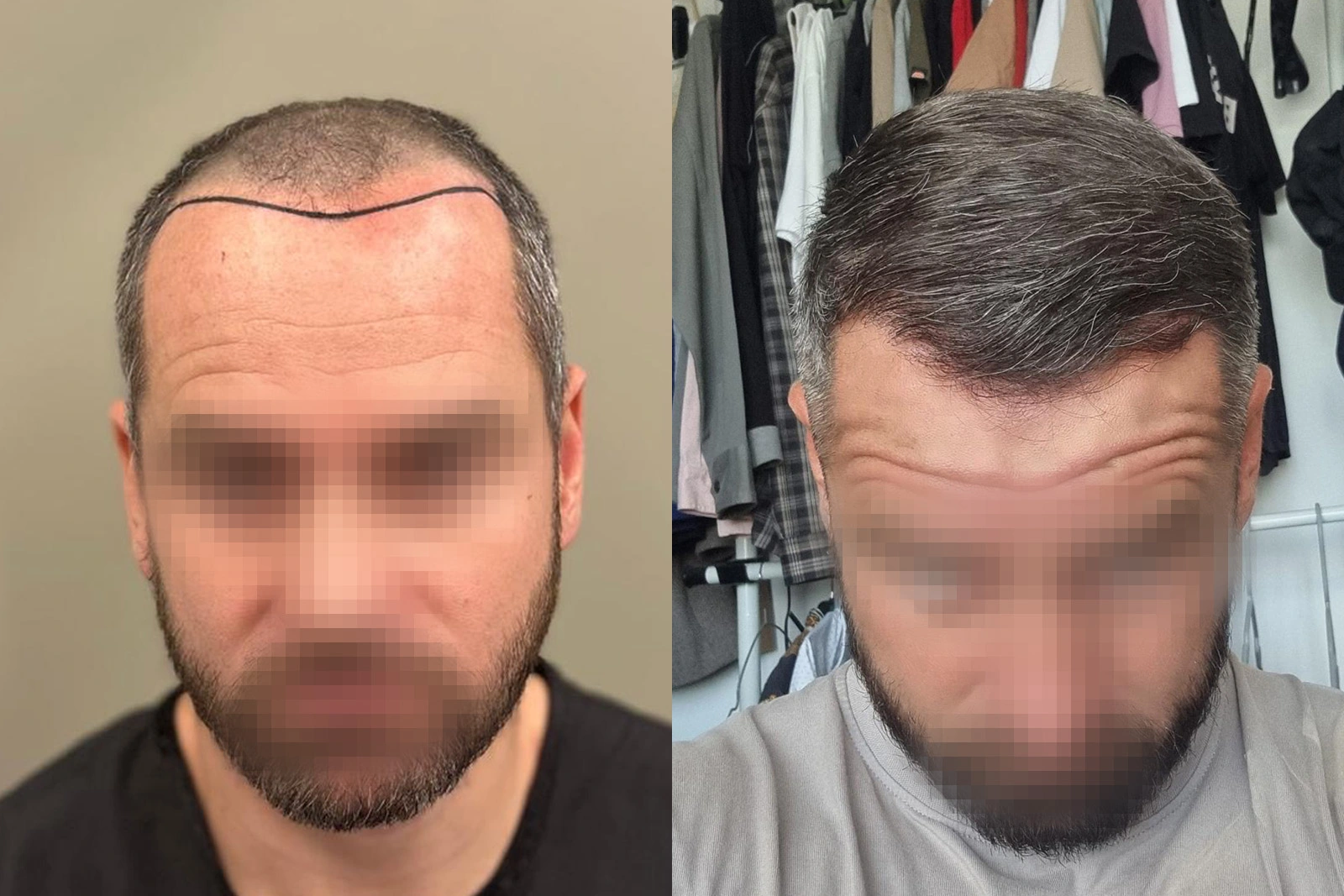
 Before
After
Before
After
Hair loss extended across the frontal region, mid-scalp and crown. Most of the grafts were directed to the front and mid-scalp, while the crown received a smaller number for additional density.
The line visible in the pre-operative photograph is the hairline design drawn before surgery, not a scar or skin change.
The patient chose not to use finasteride or minoxidil, either before or after the procedure.
Case summary
| Clinical detail | This case |
|---|---|
| Norwood stage before surgery | Norwood VI |
| Technique | FUE |
| Total grafts | 4,610 |
| Transplanted hair count | 8,509 |
| Single-hair grafts | 1,310 |
| Double-hair grafts | 2,701 |
| Multi-hair grafts | 599 |
| Treatment areas | Frontal region, mid-scalp and limited crown grafting |
| Crown transplanted | Yes, limited grafting |
| Follow-up shown | 10 months |
| Previous finasteride/minoxidil use | No |
| Finasteride after surgery | No |
| Minoxidil after surgery | No |
Across our case library, follicular units containing three or more hairs are described as multi-hair grafts. All 599 multi-hair grafts in this case were recorded as triple-hair units.
Treatment planning
Before surgery, the hair loss was classified as Norwood VI.
The area of hair loss was too broad to approach every region with the same density.
The front and mid-scalp received most of the available grafts because improving coverage there would have the greatest effect on the patient’s overall appearance. The crown was treated more lightly so that donor hair could still be used where it would make the largest visible difference.
Graft composition
The 4,610 grafts consisted of 1,310 single-hair grafts, 2,701 double-hair grafts and 599 multi-hair grafts.
Single-hair units were useful where a softer transition was needed, while double- and multi-hair units provided more hair mass through the broader treated areas.
Across our case library, we do not assign exact retrospective graft counts to the frontal region, mid-scalp or crown when the boundaries between treatment zones overlap. Doing so would suggest a level of precision that the surgical distribution does not support.
Was the crown transplanted?
Yes, but only with a limited number of grafts. Most of the 4,610 went to the front and mid-scalp; the crown received the remainder for additional density.
The 10-month result
At 10 months, the most obvious change is the increase in visible coverage across the front of the scalp.
The follow-up photograph was taken with the head tilted forward and the hair combed toward the front. This provides a useful view of overall coverage, but it also conceals most of the hairline. The final hairline therefore cannot be compared directly with the pre-operative design from these two photographs alone.
The patient’s hair is also noticeably grayer in the follow-up image. Gray hair has less contrast against the scalp than darker hair, which can make coverage appear fuller, particularly depending on lighting and exposure.
The photographs document a clear cosmetic change, but differences in hairstyle, head position, hair color and lighting mean they cannot be used to calculate an exact increase in density or graft-survival percentage.
10 months is not the final endpoint
This photograph was taken 10 months after surgery.
Hair growth and shaft maturation can continue through the 12- to 18-month period, and the crown often matures more slowly than areas further forward.
The photograph therefore documents the patient’s progress at 10 months rather than the final stage of the transplant.
No finasteride or minoxidil
The patient chose not to use finasteride or minoxidil before or after surgery.
For comparison, our 3,853-graft FUE case with post-operative finasteride and minoxidil shows a patient who began both treatments after transplantation. In that case, changes in the patient’s remaining native hair also had to be considered when interpreting the 12-month photographs.
No new medical treatment was introduced in this case.
Hair transplantation, however, does not stop susceptible native hair from continuing to thin over time. This includes existing hairs within and around transplanted areas. Hair taken from more resistant donor regions is generally less affected by the same pattern of miniaturization, while surrounding native hair may continue to change independently.
Longer-term follow-up is therefore particularly useful when medical treatment is not being used.
What this case shows
The 4,610 grafts were used across a broad area of hair loss, with most of the treatment directed to the front and mid-scalp and lighter grafting in the crown.
The graft composition was 1,310 single-hair, 2,701 double-hair and 599 multi-hair follicular units. The patient did not use finasteride or minoxidil, and the photograph documents the result at 10 months, while further maturation may still occur.
The follow-up photograph also shows why the way a result is photographed matters. Head position, hairstyle, hair color and the timing of the photograph can all influence how coverage appears.
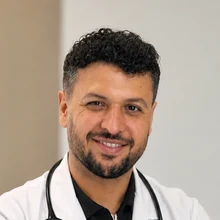
Dr. Mesut Demir’s note
“This patient had hair loss extending from the front through the mid-scalp and into the crown. We concentrated most of the grafts in the front and mid-scalp because stronger coverage there would make the biggest difference to his overall appearance.
The crown received fewer grafts. Spreading the donor hair evenly across the entire area would have reduced the density we could achieve further forward.”
Dr. Mesut Demir · Pure Line, Istanbul
About this result
This page documents an individual patient’s result at 10 months.
Individual results vary with donor capacity, hair characteristics, hair loss progression, healing and treatment.
The photographs document this patient’s outcome and should not be interpreted as a guarantee that another patient will achieve the same result.
The patient gave written consent for these photographs to be published.
Information about medication on this page describes this individual’s treatment history and is not a recommendation or prescription for another patient. Medication decisions should be made individually with an appropriate clinician.
Medically reviewed by Dr. Mesut Demir, M.D. ·
What is realistic for your case?
Send clear photos of your hairline, crown, and donor area. We will review what can be planned safely and whether surgery makes sense at this stage.
Review My Case