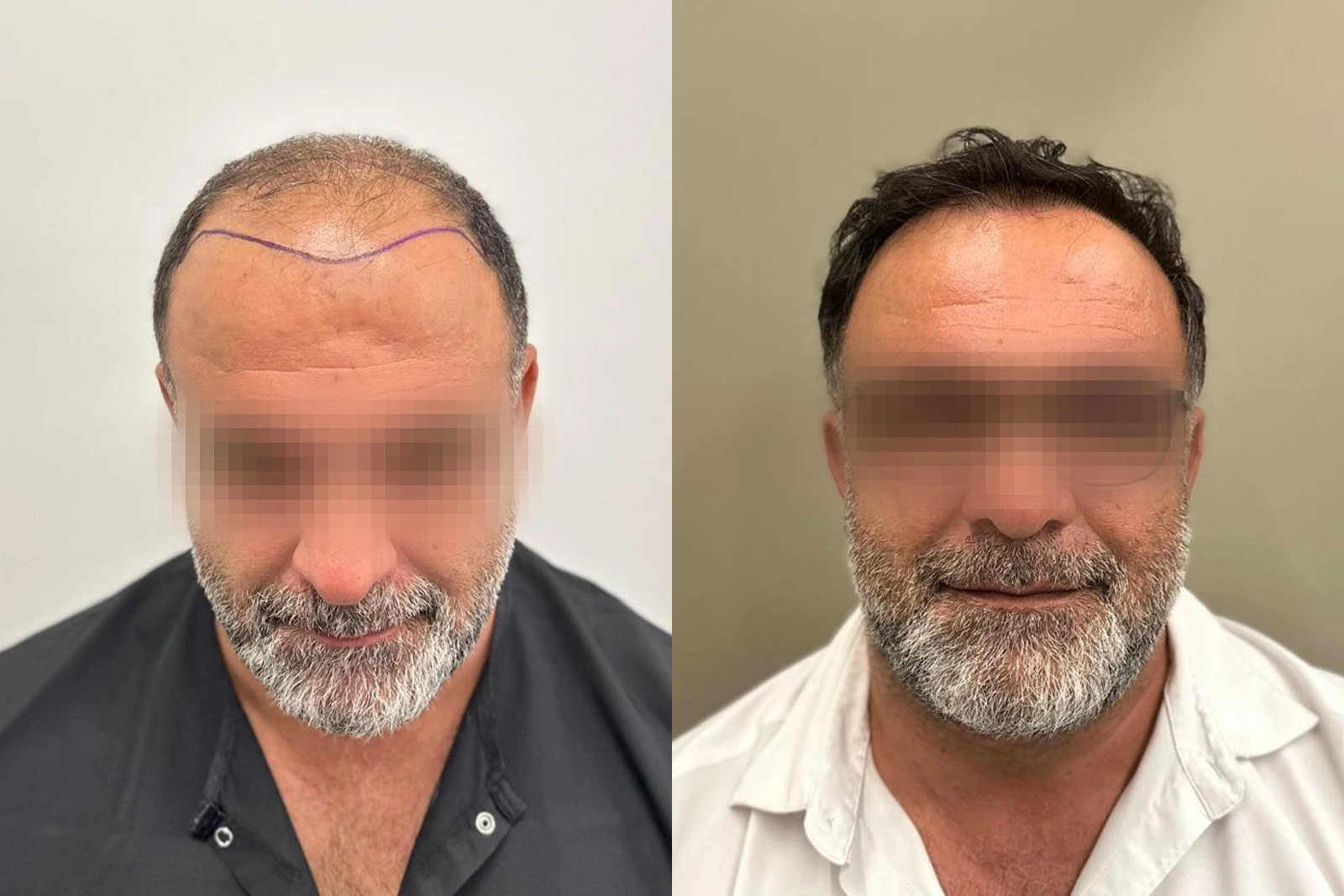
 Before
After
Before
After
The treatment focused on the frontal region and mid-scalp. The hairline was designed in a mature position with deliberate irregularities, creating the appearance of a naturally preserved adult hairline rather than an unusually low or rigid frontal edge.
The crown was left untreated during this session and remained an area that could be reconsidered later.
The patient had not used finasteride or minoxidil before surgery and chose not to begin either treatment afterward.
Case summary
| Clinical detail | This case |
|---|---|
| Norwood stage before surgery | Norwood VI |
| Technique | FUE |
| Total grafts | 4,127 |
| Transplanted hair count | At least 8,105 |
| Single-hair grafts | 982 |
| Double-hair grafts | 2,312 |
| Multi-hair grafts | 833 |
| Treatment areas | Frontal region and mid-scalp |
| Crown transplanted | No |
| Follow-up shown | 8 months |
| Previous finasteride/minoxidil use | No |
| Finasteride after surgery | No |
| Minoxidil after surgery | No |
Across our case library, follicular units containing three or more hairs are described as multi-hair grafts.
Treatment planning
Before surgery, the hair loss was classified as Norwood VI.
Why was a mature hairline chosen?
The aim was to restore the frontal frame without creating an unusually low or overly uniform hairline.
The pre-operative design preserves some recession at the corners and incorporates small variations along the frontal edge. The shape was chosen to suit the patient’s facial proportions, existing pattern of hair loss and the amount of scalp requiring treatment.
The thinning also extended behind the frontal edge into the mid-scalp, so the plan needed to provide meaningful coverage beyond the hairline itself.
Why intentionally make the hairline irregular?
Natural adult hairlines rarely form a perfectly smooth geometric line.
Small changes in depth and direction along the leading edge soften the transition between the forehead and the transplanted hair. In this case, those irregularities were part of the pre-operative design.
Single-hair follicular units were used where a softer leading edge was required, while follicular units containing more hairs contributed greater hair mass further behind it.
Graft composition
The 4,127 transplanted grafts consisted of 982 single-hair grafts, 2,312 double-hair grafts and 833 multi-hair grafts.
Based on the recorded composition, the procedure involved at least 8,105 individual hairs:
- 982 single-hair grafts contributed 982 hairs
- 2,312 double-hair grafts contributed 4,624 hairs
- 833 multi-hair grafts contributed at least 2,499 hairs
The actual total may have been higher because our multi-hair category includes follicular units containing three or more hairs.
Across our case library, we do not assign exact retrospective graft counts to the frontal region, mid-scalp or crown when treatment-zone boundaries overlap. Doing so would imply a level of precision that the surgical distribution does not support.
Was the crown transplanted?
No. The first procedure concentrated on the frontal region and mid-scalp. Miniaturized native hairs were still present in the crown.
Finasteride and minoxidil were discussed as options for supporting those hairs. The patient explained that he was not accustomed to maintaining regular medication or topical routines and felt that inconsistent treatment would not suit him. He preferred not to start either medication.
During follow-up, we also discussed the possibility of a second transplant session for additional crown density.
The patient was already very satisfied with the cosmetic improvement from the first procedure and did not feel any urgency to add more density to the crown at that stage.
The crown can be reassessed in the future if his hair loss progresses or his priorities change.
The 8-month result
At eight months, the follow-up photograph shows substantially greater visible frontal coverage and a more defined mature hairline.
The patient’s hair is longer in the follow-up photograph and becomes naturally wavier as it grows. That longer, wavier texture contributes to visual coverage compared with the shorter pre-operative hairstyle.
The hair had also been dyed darker by the time of the follow-up photograph. Changing hair color alters the contrast between the hair and scalp and can affect how density appears in photographs.
The hairline itself is visible, but hair length, wave pattern, color, styling, head position and lighting differ between the two images. These photographs therefore cannot be used to calculate an exact increase in density or graft-survival percentage.
The published image is mainly a frontal view. The mid-scalp was also treated, but this angle does not show the full extent of that area.
The result shown here was photographed at 8 months, with further maturation still possible.
What this case shows
The procedure involved 4,127 grafts containing at least 8,105 individual hairs, made up of 982 single-hair, 2,312 double-hair and 833 multi-hair follicular units.
The mature height and irregular shape of the hairline came from the pre-operative design, while the graft record documents the number and composition of the follicular units transplanted.
The crown was left for a possible later session, and the patient chose not to use finasteride or minoxidil. The eight-month photograph therefore shows what one frontal and mid-scalp procedure achieved on its own.
Dr. Mesut Demir’s note
“The area of hair loss was broad, so we designed a mature hairline that kept some natural recession at the corners and small irregularities along the edge.
The aim was for the patient to look as though he had retained more of his own hair, without creating a hairline that looked unusually low or too perfect.
We later discussed additional crown density, but he was already very satisfied with the first result and preferred to wait.”
Dr. Mesut Demir · Pure Line, Istanbul
About this result
This page documents an individual patient’s result at 8 months.
Individual results vary with donor capacity, hair characteristics, hair loss progression, healing and treatment.
The photographs document this patient’s outcome and should not be interpreted as a guarantee that another patient will achieve the same result.
The patient gave written consent for these photographs to be published.
Information about medication on this page describes this individual’s treatment history and is not a recommendation or prescription for another patient. Medication decisions should be made individually with an appropriate clinician.
Medically reviewed by Dr. Mesut Demir, M.D. ·
What is realistic for your case?
Send clear photos of your hairline, crown, and donor area. We will review what can be planned safely and whether surgery makes sense at this stage.
Review My Case