A beard transplant
should not look
transplanted.
A beard transplant borrows follicles from the scalp donor area to build or reinforce facial hair where growth is patchy, scarred or absent. The hard part is not getting hair to grow on a face — it is getting it to grow at the angle the surrounding beard already grows, so the result survives being looked at up close.
Quick answer
Beard transplantation uses donor follicles to fill selected facial-hair gaps. Natural appearance depends on the cause of loss, skin health, donor supply, graft selection, direction and angle; not every patient can safely achieve a full beard.
Beard restoration is
not simply about more hair.
A believable beard is mostly a question of restraint. Too much density, or density in the wrong zone, is what makes a transplanted beard read as transplanted.
Design, Not Just Restoration
Some patients want to fill patches. Others want clearer jaw definition, a stronger goatee, or wider coverage. The plan changes with the goal and the donor supply.
Donor-Aware Planning
Every graft that goes into a face is a graft that can never go into a scalp. We decide the beard plan with that trade already in mind, because the donor area is a lifetime budget and a beard is only one thing you may want to spend it on.
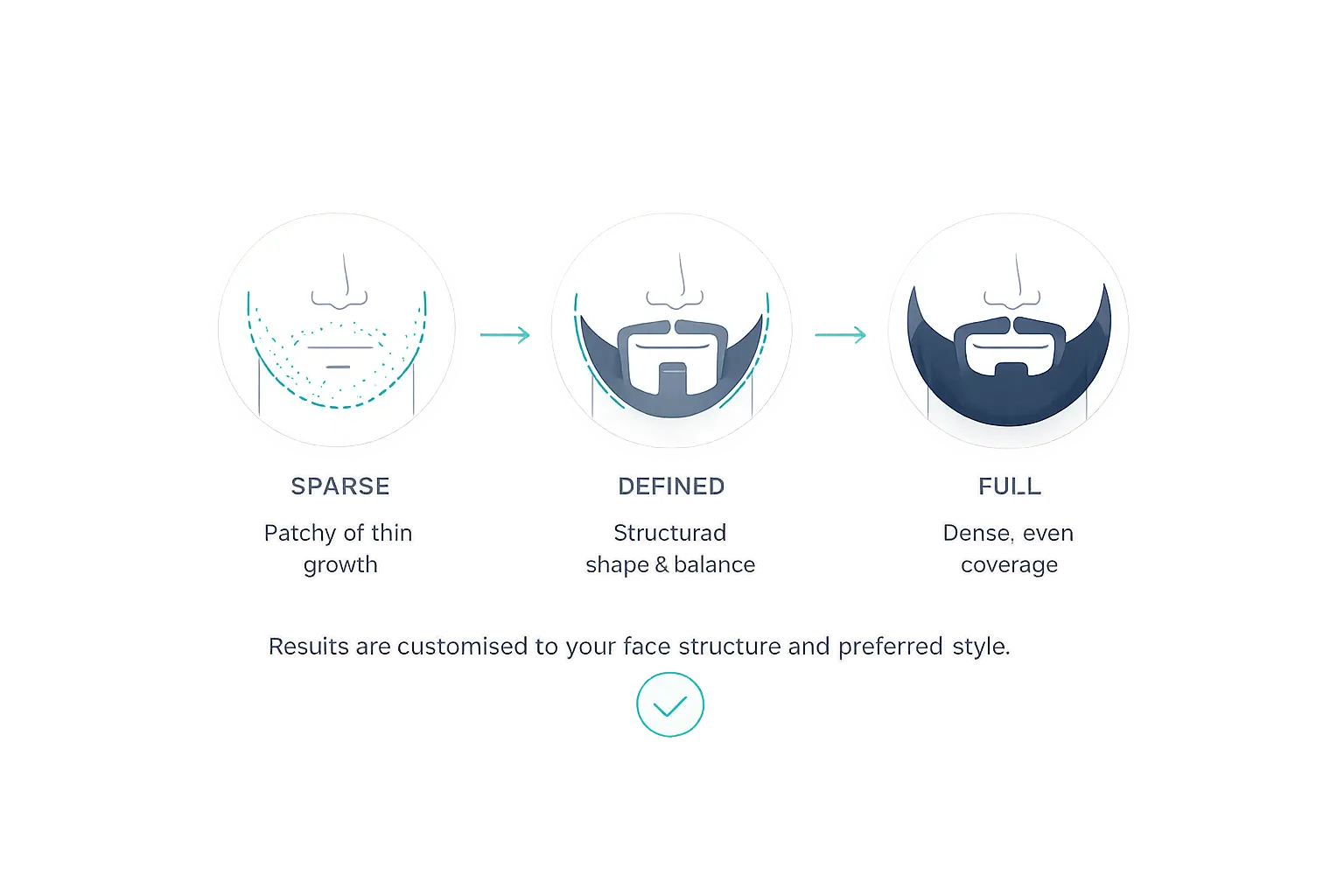
Different goals.
One realistic plan.
Beard transplantation is not one design. A patchy cheek, a weak goatee, a thin mustache, and a full beard plan all require different graft distribution. The right plan should improve the face without forcing density where it does not belong.
Full Beard Restoration
Build coverage across the beard zone — cheeks, jaw, chin, and upper lip — with density planned around the face and donor supply, not a fixed graft number.
Patch & Gap Filling
Target specific sparse areas to improve balance — common for men with patchy growth along the cheeks or jaw.
Mustache & Goatee Design
Focused graft placement for isolated areas — creating or strengthening the mustache and goatee with natural direction and controlled density.
Scar Concealment
In stable scars, beard transplantation may help soften visible gaps caused by trauma, surgery, burns, or previous procedures. Suitability depends on the scar tissue, blood supply, and stability of the underlying condition.
Why some men
cannot grow a full beard.
Thin or patchy facial hair usually has an underlying pattern or cause. Understanding it helps decide whether the right answer is medical, surgical, or simply waiting.
Genetics
Beard density is strongly influenced by inherited follicular distribution. When sparse growth is genetic, surgery may be considered only if the design goal and donor plan are realistic.
Hormonal Factors
Hormonal factors can affect facial hair development, but they should not be guessed from appearance alone. If symptoms suggest an endocrine issue, bloodwork and specialist evaluation may be recommended before any surgical decision.
Alopecia Areata
Alopecia areata can cause patchy loss in the beard zone. Surgery is considered only after the condition has been stable for a meaningful period, and recurrence risk should be discussed clearly before any plan is made.
A beard plan should
look natural up close.
Beard transplantation follows the same FUE principles as scalp surgery: individual follicular units are extracted from a stable donor area and placed according to the beard plan. Density is built gradually across each facial zone. The scalp donor should never be used carelessly for a beard goal that does not make long-term sense.
Design & Donor Planning
What you want, what the donor area can give, and where those two disagree — that conversation happens before anything is booked. What a consultation should cover.
Donor Area Work
Single follicular units are harvested individually from the scalp, usually from the back and sides, using the FUE method. There is no linear incision.
Recipient Area Preparation
Recipient sites are opened zone by zone, each following the direction the beard already grows there — which changes noticeably between the cheek, the jawline and the upper lip.
Graft Placement
Grafts are placed zone by zone, with density built gradually to avoid a blocky or artificial look.
FUE (Follicular Unit Extraction)
The method we use for beard transplantation. Individual follicular units are extracted one at a time from the donor area and placed zone by zone. There is no linear scar, and the tiny extraction points usually become difficult to notice after healing. Why the technique name matters less than the planning.
- No linear scar in the donor area
- Natural-looking, individual follicle placement
- Most patients return to light grooming after the early healing phase
- Long-term growth that can be shaved and shaped once matured
- Planning can be adapted across hair and skin types, but individual suitability and achievable coverage still vary
FUT (Follicular Unit Transplantation)
An older technique involving the removal of a strip of scalp tissue. While capable of yielding high graft counts, it leaves a permanent linear scar and carries longer recovery.
- Higher graft yield per session possible
- Permanent linear scar in the donor region
- Longer recovery and more post-op discomfort
- Not offered at Pure Line
Pure Line performs FUE for beard transplantation because it avoids a linear donor scar and fits our donor-preservation approach.
Why patients choose
beard restoration.
Controlled Design
The plan is drawn around the face you have: where the cheek line should stop, how much the jaw needs to be defined, and how much coverage will still read as natural rather than drawn on.
Donor-Safe Planning
Graft allocation is tailored to the design goal and donor capacity. The aim is a stronger beard without unnecessarily compromising future scalp donor reserves.
Long-term Facial Hair
Once matured, the transplanted hairs keep growing on the face and are shaved and trimmed like the rest of the beard. They also keep their scalp character, so they generally grow faster and need trimming more often. What changes over ten or twenty years.
Consider every option
before the operating table.
We go through the non-surgical options first, and for a minority of men that is where the conversation ends. For most with genuinely genetic patchiness it is not — but you are entitled to hear it before you are asked to decide.
Topical minoxidil is widely used in hair restoration and may be discussed as an off-label option for selected beard-density concerns. It requires consistency, and results may not persist after stopping.
If symptoms suggest a hormonal issue, referral for medical evaluation may be appropriate before surgery is considered. Hormonal treatment should only be discussed with a qualified specialist when there is a confirmed medical indication.
Our honest position: non-surgical options work best when there are still active follicles to support. If an area has very limited active follicles, medication may improve thickness in existing hairs but is unlikely to create a reliable beard pattern on its own. Surgery becomes appropriate only when the donor supply, design goal, and medical assessment all align.
Dr. Demir's decision framework
Three questions decide it, in this order: what is causing the patchiness, what the donor area can afford, and whether the design you want survives those two answers.
Patchiness may be genetic, hormonal, autoimmune, or scar-related. The cause determines whether surgery is appropriate.
Map scalp donor density and quality, then balance beard goals with long-term donor preservation. The plan should improve the beard without wasting the donor area.
The design has to fit the face and stay inside what the donor can give. Pushed past that, a beard transplant stops looking dense and starts looking filled in.
The right candidate for
a beard transplant.
Beard transplantation works well when the design goal is realistic and the donor area can actually pay for it. Those two conditions decide most cases.
Genetic Sparse Growth
Men who have never been able to grow the beard pattern they want because of inherited follicular distribution. This can be common across several ethnic backgrounds.
Patchy or Asymmetric Beards
Men who grow hair in some areas but not others — creating asymmetry or defined bald patches. Targeted graft placement may improve balance and fill gaps that shaping alone cannot overcome.
Scar & Alopecia Concealment
Men with facial scars from accidents, surgery, or prior procedures may be suitable after assessment. Localized alopecia areata may be considered only when the condition has been stable and recurrence risk has been discussed.
Facial hair
has its own rules.
Beard work sits in one of the most visible areas of the face. Every graft must respect the natural growth angle, which changes across the cheek, jaw, chin, and upper lip. The goal is not density at any cost. It is facial hair that looks grown, not transplanted.
Facial hair grows in different directions across each zone. Precise angle control helps prevent the planted look that can make beard transplants obvious.
Natural beards are not uniformly dense. The chin, cheeks, jaw, and mustache area each need different density decisions.
The mustache and border zones often need single-hair follicles to keep the edge soft and believable.
When donor supply is limited, Dr. Demir allocates grafts where they create the strongest visual effect while preserving the scalp donor for the long term.
Finer hairs are usually better for border zones, while stronger grafts may be used in the body of the beard. The aim is to avoid a uniform, artificial texture.
The questions men
ask us about beards.
These come up in almost every beard assessment. The answers here are general information and cannot replace an individual examination.
Read the Full FAQDoes a beard transplant use up scalp hair I might need later?
Will the transplanted hair look and behave like beard hair?
I have no growth at all in some areas. Can that be fixed?
Can I have a beard transplant if I have alopecia areata?
When can I shave again?
Am I too young for a beard transplant?
Know what is realistic
before you commit to surgery.
Send your photos and tell us what you want to change. We will look at how your beard grows now and at what the donor area can spare, and tell you plainly whether surgery is the right answer for your case.
Clinical context and evidence
- Education
- Kocaeli University, Faculty of Medicine — M.D., 2016
- Clinical focus
- Hair restoration surgery since 2018
- Registration
- Turkish Medical Association
Dr. Mesut Demir, M.D., is the co-founder and medical director of Pure Line. This page describes general clinical considerations; individual suitability, risks, alternatives and expected outcomes require a personal assessment.
Meet Dr. Mesut Demir and view his background →- Effective Techniques for Beard and Eyebrow TransplantationFacial Plastic Surgery Clinics of North America · 2019
- Follicular unit extraction for restoration of the beardJournal of Cosmetic Dermatology · 2020
The medical information on this page is provided for educational purposes and does not replace a personal consultation. Treatment suitability can only be determined after an individual assessment.