Female hair transplant,
planned after we know
why it is thinning.
A female hair transplant restores density in thinning areas — most often the hairline, temples, or parting line — using the patient’s own follicles. Many women experience visible hair thinning, yet most hair clinics are built around men. Most hair clinics are built around men, so women arrive having been offered a male plan in a smaller size. Here the diagnosis comes first and the design is drawn for a female hairline, not adapted from one.

Quick answer
A female hair transplant may help selected, stable patterns of loss, but diffuse thinning and active medical causes must be assessed first. Diagnosis, donor stability and realistic expectations determine whether surgery is appropriate.
Female hair loss requires
a fundamentally different approach.
Female hair loss is not a smaller version of male hair loss. The pattern is different, the causes are more often reversible, and the donor area cannot simply be assumed to be safe.
Diffuse Thinning Pattern
Women rarely lose hair in defined patches. Instead, thinning tends to be diffuse — affecting density across the entire crown while the hairline remains largely intact. This creates unique surgical planning challenges.
Medical Complexity First
Female hair loss frequently has hormonal, nutritional, or dermatologic roots — thyroid imbalance, iron deficiency, postpartum shedding. These must be investigated and stabilized before surgery is appropriate.
Hairline as Identity
The female hairline frames the face, and what makes it read as female is mostly irregularity: single hairs of varying caliber, a line that never runs straight, and temples that soften rather than end. Rebuilding that is closer to drawing than to surgery.
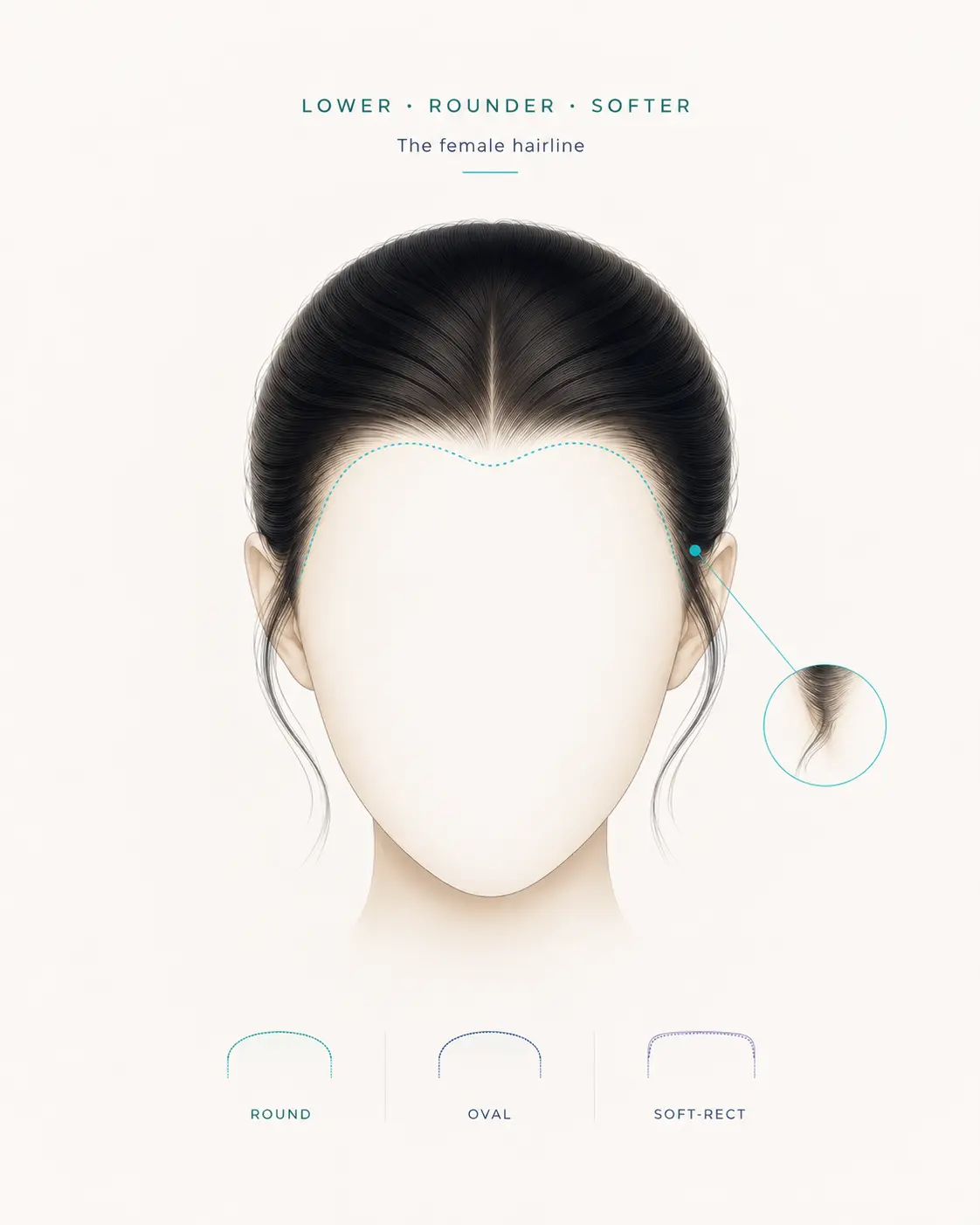
A female hairline
is more than a boundary.
Unlike male hairlines, the female hairline sits lower, frames the face with softness, and carries micro-details that signal femininity. Restoring it requires as much artistry as surgery.
Lower Placement & Wider Arch
Female hairline placement depends on facial proportions, forehead height, and individual anatomy. In most cases, it sits lower and softer than a typical male hairline — but every plan is unique to the patient.
Micro-Irregularity & Natural Flow
The "micro" structure of a female hairline is never perfectly straight. In the temple the hair sweeps back and downward, so each site has to be opened to that direction or the result reads as a wig line.
Temple Framing
For women who have lost temple hair through surgery (facelift, brow lift) or aging, precise graft placement restores the framing that defines a youthful, feminine appearance.
Scar Concealment
Hair transplantation may help camouflage suitable scars from previous facial procedures in the temple, sideburn, and post-auricular regions — especially when the scar tissue can safely support graft survival.
Understanding Your Case
Two different needs.
Two different plans.
Design-focused. Often stable.
For women born with a naturally high hairline or a large forehead. The donor area is typically stable, making surgical planning more predictable. The priority is design: where the line sits, how soft its edge is, and how it meets the temples.
Medical-first. Stability-dependent.
For women experiencing progressive thinning across the top or crown. Medical stabilization comes before any surgical discussion — and a combined approach is often more appropriate than surgery alone.
Understanding the Ludwig Scale
The Ludwig scale classifies female-pattern hair loss into three grades based on the degree of central thinning. Identifying your stage guides which treatments — medical, surgical, or combined — are most appropriate.
Ludwig Grade I
Earliest detectable stage. The frontal hairline remains intact while a slight widening of the central parting becomes visible.
- Central parting widens subtly when hair is combed
- More scalp shows under direct overhead light
- Ponytail volume slightly thinner than before
Medical therapy first. Minoxidil, hormonal evaluation, and nutritional review usually deliver meaningful improvement at this stage. At this point, surgery is rarely the responsible first step.
Ludwig Grade II
A clearly widened central part with diffuse thinning that begins to spread outward across the crown — the most common presentation we see in consultation.
- "Christmas tree" pattern visible from above
- Reduced density across crown and mid-scalp
- Styling no longer covers thinning areas reliably
Combined plan. Medical stabilization first, then strategic transplantation to restore density where coverage matters most. Sequencing is critical.
Ludwig Grade III
Severe diffuse thinning across the entire crown. The scalp is clearly visible through remaining hair and styling no longer offers coverage.
- Significant scalp visibility under any lighting
- Crown density reduced beyond compensation by styling
- Donor stability must be confirmed, because female donor zones can miniaturize too — and a graft is only as permanent as the zone it came from
Surgery may be considered when donor capacity is sufficient and the loss pattern is stable. In suitable cases, transplantation combined with ongoing medical therapy can improve visible density.
Diffuse Unpatterned
A distinct presentation where thinning extends into the donor zone itself — the sides and back of the scalp — making it the most complex pattern to plan for.
- Thinning visible across the entire scalp, not just crown
- Donor area shows reduced density on close inspection
- Often progresses more uniformly than patterned loss
Highly individualized. Donor capacity is the limiting factor. Surgery is only considered when long-term stability can be ensured — otherwise medical therapy alone is the responsible path.
Classification presented for educational purposes. A personal consultation is essential for accurate assessment.
Surgery is step two.
Understanding why
comes first.
Female hair loss rarely has one cause. Before we will discuss surgery at all, the reversible causes have to be excluded — because operating on a thyroid problem or an iron deficiency treats the symptom and leaves the cause running. What a consultation should cover.
Hormonal Profile Assessment
Androgens, estrogen levels, and thyroid function are evaluated. Hormonal imbalances can drive hair loss independently of genetics — and are often treatable.
Nutritional Status
Serum ferritin, iron, zinc, and vitamin D are measured. Low ferritin may affect shedding, hair quality, and recovery potential, so it should be corrected before surgery when clinically relevant.
Loss Stability Assessment
Active, accelerating hair loss is a contraindication for surgery. Our specialists assess the rate and pattern of loss to confirm it has stabilized or can be stabilized before proceeding.
Dermatologic Scalp Evaluation
Inflammatory conditions (scarring alopecia, lichen planopilaris) must be identified and treated prior to surgery. A short course of topical steroids may be recommended.
Donor Area Evaluation
Unlike men, women's donor areas can themselves be thinning. Density and caliber are measured across the whole zone before any plan is proposed, because a donor area that looks adequate at a glance can fail under closer inspection.
Important: In women, the donor area is not always permanently stable. This is why donor mapping matters before any surgical plan is discussed.
Conditions we investigate before surgery
Both hypo- and hyperthyroidism can trigger diffuse hair loss. When clinically relevant, correcting thyroid imbalance may help reduce shedding and improve hair quality.
Low serum ferritin is one of the most common and overlooked causes of female hair loss. Correcting the deficiency can support recovery and improve the response to treatment.
Telogen effluvium following childbirth is temporary and typically resolves within 6–12 months. Surgery is not indicated during this phase.
Polycystic ovary syndrome elevates androgens, accelerating female-pattern hair loss. Medical management alongside surgery may improve long-term outcomes.
Certain medications — including some contraceptives, antidepressants, and blood thinners — can cause or exacerbate hair thinning and must be flagged during evaluation.
A plan built around your hair,
not a protocol.
Female hair restoration is rarely one-size-fits-all. Our core team combines medical and surgical options into a personalized strategy — sometimes phased, always evidence-based.
One of the most evidence-supported non-surgical options for women. May thicken existing hair shafts, help slow progression, and support scalp stabilization in suitable patients. Pre-operative use may also be recommended to help stabilize shedding before surgery.
When scalp inflammation is present, a short course of topical anti-inflammatory treatment may be considered under medical supervision. Not a standalone solution — always assessed case by case. Why inflammation is treated before surgery.
PRP uses growth factors from your own blood to support the scalp environment and may improve hair quality in selected patients. A natural adjunct to both medical and surgical treatment.
Regenera Activa® may be considered as a supportive, non-surgical option in selected early-stage thinning cases. It is not a replacement for medical diagnosis, long-term stabilization, or surgery when surgery is truly indicated. What the studies report so far.
Iron, ferritin, zinc, biotin, and vitamin D — when deficient, targeted supplementation can yield meaningful improvement in hair density before any other intervention.
For most women the sequence matters more than any single treatment: stabilize medically, restore surgically where it is warranted, then maintain. Skipping the first step is what makes the third one fail. How a multi-year plan is built.
- No-shave or minimal-shave FUE available for women
- Donor harvested from the nape and sides — areas less affected by female-pattern loss
- Natural hairline design using single-hair grafts at the front
- Return to styling in 7–10 days, once early swelling and scabbing have settled
- Full results visible at 12–18 months
For selected patients, no-shave or partial-shave FUE may be possible. Suitability depends on donor density, graft number required, hairstyle, and the area being restored. This is assessed individually — not offered as a blanket option.
- Comprehensive donor mapping before any commitment
- Recipient design placed where the eye actually reads density — the parting line before the crown
- Medical therapy used to protect remaining donor hair
- Staged approach available when donor supply is limited
Not all women are surgical candidates. An honest evaluation may conclude that medical therapy alone — or a staged approach — will deliver better long-term results than immediate surgery.
The most underused tool in female hair restoration.
Minoxidil has strong clinical support in female pattern hair loss, and it is still the treatment women most often abandon before it has had a chance to work. Most stop inside the first three months, usually because of the shedding phase described below. Used properly it is also what stabilizes a scalp before surgery, which is why it comes up in almost every consultation here.
Premature discontinuation is the most common mistake. The follicular cycle takes months to respond — patience is essential to accurate assessment.
Temporary increased shedding can occur during the first weeks as follicles transition through the growth cycle. It is a known response and usually settles with continued use.
In suitable patients, pre-operative use helps stabilize the scalp before surgery. Post-operatively, continued use supports the long-term environment for transplanted and existing hair.
Who is the right candidate?
Female hair transplantation works well for the right patient at the right time. The honest part is the selection: not every woman needs surgery, and some who want it are not ready for it yet.
Women with High Hairlines
Born with a naturally high or large forehead, feeling that hairline proportions are off. Hair transplantation can lower and reshape the hairline to better frame the face — often transformative with relatively few grafts.
Female-Pattern Hair Loss
Stable thinning across the crown with adequate donor density. Surgery can restore meaningful density — particularly when medical therapy has plateaued or the visual impact on daily life is significant.
Aging & Receding Hairlines
Gradual retreat of the temples and frontal hairline with age. Hair transplant subtly restores a youthful framing without dramatic change — often combined with PRP to support remaining native hair.
Transgender Women (MTF)
A feminine hairline is one of the most meaningful parts of gender affirmation, and the design work is the same as for any female hairline: a lower, rounder line, softened temples, and single hairs across the front so the edge never looks drawn. How the procedure is planned.
Five factors that shape your plan.
Every consultation follows the same five questions, in the same order, because each answer changes what the next one means. I would rather be predictable here than creative.
Loss Stability
Is the loss stable, slowing, or accelerating? Timing surgical intervention correctly is critical.
Donor Quality
Density, caliber, and extent of thinning in the donor zone — the foundation of any surgical plan.
Medical Status
Hormonal, nutritional, and dermatologic factors that must be addressed before or alongside surgery.
Hair Characteristics
Caliber, curl, color contrast with the scalp — these determine visual density impact per graft.
Goals & Expectations
Alignment between what surgery can achieve and what the patient expects is essential for satisfaction.
The questions women
actually ask us.
These come up in almost every consultation. The answers here are general information about female hair loss and cannot replace an individual assessment.
Read the Full FAQCan I have a transplant if my thinning is diffuse?
Will my head have to be shaved?
Will a transplant help if my hair loss is hormonal?
How long should I use minoxidil before surgery?
Can a transplant lower a naturally high hairline?
Is my donor area safe if I have female pattern loss?
Your hair has a story
worth protecting.
Whether you're dealing with a high hairline, diffuse thinning, or decades of gradual loss — the right plan starts with an honest conversation. One patient. One core team. One standard.
Clinical context and evidence

- Education
- Kocaeli University, Faculty of Medicine — M.D., 2016
- Clinical focus
- Hair restoration surgery since 2018
- Registration
- Turkish Medical Association
Dr. Mesut Demir, M.D., is the co-founder and medical director of Pure Line. This page describes general clinical considerations; individual suitability, risks, alternatives and expected outcomes require a personal assessment.
Meet Dr. Mesut Demir and view his background →- Female pattern hair loss: a comprehensive reviewDermatologic Therapy · 2020
- Clinical Features of Patients Treated With Hair Transplants in Female Pattern Hair LossAnnals of Dermatology · 2024
- Antiandrogen therapy for the treatment of female pattern hair loss: a clinical review of current and emerging therapiesJournal of the American Academy of Dermatology · 2025
- The role of platelet-rich plasma in androgenetic alopecia: a systematic reviewJournal of Cosmetic Dermatology · 2024
- Short-Term Efficacy of Autologous Cellular Micrografts in Androgenetic AlopeciaClinical, Cosmetic and Investigational Dermatology · 2021
The medical information on this page is provided for educational purposes and does not replace a personal consultation. Treatment suitability can only be determined after an individual assessment.