
Quick answer
FUE is not scarless: every extraction leaves a small circular wound, and the pale marks left behind are hypopigmented scars commonly called FUE white dots. Punch diameter matters more than it looks, because wound footprint scales with the square of the radius — a 0.85 mm punch covers about 47% more area than a 0.70 mm one, and a 1.00 mm punch roughly twice as much. Dr. Mesut Demir works around 0.70 mm when the follicular anatomy allows, but treats the smallest safe punch, even extraction spacing and total harvest limits as one decision rather than chasing the smallest number. Visibility also depends on skin-to-scar contrast, and scalp micropigmentation can camouflage established white dots without restoring lost donor hair.
When patients research FUE hair transplantation, almost all of their attention goes to the front. How low will the hairline be? How dense will it look? How many grafts can be transplanted?
I understand that. The new hairline is the exciting part.
But when I examine a patient who has already had a hair transplant somewhere else, I usually look at the back of the head first.
The donor area tells me a great deal.
Sometimes it has healed beautifully. The extraction points are hard to find, the remaining hair still gives good coverage, and the patient can wear a short haircut without thinking about it.
Sometimes I see something very different: thousands of pale dots, visible gaps between the remaining hairs, and an irregular, almost moth-eaten appearance across the back and sides of the scalp.
That is usually the moment the patient turns his phone around, shows me a photo taken in bad bathroom lighting, and asks the same question:
"Can this be fixed?"
Before answering, it helps to understand how those white dots appeared in the first place. And one of the most overlooked factors sounds almost trivial: the diameter of the FUE punch.
FUE Is Not a Scarless Hair Transplant
There is a phrase I wish had disappeared from hair transplant marketing years ago: "scarless FUE."
FUE avoids the long linear donor scar left by strip surgery. It does not mean the skin is never injured.
During FUE, every follicular unit has to be separated from the surrounding tissue and removed through a small circular opening. That opening heals. In a well-planned procedure the resulting marks can be extremely hard to notice once the surrounding hair grows back — but microscopically, and sometimes visibly, scar tissue still forms.
The small pale marks patients notice afterwards are commonly called FUE white dots. In the medical literature they are described as pinpoint or hypopigmented scars following follicular unit extraction, and recent reviews make the same point plainly: describing FUE as completely scarless is misleading.
So my objective during extraction is not to pretend these wounds do not exist. It is to make each one as small and as visually insignificant as I safely can, while still removing a healthy, intact graft.
That last part matters. A lot.
What Actually Causes FUE White Dots?
Punch size is important, but donor scarring is never decided by one number. How visible a donor area becomes depends on:
- Punch diameter
- Punch design and sharpness
- Extraction depth
- The angle and anatomy of the follicular unit
- The number of grafts removed
- How closely the extraction sites are placed
- How evenly those extractions are distributed
- Original donor density and hair caliber
- Skin and hair color contrast
- The patient's individual healing response
- Previous FUE sessions in the same area
This is why two patients can each have 3,500 grafts extracted and end up with completely different-looking donor areas. One still looks dense and uniform. The other looks visibly depleted.
Recent work on FUE complications describes excessive harvesting as a major cause of the moth-eaten donor appearance, particularly when too many follicular units come out of concentrated areas or the donor plan was poor.
Punch size then adds another variable on top of all that. And this is where 0.15 mm becomes far more interesting than it sounds.
0.70 mm vs 0.85 mm: Can 0.15 mm Really Matter?
Put a 0.70 mm punch next to a 0.85 mm punch and show them to a patient. The difference looks almost comical. It is 0.15 mm.
But diameter is the wrong way to think about what is happening to the skin. We need to look at area.
For a circle, area = π × radius². Using the nominal punch diameters as a straightforward geometric comparison, a 0.70 mm punch has a radius of 0.35 mm and a circular footprint of about 0.385 mm². A 0.85 mm punch has a radius of 0.425 mm and a footprint of about 0.567 mm².
The diameter went up by roughly 21%. The theoretical footprint went up by about 47%.
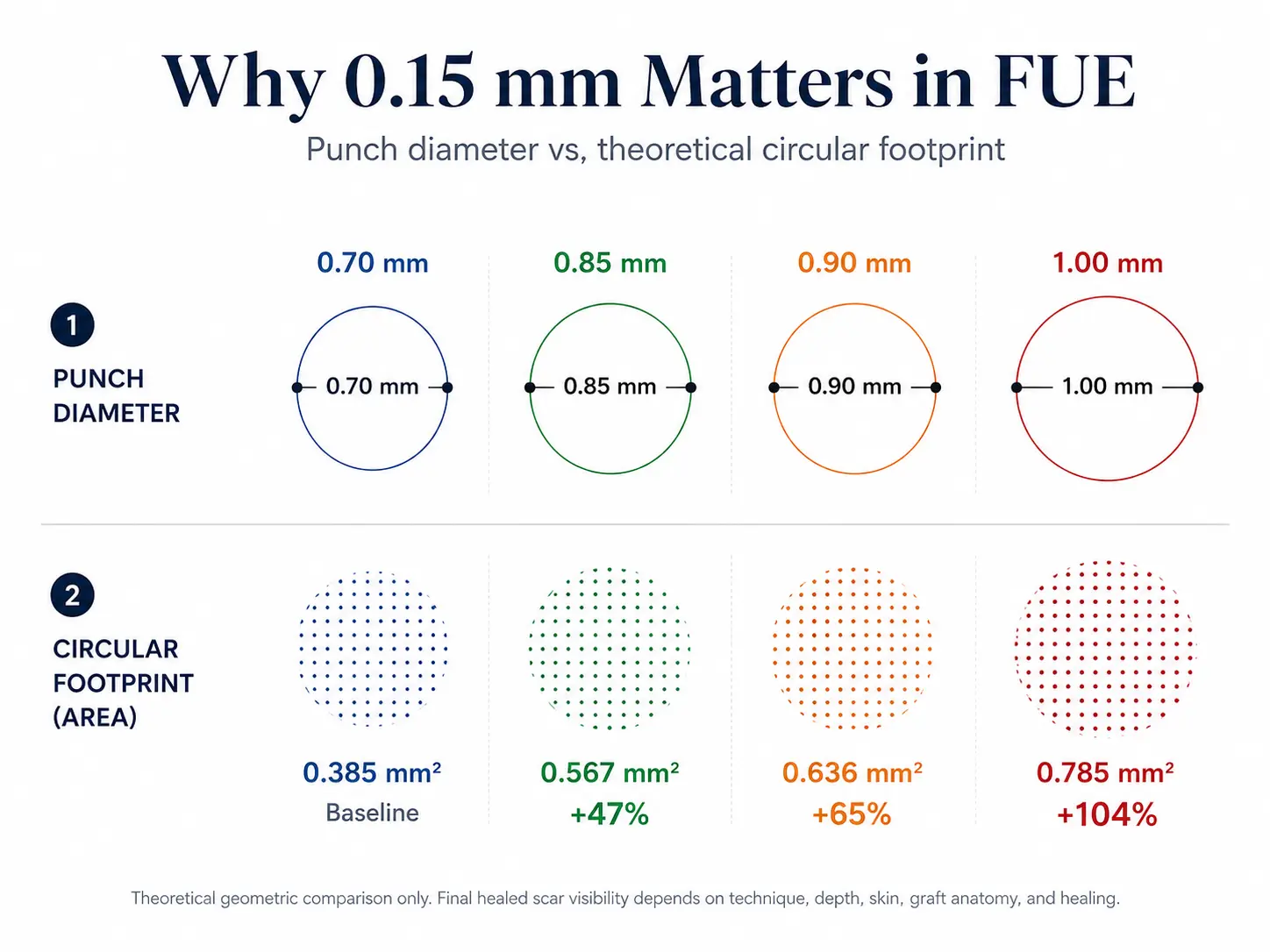
| Punch diameter | Approx. circular footprint | Increase vs 0.70 mm |
|---|---|---|
| 0.70 mm | 0.385 mm² | Baseline |
| 0.85 mm | 0.567 mm² | +47% |
| 0.90 mm | 0.636 mm² | +65% |
| 1.00 mm | 0.785 mm² | +104% |
Figures are nominal circular footprints calculated from punch diameter (πr²). They describe the geometric relationship between instrument size and the skin involved in each extraction, not the dimensions of a healed scar — those also depend on punch design and wall thickness, extraction depth, skin properties, wound contraction and individual healing.
A nominal 1.00 mm circle has slightly more than twice the area of a 0.70 mm one. If penetration depth were identical, the geometric volume enclosed by the punch would increase in the same proportion.
This is not my own arithmetic curiosity. The published FUE literature makes the same point: reducing punch diameter by 10%, from 1.0 mm to 0.9 mm, reduces the area by about 19%.
None of this means the healed scar will literally be 47%, 65% or 104% bigger. Human skin does not heal according to a spreadsheet, and studies comparing FUE punches have shown final wound dimensions change substantially during healing.
But the geometry explains something worth holding onto: a very small increase in punch diameter can mean a surprisingly large increase in the amount of donor skin involved.
And we do not make one extraction during a hair transplant. We make thousands.
A Microscopic Difference, Repeated Four Thousand Times
This is the part I find myself explaining most often in consultation.
A difference of 0.1 or 0.15 mm around a single follicle sounds irrelevant. Repeat that process several thousand times across the donor area and donor preservation becomes a serious part of the operation rather than a detail.
I do not calculate scar burden by simply multiplying punch area by graft count, because real wound healing is far more complicated than that. But the principle holds: every extraction spends part of a limited donor resource.
That resource is not only the hair. It is also the untouched skin between those hairs.
Why We Usually Work Around a 0.70 mm Punch
At Pure Line, most of our scalp extractions are performed around 0.70 mm when the follicular anatomy allows it.
With an appropriately selected smaller punch I can limit how much surrounding tissue is involved in each extraction and leave more intact skin between the extraction points. Cosmetically, that helps preserve the visual integrity of the donor area.
The literature supports the underlying trade-off. Smaller punch diameters reduce donor scar volume; larger punches give the surgeon more clearance around the follicular unit and may reduce transection risk.
But I want to be very clear about something: I do not believe the best FUE is simply the FUE done with the smallest punch.
That would make an easy marketing message. Surgery is not that easy.
Smaller Punches Leave Less Room for Error
A follicular unit is not a piece of spaghetti sitting perfectly straight in the skin. What we see above the scalp is only part of its anatomy.
Underneath, follicles curve. Multi-hair units spread apart. The angle below the surface may not follow the angle we can see at the surface at all.
The smaller the punch, the smaller the margin around that follicular unit — which makes accurate positioning increasingly important. If the punch is poorly centered, follows the wrong angle, or goes too deep in the wrong direction, part of the follicle gets cut. We call that transection. A transected graft may lose one or more follicles and, depending on where the damage falls, may no longer be usable at all.
So smaller punches demand steady hand control, an understanding of follicular anatomy, and the experience to recognize when the chosen diameter is simply too small for that particular graft.
FUE literature has described this balance repeatedly: a larger punch may reduce transection but increases donor scar volume, while a smaller one protects donor tissue but makes extracting an intact follicular unit technically harder.
The Goal Is Not the Smallest Punch
My rule is simpler than it sounds: use the smallest punch that allows that particular follicular unit to be extracted safely.
Most of the time in our scalp cases, that is around 0.70 mm. But when I see a wide multi-hair unit, significant follicular splay, unusual curvature, or anatomy that makes a larger punch safer, I adjust.
I would rather move slightly above 0.70 mm for a difficult graft than destroy a perfectly healthy follicular unit so that I can quote the patient a smaller number.
That number belongs on an instrument. The graft has to live on the patient's head.
So Is a 0.90 mm Punch Bad?
No — and this distinction matters.
Punches around 0.9 mm are widely used in scalp FUE and are well represented in the literature; some reviews describe 0.9 mm as the most commonly used scalp diameter. A surgeon working at 0.90 mm is not automatically doing poor surgery.
My concern is different. It is when 0.9 or 1.0 mm becomes the automatic choice for virtually every graft and every patient, simply because extraction is faster and easier with more room around the follicle.
The convenience of extraction should not be the only thing deciding punch size. The patient's donor area lives with that decision permanently.
Punch selection should follow the anatomy of the graft. The graft should determine the punch — the punch should not dictate which grafts we are willing to take. This is the same reasoning I apply to the DHI versus FUE marketing debate: the name and size of the instrument matter far less than the judgment behind it.
Punch Size Is Only Half the Donor Story
I could use a 0.70 mm punch throughout an operation and still ruin a donor area by harvesting badly. This is why I never want patients choosing a clinic on punch diameter alone.
Distribution matters just as much.
Picture a donor area with a limited number of hairs. Remove grafts evenly across a broad safe donor zone and the remaining follicles keep providing visual coverage between the extraction points. Take the same number from a much smaller area and visible gaps start to appear. That is how a scalp ends up looking thin, patchy or eaten away.
Modern reviews of donor complications specifically emphasize uniform extraction patterns, avoiding excessive extraction from the same zone, and planning around the patient's long-term donor capacity.
So I often tell patients that donor management is not a graft-counting exercise. More grafts are not automatically better.
You can be delighted that somebody extracted 5,000 grafts today and very unhappy five years later when you understand what was spent to get them.
Visual Donor Density Is Not the Same as Hair Count
Two donor areas can hold a similar number of remaining hairs and still look completely different. What your eye actually registers depends on remaining density, hair shaft thickness, hair-to-skin color contrast, the distance between extraction points, how much scalp shows through, scar color, hair length, and the pattern in which grafts were removed.
That is visual density, and it is not the same as the number on a graft count sheet.
It matters most for patients who like fades, short back-and-sides, or a very short buzz cut — which is to say, a large proportion of the men who come to see us.
Why FUE White Dots Can Be More Obvious on Darker Skin
Skin tone changes this conversation considerably.
A fair-skinned patient can have thousands of small hypopigmented extraction scars and barely notice them, because there is little contrast between the pale scar tissue and the surrounding scalp. That does not mean there is no scarring. It means the eye has a harder time finding it.
On darker skin the situation can be very different. Hypopigmented scar tissue sitting against more heavily pigmented surrounding skin creates far stronger contrast, so even relatively small extraction marks may become noticeable once the hair is cut short.
A recent review of FUE complications specifically notes that pinpoint white dots can be more visible in people with darker skin phototypes and in patients who wear short hairstyles.
That is why I am particularly careful with donor planning in patients with darker skin. A donor result that looks perfectly acceptable on very pale skin can look quite different on a deeply pigmented scalp.
Afro-Textured Hair Needs Its Own FUE Strategy
Afro-textured hair adds a second challenge. Above the skin you can see the curl. Below the skin, the follicle may follow an equally curved, sometimes C-shaped path.
That makes extraction technically demanding, because the punch enters the scalp based on what we can see at the surface while the deeper follicle curves away from that line. Studies looking specifically at FUE in tightly curled Afro-textured hair have reported unacceptably high transection rates with conventional rotary punches, which is why instrumentation, technique and experience matter so much in these patients.
There is a genuine conflict here. Darker skin makes white-dot scarring something we especially want to minimize. At the same time, strongly curved follicles may need a different punch diameter, geometry or approach to come out intact.
So telling every Afro-hair patient that the smallest punch is always best would be irresponsible. You have to protect the donor skin and get the follicle out whole, and sometimes those two goals pull in opposite directions.
Why Aggressive Harvesting Creates the "Moth-Eaten" Look
The donor areas that worry me most rarely have a single problem. They have several at once — larger wounds, high extraction density, poor distribution, and excessive total harvesting.
That combination produces the patchy appearance patients describe as moth-eaten. The remaining hairs sit too far apart to disguise the scalp, and pale extraction points add even more contrast. It becomes most obvious the moment the donor hair is cut short.
Overharvesting is a recognized FUE complication, and published work describes exactly this donor appearance following excessive or poorly planned extraction.
Once that hair has been removed, we cannot put it back. Which is why the first operation deserves so much attention — the same argument I make about designing a hairline that consumes more donor supply than the patient can afford, and a large part of why we treat only one patient a day.
When Patients Come to Istanbul for a Revision
A growing number of the patients we see in Istanbul are not coming for their first hair transplant. They are coming because something about the first one needs correcting.
Sometimes it is an unnatural hairline. Sometimes poor density. Sometimes the transplanted hair grows in the wrong direction. And sometimes the front actually looks acceptable, but the donor area paid far too high a price for it.
Revision work starts with understanding what donor capacity is still available. I look at remaining donor density, the extraction pattern from the previous surgery, areas of visible depletion, scar distribution, hair caliber, safe donor boundaries, the likely future progression of the hair loss, and whether another extraction session can be justified at all.
There are cases where the right decision is not to extract another large number of scalp grafts. That answer disappoints some patients initially, but protecting what remains matters more than promising another impressive graft count.
Can FUE White Dots Be Removed?
Scar tissue cannot be turned back into untouched skin. So when somebody promises to erase thousands of FUE scars, I would be cautious.
What we can often do is make them much less noticeable. For many patients the best tool for that is scalp micropigmentation.
SMP for Hair Transplant Scars
Scalp micropigmentation, or SMP, places carefully controlled pigment deposits that reproduce the visual impression of very short hair follicles. For a depleted donor area the purpose is not to create hair. It is camouflage.
If you have dark hair and thousands of pale dots between the remaining follicles, what your eye notices is the light scalp showing through. SMP reduces that color contrast by placing follicle-like pigment impressions through the visibly thin or scarred areas. The medical literature describes SMP as a useful technique for concealing scalp scars, including those left by previous hair transplantation.
What good donor SMP can do:
- Reduce the contrast of FUE white dots
- Make an overharvested donor look visually fuller
- Blend scarred skin with surrounding short hair
- Make shorter hairstyles possible again for some patients
- Improve the appearance of old FUT or FUE scars
What it cannot do:
- Replace missing follicular units
- Restore actual donor density
- Remove scar tissue
- Give unlimited freedom to shave regardless of scar texture
- Correct every case of severe donor depletion
Quality matters enormously here too. Pigment color, depth, dot size, distribution and how the pigment ages all decide whether the result reads as follicles or as tattooed dots.
For the right patient, though, the visual difference can be remarkable. I have seen men who had spent years avoiding the back of their own head in photographs go back to wearing their hair considerably shorter.
Choosing a Clinic? Ask to See Donor Areas
People comparing hair transplant clinics in Turkey understandably start with before-and-after photographs of hairlines. If you are searching for the best FUE clinic in Istanbul, I would suggest doing something slightly different.
Do not only look at the front. Ask to see donor areas: before surgery, immediately after extraction, several months later, and with the hair cut relatively short.
Then ask a few questions that are harder to answer with a photograph:
- What punch sizes are normally used?
- Is punch diameter adjusted according to the follicular unit, or fixed for everyone?
- How does the clinic decide how many grafts the donor can safely provide?
- Who actually performs the extraction?
- Does the surgical plan account for the possibility that you may need another procedure ten years from now?
A beautiful frontal photograph tells you nothing about what happened behind the patient's head.
Our Donor Philosophy
When I plan an FUE procedure, I am thinking about two different heads of hair: the one we are going to create at the front, and the one I want to leave behind at the back. Both matter.
We generally work around a 0.70 mm punch for scalp extraction when the graft anatomy safely allows it. I like the donor-preservation advantage of a small punch. I also know that the smaller the instrument, the less forgiving the extraction.
So the objective is never to force every follicular unit through the smallest possible punch. It is the smallest safe punch, an intact graft, sensible extraction spacing, and a donor area that still looks like a donor area afterwards.
That philosophy also means knowing when to stop. Your donor supply is finite. Once a follicular unit is moved from the back of your scalp to the front, another one does not grow in its place.
Frequently Asked Questions
Does FUE always leave scars?
What causes white dots after FUE?
Do FUE white dots go away over time?
Is a 0.70 mm punch better than a 0.90 mm punch?
How much bigger is a 0.85 mm punch than a 0.70 mm punch?
Does a 1.0 mm punch create twice the wound area of a 0.7 mm punch?
Why are FUE scars more noticeable on darker skin?
Is FUE more difficult with Afro-textured hair?
Can I shave my head after an FUE hair transplant?
Can SMP cover FUE white dots?
Can an overharvested donor area be repaired?
A Final Thought
Patients understandably want to know how many grafts I can transplant. I think another question deserves equal attention: how much donor area can I preserve?
A good hair transplant should not look successful only when someone photographs you from the front. You should be able to turn around. And if years from now you decide to cut your hair shorter, or you need another procedure, the decisions made during your first surgery should not be something you regret.
That is why punch size matters. Not because 0.70 mm is a magic number — it is not.
It matters because good FUE is a series of very small decisions, made thousands of times in one operation. With the donor area, small decisions add up.
— Dr. Mesut Demir
Worried about your donor area?
Send us clear photographs of the back and sides of your scalp, ideally with the hair cut short. We will tell you honestly what donor capacity looks like, whether further extraction is advisable, and when camouflage rather than surgery is the better answer.
Request a Case Review- Dua A, Dua K. Follicular unit extraction hair transplant. Journal of Cutaneous and Aesthetic Surgery. 2010;3(2):76–81. doi:10.4103/0974-2077.69015
- Garg AK, Garg S. Donor Harvesting: Follicular Unit Excision. Journal of Cutaneous and Aesthetic Surgery. 2018;11(4):195–201. Punch diameters, transection risk and the relationship between punch size and donor scar volume. doi:10.4103/JCAS.JCAS_123_18
- Rassman WR, Bernstein RM, et al. Follicular unit extraction: minimally invasive surgery for hair transplantation. Dermatologic Surgery. 2002;28(8):720–728. doi:10.1046/j.1524-4725.2002.01320.x
- Romera de Blas C, Vega Díez D, Ricart Vayá JM, Gómez Zubiaur A. Complications in follicular unit excision hair transplantation. Frontiers in Medicine. 2026. Overharvesting, moth-eaten donor appearance, hypopigmented white dots, extraction distribution and donor repair options including SMP. doi:10.3389/fmed.2026.1750989
- Umar S. Comparative Study of a Novel Tool for Follicular Unit Extraction for Individuals with Afro-textured Hair. Plastic and Reconstructive Surgery — Global Open. 2016. doi:10.1097/GOX.0000000000001069
- Park JH, Ho YH, Manonukul K. Natural results of scalp micropigmentation: a review. Journal of Cosmetic Dermatology. 2022;21(11):5509–5513. doi:10.1111/jocd.15297
- Rassman WR, Pak JP, Kim J, et al. Scalp micropigmentation: a concealer for hair and scalp deformities. Journal of Clinical and Aesthetic Dermatology. 2015. PMID 25852813