Quick answer
DHI and FUE are not competing operations. FUE describes how follicular units are harvested from the donor area, while DHI usually describes placing those grafts with sharp implanter pens, and most procedures marketed as DHI still begin with FUE harvesting. Outcomes depend on diagnosis, planning, donor management, recipient-site design and team experience rather than the name of the instrument.
When patients start researching hair transplantation, it usually does not take long before they come across claims like these:
- "DHI is more advanced than FUE."
- "DHI gives a higher graft survival rate."
- "DHI creates greater density."
- "DHI produces more natural hairlines."
- "Only DHI can be performed without shaving."
After seeing these statements repeated across enough clinic websites and social media accounts, it is understandable that many patients begin to think of DHI as a completely separate, newer and automatically better type of hair transplant.
Some patients decide that they want DHI before they have even sent us photographs.
I hear this quite often:
"I have done my research, and I want DHI."
The problem is that the comparison itself is technically confused.
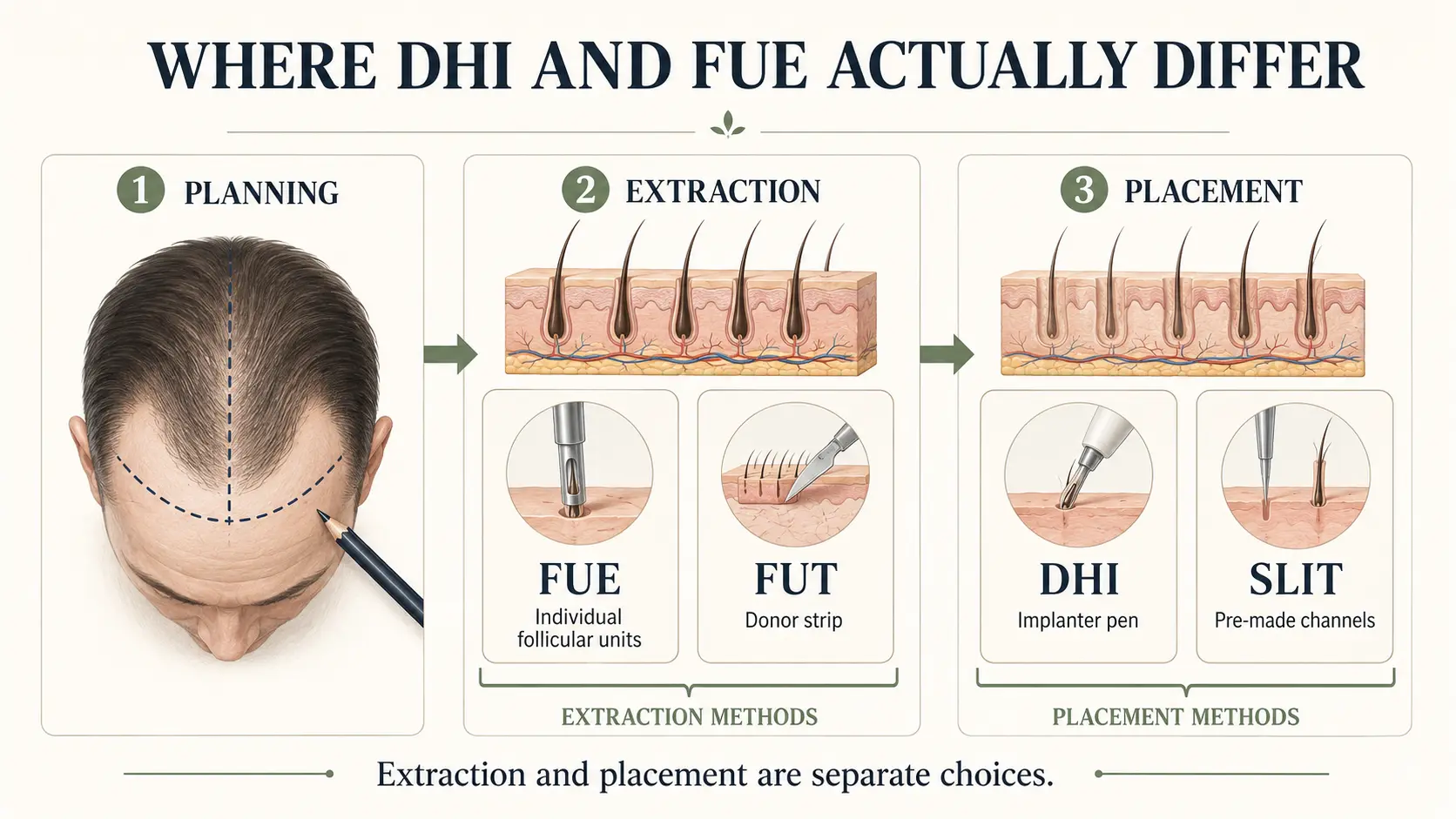
FUE describes how follicular units are removed from the donor area. DHI usually describes one way those grafts are placed into the recipient area. They are not two competing operations.
In fact, most procedures advertised as DHI still begin with FUE harvesting. The follicular units are removed individually with FUE punches and are then placed with sharp implanter pens.
In practical terms, many procedures sold as DHI are: FUE harvesting followed by sharp implanter placement.
The International Society of Hair Restoration Surgery, or ISHRS, makes this distinction very clearly. It describes FUE as a donor-harvesting method and explains that DHI is a term used for implantation with sharp implanters or immediate placement after extraction. The organization specifically states that DHI is not a separate hair transplant method and should not be marketed as one.
This article is not an argument against DHI.
We perform DHI at Pure Line®. We also create recipient sites in advance with custom-sized metal slit blades. In some operations, we use both approaches in different parts of the same scalp.
My concern is not the instrument.
My concern is the way that instrument is sometimes presented to patients.
A hair transplant is not one single technique
Describing an entire hair transplant with only one word such as DHI, FUE or metal slit leaves out most of what actually happens during the procedure.
A transplant consists of several connected stages. Each stage can affect the final result.
1. Evaluating the patient and planning the operation
Before deciding how the grafts should be implanted, we first need to decide whether the patient is suitable for surgery.
We look at:
- The diagnosis and pattern of hair loss
- How long the hair loss has been progressing
- The speed of recent progression
- Donor density and safe donor boundaries
- Hair caliber and texture
- Miniaturization in the donor and recipient areas
- Facial and forehead proportions
- The appropriate position of the hairline
- Which areas should be prioritized
- The possibility of future hair loss
- The patient's expectations
Sometimes a patient is mainly concerned about the frontal hairline, but there is already clear miniaturization through the mid-scalp.
Another patient may have a reasonable frontal area but rapidly progressing crown loss.
A donor area can also look dense from a distance while having a smaller safe harvesting zone than expected.
None of this can be assessed by choosing DHI or FUE from a price list.
We first need to understand the patient's hair loss.
The instruments come later.
2. Harvesting the grafts from the donor area
The two established donor-harvesting approaches are FUE and FUT.
What is FUE?
With FUE, follicular units are individually separated from the surrounding tissue using small circular punches and are then removed from the donor area.
The punches may be manual or motorized. They come in different diameters and designs, and the surgeon or extraction specialist may adapt the instrument and movement according to the patient's skin, follicular direction and hair characteristics. That diameter is not a minor detail, and I have looked separately at how punch size affects donor area scarring and FUE white dots.
FUE was commonly expanded as "follicular unit extraction." The preferred medical term is now follicular unit excision, because an incision is made around each follicular unit before it is removed.
What is FUT?
With FUT, a strip of donor tissue is surgically removed and then dissected into individual follicular-unit grafts.
FUE and FUT tell us how the grafts were obtained.
Neither term tells us how those grafts will later be placed into the recipient area.
3. Creating recipient sites and placing the grafts
Once the grafts have been harvested, examined and prepared, they need to be placed into the areas affected by hair loss.
This can be done in several ways.
Recipient sites may first be created with needles or custom-sized metal slit blades. The grafts are then carefully placed into those prepared sites.
When sharp implanter pens are used, the device creates the recipient opening and places the graft during the same movement.
Dull implanters may also be used to place grafts into recipient sites that have already been prepared.
More than one approach can be used during the same operation.
These are different ways of completing the recipient stage. Each requires planning, control and experience. Published surgical literature describes successful transplantation with sharp implanters, premade recipient sites and combinations of the two. It also notes that a single patient may require more than one placement method because different areas of the scalp can have different characteristics.
What is DHI?
DHI stands for Direct Hair Implantation.
In everyday hair transplant marketing, it usually means that grafts are placed with sharp implanter pens, often Choi-style devices.
A follicular-unit graft is loaded into a fine hollow needle. The tip enters the scalp at the required position, angle and direction. A plunger then releases the graft as the device is withdrawn.
Because the tip is sharp, the recipient opening is created and the graft is inserted during the same movement.
That is the basic idea.
However, the term DHI is not used consistently.
Some clinics use it specifically for sharp-implanter placement. Others use it to describe placing grafts shortly after extraction. In some cases, it is simply the commercial name given to a treatment package.
This is why I prefer explaining what will physically happen during the operation rather than relying on a label.
How will the grafts be harvested? Will the recipient sites be created in advance? Will sharp implanters be used? Could different tools be used in different areas?
These questions tell you much more than asking whether the package is called DHI.
What is the metal slit technique?
With the metal slit approach, recipient sites are created using fine metal blades.
The size of the slit can be selected according to the follicular unit that will be placed into it. A fine single-hair graft intended for the front of the hairline may not require the same site dimensions as a larger graft containing several hairs.
Creating the recipient sites in advance allows me to plan the transplanted area as a complete design.
Before implantation begins, I can establish:
- The position and shape of the hairline
- Small irregularities along the front
- The angle at which the hairs should emerge
- Direction changes between different zones
- The transition from single-hair to multi-hair grafts
- Frontal density
- The flow through the mid-scalp
- The natural whorl pattern in the crown
- The overall distribution of grafts
The implantation team then places the grafts into this framework.
Recipient-site design has a major influence on the final appearance because it establishes the position, direction, angle and distribution of the transplanted hair. Research on recipient-site creation also shows that blade shape, site depth and incision angle can affect how the graft fits and how much surrounding tissue is disturbed.
The same principle of control applies when sharp implanters are used.
The person holding the implanter must still choose the position, angle, direction and depth of every placement.
No instrument makes those decisions by itself.
Do we use DHI or metal slit at Pure Line®?
We use both.
In some operations, I create the recipient sites in advance with custom-sized metal slit blades.
In other operations, we use sharp implanter pens.
There are also cases in which we combine the two approaches during the same procedure.
For example, it may make sense to plan the direction and density of a wider frontal or mid-scalp area with premade recipient sites.
The same patient may also have another area where we need to work carefully between existing native hairs. In that area, an implanter may suit the plan better.
There is no medical rule stating that the entire scalp must be treated with one instrument simply because a package has been given a particular name.
The same is true for metal slit placement.
A patient does not walk into the clinic with a "DHI scalp" or a "metal slit scalp."
He arrives with his own pattern of hair loss, donor capacity, hair characteristics and long-term needs.
The procedure should be planned around those factors.
Can DHI and metal slit be used together?
Yes.
They are not opposing teams.
They are surgical tools and workflows that can be used separately or together.
During a hybrid procedure, premade metal slit sites may be used in one part of the scalp while sharp implanters are used in another.
Implanters may also be used to place grafts into premade recipient sites. This type of combined workflow has been described in published hair-transplant literature.
There is nothing contradictory about this.
The frontal hairline, mid-scalp and crown can present very different technical requirements in the same patient.
The instrument should adapt to the plan for each area.
The plan should not be forced to fit the name of a package.
Common DHI Marketing Myths
Myth 1: "DHI is better than FUE"
This is one of the most common claims, and it is based on a false comparison.
FUE describes how the grafts were harvested.
DHI usually describes how they were implanted.
After FUE harvesting, the grafts may be placed using:
- Premade metal slit sites
- Sharp implanters
- Dull implanters
- Forceps
- A combination of placement methods
All of these procedures may begin with exactly the same FUE harvesting process.
The technically meaningful comparisons would be:
- FUE harvesting versus FUT harvesting
- Sharp-implanter placement versus premade recipient sites
- Forceps placement versus implanter placement
"DHI versus FUE" compares two different stages of the operation.
It may be a useful phrase for online advertising because patients search for it.
It is not a useful way to judge surgical quality.
Myth 2: "DHI uses a special donor extraction method"
DHI does not tell us how the grafts were removed from the donor area.
A clinic offering DHI may use a manual FUE punch, a motorized FUE system or another FUE device.
The grafts still need to be individually excised and removed before they can be loaded into the implanters.
Punch diameter, tip design, sharpness, movement and operator control can all influence the FUE harvesting process. The patient's follicular direction, skin characteristics and hair caliber also matter.
These are FUE variables.
They do not become DHI variables simply because the grafts are later placed with a pen.
When a clinic advertises a special "DHI extraction system," patients should ask what the term actually means.
Myth 3: "DHI guarantees better graft survival"
No implantation device can guarantee graft survival.
A graft can be injured during:
- Donor excision
- Extraction
- Examination
- Sorting
- Storage
- Loading
- Placement
It may be allowed to dry, held incorrectly, compressed, bent or inserted at an unsuitable depth.
Growth depends on the entire workflow:
- The quality of harvesting
- Whether the follicular unit is removed without significant injury
- Hydration and storage
- Temperature
- Time outside the body
- How the graft is handled
- Whether the recipient site fits the graft
- The force used during insertion
- Placement depth
- Coordination within the team
Implanter pens may reduce direct handling of the lower part of the graft during final placement. The ISHRS describes this as a potential advantage of implanters. However, the graft still needs to be loaded correctly, kept in the right orientation and released without trauma.
Premade sites can also produce strong growth when the grafts are harvested, protected and placed correctly.
Published reports show that natural and dense results can be achieved with sharp implanters, but they also emphasize the importance of technique, staff training, depth control and experience. They do not support using the word DHI as a guarantee of superior survival in every patient.
Myth 4: "DHI creates more natural hairlines"
A pen does not create a natural hairline.
A good design does.
The surgeon needs to decide:
- Where the hairline should begin
- How it should relate to the patient's age and face
- How the frontal-temporal corners should be shaped
- Where small irregularities should be introduced
- Which grafts should be used at the front
- How the angle and direction should change
- How density should increase behind the first rows
- How the design may look if the patient loses more native hair later
Fine single-hair follicular units are generally selected for the leading edge. Larger grafts can then be used behind them to create visual density.
If the hairline is too low, too straight or built with unsuitable grafts, it can look unnatural whether the grafts were placed with a Choi pen or into metal slit sites.
The instrument follows the design. It does not create it.
Myth 5: "DHI controls angle and direction better"
Sharp implanters can provide excellent control when used by someone experienced with them.
Metal slit blades and needles can also provide excellent control.
With a narrow blade holder, recipient sites can be created at low angles and adjusted across the frontal area, temples, mid-scalp and crown.
With a sharp implanter, the person using the device must also control:
- Position
- Angle
- Direction
- Depth
- Distance from neighboring grafts
No device makes these decisions automatically.
Sharp-implanter literature places considerable emphasis on grip, insertion movement, gradual directional changes and depth control precisely because the quality of the outcome depends on how the device is used.
A pen does not understand anatomy. A metal slit does not understand anatomy either.
The person holding the instrument does.
Myth 6: "DHI always gives greater density"
Density is more complicated than placing the largest possible number of grafts into a small area.
The surgeon needs to consider:
- Hair caliber
- The number of hairs within each graft
- The condition of the recipient skin
- Existing native hair
- Blood supply
- Total donor capacity
- The size of the area requiring treatment
- The possibility of future hair loss
- The visual importance of each zone
Sharp implanters can be used for dense placement.
Premade metal slit sites can also be created at high density.
But the highest possible density is not always the correct target.
A transplant needs to look natural, respect the donor supply and remain sensible if the patient's native hair continues to thin.
Using too many grafts in the frontal area may reduce the reserve available for the mid-scalp or crown later.
Density is a planning decision.
It is not a feature built into an implanter pen.
Myth 7: "DHI gives a more accurate graft count"
The device used for implantation has nothing to do with whether the grafts are counted properly.
Harvested follicular units should be counted, examined and classified.
They may be separated according to:
- The number of hairs they contain
- Hair caliber
- Graft structure
- The area in which they will be placed
When recipient sites are created in advance, those sites can also be counted and distributed according to the surgical plan.
An implanter does not improve the mathematics.
A well-organized team does.
Patients should also ask whether a clinic is quoting grafts or individual hairs.
One follicular-unit graft may contain one, two, three or occasionally more hairs. Four thousand hairs and four thousand grafts are not the same thing.
That distinction matters much more than the brand of an implantation device.
Myth 8: "Only DHI can be performed without shaving"
DHI is one option when working between existing hairs.
It is not the only way to perform an unshaven or partially shaven transplant.
Shaving involves several separate decisions:
- Will the donor area be fully shaved?
- Will only narrow donor strips be shaved?
- Will donor hairs be left long?
- Will the recipient area be shaved?
- Will grafts be placed between existing long hairs?
Different placement tools can be used according to the case and the team's workflow.
Sharp implanters can be practical in some unshaven recipient areas, particularly when working around existing long hair. However, the ISHRS also explains that forceps, dull implanters and sharp implanters may all be used with long, shaved, trimmed or cut hairs. Unshaven transplantation is therefore not exclusive to DHI.
The important question is not whether the operation can technically be performed without shaving.
The real question is whether avoiding a shave will still give the team the visibility, access and control required for that particular procedure.
In a limited area, unshaven work may be perfectly reasonable.
In a larger area, shaving may help the team see the scalp more clearly, control distribution and avoid missing spaces between native hairs.
Unshaven does not automatically mean better.
Myth 9: "DHI is scar-free, risk-free or guaranteed"
No surgical hair transplant is completely scar-free or risk-free.
FUE harvesting creates small circular wounds in the donor area.
When the procedure is performed correctly and the extractions are distributed appropriately, the resulting marks can be extremely difficult to detect. But describing an operation involving skin incisions as completely scar-free is not medically honest.
The same applies to statements such as:
- Guaranteed graft survival
- No risk
- No incision
- Unlimited grafts
- Guaranteed natural results
- Completely pain-free surgery
The ISHRS lists phrases such as "scarless surgery," "no incision," "guaranteed results," "unlimited grafts" and "no risk" as misleading language in hair-restoration marketing. Its current guidance also stresses that promotional terminology should not misrepresent real surgical procedures.
A responsible clinic can explain the likely benefits, limitations and risks.
It cannot guarantee biology.
Is DHI less traumatic for the grafts?
It may reduce direct handling of part of the graft during final placement.
That does not mean the entire operation is automatically less traumatic.
Before a graft reaches its final position, it still needs to be:
- Excised
- Extracted
- Examined
- Sorted
- Stored
- Loaded or prepared
- Positioned
- Released at the correct depth
Every one of these stages matters.
A trained and coordinated team can handle grafts gently with different placement systems.
A poorly organized team can damage grafts while using an expensive implanter.
This is why I pay more attention to the complete workflow than to the name of the device.
Hair transplantation is a team procedure. The grafts pass through several stages before reaching their final position. The quality of that entire chain matters.
Does DHI cause less bleeding?
A sharp implanter creates the recipient opening and places the graft during the same movement.
Because the opening is immediately occupied by the graft, there may be less visible bleeding during placement in some cases.
However, less visible bleeding during one stage does not automatically mean:
- Higher graft survival
- Faster healing
- Greater density
- A more natural result
- Fewer complications
Bleeding varies between patients and may be influenced by scalp vascularity, blood pressure, medication, local anesthesia, incision depth, the instrument used and surgical technique.
It can be a practical difference during an operation.
It is not proof that one approach is universally better.
What actually determines the result?
Nothing in this article should be taken to mean that DHI is bad and metal slit placement is always better.
That would simply repeat the same marketing mistake in favor of another instrument.
In one patient, we may use sharp implanters.
In another, we may prepare the recipient sites with metal slit blades.
In the same operation, we may use both approaches in different areas.
What matters is not the name of the instrument, but why it was selected and how well it is used.
Several factors have a much greater influence on the final result.
Correct diagnosis and patient selection
Not every form of hair loss should be treated with transplantation.
Even a patient with androgenetic hair loss may not be ready for surgery at the time of consultation.
We need to understand the diagnosis, the progression of the hair loss and the condition of the donor area before discussing implantation tools.
A sensible long-term plan
A hair transplant should not be designed only for the next twelve months.
Male pattern hair loss may continue after surgery.
The hairline, density distribution and donor usage should still make sense if the patient's native hair becomes thinner in the future.
Donor management
The donor area is limited.
The way extractions are distributed matters just as much as the total number removed.
Overharvesting or concentrating extractions in the wrong areas can leave visible thinning and reduce the patient's options for future procedures.
Hairline and recipient-area design
The position, angle, direction and distribution of the transplanted hairs are established through planning and recipient-site creation.
Whether the sites are made in advance with metal slit blades or created during placement with sharp implanters, the person responsible needs to understand natural hair growth.
Graft selection
Fine single-hair grafts are generally preferred along the front edge of the hairline.
Larger multi-hair grafts can be used farther behind to create density.
Using the wrong grafts in the wrong areas can produce an unnatural result regardless of the device used.
Graft protection
Follicular units are living tissue.
They need to be protected from:
- Drying
- Crushing
- Excessive heat
- Unnecessary manipulation
- Incorrect loading
- Unsuitable placement depth
The experience and coordination of the team
Hair transplantation is not a one-person performance.
The team needs to understand the surgical plan, identify different graft types, work consistently and communicate throughout the procedure.
The sharp-implanter literature itself describes hair transplantation as a team effort and notes that the surgeon's skill cannot compensate for poor handling, dehydration or trauma caused elsewhere in the workflow.
A strong plan can be weakened by careless execution.
Careful execution cannot rescue a poor design.
Questions to ask before choosing a clinic
Rather than asking only whether a clinic offers DHI or FUE, I would ask:
- Who will evaluate my hair loss and donor area?
- Who will design my hairline?
- Who will prepare the surgical plan?
- Who will perform the donor harvesting?
- Who will create the recipient sites?
- Who will classify, handle and place the grafts?
- Which implantation tools may be used in my case?
- Why have those tools been selected?
- Could more than one placement technique be used?
- How will my donor area be protected?
- How many patients will the team treat that day?
- How long has the team worked together?
- What is the plan if my native hair continues to thin?
- How will my postoperative recovery be followed?
The ISHRS similarly advises patients to investigate who will evaluate them, recommend treatment and perform the different surgical stages rather than relying on promotional terminology alone.
Clear answers to these questions tell you far more than the three letters printed at the top of a treatment package.
Frequently Asked Questions
Is DHI better than FUE?
Is metal slit better than DHI?
Can DHI and metal slit be used together?
Does Pure Line® perform DHI?
Does DHI give better graft survival?
Does DHI create a more natural hairline?
Is DHI the only option for an unshaven transplant?
Is a newer device automatically better?
My final view
DHI is a useful implantation approach.
Creating recipient sites with metal slit blades is also a useful approach.
Sometimes we use one. Sometimes we use the other. Sometimes we combine them because different parts of the scalp require different things.
There is nothing contradictory about that. It is simply surgery being adapted to the patient.
What I do not agree with is presenting DHI as a completely separate operation that automatically provides better growth, greater density, a more natural hairline or a safer result in every patient.
An implanter pen cannot diagnose hair loss. It cannot design a responsible hairline. It cannot protect the donor area by itself. It cannot decide how the result should age over the coming years. And it cannot replace an experienced, coordinated team.
Do not begin your hair transplant journey by choosing a technique name. Choose the doctor who will assess you honestly, the plan that makes sense for your future and the team that will handle your grafts carefully.
The right instruments for your case should be chosen after that.
— Dr. Mesut Demir
Not sure whether DHI, FUE or metal slit is right for your case?
Share your photos and hair loss history. We will explain exactly which techniques we would use for your case, and why — no technique names, just an honest plan.
Request a Case Review