FUE hair transplant, planned around
donor safety and natural growth.
FUE hair transplantation in Istanbul. The plan begins with your diagnosis and with what your donor area can safely spare.
Quick answer
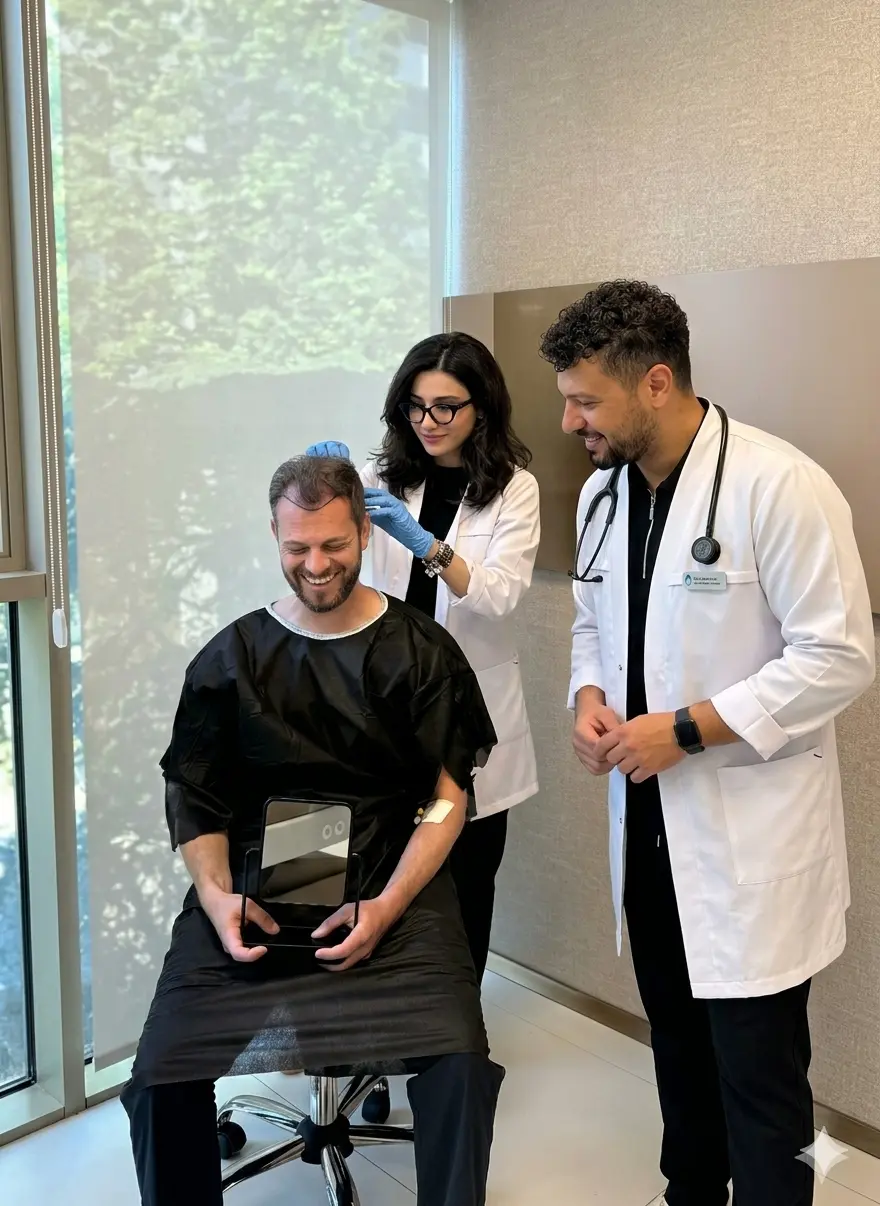
FUE removes follicular units one by one from a donor area and places them in thinning areas. It avoids a linear strip scar, but still creates small extraction wounds and cannot guarantee a particular density or outcome. Candidacy depends on diagnosis, donor quality, health and long-term hair-loss planning.
Health First. Always.
Before planning your hairline, we review whether surgery is safe for you at all — your medical history, the medicines you take, your allergies and your blood pressure, checked before anyone picks up a punch. If there is a concern, we pause, reassess, or recommend postponing. What a consultation should actually cover.
What is FUE Hair Transplant?
FUE, short for Follicular Unit Extraction, is a hair transplant method where individual follicular units are extracted one by one from the donor area and implanted into areas of thinning or baldness.
Unlike strip surgery (FUT), FUE does not require a scalpel incision across the back of the head and does not leave a linear scar. Each graft is removed through a small punch, which can leave tiny dot-shaped scars. Their visibility varies with healing, skin and hair characteristics, extraction pattern, hair length, and the punch size used during extraction.
Working graft by graft is what makes the rest controllable: which follicles are taken, where the hairline sits, how density is spread across it, and how much donor reserve is left behind.
But FUE is only the method. What separates two FUE results is everything in between: how much donor area was spent to get the grafts, how long those grafts sat outside the body, and at what angle they went back in.
FUE vs DHI: What Really Matters
FUE and DHI are often presented as two competing techniques. In reality, they describe different stages of the same procedure.
FUE refers to how grafts are extracted — one by one from the donor area. DHI refers to one way of implanting those grafts, typically using an implanter pen called a Choi pen. In most DHI procedures, grafts are still extracted using the FUE method.
The real difference is not in the name of the technique. It is in the decisions made during the procedure:
- How the donor area is protected
- How grafts are preserved during the procedure
- How the hairline is designed for your face and your age
- How density is distributed naturally
- How the plan protects both today's result and future donor reserve
At Pure Line, the method is chosen from the patient's donor area, what the recipient area needs and where the loss is likely to go next. We do not market technique names as shortcuts to a natural result.
Dr. Mesut Demir takes the specific claims made for each name apart in DHI vs FUE: the marketing myths patients should know.
| At a glance | FUE | DHI (FUE + implanter pen) | FUT (strip surgery) |
|---|---|---|---|
| What the name describes | How grafts are extracted — individually, one by one | How grafts are implanted; extraction is still FUE | How donor tissue is harvested — as a single strip |
| Incision & stitches | No scalpel incision, no stitches | No scalpel incision, no stitches | Scalpel incision closed with sutures |
| Scarring | Small round scars that may become less noticeable after healing | Same as FUE | A permanent linear scar across the donor area |
| Donor healing | Early healing often occurs over days; final scar visibility varies | Same extraction method as FUE; healing and scar visibility vary | Weeks; sutures typically removed after 10–14 days |
| Design flexibility | Single-graft control over hairline, angle and density | Implanter pen controls depth and angle at insertion | Graft supply fixed by the excised strip |
Pure Line plans every case around FUE extraction; implanter pens are used where the surgical plan benefits from them. We do not perform strip (FUT) surgery.
Who FUE tends to suit
FUE moves hair you already own from one part of your head to another. It creates nothing. So the question is never really whether the technique works — it is whether you have enough hair to move, and whether the pattern it is moving into is predictable enough to design around.
- A diagnosed cause of loss, most often androgenetic alopecia, that has been stable long enough to plan around
- A donor area dense enough to cover the recipient area without leaving the back of the head visibly thinner
- Expectations set on coverage and proportion rather than on a graft number
- General health that makes elective surgery under local anesthesia reasonable
- A readiness to treat continuing loss medically, because surgery does not slow it down
When we advise waiting
Declining a case costs a clinic money, which is exactly why it is worth asking any surgeon when they last did it. These are the situations where we will suggest treating something else first, or simply waiting:
- Loss that is still moving quickly, where a hairline drawn today would sit wrongly on the face in a few years
- A cause that has not been established — diffuse shedding, patchy loss and scarring patterns need a diagnosis before any surgical plan
- Active scalp inflammation or untreated skin disease in the area that would be operated on
- A donor area that cannot cover what you want covered, where surgery would spend the reserve without solving the problem
- A medical condition or medicine that makes elective surgery unwise for now
You get the same team every time.
A hair transplant is not carried out by one pair of hands. Planning, graft handling and aftercare each have someone accountable for them, and at Pure Line those are the same people on every case — so the standard does not depend on who happened to be rostered that day.
One patient. One day.
One procedure per day — no overlap, no split attention. From arrival to discharge, every person in this building is focused on you alone. Why we schedule it this way.
The team retrains every quarter.
FUE quality lives or dies in graft handling. Every quarter the whole surgical team trains together, because technique drifts quietly when nobody is measuring it.
Every stage matters.
Your procedure is carried out by our core team from arrival to aftercare. Every step below exists to protect one of two things — the donor area you cannot get back, or the grafts already taken from it.
Your medical history and current health are reviewed first, because safety comes before design. Only then do we look at donor capacity, your pattern of loss, facial proportion and what you are expecting — and only after that is a hairline drawn.
The donor and recipient areas are cleaned and draped under sterile conditions. The first anesthetic step is the part most patients are anxious about, so that is where PureSoft® is used.
Follicular units are taken with spacing that keeps the donor area looking untouched at normal hair length. The goal is never only to reach a graft count — it is to leave behind a donor area you could still draw from later.
Each graft is inspected under magnification and sorted by how many follicles it carries. That sorting is what allows single-hair grafts to be saved for the hairline instead of being used up behind it.
Recipient sites are opened to the plan — each one following the direction the surrounding hair already grows in, at a density the donor area can genuinely support.
Grafts are placed according to the hairline and density plan. Single-hair grafts are reserved for softer transition zones, while multi-hair grafts support coverage behind them.
Care continues after you leave the clinic. You go home with a written aftercare plan and a direct line to the team for the whole 12 to 18 months it takes before a result can be judged.
Precision starts under
the microscope.
Before any graft is placed, it's inspected and classified under magnification. Single-follicle grafts are assigned to the hairline — they create the soft, gradual edge that makes a transplant undetectable. Multi-follicle units build volume and coverage behind. This classification step directly shapes how natural the final result looks and how well it ages over time.
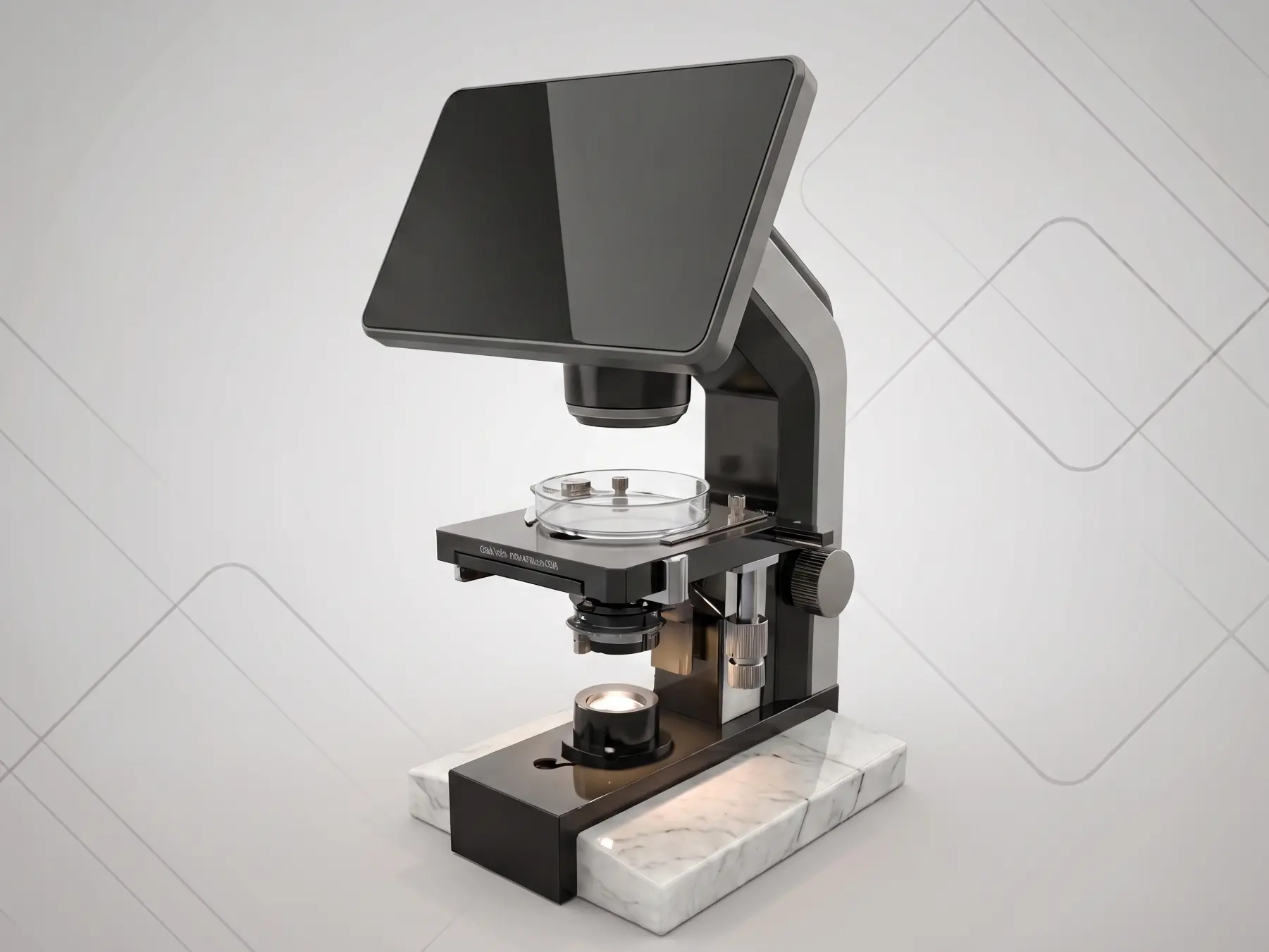
Every graft is assessed for follicle count, root integrity and hair caliber, then laid out in the order the plan calls for before placement begins.
PureSoft® Technique.
A comfort-focused start.
The initial local-anesthetic phase can feel uncomfortable. PureSoft® uses a needle-free, high-pressure device for the first delivery step before fine-gauge needles complete the anesthesia.
Some patients may find this first step easier, but pressure, pinching or discomfort can still occur and individual experience varies.
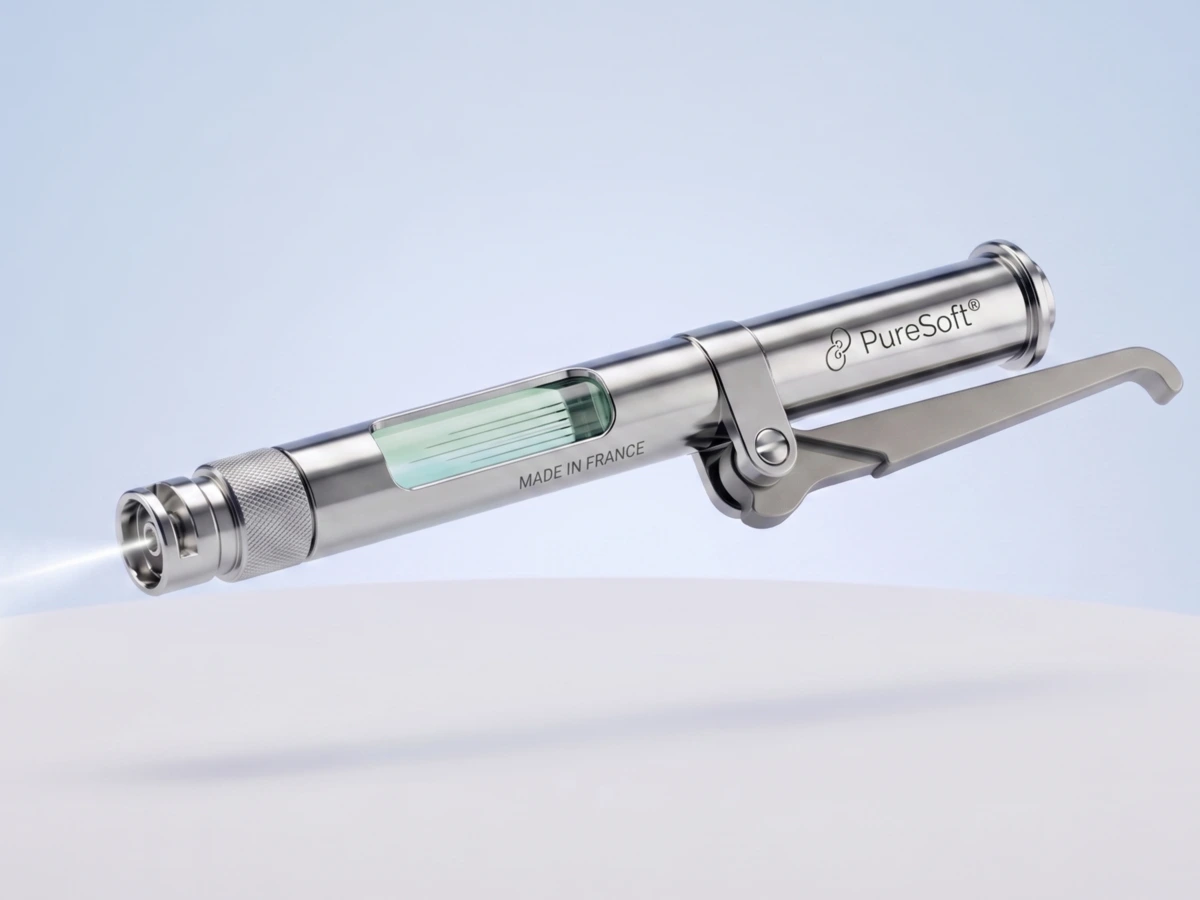
The device delivers anesthetic without a needle for the first step. Pressure and individual sensation vary.
Designed to distribute the first anesthetic dose quickly; onset and comfort still vary between patients.
Fewer needle entries may help make the anesthesia phase feel calmer and more comfortable for suitable patients.
What to expect.
Honestly.
FUE is elective surgery, and no surgical procedure is risk-free. Short-term swelling, discomfort, scabbing, redness and temporary numbness can occur during recovery. Less common complications include bleeding, infection, a reaction to anesthesia, persistent altered sensation, visible scarring, poor graft growth, or an unsatisfactory cosmetic result; some may require further treatment. Your individual risks, warning signs, and follow-up plan should be discussed before you decide.
Ask Us AnythingMild forehead and eye-area swelling can occur during early recovery and often improves over several days. How long it lasts differs from person to person; follow your own aftercare plan and contact the clinic if swelling is severe, worsening, or accompanied by other unexpected symptoms. What is normal and when to worry.
Some transplanted or nearby existing hair may shed during the first several weeks. Regrowth often begins over the following months, but the timing is not predictable and not every graft grows; shedding alone does not tell you what the final result will be.
Small scabs can form around implanted grafts and often clear as healing progresses. How quickly they go differs between patients; follow the washing instructions given for your case and do not pick or scratch the area.
FUE leaves small round scars in the donor area. They often become less conspicuous as healing progresses, but how visible they stay depends on your skin and your healing, and nobody can promise you they will disappear.
Infection can occur after hair transplantation and needs prompt assessment. Follow the aftercare plan and contact the clinic if you develop increasing pain, redness, warmth, swelling, discharge, fever, or other unexpected symptoms.
Growth and maturation can continue for
12 to 18 months.
Growth develops gradually. Early changes may appear after several months, but how fast it comes, how dense it looks and how much of it survives differ by patient and by the area treated. What the result looks like after ten or twenty years.
The questions
patients actually ask.
These come up in almost every case review. Answers here are general information about FUE and cannot replace an individual assessment — the full list covers recovery, travel and medication in more detail.
Read the Full FAQIs FUE better than DHI?
How many grafts will I need?
Will my donor area look thinner afterwards?
Does FUE hurt?
When will I look normal in public?
Is the result permanent?
If you are making this
decision once, make it right.
Send us your photos and we'll review your case honestly — including graft estimate, feasibility, and what a realistic result could look like for you.
Clinical context and evidence
- Education
- Kocaeli University, Faculty of Medicine — M.D., 2016
- Clinical focus
- Hair restoration surgery since 2018
- Registration
- Turkish Medical Association
Dr. Mesut Demir, M.D., is the co-founder and medical director of Pure Line. This page describes general clinical considerations; individual suitability, risks, alternatives and expected outcomes require a personal assessment.
Meet Dr. Mesut Demir and view his background →- Follicular unit extraction: minimally invasive surgery for hair transplantationDermatologic Surgery · 2002
- Complications in follicular unit excision hair transplantationFrontiers in Medicine · 2026
The medical information on this page is provided for educational purposes and does not replace a personal consultation. Treatment suitability can only be determined after an individual assessment.