
Quick answer
A hair transplant consultation should include a medical history, examination of the scalp and donor area, assessment of the diagnosis and progression of hair loss, discussion of appropriate nonsurgical options, realistic planning of coverage and density, and a clear explanation of risks, alternatives, costs, team responsibilities, and follow-up. The objective is to determine whether surgery is appropriate, whether it should happen now, and how to use a limited donor supply responsibly. Dr. Mesut Demir treats the graft number as the last output rather than the first: a Norwood grade is not a graft calculator, trained observers agree on that grade only moderately, and a consultation may reasonably end with a surgical plan, medical treatment, observation, further investigation, or a recommendation not to proceed.
I regularly meet patients who already have three or four graft estimates before anyone has clearly explained why they are losing hair.
One clinic has suggested 2,500 grafts. Another has suggested 4,000. A third has promised “maximum density.” The patient arrives expecting me to settle the argument by choosing a number.
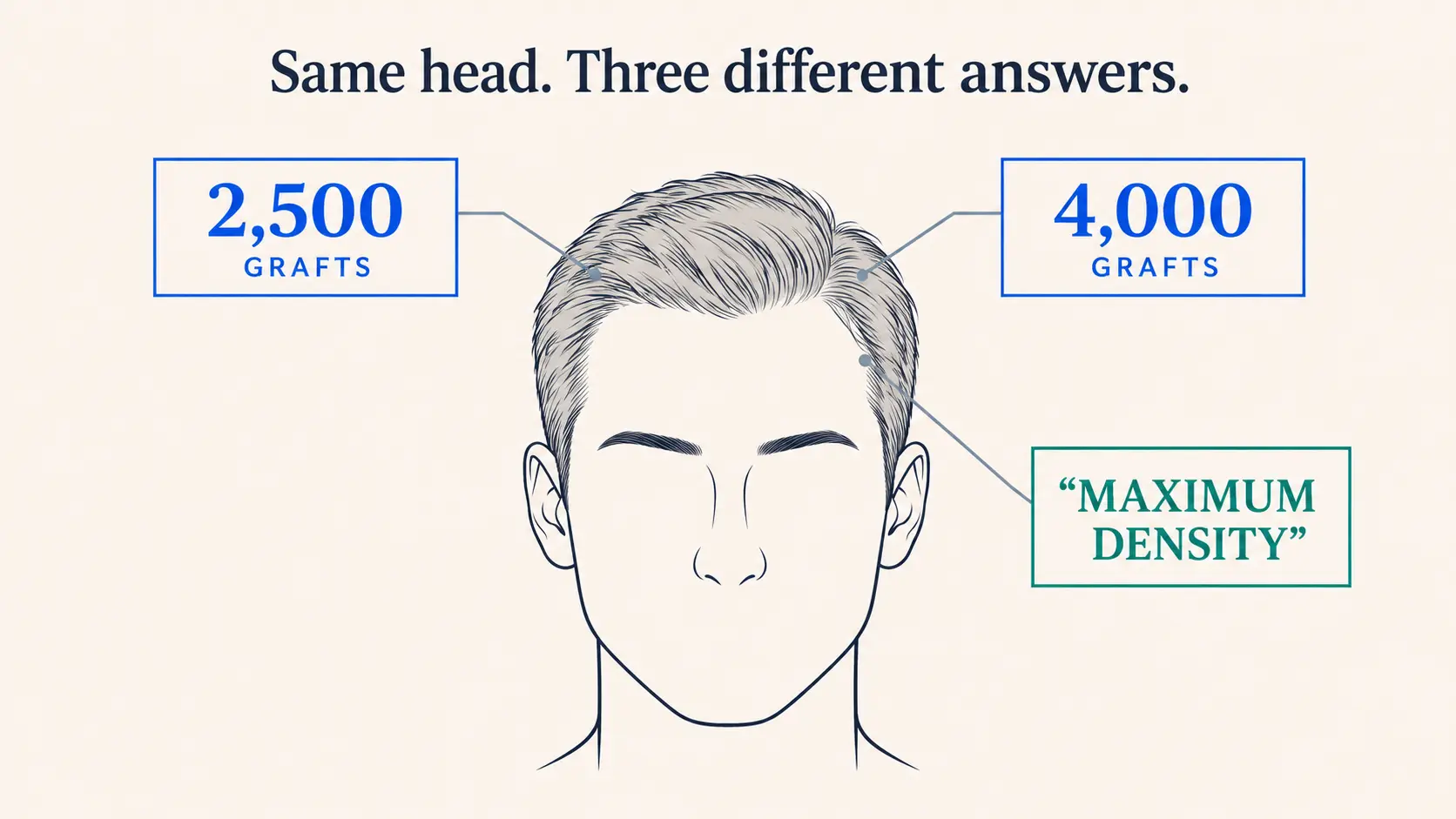
But a number is not a diagnosis, and it is not a long-term plan.
A proper hair transplant consultation should answer three questions before surgery is recommended: what is causing the hair loss, what surgery can realistically improve now, and whether the plan will still look coherent if the patient’s native hair continues to thin.
Why can three clinics give three different graft estimates?
Different estimates do not automatically prove that one clinic is dishonest. They do show that the number needs an explanation.
Even the label used to describe a patient’s hair-loss stage is not perfectly reproducible. In a reliability study of the Hamilton–Norwood classification, agreement among trained observers was only moderate, with interobserver intraclass correlation coefficients of 0.63–0.68. In a separate study, men comparing their own hair loss with standardized diagrams matched a trained observer’s exact classification in only 48.5–55.8% of assessments.
These studies do not measure graft calculations directly. They demonstrate something more basic: a stage label contains judgment, and self-staging from a chart or photograph is especially limited. A Norwood grade is useful shorthand; it is not a graft calculator.
Graft estimates can also differ because clinics are using different assumptions about:
- the measured size of the recipient area;
- how much native hair remains within it;
- the target visual density;
- whether the crown is included;
- hair-shaft caliber, curl, and color contrast;
- the size and quality of the safe donor area;
- the extraction limit considered acceptable;
- the likelihood of future loss;
- whether the priority is one large session or donor preservation across a lifetime.
A credible estimate should therefore be explainable as a plan: the area to be treated, the proposed distribution, the donor evidence, and the trade-offs. If the number cannot be reconstructed from those elements, it is a sales figure rather than a clinical conclusion.
Why must diagnosis come before hairline design?
“Hair loss” is a description, not a diagnosis.
Androgenetic alopecia is the most common reason people seek a hair transplant, but it is not the only reason hair becomes thinner. Telogen effluvium, alopecia areata, inflammatory or scarring disorders, traction, nutritional problems, and other medical factors can produce different patterns and require different decisions.
I begin with the history of the problem rather than a drawing on the forehead. I want to know:
- when the change began;
- whether it has been gradual or sudden;
- which areas are changing;
- whether there is itching, scale, redness, pain, or patchy loss;
- whether close relatives followed a similar pattern;
- which medical conditions, medications, or recent stressors may be relevant;
- which treatments have already been tried and for how long;
- whether there has been a previous hair transplant.
The scalp examination then tests whether the visual pattern supports that history.
Are shedding and progressive hair loss the same thing?
No. It is normal for scalp hairs to move through growth, transition, resting, and shedding phases. The NHS notes that people commonly shed approximately 50–100 hairs a day without noticing it. Visible hair in the shower does not, by itself, prove that androgenetic alopecia has suddenly accelerated.
Progressive pattern hair loss involves miniaturization: susceptible follicles gradually produce hairs that are shorter, finer, and less cosmetically effective. Surgery does not treat every form of shedding. Operating before a temporary, inflammatory, or medically driven change is understood may address the wrong problem.
What does trichoscopy add?
Trichoscopy is a noninvasive, magnified examination of the scalp. It can show variation in hair-shaft diameter, miniaturized hairs, follicular-unit composition, and donor density. It may also reveal findings that suggest a diagnosis other than straightforward pattern hair loss.
A 2024 systematic review found hair-diameter variability in 94.07% and vellus hairs in 66.45% of the included androgenetic alopecia observations. Those figures do not mean either sign proves the diagnosis on its own. They show why magnified examination is more informative than judging density from ordinary photographs alone.
I prefer patients to see these images with me. “Your hair is thinning” is abstract. Comparing stronger multi-hair follicular units with increasingly fine or single-hair units makes the reasoning visible. Trichoscopy supports clinical judgment; it does not replace medical history, examination, or further investigation when needed.
How do I decide whether hair loss is stable enough for surgery?
A hair transplant moves follicles. It does not switch off the process affecting the native hair that remains.
A transplanted hairline can continue to grow while untreated hair immediately behind it becomes thinner. The grafts may still be present, yet the overall pattern can become disconnected or visually unnatural. I assess this risk through age, recent photographs, speed of change, family history, distribution of miniaturization, involved areas, and response to previous treatment.
Two patients may show similar temple recession today. One may be 22 with rapid change across the frontal and mid-scalp; the other may be 42 with a pattern that has changed little for years. Giving them the same hairline and graft plan would ignore the difference most likely to shape their future result.
Why do younger patients sometimes need more time?
Age alone does not determine candidacy. It changes the time horizon and the uncertainty.
In a population study of men aged 18–49, moderate or extensive hair loss — Hamilton–Norwood grade III or higher — was present in 16% of men aged 18–29 and 53% of men aged 40–49. This was cross-sectional prevalence data, not a prediction that any individual young man will follow the same course. It does show why a snapshot taken early in adult life may reveal less of the eventual pattern.
Practice guidelines also advise caution with transplantation at a young age, but the age thresholds in those recommendations are based on low-level evidence and should not be treated as universal rules. The more useful questions are whether loss is active, how much miniaturization is present, how aggressive the family pattern appears, and whether today’s design can remain credible over decades.
Sometimes the responsible recommendation is treatment and reassessment. Sometimes it is a deliberately conservative design. Sometimes it is no surgery.
Why do medical options belong in a surgical consultation?
Surgery redistributes hair; appropriate medical treatment may help protect or improve susceptible native hair. That distinction belongs in the consultation even when the patient’s first question is about an operation.
Depending on the diagnosis, sex, medical history, and risk profile, the discussion may include topical or prescription treatment. No option works for everyone. Potential benefit has to be weighed against adverse effects, contraindications, patient preferences, cost, adherence, and the likelihood that continued use will be needed.
My responsibility is to explain:
- what each relevant option is intended to do;
- what evidence supports it;
- how long a fair trial may take;
- which adverse effects or contraindications matter;
- what may happen if treatment is stopped;
- how accepting or declining treatment changes the surgical plan.
The decision belongs to the patient. Declining medication does not automatically make every person unsuitable for surgery. It may require more conservative assumptions about continued native-hair loss.
I would not tell a patient to “have one operation and forget about hair loss forever.” A transplant can create a durable improvement, but it cannot guarantee that the surrounding native hair will remain unchanged. I explain that distinction in Is a Hair Transplant Permanent? What Changes After 10 or 20 Years.
How should the donor area be measured and protected?
The donor area is a finite, nonrenewable resource. When a follicular unit is removed by FUE and transplanted, it does not regrow in its original position. Each extraction may add coverage to the recipient area while permanently reducing the reserve at the back or sides of the scalp.
The clinically useful question is not simply, “How many grafts can be extracted today?” I need to ask how many can be used while keeping the donor visually acceptable and preserving reasonable options if loss progresses.
Published figures help illustrate the variables, but they should never be converted into an automatic personal allowance:
- Practice guidelines describe a safe donor area of approximately 189–203 cm², while explicitly noting individual and ethnic variation and stating that no single boundary is valid for everyone. The recommendation was graded C with level 3 evidence.
- In a study of 580 Indian men with Hamilton–Norwood grade III or higher, mean scalp follicular-unit density was 78.2 FU/cm². That cohort is useful for understanding measurement, not for assuming that every patient or ethnicity has the same density.
- A mathematical donor model reported occipital densities of 65–85 follicular units/cm² and 124–200 hairs/cm², again demonstrating substantial variation.
Multiplying a surface area by an average density does not produce a safe extraction target. The borders may not be stable, miniaturization may be present, density is not uniform, previous harvesting matters, and only part of the donor can be removed without changing its appearance.
I also assess:
- hair-shaft caliber;
- the proportion of single-, double-, and multi-hair follicular units;
- curl or wave;
- hair-to-skin color contrast;
- signs of donor miniaturization;
- scars or previous extraction patterns;
- the patient’s preferred hair length;
- the credible extent of future loss.
Two donor areas with the same follicular-unit density can create different visual coverage. Coarse, wavy hair with low color contrast may create more apparent fullness than fine, straight, high-contrast hair.
Does a larger graft number mean a better plan?
No. More grafts may be appropriate when the area is large, the donor is strong, and the extraction pattern is safe. In another patient, pursuing the largest possible session can create visible donor thinning and leave too little flexibility for later loss.
An 820-patient retrospective series in advanced baldness makes another important point. At 12 months, 94% of surveyed patients were satisfied, yet 62% still wanted another session for greater coverage or density. The study involved men with advanced Hamilton–Norwood grades V–VII and cannot be generalized to every patient. It nevertheless shows that satisfaction and completion are different outcomes. A patient may value the first improvement and still require or request further work.
My aim is to use the right grafts, in the right distribution, for the greatest responsible cosmetic return. A FUE hair transplant should be planned around the remaining donor appearance, not only the number removed.
How should the hairline and graft distribution be planned?
A hairline is designed for a changing biological situation, not only for the photograph taken at the end of surgery.
I consider facial proportions, age, temple shape, existing miniaturized hair, the area behind the proposed hairline, and the donor reserve likely to remain available. The lowest or densest possible hairline is rarely the most intelligent target.
The same principle applies when dividing grafts among the front, mid-scalp, and crown. The frontal area usually has a strong effect on facial framing. The crown can consume many grafts because of its surface area and whorl pattern. In a patient with limited donor capacity or an expanding pattern, treating every area lightly may be less effective than establishing clear priorities.
There is no universal order. The patient’s concern matters, but it must be balanced with anatomy and future risk. I explain the specific trade-offs of the vertex in Why Crown Hair Transplant Results Can Take Longer.
A sound plan does not pretend to predict the future perfectly. It remains acceptable across several plausible futures.
What should an international patient confirm before flying?
An online consultation can narrow the possibilities, identify obvious concerns, and produce a preliminary graft range. It cannot reproduce palpation, standardized measurement, magnified examination at multiple scalp points, or every part of an in-person medical assessment.
This limitation matters when the patient is booking flights and accommodation around a procedure in Istanbul. Before travel, the patient should receive enough information to make the journey an informed decision rather than a commitment to an unchangeable operation.
| Before travel | What should be documented or explained |
|---|---|
| Preliminary candidacy | Why transplantation appears reasonable from the available history and images, and what remains unconfirmed |
| Working diagnosis | The likely cause and pattern of loss, including any reason an in-person examination could postpone surgery |
| Provisional plan | A graft range, treatment priorities, and areas that may be deferred — not a guaranteed final count |
| Medical information | Required history, medication and supplement instructions, allergies, tests, and conditions that could change suitability |
| Clinical responsibility | The doctor responsible for assessment and design, the roles of the team, and when the patient will meet them |
| Financial terms | What the quotation includes, what can change, and the cancellation or postponement terms |
| Follow-up | Who answers clinical questions after the patient returns home, how photographs are reviewed, and when local care is needed |
What if the plan changes after the in-person examination?
Minor refinement is normal. Hairline position, distribution, or the final graft count may change when the scalp can be examined and measured directly. A material change is different. If the diagnosis, donor capacity, safety assessment, cost, or realistic benefit changes substantially, the revised plan should be explained and consented to before treatment begins.
The patient should retain a genuine option to pause or decline. A flight already taken does not convert uncertainty into medical suitability.
Is it acceptable to meet the doctor for the first time on surgery day?
The final in-person examination may occur on the procedure day, particularly for an international patient. The first meaningful medical contact should not. Before booking, the patient should know which doctor is responsible, have an opportunity to provide a full history and ask questions, and understand which conclusions remain provisional. If the doctor becomes visible only after payment, travel, and the main planning decisions, informed choice has been weakened.
How should follow-up work after the patient returns home?
Follow-up should not depend on an anonymous inbox. The patient should know the expected review schedule, how to send standardized photographs, which symptoms are routine, which require urgent contact, and who will coordinate with a local clinician if hands-on assessment is necessary. Time-zone expectations and emergency contact routes should be established before travel.
How should you compare second opinions?
When three clinics provide three numbers, comparing the numbers alone repeats the original problem. Compare the reasoning that produced them.
Ask each clinic for a written summary that separates confirmed findings from provisional judgments. Where clinically appropriate and available, request copies of trichoscopy images or donor measurements. These records make a later discussion more precise and reduce reliance on memory.
| Compare this | Useful evidence to request | The question it should answer |
|---|---|---|
| Diagnosis | Written working diagnosis, history, scalp findings, trichoscopy images if taken | Are the clinics treating the same condition? |
| Stability | Recent-photo comparison, miniaturization pattern, treatment history | Do they agree about the risk of continued loss? |
| Recipient plan | Measured areas, hairline position, zone-by-zone graft distribution | Where will the grafts go, and what will remain untreated? |
| Donor assessment | Density measurements, caliber, miniaturization, prior extraction map | What limits the safe plan? |
| Future strategy | Plausible progression, remaining reserve, possible later sessions | Does today’s plan leave options? |
| Team and follow-up | Named responsibilities and postoperative pathway | Who is accountable before, during, and after surgery? |
An evidence-based second opinion does not have to reproduce the first clinic’s figure. It should explain the difference. If one plan includes the crown and another does not, or one protects more donor reserve, the estimates are no longer contradictory; they answer different planning questions.
What should a transparent quotation explain?
Price belongs in a consultation because informed consent includes practical and financial expectations. A higher or lower quotation does not establish clinical quality by itself, and a “per graft” model is not inherently more transparent than a fixed package.
The written quotation should explain:
- whether the fee is fixed, based on a graft range, or calculated per graft;
- which examinations, procedure stages, medications, supplies, and postoperative products are included;
- whether accommodation and transfers are included and under what conditions;
- which follow-up reviews are included and for how long;
- how additional tests or a medically necessary plan change would affect the fee;
- who manages and pays for assessment of a suspected complication after the patient returns home;
- whether a later procedure or revision is included, discounted, or entirely separate;
- the cancellation, postponement, refund, card-charge, and bank-transfer terms.
The purpose is to prevent the patient from discovering material conditions after travel or treatment. A quotation should describe the service being purchased; it should not pressure the patient with an expiring medical promise.
Who is responsible for each part of care?
The doctor responsible for medical planning should be meaningfully involved before surgery is agreed, rather than introduced after the principal decisions have already been made.
During the consultation, the patient should be able to establish:
- who makes the diagnosis and approves medical suitability;
- who designs the hairline and graft distribution;
- who performs each stage of the procedure;
- who supervises the clinical team;
- who manages complications and postoperative questions;
- who can revise or stop the plan if new findings appear.
Hair transplantation is team-based, but “team-based” should not mean anonymous. Roles, qualifications, and responsibility should be clear.
At Pure Line, I lead the medical assessment, long-term planning, and hairline design. The clinical roles and the limits of any remote assessment should be explained before consent so that the plan discussed with the patient remains the plan guiding the procedure and follow-up.
Why should a consultation reduce pressure?
Hair loss can make people feel urgent, exposed, and unusually vulnerable to certainty. A medical consultation should slow the decision down enough for the patient to understand the trade-offs.
An immediate booking is not the measure of a successful consultation. The appropriate outcome may be surgery, treatment, observation, further investigation, a second opinion, or no intervention.
Pressure can take several forms: a discount that expires tonight, a date that must be secured immediately, a guaranteed result, or the suggestion that hesitation means losing the only opportunity. None of these improves diagnosis or donor capacity.
What should you know before leaving the consultation?
| Question | A useful consultation should give you |
|---|---|
| What is causing my hair loss? | A working diagnosis and the findings that support it |
| Is my loss stable enough for surgery? | An assessment of recent progression and the uncertainties that remain |
| What can treatment do? | Relevant options, limitations, risks, and the implications of declining treatment |
| How strong is my donor area? | Measurements and an explanation of density, caliber, follicular-unit quality, and long-term capacity |
| Why this graft estimate? | A zone-by-zone distribution linked to measurable areas, priorities, and donor preservation |
| What if I lose more native hair? | A credible long-term scenario, including whether another procedure might be considered |
| Who performs each stage? | Clear roles, qualifications, supervision, and medical responsibility |
| What will I pay for? | Written inclusions, exclusions, change conditions, and follow-up terms |
| What happens after I fly home? | A review schedule, contact route, warning signs, and escalation plan |
| What are my alternatives? | A balanced discussion of treatment, observation, surgery, and no treatment |
If you leave with only a price, a graft number, and an available date, the most important part of the consultation may still be missing.
What are the red flags during a hair transplant consultation?
No single sign proves that a clinic is unsafe, but I would pause if:
- a precise graft count is guaranteed from a few photographs without a medical history;
- the same graft range appears to be recommended to almost everyone;
- no one examines or discusses the donor area;
- ongoing native-hair loss is treated as irrelevant;
- medication is promised as risk-free or dismissed without discussion;
- the doctor responsible for the plan cannot be identified;
- density, graft survival, or permanence is guaranteed;
- a material plan change cannot be declined after arrival;
- follow-up after returning home is vague;
- the patient is pressured to pay before having time to think.
Which questions should you ask at a hair transplant consultation?
You do not need specialist knowledge. These questions reveal whether the planning is specific to you:
- What is my working diagnosis, and what findings support it?
- Does my hair loss appear active or stable?
- Would you recommend treatment, investigation, or observation before surgery?
- How did you calculate my graft range?
- Which areas are being prioritized, and which are being left untreated?
- What could this design look like if I lose more native hair?
- How are you measuring and protecting my donor area?
- May I receive the measurements, plan, and trichoscopy images taken during my assessment?
- Who will perform and supervise each stage?
- What are the principal risks and realistic limitations in my case?
- What exactly does the quotation include and exclude?
- What happens if the in-person findings differ from the online plan?
- Who follows me after I return home?
- What alternatives do I have if I decide not to proceed now?
A clinic should be able to answer without turning every response into a sales promise.
My final rule
The first purpose of a hair transplant consultation is to decide whether moving grafts is the right intervention at all.
Diagnosis tells us what we are treating. Stability tells us whether this is the right moment. Medical options tell us what native hair may still be protected. Donor assessment defines the lifetime budget. Long-term design decides how carefully that budget should be spent.
Only then does the graft number become meaningful.
Frequently Asked Questions
How long should a hair transplant consultation take?
Can an online hair transplant consultation be reliable?
How many clinics should I consult before choosing?
What should a hair transplant price include?
Can I request my trichoscopy images and donor measurements?
Can my plan change on the day of surgery?
What should I bring to a hair transplant consultation?
Should I meet the doctor before booking a hair transplant?
How many grafts will I need?
Do I have to use hair-loss medication before a transplant?
Is shedding the same as going bald?
Is one hair transplant enough for life?
How does follow-up work after I return home?
Written by Dr. Mesut Demir, M.D. — Co-Founder & Medical Director, Pure Line
Start with a clear assessment
Send your photographs and medical history for a preliminary review. We will explain what can be assessed remotely, what remains provisional, and what must be confirmed during an appropriate medical examination before treatment.
Request a case review- National Health Service. Hair loss. Last reviewed 24 January 2024. nhs.uk
- Issa NT, Tosti A. Trichoscopy for the hair transplant surgeon: assessing for mimickers of androgenetic alopecia and preoperative evaluation of donor site area. Indian Journal of Plastic Surgery. 2021;54(4):393–398. doi:10.1055/s-0041-1739245
- Kuczara A, Waśkiel-Burnat A, Rakowska A, Olszewska M, Rudnicka L. Trichoscopy of androgenetic alopecia: a systematic review. Journal of Clinical Medicine. 2024;13(7):1962. doi:10.3390/jcm13071962
- True RH. Is every patient of hair loss a candidate for hair transplant? Deciding surgical candidacy in pattern hair loss. Indian Journal of Plastic Surgery. 2021;54(4):435–440. doi:10.1055/s-0041-1739247
- Guarrera M, Cardo P, Arrigo P, Rebora A. Reliability of Hamilton–Norwood classification. International Journal of Trichology. 2009;1(2):120–122. doi:10.4103/0974-7753.58554
- Taylor R, Matassa J, Leavy JE, Fritschi L. Validity of self reported male balding patterns in epidemiological studies. BMC Public Health. 2004;4:60. doi:10.1186/1471-2458-4-60
- Rhodes T, Girman CJ, Savin RC, et al. Prevalence of male pattern hair loss in 18–49 year old men. Dermatologic Surgery. 1998;24(12):1330–1332. doi:10.1111/j.1524-4725.1998.tb00009.x
- Mysore V, Kumaresan M, Garg A, et al. Hair transplant practice guidelines. Journal of Cutaneous and Aesthetic Surgery. 2021;14(3):265–284. doi:10.4103/JCAS.JCAS_104_20
- Chouhan K, Kota RS, Kumar A, Gupta J. Assessment of safe donor zone of scalp and beard for follicular unit extraction in Indian men: a study of 580 cases. Journal of Cutaneous and Aesthetic Surgery. 2019;12(1):31–35. doi:10.4103/JCAS.JCAS_142_18
- Jimenez F, Ruifermández JM. Distribution of human hair in follicular units: a mathematical model for estimating the donor size in follicular unit transplantation. Dermatologic Surgery. 1999;25(4):294–298. doi:10.1046/j.1524-4725.1999.08114.x
- Chouhan K, Roga G, Kumar A, Gupta J. Approach to hair transplantation in advanced grade baldness by follicular unit extraction: a retrospective analysis of 820 cases. Journal of Cutaneous and Aesthetic Surgery. 2019;12(4):215–222. doi:10.4103/JCAS.JCAS_173_18
- Nestor MS, Ablon G, Gade A, Han H, Fischer DL. Treatment options for androgenetic alopecia: efficacy, side effects, compliance, financial considerations, and ethics. Journal of Cosmetic Dermatology. 2021;20(12):3759–3781. doi:10.1111/jocd.14537
- Goldin J, Zito PM, Raggio BS. Hair transplantation. StatPearls. NCBI Bookshelf. NBK547740
- International Society of Hair Restoration Surgery. Top 5 things to know about hair transplantation. Published 12 July 2019. ishrs.org