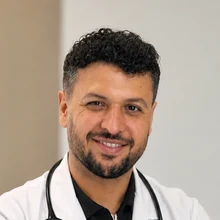
Quick answer
Pure Line operates on one patient per operating day so that hairline design, donor harvesting and graft placement are never decided against another operation's start time; a full FUE case runs six to eight hours. Donor hair is also finite — in a survey of 34 experienced surgeons, estimated lifetime follicular units for a man expected to reach Norwood V ranged from about 4,963 with below-average donor density to 7,904 with above-average density — so a larger graft quote is not automatically the better plan. A one-patient-a-day schedule guarantees no particular result; it removes schedule pressure from the surgical decisions.
When patients first hear that we schedule only one hair transplant a day, some assume our procedures must be unusually slow. Others ask why we do not simply add another room.
The answer is fairly practical. We could increase capacity. I just do not want the schedule influencing decisions I am making about somebody's donor area or hairline.
A donor can turn out to be more difficult than it looked in photographs. Follicular units may behave differently during extraction. The proportion of single-hair grafts may not be what we expected. Occasionally I look at part of a hairline again and decide I want to change it before creating the recipient sites. None of those things should become inconvenient because another patient has already arrived.
I have seen enough working models over the years to know that hair transplantation can be organized much faster and at much higher volume, and that good results come out of those systems too. Pure Line was built differently because this is how I am most comfortable working.
If I can follow one donor area, one hairline and one set of grafts from planning through to the last implant, I see little benefit in splitting that attention across unrelated cases.
What One Patient a Day Actually Changes
A full FUE day at Pure Line usually runs six to eight hours, though it varies with the patient, the graft number, donor characteristics and technical complexity.
Many larger restoration cases land somewhere around 3,500 to 4,000 grafts. I do not treat that as a target range. Some patients need considerably fewer, some suitable cases need more, and starting from a preferred number and making the patient fit it is backwards.
Once extraction begins, the total count is only part of what we are watching. Follicular units differ in how many hairs they contain, in caliber and in structure.
A recent smaller case shows this well. The final count was 2,641 grafts: 615 singles, 1,314 doubles and 712 triples.
For planning the recipient area, that breakdown tells me considerably more than the number 2,641 does on its own. The single-hair grafts matter most around the frontal edge — we generally build the first two or three irregular rows from singles, then introduce suitable multi-hair units further back as visual density increases. The exact distribution shifts from patient to patient, because what we harvest shifts too.
This is why graft assessment takes real time during a procedure. Thousands of follicular units are not identical parts being moved from point A to point B.
We also commonly work around a 0.70 mm punch when the individual follicular anatomy allows it. Smaller is not automatically better; a punch too small for a particular unit raises the risk of damaging it. The aim is an appropriate diameter that preserves as much healthy donor tissue as is reasonable — I have gone through the geometry and the donor consequences in more detail in our piece on FUE white dots and donor-area scarring.
So through a procedure we are tracking several things at once: how cleanly units are coming out, whether the extraction pattern is staying evenly distributed, what proportion of singles and multis we are actually getting, and whether the original recipient plan still makes sense given all of that.
The literature is also clear that graft care does not end when the follicle leaves the scalp. A review of factors affecting graft growth and survival puts the fundamentals plainly: hydration, temperature, time out of body and gentle handling come first, before storage solutions and additives.
That is not an argument for working slowly. It is an argument for a workflow that is efficient without being governed by the start time of another operation.
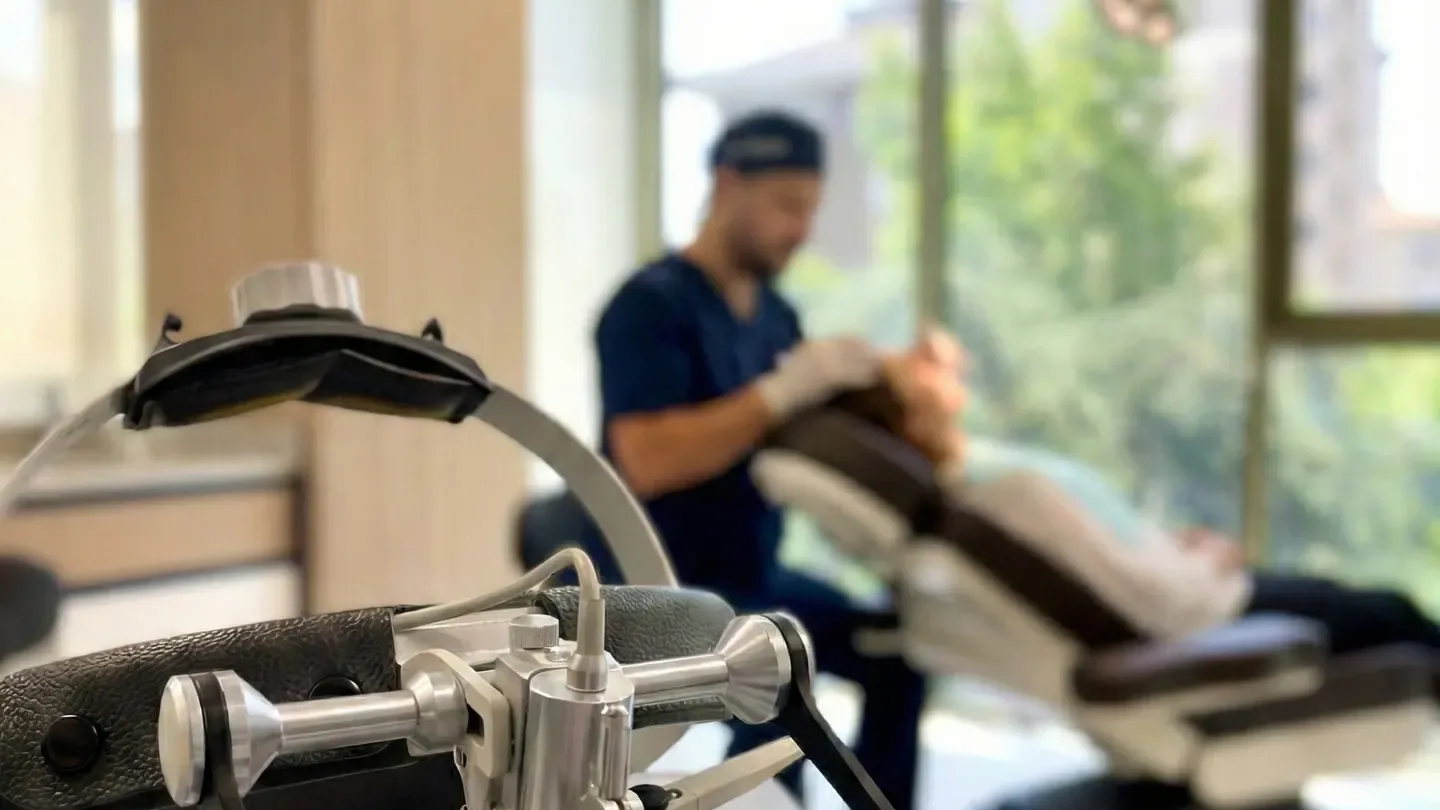
Why Hairline Design Needs This Much Attention
Drawing a hairline is not difficult. Deciding where it belongs is the hard part.
I am looking at age, facial proportions, temporal recession, existing hair direction, donor supply and the pattern the loss may eventually follow. A man in his twenties with active recession asking for a low adolescent hairline needs a different plan from someone in his forties with a stable pattern and a strong donor.
A few millimeters at the front also consume far more donor than patients expect, because lowering the hairline enlarges the whole surface that has to be covered. I have written separately about why I am cautious with aggressive hairline lowering.
The same case can call for different implantation approaches in different areas. After harvesting we commonly create recipient sites with custom-sized metal slit blades; in selected areas we use sharp implanter pens, and the two can be combined in one procedure. Our DHI and FUE article covers the technical distinction, because the terminology gets muddled online.
I am not interested in presenting sapphire, DHI or any other instrument name as the reason a result will be good. With premade sites, what matters is their position, depth, direction, angle and distribution, and how the chosen graft will sit in them. With an implanter, those same decisions still have to be made by the person holding it.
A technique cannot decide whether a 28-year-old's hairline should sit a centimeter lower, or whether the crown is worth spending donor on today. Those are planning decisions.
And I want enough time to make them without mentally moving on to the next face.
Why We Sometimes Recommend Fewer Grafts
Donor hair is finite. That sounds obvious until graft numbers start being compared the way prices are.
A patient gets an estimate of 3,500 from one clinic and 5,000 from another, and naturally assumes the larger number is the better treatment. It may be the opposite.
Overharvesting means taking more follicular units than the donor can reasonably spare, leaving excessive thinning, visible scarring or an irregular, depleted look. Published reviews of FUE complications describe exactly this pattern — the moth-eaten donor area that follows excessive or poorly distributed extraction.
What is genuinely striking is how limited the lifetime supply appears to be when experienced surgeons are asked to estimate it.
Unger, Unger and Wesley surveyed 34 highly experienced hair transplant surgeons, asking them to estimate the permanent follicular units available over a lifetime in hypothetical 30-year-old men with different donor densities and different expected degrees of male pattern baldness.
| Donor density | Expected Norwood V | Expected Norwood VI |
|---|---|---|
| Below average | 4,963 FU | 4,204 FU |
| Average | 6,404 FU | 5,393 FU |
| Above average | 7,904 FU | 6,661 FU |
These are expert estimates from a survey, not measured biological limits, and donor anatomy varies far too much for them to function as a calculator for an individual patient. They are useful for the scale they suggest, not for arithmetic.
Read them that way and the point lands hard enough. If a young man who may eventually reach Norwood V or VI spends 4,500 or 5,000 grafts in his first operation, that single decision can account for a very large share of everything he will ever have available.
Which changes the conversation.
Sometimes the right plan uses fewer grafts. Sometimes I prioritize the frontal area and mid-scalp and leave the crown alone. In a younger patient with active progression, it often makes more sense to stabilize the loss medically and reassess before committing a large part of the donor.
The frustrating consultation is not the one where I say I want to use 3,500 instead of 4,500. The genuinely difficult one is meeting a patient years after an aggressive earlier procedure and finding that the donor needed for a repair, or simply for the hair loss that kept going, has already been spent.
Why We Keep One Consistent Team
The one-patient schedule only helps if the people working around that patient also work together consistently.
Pure Line has used the same core-team model since 2018. We do not answer busy periods by filling extra rooms with temporary outside teams.
That does not mean a hair transplant is a one-person operation. It is not, and the industry sometimes sells an unrealistic image of a single surgeon personally performing every microscopic movement for eight hours.
It depends on a coordinated medical team with clearly defined responsibilities. From a patient's point of view, what matters is knowing who carries responsibility for the medical plan and who will actually be in the room.
Our fixed-team model is built around that continuity. The people handling graft preparation, implantation support, procedure-room organization and patient care are not learning each other's habits on the morning of the operation. Over time small things become easier to notice — the expected rhythm of a day, how grafts are being organized, when something differs from what was anticipated. It does not make mistakes impossible. It removes some unnecessary variation.
There is broader surgical evidence pointing the same way, though I would not pretend operating-room research in other specialties proves anything about a hair transplant model. Verhoeff, Janssen and Hoff found that familiarity between operating-room team members predicted perceived team effectiveness, both directly and through stronger shared mental models, with mutual trust also playing a significant role.
The fatigue literature deserves even more restraint, and I want to represent it accurately rather than conveniently. Reijmerink and colleagues reviewed 134 studies covering more than 1.68 million surgical cases. Among simulator studies, 46% found performance deteriorated with fatigue. Among real-life surgical studies the signal was considerably weaker: 35.5% showed deterioration, and only in 12.5% of all outcome measures.
That paper does not show that somebody's fourth hair transplant of the day will be worse than the first. I am not going to claim it does.
What it supports is the fairly uncontroversial idea that attention and workload are worth considering when a surgical schedule is designed. And for us there is no reason to find out how far that capacity stretches when keeping the schedule smaller is simply an option.
Why We Don't Refer Patients to Other Clinics
This probably explains our attitude to responsibility better than the schedule does.
A large share of our patients travel to Istanbul from abroad. Once somebody is already here for several days, it is common to be asked whether we can recommend a dentist, a rhinoplasty surgeon or another aesthetic clinic. After years working in healthcare in this city, of course we know people in other fields whose work we respect.
We still do not send our patients to them.
A medical recommendation is not the same as telling somebody where to have dinner. An international patient may know very little about the provider being suggested, and may agree largely because they already trust us.
If I make that introduction and the patient later develops a dental complication, or is unhappy after a cosmetic operation, the treatment is outside my field. I may not be qualified to judge whether the problem is an expected part of recovery, a complication, or something avoidable. More to the point, I may not be able to fix it.
Saying that Pure Line did not perform the treatment would be factually correct and would completely ignore why they went there.
Referral arrangements could easily become another revenue stream in medical tourism. We decided not to make them part of Pure Line. Staying inside an area where we can follow the patient, understand the treatment and answer for our own decisions matters more to us than expanding the list of services attached to a trip to Istanbul.
Does One Patient a Day Mean a Better Result?
Not automatically, and I would be careful with anyone who tells you otherwise.
A clinic could treat one person a day and still make poor decisions. Another organization may treat several and produce excellent work. Daily case volume is not a clinical outcome measure.
For us it is a way of removing a variable we do not need. If the donor changes the plan at eleven in the morning, we have the rest of the day to adapt. If I want to redraw a section of hairline, I am not thinking about someone waiting downstairs. If the graft distribution comes out differently from what we expected, it can shape the plan instead of being treated as an inconvenience.
It also protects something that gets easy to forget after years in the field. A hair transplant may be an ordinary Tuesday for us. For the patient it usually followed months of research, an international flight, and handing over a donor area that cannot be restored if it is spent badly.
By the end of six, seven or eight hours in that room, I want to know why we made every decision we made for that person. I do not need the day to contain three more operations for it to feel productive.
The patient will probably never know about most of the small adjustments made during those hours. They do not need to follow the single-graft count, notice a change in extraction strategy, or know that we looked at one section of the hairline twice before continuing.
That work belongs on our side of the procedure. Making room for it is most of the reason the schedule looks the way it does.
Frequently Asked Questions
How many hair transplant patients does Pure Line treat per day?
How long does a hair transplant take at Pure Line?
Why not simply perform more operations per day?
Does Pure Line use DHI or metal slit implantation?
Why is the largest graft number not always the best graft number?
How many grafts can someone have in a lifetime?
What is donor overharvesting?
Does one patient per day guarantee a good result?
— Dr. Mesut Demir
Want an honest read on your case?
Send us photographs of your hairline and donor area along with your age and history. We will tell you what your donor can realistically support, how many grafts we would actually use, and when we would rather you waited.
Request a Case Review- Unger WP, Unger RH, Wesley CK. Estimating the number of lifetime follicular units: a survey and comments of experienced hair transplant surgeons. Dermatologic Surgery. 2013;39(5):755–760. Survey of 34 surgeons. doi:10.1111/dsu.12108
- Parsley WM, Perez-Meza D. Review of factors affecting the growth and survival of follicular grafts. Journal of Cutaneous and Aesthetic Surgery. 2010;3(2):69–75. doi:10.4103/0974-2077.69014
- Reijmerink IM, van der Laan MJ, Wietasch JKG, Hooft L, Cnossen F. Impact of fatigue in surgeons on performance and patient outcome: systematic review. British Journal of Surgery. 2024;111(1):znad397. 134 studies, 1,684,073 surgical cases. doi:10.1093/bjs/znad397
- Verhoeff TL, Janssen JJHM, Hoff RG. Team member familiarity and team effectiveness in the operating room: the mediating effect of mutual trust and shared mental models. Surgery. 2024;176(4):1083–1089. doi:10.1016/j.surg.2024.06.039
- Romera de Blas C, Vega Díez D, Ricart Vayá JM, Gómez Zubiaur A. Complications in follicular unit excision hair transplantation. Frontiers in Medicine. 2026. Overharvesting and moth-eaten donor appearance. doi:10.3389/fmed.2026.1750989
- Garg AK, Garg S. Donor Harvesting: Follicular Unit Excision. Journal of Cutaneous and Aesthetic Surgery. 2018;11(4):195–201. Punch diameter and donor scar volume. doi:10.4103/JCAS.JCAS_123_18
- Hair Transplantation. StatPearls, NCBI Bookshelf. Updated 2025. NBK547740
Note on the lifetime-graft figures. The numbers in the table come from a survey of surgeons' estimates, not from measured donor biology. They are quoted here to show the scale of a lifetime donor supply, and should not be used to calculate what any individual patient can safely have.