
Quick answer
Lowering a male hairline is possible in selected patients, but an aggressively low design enlarges the area that needs coverage, consumes a limited donor supply and can look disconnected if the native hair behind it keeps receding. Age, donor capacity, the current pattern and the likely future pattern should guide the position before any grafts are placed.
One of the most common requests I hear during consultations is:
"Can you bring my hairline a little lower?"
Sometimes the patient means a few millimeters. Sometimes he wants the hairline he had when he was sixteen. And occasionally, a patient will show me a photograph of somebody else and ask for exactly the same design.
I understand the request. A lower hairline can make the forehead appear smaller and may seem more youthful. But in male hair restoration, lower does not automatically mean better.
In fact, placing the hairline too low is one of the easiest ways to create a result that looks good for a few years but becomes difficult to maintain over a lifetime.
When I design a hairline, I am not only thinking about how the patient will look twelve months after surgery. I am also thinking about what may happen if his native hair continues to thin over the next ten, twenty or thirty years.
Hair transplantation is permanent surgery. The design should be able to age with the patient.
Getting that decision right takes time on the day itself, which is one of the reasons we only operate on one patient a day.
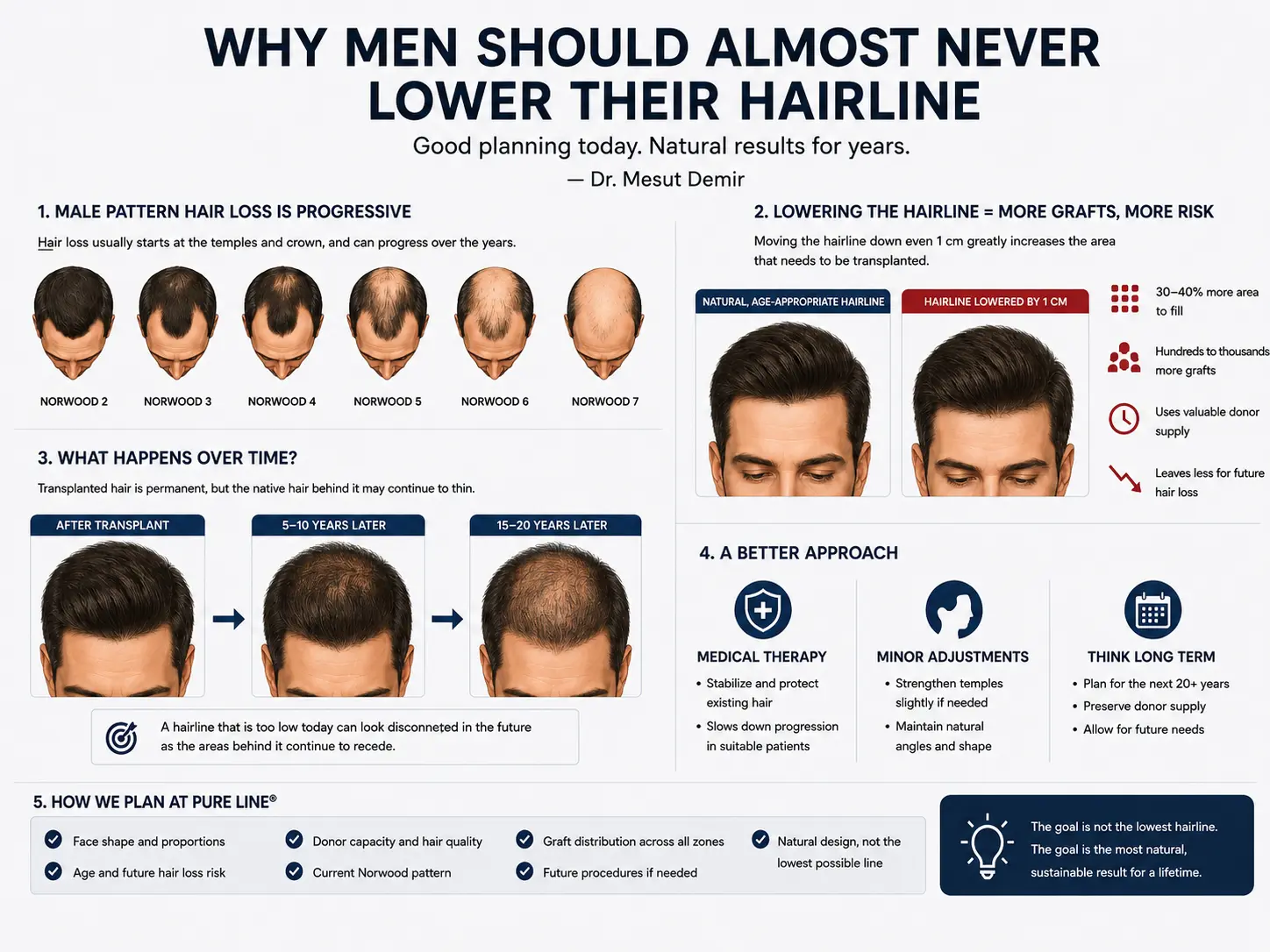
Male pattern hair loss usually keeps moving
The most common cause of hair loss in men is androgenetic alopecia, more commonly known as male pattern hair loss.
It often begins with recession at the temples. The frontal corners move backwards, the central forelock may become thinner, and the crown can gradually lose density. In more advanced cases, the frontal and crown areas eventually connect, leaving only the permanent donor zone around the back and sides.
The Norwood-Hamilton scale is commonly used to describe this progression, from mild temple recession to extensive hair loss across the top of the scalp. We plan every male hair transplant around where the patient sits on it.
The important point is that the pattern we see today may not be the final pattern.
A 22-year-old man may currently have only mild recession. That does not tell us with certainty what his hair will look like at 35 or 45. Family history can offer clues, and scalp examination can reveal miniaturization, but nobody can predict the future with complete accuracy.
This uncertainty is exactly why aggressive hairline lowering can be risky in younger men.
Transplanted hair may remain while the hair behind it disappears
Hair follicles taken from the permanent donor area are generally more resistant to the hormonal process responsible for male pattern hair loss.
However, the patient's existing hair behind the transplant may still continue to thin.
If I create a very low hairline and the native hair behind it later recedes, the patient can be left with a strong band of transplanted hair at the front and a widening area of thinning or bald scalp behind it.
This can produce what patients sometimes describe as an "island" of hair.
Correcting that situation may require another operation. Then perhaps another one several years later. The problem is that every operation uses part of a limited donor supply.
You cannot keep chasing progressive hair loss indefinitely.
The donor area is not an unlimited supply
A common misunderstanding is that we can simply keep taking more grafts whenever new areas become thin.
Unfortunately, the donor area does not work like that.
Every patient has a limited number of follicles that can be removed safely without leaving the back and sides visibly depleted. That number depends on several factors:
- Donor density
- Hair shaft thickness
- Hair color and scalp contrast
- The size of the safe donor zone
- The presence of miniaturization
- Previous surgery
- Hair texture and curl
- The total area that may eventually need coverage
A patient with thick, curly hair and a strong donor area may achieve more visual coverage than somebody with fine, straight hair and lower density. But even the strongest donor area has limits.
When the hairline is placed lower, the area requiring transplantation becomes larger. A difference of only one centimeter across the forehead can require a substantial number of additional grafts if we want the result to look dense and natural.
Those grafts may be needed later for the mid-scalp or crown.
Using too many of them simply to achieve the lowest possible hairline can be a poor long-term trade.
A teenage hairline rarely belongs on an adult man
Natural male hairlines change with age.
Even men who do not develop significant baldness often lose some of the rounded, low hairline they had during adolescence. The temples become slightly more defined and the overall shape matures.
That is normal.
Trying to recreate a teenage hairline on an adult face can make the result look unnatural, particularly as the patient gets older. The problem is not always obvious immediately after surgery. At 25, the design may look acceptable. At 45 or 55, it may look strangely low and disconnected from the patient's facial maturity.
A successful hairline should not only match the face today. It should continue to make sense as the face ages.
This is why I generally prefer a mature, balanced hairline rather than an aggressive one.
Lower is not always younger
Patients often assume that moving the hairline down will automatically make them look younger.
In reality, density, shape and framing usually matter more than simply lowering the central point.
A slightly higher hairline with good density can look far more convincing than a low hairline that appears thin. Strengthening the frontal area and improving the temple transitions can often create a younger and more balanced appearance without moving the entire hairline significantly downward.
The shape of the hairline also matters.
A natural male hairline is not a perfectly straight line drawn across the forehead. It usually rises gently towards the temples and contains small irregularities. The first rows should be soft and irregular, with carefully selected single-hair grafts. Density should build gradually behind them.
When the line is too low, too straight or too symmetrical, it can resemble a wig or a painted border.
The goal is not to create the most hair possible in the lowest position possible. The goal is to make the surgery difficult to detect.
Young patients require more conservative planning
I am especially cautious when a patient is in his late teens or early twenties.
At that age, hair loss may still be actively progressing. A young patient may feel that his current recession is the only area that will ever concern him, but the pattern can change significantly over the following years.
Before recommending surgery, I look at several things:
- When the hair loss started
- How quickly it has progressed
- Whether there is miniaturization behind the hairline
- Whether the crown is beginning to thin
- The patient's family history
- The quality and stability of the donor area
- Whether medical treatment has been considered
- The patient's expectations
- The likelihood of future procedures
Age alone does not decide whether someone is suitable for a transplant. Some younger patients have a stable pattern, realistic expectations and an appropriate donor area.
But a very young patient asking for an unusually low hairline is a situation where I will almost always be conservative.
Being able to perform a procedure does not mean it is the right procedure to perform.
Medical treatment may help us protect the long-term result
In younger patients, or in anyone whose hair loss is still active, medical treatment may be worth discussing before surgery.
Treatments such as finasteride or minoxidil may help some patients slow further loss or maintain existing hair. They do not produce the same result as surgery, and they are not suitable for everyone, but stabilizing the native hair can make long-term surgical planning more predictable.
I do not believe every patient must wait for years before having a transplant. But I do believe we should understand whether the hair loss is stable, progressing slowly or progressing aggressively.
Sometimes the right decision is to begin treatment, monitor the pattern and reconsider surgery after we have more information.
That is not delaying the patient unnecessarily. It is avoiding a permanent decision based on an incomplete picture.
What about lowering only the corners or temples?
There are cases where I may consider a limited adjustment.
Some men have a reasonable central hairline but significant recession at the frontal-temporal corners. This can make the forehead appear wider and create a more advanced pattern than the patient actually has.
In selected patients, carefully strengthening these corners may improve the facial frame without dramatically lowering the entire hairline.
Even then, the design must remain conservative.
Temple work is technically demanding because the hairs in this area are usually fine and emerge at very acute angles. Using thick grafts, placing them too upright or creating an overly sharp corner can make the result obvious.
The objective is not to close every visible gap. It is to restore a natural transition.
Can older men lower their hairline?
Possibly, within reason.
In a man in his late thirties, forties or beyond, we usually have more information about how his hair loss has behaved over time. If his hairline has been stable for many years, his donor area is strong and there are no signs suggesting extensive future loss, a modest reduction may be considered.
However, getting older does not automatically make aggressive lowering safe.
A patient may be 45 and still have progressive thinning. Another may have a strong frontal area but a rapidly weakening crown. The total pattern matters more than the number on his passport.
I would consider limited hairline lowering only when:
- The hair-loss pattern is reasonably stable
- The donor area is strong
- The requested change is modest
- There is enough reserve for possible future loss
- The design remains appropriate for the patient's age
- The patient understands the limitations
Even in ideal cases, I would rather lower the hairline slightly and create strong density than lower it aggressively and struggle to fill the area properly.
What about surgical forehead reduction?
Surgical hairline advancement, sometimes called forehead reduction, is different from hair transplantation.
During this procedure, a strip of forehead skin is removed and the hair-bearing scalp is advanced forward. It can produce an immediate reduction in forehead height, but it also leaves a scar along the hairline.
In carefully selected patients, particularly women with a naturally high and stable hairline, the procedure can be effective.
In men, I am much more cautious.
If male pattern hair loss develops or progresses after the surgery, the hairline may recede away from the scar and make it visible. Covering that scar later can be difficult, particularly if the donor reserve has also become limited.
For that reason, surgical advancement in men should only be considered in unusual cases where the risk of future recession appears very low.
It is not a routine solution for a young man who simply wants a smaller forehead.
Why not use beard or body hair later?
Patients sometimes ask whether beard or body hair can be used if the scalp donor supply runs out.
These follicles can be useful in selected repair or advanced cases. Beard hair, in particular, may provide additional density because it is often thick.
However, it does not behave exactly like scalp hair.
The texture, growth cycle, curl and appearance may be different. Beard hair is generally more suitable for adding support within the mid-scalp or crown than for creating a soft frontal hairline.
Body hair is usually even less predictable.
These grafts can expand our options, but they should not be treated as an excuse to waste the scalp donor area during the first operation.
Good planning begins by protecting the best donor source.
How I design a male hairline
At Pure Line, I do not decide the hairline by using a fixed number of fingers above the eyebrows or by copying a photograph.
Those methods ignore individual anatomy.
When I plan a hairline, I consider:
- The patient's facial proportions
- Forehead height and shape
- The position of the frontal muscles
- Existing hairline remnants
- Temple recession
- Age and expected aging
- Current Norwood pattern
- Miniaturization in the frontal and mid-scalp areas
- Donor capacity
- Hair caliber and texture
- The number of areas requiring coverage
- The possibility of future hair loss
The hairline is then designed in relation to the entire scalp.
If the patient has extensive crown loss and a limited donor area, it may not make sense to spend thousands of grafts lowering the front. If the crown is stable and the donor is excellent, we may have more flexibility.
The plan must belong to that patient. Not to a celebrity, not to a clinic advertisement and not to an edited photograph.
Why I sometimes refuse the hairline a patient asks for
Patients are naturally focused on the feature that bothers them today.
My responsibility is to consider what they may need later.
There are times when a patient asks for a hairline that I could technically create, but I do not believe it would be responsible to do so. In those situations, I explain why I recommend a higher or more conservative position.
This is not because I want to give the patient less.
It is because lowering the line too far may reduce density, consume donor grafts and make future hair loss much harder to manage.
Hair restoration should not be planned as a single photograph taken one year after surgery. It should be planned as a result the patient can live with for decades.
Sometimes the most ethical surgical decision is to say no.
Frequently Asked Questions
Can a male hairline be lowered with a hair transplant?
How much can a hairline be lowered?
Is a lower hairline always more attractive?
Can a 20-year-old have a hair transplant?
Will the hair behind a transplant continue to fall out?
Can I have another transplant if my hair loss continues?
Is beard hair a substitute for scalp donor hair?
— Dr. Mesut Demir
Not sure what your hairline should look like?
Share your photos and hair loss history. We will give you an honest, individual assessment — not a copy of someone else's result.
Request a Case Review