Quick answer
A well-planned hair transplant can last for decades, and many follicles taken from a stable donor area may continue growing for life. Dr. Mesut Demir is still careful with the word permanent, because patients often mean something more absolute by it: that every transplanted hair is guaranteed to remain unchanged and that the result will look the same at 50 as it did at 30. Long-term evidence supports durability but also shows that density can change. A 2023 retrospective study of 70 patients at least 10 years after surgery found most remained highly satisfied alongside measurable density change, and in advanced hair loss a series of 820 men found 94% satisfied at 12 months while 62% chose a second session. Native hair around the transplant can keep miniaturizing, donor stability varies between patients, and a transplant does not stop androgenetic alopecia in the hair it did not move.
A well-planned hair transplant can last for decades, and many follicles taken from a stable donor area may continue growing for life. I would still be careful with the word permanent, because patients often use it to mean something more absolute: that every transplanted hair is guaranteed to remain unchanged and that the overall result will look the same at 50 as it did at 30.
Those are different questions.
Long-term evidence supports the durability of hair transplantation, but it also shows that density can change. Native hair around the transplant may continue to miniaturize, donor hair is not equally stable in every patient, and some people eventually choose another procedure despite being satisfied with their first one.
A 2023 retrospective study evaluated 70 patients with androgenetic alopecia at least 10 years after hair transplantation. Most remained highly satisfied, but the investigators also found measurable changes in hair density over time.
That is close to how I explain it in consultation. Hair transplantation can age extremely well, but the operation does not stop the scalp itself from aging or prevent untreated androgenetic alopecia from progressing.
Why transplanted hair can last so long
Modern hair transplantation is built around the principle of donor dominance, first described by Norman Orentreich in 1959.
In androgenetic alopecia, follicles through the frontal scalp, mid-scalp, and crown are genetically more susceptible to progressive miniaturization under androgen influence. Follicles around the back and sides of the scalp are generally much more resistant. When one of these follicles is moved into a thinning area, it usually retains much of the biological behavior of the donor site rather than beginning to behave like the follicle that originally occupied the recipient area.
Orentreich later reported long-term observations from several thousand grafts, with transplanted hair continuing to grow over periods extending to approximately 15 years. Other observations have shown that donor characteristics can remain surprisingly specific after transplantation. Dinh, Sinclair, and Martinick, for example, described transplanted follicles retaining donor-site pigmentation after being moved into graying recipient scalp, including one case in which the difference remained visible after 10 years.
So donor dominance is not the questionable part of the “permanent hair transplant” claim. The problem begins when relative resistance is interpreted as absolute immunity, regardless of the patient’s donor pattern, future hair loss, aging, or the quality of the original donor selection.
What does “permanent” actually mean?
When a patient asks whether a hair transplant is permanent, I usually separate the question into three parts.
The first is whether properly transplanted follicles can establish themselves and grow after surgery. In a suitable patient, with careful extraction, graft handling, placement, and postoperative care, this is generally predictable.
The second is whether those follicles can continue growing for many years. Again, the answer is yes. Long-term clinical experience and the available evidence support that.
The third question is the one that matters most when we are talking about 10, 20, or 30 years: will the patient’s overall hair still look exactly the same?
That cannot be promised.
A transplanted hairline might remain strong while the native hair directly behind it becomes progressively thinner. Hair caliber can change with age. Parts of the donor may prove less stable than expected. Even when the transplanted follicles continue growing, the visual relationship between those grafts and the rest of the scalp can change considerably.
What does the long-term evidence actually show?
There are fewer long-term studies than you might expect considering how confidently the word “permanent” is used in hair transplant advertising. The evidence we do have is useful, provided that the limitations of each study travel with the numbers rather than being quietly separated from them.
| Study | Patients | Follow-up | Main finding | What I take from it |
|---|---|---|---|---|
| Orentreich, 1970 | Several thousand graft observations | Up to ~15 years | Sustained long-term growth was observed in transplanted scalp hair | Strong historical evidence for donor dominance and long-term survival |
| Pathomvanich & Mella, 2023 | 70 patients with androgenetic alopecia | ≥10 years | Most patients remained highly satisfied; long-term density assessment still showed measurable change | Hair transplantation can remain successful for a decade or longer without remaining literally unchanged |
| Kumaresan & Subburathinam, 2020 | 112 men with Norwood IV–VI androgenetic alopecia | 4 years | Only 8.92% were graded as having no visible density change compared with the 1-year result; the remainder had slight, moderate, or greater photographic density reduction | This does not mean 91.08% of grafts died. It shows that visible transplanted-area density can change after the first year, and that photographic density is not the same as individual graft survival |
| Chouhan et al., 2019 | 820 men with Norwood V–VII hair loss | 12–24 months | 94% were satisfied at 12 months, while 62% chose another session for additional coverage or density | A patient can be satisfied with a successful first transplant and still benefit from a second procedure |
| Vañó-Galván et al., 2019 | 51 patients with frontal fibrosing alopecia | Up to 5+ years | Mean graft survival was approximately 87% at year 1, 71% at year 2, 60% at year 3, and 41% at year 5 | Diagnosis can radically change long-term graft behavior. These FFA figures must not be applied to ordinary androgenetic alopecia |
The Kumaresan study is a good example of why the number and its limitation should be presented together. The investigators compared standardized photographs from one year and four years after FUT and used a blinded observer to grade changes in visible density. Only 8.92% of the 112 patients were graded as having no change, while the others showed varying degrees of photographic density reduction.
It would be completely inappropriate to turn that into a statement such as “91% of transplanted grafts eventually fail.” The study did not count the survival of every follicular unit, and a photograph cannot reliably separate loss of a transplanted shaft from changes in caliber, hair cycling, recipient characteristics, surrounding native hair, styling, or other factors. What it does tell us is that the result visible at one year should not automatically be treated as a biological endpoint that will remain frozen thereafter.
The 10-year study gives us a more reassuring perspective. Most patients remained highly satisfied a decade or more after transplantation. I think those two findings belong in the same conversation: a transplant can remain very successful over the long term even if measurable density or the overall cosmetic picture changes with time.
“My hair transplant fell out.”
I occasionally see patients who had surgery years earlier somewhere else and come for an assessment convinced that their transplant has disappeared. Once we examine the scalp carefully, the situation can look quite different from what they expected.
The frontal hairline may still be clearly present, with reasonably strong transplanted hair. What has changed is the native hair immediately behind it. The frontal zone or mid-scalp has continued to miniaturize, so an area that once looked connected and dense now shows considerably more scalp.
To the patient, the transplant looks thinner. Clinically, many of the grafts they are worried about may still be there.
Older photographs are particularly useful in these cases. A patient may bring a photograph from around the time of a transplant 10 or 15 years ago, sometimes together with images taken during the first year. Comparing those images with the scalp in front of me today can show whether the transplanted hairline has actually weakened or whether the major change has occurred in the native hair behind it.
That distinction is important because the next step may be completely different. Someone who has lost native mid-scalp density may need progression management or selective additional transplantation rather than a “repair” of a hairline that is still functioning well.
What can a hair transplant look like after 10 years?
In a well-selected patient, it can still look excellent.
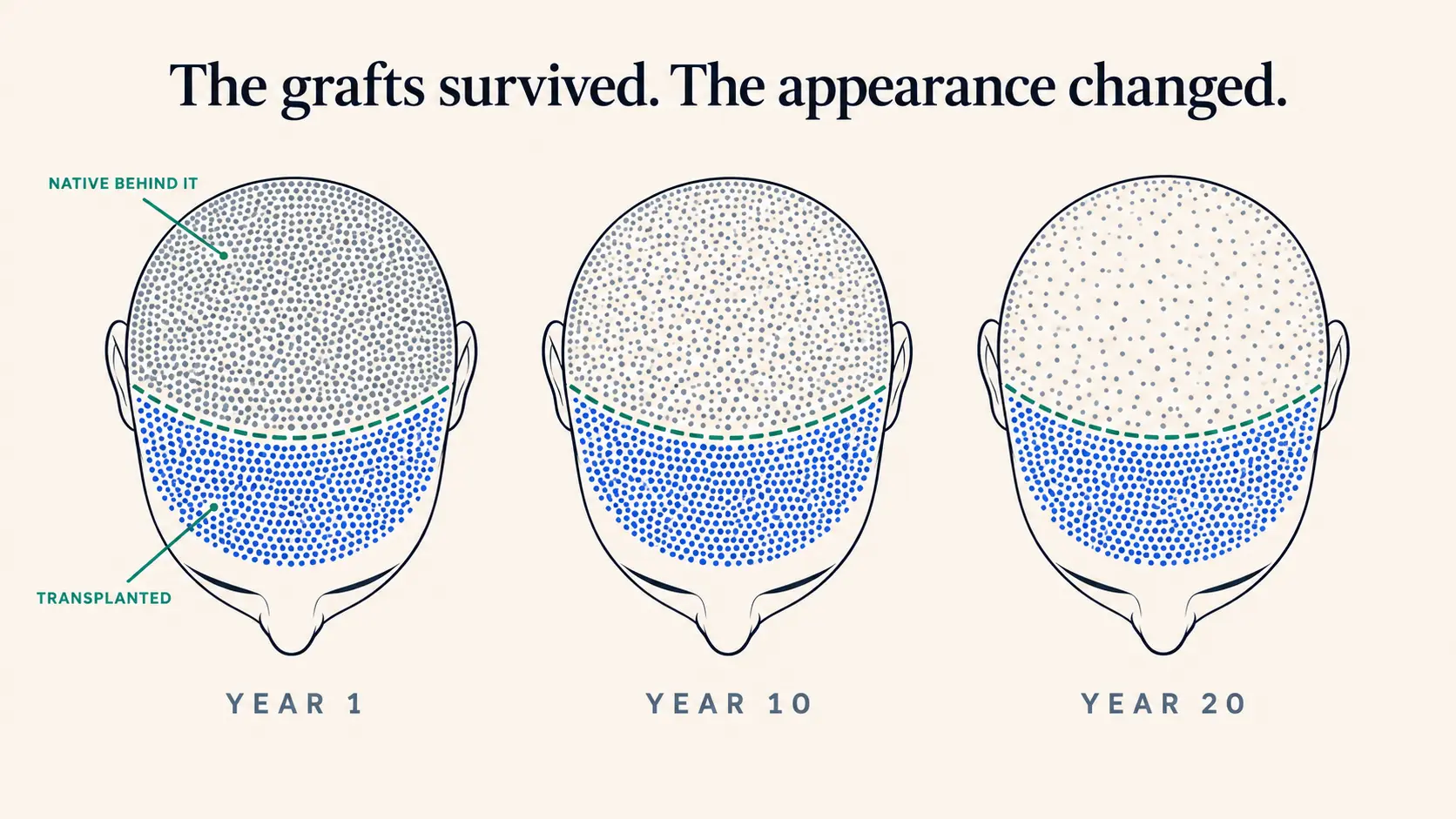
Consider someone who had the frontal third transplanted at 35. At 45, the transplanted hairline may still give strong facial framing. If the native hair behind it has remained reasonably stable, the overall result may continue to look very similar.
If that native mid-scalp has continued to miniaturize, the situation changes. The transplanted front can remain intact while density behind it slowly decreases, making the entire result look weaker even though the original operation has not simply “fallen out.”
This is also why the discussion about long-term medical management is relevant after surgery. In many patients, preserving existing native hair is as important to the future appearance of the transplant as protecting the transplanted area itself.
What about 20 or 30 years after a hair transplant?
This is where I become more cautious, because the evidence becomes much thinner.
Historical experience shows that transplanted hair can remain for decades, and modern data beyond 10 years are reassuring. What we do not have is a modern FUE dataset that allows me to tell a 28-year-old exactly what percentage of his grafts will still be present at 58.
A sensible long-term strategy therefore has to be built around uncertainty. Before the first operation, I want to understand how far the patient’s hair loss may progress, how stable the donor appears, whether the proposed hairline will still suit an older face, how much donor supply we are using today, and what will remain available if the pattern progresses.
This is particularly important in younger patients. A 24-year-old and a 45-year-old can both present as Norwood III, but the younger patient has far more unanswered questions about his eventual pattern.
Hair transplantation is surgery performed today on tissue that will continue changing for decades. Long-term planning is essentially an attempt to make today’s operation remain aesthetically logical as those changes happen.
The safe donor area is not an invisible force field
Standard diagrams make the donor area look wonderfully tidy: a horseshoe-shaped band survives, the top is vulnerable, and the border between them appears obvious.
Actual donor areas are less obedient.
Hair transplant practice guidelines recommend evaluating the proposed donor region for density, hair caliber, miniaturization, retrograde alopecia, and other signs of instability. They also emphasize that a single safe-donor template should not be applied identically to every patient.
A study of 580 men undergoing FUE similarly emphasized the difficulty of defining an absolutely permanent donor zone using one fixed geometric pattern.
This means that when I assess a donor, I am not simply checking whether there is hair at the back of the head. I am trying to estimate which portion of that hair has the greatest probability of remaining stable over the patient’s lifetime. Age, family history, current pattern, hair caliber, miniaturization, previous surgery, and the likely future progression of hair loss all influence that judgment.
Retrograde alopecia and the lower donor border
Retrograde alopecia is particularly relevant because it affects an area that can easily be mistaken for safe donor hair if the examination is rushed.
In this pattern, thinning develops through the lower occipital scalp and often around the regions above the ears. The lower edge of what once appeared to be a dense donor gradually moves upward or shows increasing miniaturization.
If a large number of grafts are extracted from an area that is already becoming thinner, the remaining donor can become cosmetically weak. There is also less confidence that follicles taken from that unstable lower margin will behave like follicles harvested from the strongest central donor region.
Hair transplant guidelines specifically recommend identifying and documenting retrograde alopecia before surgery. This is one reason I do not consider a wider harvesting area automatically better. Expanding the extraction zone may increase the graft count available on the day of surgery, but it can also move harvesting into tissue with less predictable long-term stability.
Miniaturization can exist inside a donor that still looks healthy
Donor instability does not always present as an obvious bald patch.
Hair grows in natural follicular units containing one, two, three, and occasionally four hairs. Imagine a three-hair follicular unit in an area that looks clinically dense. At one point, all three shafts may be strong. Several years later, two can remain robust while the third has become noticeably finer.
The follicular unit is still present, so a simple count of follicular units would not show that anything has disappeared. Its cosmetic contribution, however, is already lower because one of its hairs has miniaturized.
If another shaft becomes finer later, the visual density decreases further even though the entire follicular unit was never suddenly lost. This gradual change is one reason patients can compare old photographs and feel that an area has become significantly thinner without seeing a completely bald patch.
For long-term planning, hair caliber and miniaturization matter alongside follicular-unit count.
Does FUE make transplanted hair permanent?
FUE is the method used to extract follicular units; it does not alter the genetics of the follicles being extracted.
A stable follicle harvested by FUE can be extremely durable. If a follicle comes from a questionable or miniaturizing donor region, changing the punch, motor, or extraction device does not make that follicle biologically more stable.
This is why donor selection comes before extraction technology in my planning. FUE can be an excellent technique, but the acronym itself tells you how a graft was removed, not whether that graft was a good long-term choice.
The donor area is a lifetime resource
Every scalp contains a limited number of follicular units that can be removed without creating cosmetically obvious thinning in the donor. Once a graft is moved to the recipient area, the donor does not manufacture a replacement follicular unit.
This becomes very clear when I evaluate someone who has already had a large transplant elsewhere. A patient may tell me that approximately 4,500 grafts were extracted in one procedure, but the number itself is only the beginning of the assessment.
I want to see how the extractions were distributed, whether harvesting remained inside a stable region, how much density is left, whether there is patchiness, how short the patient can wear the back and sides, and whether enough donor remains if further surgery is ever needed.
Two patients can both have “4,500 grafts” written in their history and have completely different donors. One may still have an evenly distributed, reasonably dense donor with useful reserve. Another can show obvious depletion or extraction marks that become difficult to camouflage when the hair is cut short.
A strong hairline may photograph beautifully after the first procedure, but long-term donor management determines how many sensible options remain afterward. This is why I would rather use a smaller number of well-selected grafts efficiently than increase the count simply because the larger number sounds more impressive.
Why a second transplant does not necessarily mean the first one failed
Some of the most straightforward second-surgery consultations begin with a patient telling me that he is actually very happy with his first transplant.
The frontal result may still be strong. He may simply have lost additional native hair behind it, or the original operation may have deliberately prioritized the hairline and frontal zone while leaving the crown lighter to preserve donor supply.
In that situation, the second operation is not necessarily a repair. It can simply be the next stage of a plan responding to progressive hair loss.
Chouhan and colleagues reviewed 820 men with advanced Norwood V–VII hair loss treated with FUE. At 12 months, 94% reported being satisfied, yet approximately 62% chose a second sitting to increase coverage or density.
This is particularly easy to understand in advanced hair loss. The recipient area can be very large, while the usable donor remains limited. The crown makes the equation even more demanding because a wide circular area can consume large numbers of grafts without producing the same visual framing effect as the frontal third.
For some patients, it is more responsible to establish a strong front, use the remaining grafts selectively through the mid-scalp or crown, and preserve future options rather than trying to cover every visible area in one operation.
Younger patients need a different type of planning
A 22-year-old patient can have an excellent donor and a relatively small amount of frontal recession, making the operation look easy if today’s appearance is the only thing being considered.
The problem is that I know much less about what his scalp will look like at 42.
If I place an extremely low juvenile hairline and use a large proportion of his donor while his final pattern is still uncertain, the transplanted front may survive well while the native hair behind it continues toward an advanced Norwood pattern. The operation can therefore remain technically successful while becoming increasingly difficult to integrate aesthetically with the rest of the scalp.
That is why age, progression, family history, donor miniaturization, and future donor demand matter so much in younger patients. Hair transplant guidelines also advise caution with early surgery because androgenetic alopecia is progressive and future loss may undermine an initially attractive result.
I do not need to predict a 22-year-old patient’s exact Norwood stage at 60. I do need to avoid designing an operation that only makes sense if his hair loss stops immediately after surgery.
Can the donor area itself look worse years later?
FUE does not produce a linear strip scar, but it is not a scarless procedure. Each extraction leaves a small circular wound, and small hypopigmented extraction marks or “white dots” can sometimes become visible, particularly with very short hairstyles.
Their appearance depends on factors such as punch diameter, extraction density, distribution, the patient’s original donor density, skin-to-hair contrast, and individual healing.
Long-term donor thinning introduces another variable. A donor may look excellent when the surrounding hair is thick enough to camouflage the extraction sites. Years later, age-related changes, retrograde thinning, or further donor miniaturization can reduce that coverage and make previously inconspicuous marks easier to see.
In other words, the long-term result of a hair transplant includes the back of the scalp as well as the front.
What if the scalp donor is no longer enough?
In advanced hair loss or after previous surgery, additional donor sources can sometimes be considered. The beard is usually the most useful secondary source, while chest and other body hair can have a role in selected cases.
Published reviews describe body-hair transplantation as an adjunct when scalp donor supply is inadequate, particularly in advanced alopecia or repair work. The limitation is that beard and body hair retain characteristics that differ from scalp hair, including caliber, texture, curl, and growth-cycle behavior.
For example, coarse beard grafts can be useful for adding visual bulk deeper within the mid-scalp or crown, but I would generally not want those same hairs creating the fine leading edge of a natural frontal hairline.
Body hair can extend the available donor strategy in selected patients. It does not make poor scalp donor management harmless.
Women require a different donor assessment
The idea of a permanently stable donor can be more complicated in women because diffuse miniaturization is more common.
Some women have clearly stable donor hair and localized loss, making transplantation in women relatively predictable. A naturally high hairline or a stable localized area of thinning, for example, is very different from diffuse female-pattern hair loss extending through both the recipient and donor regions.
Hair transplant guidelines therefore recommend evaluating women carefully for miniaturization throughout the proposed donor as well as the recipient area.
A particularly important diagnosis is diffuse unpatterned alopecia (DUPA). Here, miniaturization extends into the temporal, parietal, and occipital scalp rather than leaving a dependable donor reservoir. True’s review of surgical candidacy describes DUPA as a contraindication to conventional transplantation because the donor itself may be unstable.
Moving vulnerable follicles from one thinning area into another does not correct that underlying problem.
Diagnosis can matter more than technique
Scarring alopecia provides a useful demonstration of how strongly diagnosis can affect graft longevity.
A multicenter study of 51 patients with frontal fibrosing alopecia reported mean transplanted-graft survival of approximately 87% at one year, 71% at two years, 60% at three years, and 41% at five years.
Those figures should never be presented as expected survival rates for an ordinary patient with androgenetic alopecia. FFA is a separate inflammatory scarring disease with a very different biological environment, which is exactly why I included the distinction in the evidence table rather than leaving the warning several sections away from the numbers.
The practical lesson is that a technically competent transplant cannot compensate for an incorrect diagnosis. Unusual redness, perifollicular scale, burning, loss of follicular openings, rapid diffuse thinning, or another atypical pattern deserves investigation before elective surgery.
What role do finasteride and minoxidil play after a transplant?
Hair transplantation redistributes follicles but does not stop androgenetic alopecia in the susceptible native hair that remains.
This is why medical treatment may have an important role in selected patients.
A randomized, double-blind, placebo-controlled study evaluated 79 men receiving finasteride around hair transplantation. At 48 weeks, improvement in the surrounding non-transplanted superior/frontal scalp hair was reported more frequently in the finasteride group than in the placebo group.
The key point is that the study primarily supports protection of non-transplanted hair around the procedure. I would not use it to claim that finasteride somehow guarantees the permanent survival of every transplanted follicle.
Preserving native hair can still make an enormous difference to how the transplant looks years later because those native and transplanted hairs are visually working together.
Minoxidil has a different mechanism and may also benefit responsive follicles. Neither medication should be treated as an automatic requirement for every transplant patient. The diagnosis, potential benefit, adverse effects, and patient’s priorities should be assessed individually.
What about testosterone, TRT, and anabolic steroids?
In someone who is genetically susceptible to androgenetic alopecia, increased androgen exposure can accelerate the loss of vulnerable native hair.
That does not mean a stable transplanted donor follicle suddenly becomes identical to a susceptible frontal follicle. The larger long-term concern is often progression of the patient’s remaining hair and the additional donor demand that progression may create.
If a patient’s hair loss accelerates after beginning testosterone therapy or using anabolic steroids, I may need to plan surgery more conservatively, reconsider the timing of the procedure, or preserve more donor capacity for the future.
Can transplanted hair itself become thinner?
It can, although several different mechanisms can produce the same appearance.
A follicle may have been harvested from a less stable donor region. Miniaturization may already have been present within the donor. Hair caliber can change with aging. Native hair surrounding the transplant can thin, increasing scalp visibility. Hair-cycle variation may also affect how dense an area appears at a particular moment.
The 10-year and four-year studies are part of the reason I avoid describing every transplanted follicle as biologically guaranteed for life. At the same time, those studies do not support the opposite claim that hair transplants routinely “wear out.”
For a correctly selected patient with a stable donor and a sensible long-term plan, hair transplantation remains one of the most durable ways to restore coverage in androgenetic alopecia.
How I assess whether a transplant is likely to age well
When I assess a patient at Pure Line, I am not only measuring the area that they want filled. I am trying to understand the relationship between the hair they currently have, the hair they may lose in the future, and the donor supply available to respond to that loss.
That means considering the current pattern, age, rate of progression, older photographs when available, family history, donor density, hair caliber, follicular-unit composition, donor miniaturization, retrograde thinning, scalp health, previous surgery, extraction distribution, expected recipient demand, and remaining donor reserve.
The relative importance of those factors changes from patient to patient. In a younger patient, uncertainty about progression may dominate the discussion. In a woman with diffuse loss, donor stability can become the central issue. In advanced Norwood patterns, prioritization and donor economy are often more important than trying to achieve uniform density everywhere.
Can a hair transplant be guaranteed for life?
I would not give that guarantee.
I can explain why donor hair is generally resistant to androgenetic alopecia, assess whether the proposed donor appears stable, avoid questionable harvesting zones, design a conservative hairline, preserve future options, and discuss what long-term studies actually show.
What I cannot do is know with certainty how every follicle on a patient’s scalp will behave over the next 30 or 40 years.
My aim is therefore not to promise that the scalp will remain frozen in time. It is to perform a transplant that is technically sound now, uses the donor responsibly, and is still likely to make cosmetic sense if the patient’s hair loss progresses later.
The bottom line
Hair transplantation works because follicles taken from a relatively stable donor area usually retain the biological characteristics that allowed them to survive there in the first place. That principle is well established, and transplanted hair can remain for decades.
Long-term evidence nevertheless shows why the word “permanent” needs some qualification. A 10-year retrospective series found high patient satisfaction alongside measurable density changes. In a four-year photographic follow-up study, only 8.92% of patients were graded as having no density change compared with year one, although that result cannot be interpreted as evidence that the remaining patients lost their grafts. In advanced hair loss, another large series found that 62% of patients chose a second procedure despite 94% reporting satisfaction at 12 months.
For me, those findings lead back to the same planning question. Instead of asking only how many grafts can be transplanted today, I want to know how those grafts can be used so that the patient’s donor, hairline, and remaining native hair still make sense years later.
Hair loss is a long-term condition. A good transplant should be planned with the same time frame in mind.
Frequently Asked Questions
Is a hair transplant permanent?
How long does a hair transplant last?
What does a hair transplant look like after 10 years?
Can transplanted hair fall out after 10 or 20 years?
Does FUE last forever?
Can I lose the natural hair behind my transplant?
Will I need a second hair transplant?
Does needing a second procedure mean my first transplant failed?
Does finasteride make transplanted hair permanent?
Can donor hair become thinner?
Can FUE scars become more visible with age?
Can beard hair be used if my scalp donor is limited?
Are hair transplants permanent in women?
Written by Dr. Mesut Demir, M.D. — Co-Founder & Medical Director, Pure Line
Planning a transplant that still makes sense in 20 years?
Send photographs of the front, top, crown and donor area. Dr. Mesut Demir will assess donor stability, likely progression and how much reserve a sensible plan should keep in hand.
Request a case review- Orentreich N. Autografts in alopecias and other selected dermatological conditions. Annals of the New York Academy of Sciences. 1959;83:463–479. doi:10.1111/j.1749-6632.1960.tb40920.x
- Orentreich N. Hair transplants: long-term results and new advances. Archives of Otolaryngology. 1970;92(6):576–582. doi:10.1001/archotol.1970.04310060048010
- Pathomvanich D, Mella CA. A ten-year retrospective analysis on the long-term survival of hair transplants. Hair Transplant Forum International. 2023;33(5):157–165. doi:10.33589/33.5.157
- Kumaresan M, Subburathinam DM. Longevity of hair follicles after follicular unit transplant surgery. Journal of Cutaneous and Aesthetic Surgery. 2020;13(4):292–297. doi:10.4103/JCAS.JCAS_44_20
- Chouhan K, Roga G, Kumar A, Gupta J. Approach to hair transplantation in advanced grade baldness by follicular unit extraction: a retrospective analysis of 820 cases. Journal of Cutaneous and Aesthetic Surgery. 2019;12(4):215–222. doi:10.4103/JCAS.JCAS_173_18
- Mysore V, Kumaresan M, Garg A, et al. Hair transplant practice guidelines. Journal of Cutaneous and Aesthetic Surgery. 2021;14(3):265–284. doi:10.4103/JCAS.JCAS_104_20
- Chouhan K, Kota RS, Kumar A, Gupta J. Assessment of safe donor zone of scalp and beard for follicular unit extraction in Indian men: a study of 580 cases. Journal of Cutaneous and Aesthetic Surgery. 2019;12(1):31–35. doi:10.4103/JCAS.JCAS_142_18
- True RH. Is every patient of hair loss a candidate for hair transplant? Deciding surgical candidacy in pattern hair loss. Indian Journal of Plastic Surgery. 2021;54(4):435–440. doi:10.1055/s-0041-1739247
- Leavitt M, Perez-Meza D, Rao NA, Barusco M, Kaufman KD, Ziering C. Effects of finasteride (1 mg) on hair transplant. Dermatologic Surgery. 2005;31(10):1268–1276. doi:10.1111/j.1524-4725.2005.31202
- Avram MR, Rogers N, Watkins S. Side-effects from follicular unit extraction in hair transplantation. Journal of Cutaneous and Aesthetic Surgery. 2014;7(3):177–179. doi:10.4103/0974-2077.146681
- Saxena K, Savant SS. Body to scalp: evolving trends in body hair transplantation. Indian Dermatology Online Journal. 2017;8(3):167–175. doi:10.4103/idoj.IDOJ_283_16
- Vañó-Galván S, Villodres E, Pigem R, et al. Hair transplant in frontal fibrosing alopecia: a multicenter review of 51 patients. Journal of the American Academy of Dermatology. 2019;81(3):865–866. doi:10.1016/j.jaad.2019.05.031
- Dinh HV, Sinclair RD, Martinick J. Donor site dominance in action: transplanted hairs retain their original pigmentation long term. Dermatologic Surgery. 2008;34(8):1108–1111. doi:10.1111/j.1524-4725.2008.34228.x