Quick answer
Hair transplants can fail because the wrong patient was selected, the underlying hair loss was not adequately understood or stabilized, the operation was poorly designed, the donor area was overharvested, grafts were damaged during extraction or implantation, density was planned incorrectly, or postoperative healing and complications were not managed appropriately. Some of these problems affect graft survival. Others leave healthy, growing hairs in a result that still looks wrong or has consumed too much of a limited donor supply.
A hair transplant is usually described as a failure when the transplanted hair does not grow. In clinical practice, that is only one type of failure.
A procedure may produce reasonable graft growth and still leave a patient with an overharvested donor area, poor density distribution, an unnatural result, or a design that becomes difficult to maintain as the surrounding native hair continues to thin. In other cases, the technical execution may have been acceptable, but the patient was not an appropriate candidate for surgery in the first place.
For that reason, I do not judge a transplant only by the percentage of transplanted follicles that grow. A successful result should preserve the donor, look natural, use the available grafts intelligently, and remain sensible as the patient's hair loss changes over time.
Modern hair transplantation is generally safe. A scoping review of 43 publications found overall complication rates of 1.2% and 4.7% in two large clinical series, with serious complications uncommon in experienced hands.[1,2] Those numbers, however, do not capture every form of an unsatisfactory outcome. Poor planning and progressive hair loss may produce disappointment without technically qualifying as a surgical complication.
What does a failed hair transplant actually mean?
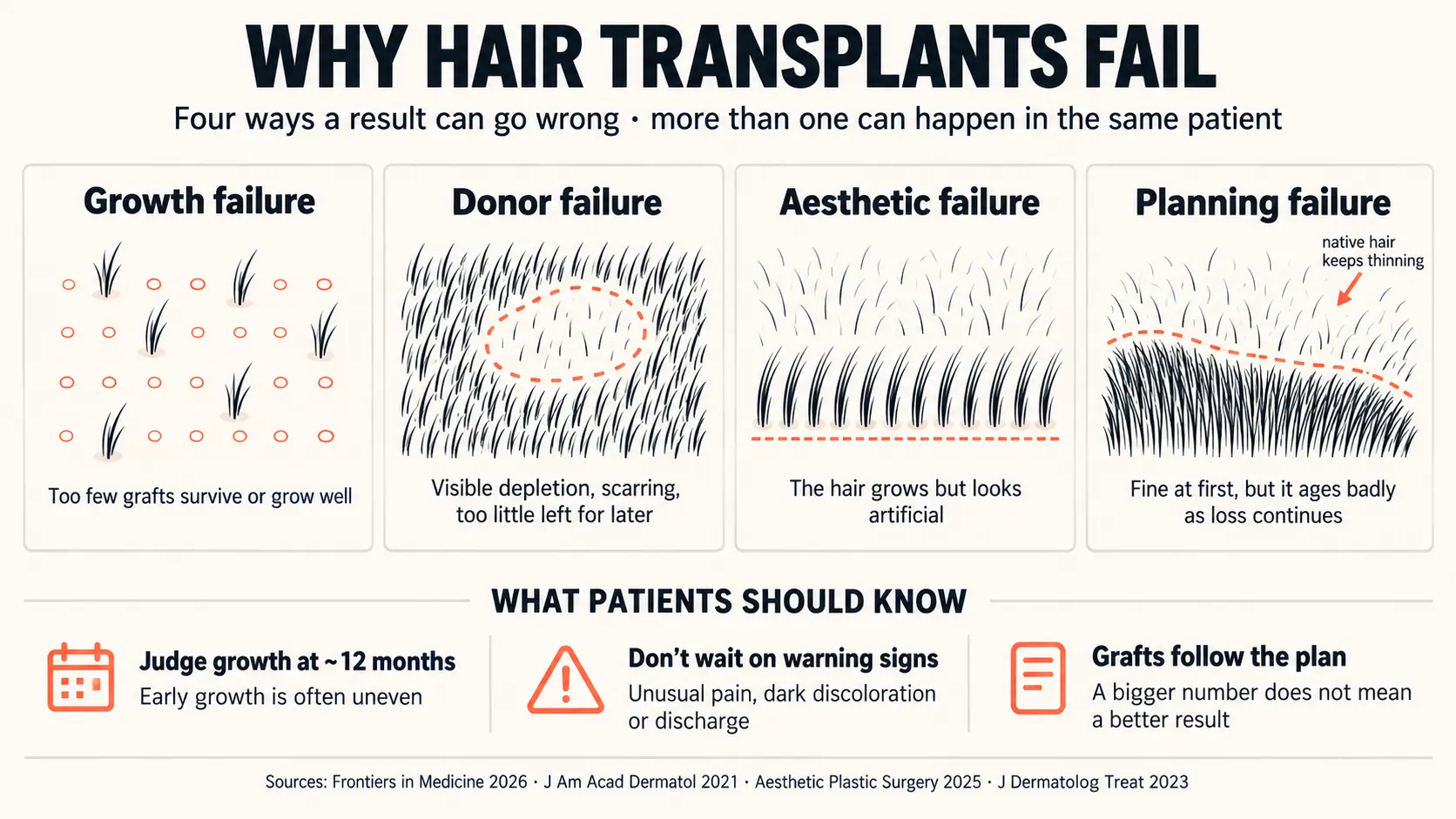
I divide poor outcomes into four broad categories because they require different explanations and often different solutions.
| Type of failure | What it means |
|---|---|
| Growth failure | Too few transplanted follicles survive or produce satisfactory growth. |
| Donor failure | Extraction leaves visible depletion, scarring, or too little donor capacity for future surgery. |
| Aesthetic failure | The hairs grow but the hairline, angles, direction, or density look artificial. |
| Planning failure | The immediate result may look acceptable, but the plan does not age well as native hair loss progresses. |
More than one category can occur in the same patient.
A patient may therefore have good frontal growth but gradually lose the miniaturized native hair immediately behind the transplant. Another may have excellent recipient density but an obviously depleted donor area. Neither should be considered a fully successful result simply because transplanted hairs are visible.
This is also why I see donor preservation as part of the final result. Hair transplantation permanently redistributes a limited resource. What remains available after the first operation can be just as important as what was moved.
1. The wrong patient was selected
The first major decision in a hair transplant is not how many grafts to extract. It is whether transplantation is appropriate at all.
Androgenetic alopecia is the most common indication for surgery, but not every patient with thinning has straightforward patterned hair loss. Autoimmune alopecia, active inflammatory disease, cicatricial alopecia, medical conditions affecting healing, and instability within the proposed donor region can all change candidacy.[1,3]
One important example is diffuse unpatterned alopecia, or DUPA. Unlike ordinary patterned androgenetic alopecia, DUPA involves diffuse follicular miniaturization across the scalp, including areas such as the occipital region that would normally be expected to provide stable donor follicles. A 2026 review describes this donor involvement as one of the characteristics that can make conventional transplantation unsuitable.[6]
The diagnosis therefore matters more than the size of the bald area. An online photograph can show where hair is missing, but it does not always establish why it is missing or whether the donor follicles themselves are stable.
International expert guidance supports this approach. A 2023 modified Delphi consensus involved 38 hair-transplant experts and an 81-statement questionnaire; 59 statements ultimately reached consensus. Among the central recommendations were correct candidate selection, assessment of comorbidities, and appropriate medical treatment of alopecia before transplantation when indicated.[5]
Scarring alopecia requires a different level of caution
Cicatricial alopecias such as lichen planopilaris (LPP) and frontal fibrosing alopecia (FFA) are particularly difficult because apparent clinical stability does not guarantee permanent inactivity.
A 2025 systematic review examined 38 studies involving 411 patients receiving procedural treatments for LPP, FFA, and discoid lupus erythematosus. In carefully selected quiescent patients, hair transplantation could provide good early cosmetic density, with several studies reporting measurements at 6–24 months. The longer-term picture was less reassuring: progressive graft loss was reported by 3–5 years, making durability an important concern.[7]
There is another, rarer issue worth discussing. A 2026 systematic review identified 66 reported patients who developed LPP after hair transplantation or facial surgical procedures, including 34 following hair transplantation. Across all 66 patients, the mean interval between the procedure and the onset of LPP was 4.88 years.[8]
This does not prove that hair transplantation causes LPP. The authors specifically note that causality remains unestablished and that subclinical LPP may already have been present in some patients. Their conclusion is more cautious: surgical trauma may act as a trigger in predisposed individuals, and clinicians may reasonably discuss this rare possibility.[8]
That distinction is important. An inflammatory alopecia can sometimes make transplantation unreliable, and on rare occasions the relationship may only become apparent years after the procedure.
Expectations are part of candidacy too
Medical suitability is not the only issue.
A 2025 narrative review on the psychological dimensions of hair transplantation highlights unrealistic expectations, body dysmorphic disorder, depression, anxiety, and other psychological factors that can influence satisfaction after surgery.[4] Screening does not mean that every anxious or unhappy patient should be refused treatment. It means recognizing when the outcome someone expects is very different from what surgery can realistically provide.
If a patient's donor cannot support the requested density, or if the perceived defect is substantially different from the clinical findings, further discussion or evaluation may be preferable to booking an operation.
There are consultations where the responsible conclusion is that surgery should not be performed.
2. The patient's hair loss was still changing
A transplant relocates follicles. It does not switch off androgenetic hair loss in the follicles that remain.
This becomes important when substantial native hair is still present within or immediately behind the planned recipient area. The transplanted follicles may grow normally while the original miniaturized hairs continue to weaken. Several years later, the patient may be left with good transplanted hair surrounded by progressively thinner native coverage.
The result can look as though the transplant has deteriorated even when the transplanted follicles themselves remain healthy.
Postoperative shedding can complicate the early picture as well. In the scoping review by Liu and colleagues, recipient-site effluvium was reported at rates of up to 6.5%, although definitions and reporting varied substantially between studies.[2] A more recent FUE review describes recipient-site shedding as typically occurring within two to eight weeks, with regrowth usually beginning around three months.[1]
Miniaturized native follicles are more vulnerable than healthy terminal hairs, which is one reason I want to understand the trajectory of the patient's hair loss rather than evaluate only the current photograph.
Medical therapy also belongs in this discussion. The international expert consensus specifically emphasizes adequate treatment of the underlying alopecia before transplantation when appropriate.[5] Treatments such as finasteride or minoxidil are not compulsory for every transplant patient, and individual risks and suitability have to be considered, but they serve a different purpose from surgery.
Medical treatment may help preserve vulnerable native hair. Surgery redistributes existing donor follicles. A long-term plan may involve one, the other, or both.
3. The design was poor
Good graft survival cannot rescue a fundamentally poor design.
Hairline position, frontal shape, temple involvement, facial proportions, age, donor capacity, hair caliber, curl, contrast between scalp and hair, and expected future loss all affect how the available grafts should be distributed.
Lowering a hairline increases the surface area that must be covered. If the donor supply is limited, every centimeter moved downward changes the number of follicles available for the mid-scalp, crown, or future procedures.
The temples create a similar trade-off. Reconstructing temporal points can improve facial framing, but these areas require grafts and precise control of direction and exit angle. In a patient with extensive frontal, mid-scalp, and crown loss, those grafts may provide more visual benefit elsewhere.
The technical details of creating a natural hairline, including single-hair graft selection, irregularity, transition-zone design, and exit angles, are covered in our separate guide to natural-looking hair transplantation.
For failure analysis, the important point is what happens when design errors have already been made.
A hairline placed too low may require selective graft removal before it can be rebuilt. Coarse multi-hair grafts at the front can sometimes be removed or camouflaged with finer follicular units. Incorrectly angled hairs are more difficult because adding new grafts does not change the direction of the existing ones.[1]
The cost of a design mistake is therefore not limited to appearance. Repair surgery consumes additional donor hair.
4. Too much was taken from the donor area
FUE redistributes follicles; it does not create new ones. Every follicular unit removed from the donor leaves that location permanently.
A 2026 review reports that visible overharvesting is increasingly seen in high-volume sessions exceeding approximately 3,000–4,000 grafts, particularly when donor density is insufficient or extraction is poorly distributed.[1]
That should not be interpreted as a universal 4,000-graft ceiling. One donor may safely support a large session while another may not support anything close to it.
The same review notes that, although there is no universally accepted extraction limit, many authors recommend removing roughly 10%–20% of the baseline follicular-unit density per session, while distributing the extractions adequately throughout the donor region.[1]
This illustrates why I prefer donor measurements to blanket graft limits. Initial density, hair shaft diameter, hairs per follicular unit, scalp-to-hair color contrast, miniaturization, future balding pattern, and the geographical size of the stable donor region all affect how much can reasonably be removed.
Overharvesting may produce diffuse thinning, a patchy or “moth-eaten” appearance, visible punch scarring, or a distinct window of reduced density. It also narrows future options if the patient eventually needs another transplant.[1]
Extraction location is equally important. Extending far outside a reasonably stable donor zone simply to reach a larger advertised number may mean transplanting hairs that are themselves more likely to miniaturize later.
Punch size also needs to be individualized. The objective is not to advertise the smallest possible punch; it is to use an instrument appropriate for the patient's follicular anatomy while minimizing transection and visible donor trauma.[1]
A donor area is a long-term reserve. Treating it as a graft warehouse is one of the easiest ways to turn a first transplant into a future repair problem.
5. Grafts were damaged between extraction and implantation
Once a follicular unit has been removed, it temporarily loses its normal blood supply. From extraction until implantation, it is vulnerable to a series of small technical stresses.
Transection can occur if the punch does not follow the follicle correctly. Forceps can compress delicate tissue. Grafts can dry out, remain outside the body unnecessarily long, or be traumatized during loading and implantation. The literature on graft survival repeatedly emphasizes hydration, temperature, time outside the body, and gentle handling.[1,10]
No single one of these steps looks particularly dramatic during surgery. The problem is repetition. A small technical error repeated across hundreds or thousands of follicular units can eventually affect the visible result.
This is also why the experience and organization of the complete surgical team matter.
The International Society of Hair Restoration Surgery has specifically warned patients about unlicensed technicians performing surgical aspects of hair restoration. Its patient-safety statement identifies preoperative diagnosis, surgical planning, donor harvesting, hairline design, recipient-site creation, and management of medical issues as areas requiring appropriately trained and licensed medical professionals within the applicable scope of practice.[12]
At Pure Line, working with the same core surgical team and scheduling one patient per operating day is partly intended to reduce unnecessary variability in planning, extraction, graft handling, and implantation. It is not a guarantee of a specific survival percentage. I would be cautious of any clinic claiming an exact 97%, 98%, or 99% graft-survival rate without explaining how that survival was measured after full maturation.
Photographic improvement and exact follicular survival are not the same measurement.
6. Density was planned incorrectly
Density is one of the most common areas where patient expectations and biological reality diverge.
A practice census cited in the 2026 FUE review found that 64% of men reported some degree of disappointment with density following hair restoration.[1] This should not be read as a 64% surgical failure rate. It demonstrates how frequently density expectations become part of postoperative dissatisfaction.
Low density can result from too few grafts being allocated to a large surface area, poor graft survival, progression of native hair loss, or hair characteristics that provide less visual coverage than expected.
Three thousand grafts of fine, straight hair spread through a large recipient region will not create the same visual density as 3,000 thicker or wavier grafts concentrated in a smaller frontal area. A graft is usually one follicular unit, a natural grouping that can hold a single hair or several, so the number of hairs in those grafts also matters.
This is why two quotations containing the same graft number may represent completely different operations.
Technical literature provides useful reference points, although none should be applied as universal targets. A review in the Journal of the American Academy of Dermatology discusses recipient densities in the approximate 25–45 follicular units (FU)/cm² range in aesthetic transplantation.[9] The 2026 complications review advises avoiding excessively high recipient densities, approximately 45–50 FU/cm² or above, when trying to minimize ischemic complications.[1]
Recipient tissue also matters. Previously scarred or operated skin, vascular disease, incision size, overlapping sites, excessive tumescence, smoking, and existing scalp characteristics can all change what is reasonable.
Recipient-site necrosis is rare, but it represents the extreme version of this problem. Current evidence associates reported cases with several factors, including dense packing above approximately 50 FU/cm², some megasessions above 3,500–4,000 grafts, deep or overlapping recipient sites, excessive tumescence, high epinephrine concentrations, smoking, diabetes, vascular disease, and scarred tissue.[1]
The true incidence remains unknown because the literature consists mainly of isolated cases and small series.[1]
The practical lesson is not that surgeons should chase a particular density number. Density has to make sense for the recipient tissue, the hair characteristics, the available donor supply, and the visual priority of each area.
7. Postoperative healing or complications were poorly managed
Fresh grafts are vulnerable during the early healing period, so direct trauma, scratching, inappropriate crust removal, and poor hygiene can affect recovery.
There is useful experimental evidence about how quickly grafts become mechanically secure. Bernstein and Rassman studied 42 transplant patients by testing whether grafts could still be manually dislodged during the postoperative period.[11]
During the first two days, pulling on a transplanted hair resulted in graft loss. By day six, pulling on the hair itself no longer removed the graft, although an adherent crust could still pull a graft out through day five. By day nine, grafts could no longer be manually dislodged in the study.[11]
This gives patients a more realistic picture of early aftercare. The first days deserve care, but grafts do not remain loosely balanced in the scalp for weeks.
Washing and hygiene also matter. Persistent heavy crusting, infection, inflammation, folliculitis, or vascular compromise can interfere with healing, and unusual pain, dark discoloration, discharge, or prolonged thick crusting should be assessed rather than assumed to be normal.[1]
At the same time, postoperative care should not become an automatic explanation for every disappointing result.
A patient who accidentally touches the scalp lightly several weeks after surgery is not equivalent to a patient who scratches out grafts during the first postoperative days. Poor aftercare cannot explain an excessively low hairline, an overharvested donor, incorrect recipient angles, or follicular units that were badly damaged before implantation.
Responsibility is shared across the process, but most of the fundamental variables are established before the patient goes home.
When can a hair transplant fairly be judged as unsuccessful?
The twelve-month timeline is for judging growth. Unusual or increasing pain, dark discoloration, discharge, or thick crusting that persists beyond about two weeks should be reported to the clinic promptly, whenever it appears.[1]
Judging a transplant at three or four months is usually too early.
Many patients first worry in the opening weeks, when the hairs placed during surgery begin to fall out. The hair shafts of transplanted grafts often shed in variable proportions around three to four weeks after the procedure, while the follicles remain in the scalp.[9] This early shedding of transplanted hairs is a separate event from shock loss, the temporary shedding of surrounding native hair, and from the progressive miniaturization of native hair that can continue for years.
A major technical review notes that visible new growth commonly begins around two to three months, while the result continues to develop over approximately six to twelve months.[9] Individual follicles do not all re-enter active growth at the same moment, which is why early growth often looks uneven.
At six months, there is usually enough information to understand the general direction of the result, but density and shaft maturation can continue afterward.
For most uncomplicated cases, I consider approximately twelve months a much more useful point for formal assessment. The 2026 complications review similarly places assessment of poor growth within the 6–12 month period and recommends waiting for final maturation before proceeding to secondary transplantation in most situations.[1]
This distinction matters because a patient with sparse early growth at month four and a patient with persistently poor coverage at month twelve do not have the same problem.
Before discussing more grafts, the original cause should be identified.
Can a failed hair transplant be repaired?
Many poor transplants can be improved, but a repair procedure has fewer options than a primary transplant because some of the donor supply has already been used.
If the main problem is inadequate density and the donor remains healthy, additional transplantation may be relatively straightforward. If coarse multi-hair follicular units were placed at the leading edge, selected grafts can sometimes be removed and the area softened with finer singles.
Incorrect direction is harder to correct. The original follicle continues to grow at its implanted angle even if additional hairs are placed nearby.
An excessively low hairline can require selective extraction, electrolysis or laser removal in appropriate cases, followed by redesign and sometimes another transplantation session.[1]
Donor damage is often the most limiting situation. Extracted follicular units do not regenerate in their original locations, so severe overharvesting can remove the very resource needed to repair the first operation.
Previously scarred recipient skin also requires more caution because vascularity and healing may be less predictable.
For these reasons, repair surgery should start with diagnosing the first failure rather than immediately calculating another graft number.
Does a larger graft number mean a better hair transplant?
No. It means a larger graft number.
If one clinic recommends 3,000 grafts and another recommends 4,500, the second plan is not automatically providing 50% more density or 50% more value.
The meaningful comparison is how large the recipient area is, what the donor density allows, how many hairs are present within the follicular units, how thick those hairs are, which areas are being prioritized, and what will remain for future surgery.
There are patients in whom 4,000 or more grafts are reasonable. In another patient, trying to reach the same number may visibly damage the donor.
The graft count should emerge from the surgical plan. It should not determine the plan.
What I would look at before choosing a hair transplant clinic
Patients naturally compare FUE, DHI, implanters, punch sizes, and graft numbers because those are easy things to put into a quotation.
I would pay more attention to who makes the important decisions.
Who establishes the diagnosis and determines whether surgery is appropriate? Who evaluates the donor region? Who designs the hairline and calculates the long-term graft requirement? Who performs the surgical stages, and what training and experience do those people have?
I would also want to know what the clinic is willing to refuse.
A responsible plan may mean declining an excessively low hairline, reducing the proposed graft number, leaving the crown lighter to protect the frontal result, recommending medical treatment first, or postponing surgery when the donor or diagnosis remains uncertain.
A technique name cannot make those decisions.
FUE, DHI, punches, blades, and implanters are tools. They become useful only after the right patient and the right plan have been established.
For me, this is the difficult part of hair transplantation: deciding which follicles should be moved, where they will create the greatest visual benefit, how much donor should be preserved, and whether the plan will still make sense years later.
Frequently asked questions
What percentage of hair transplants fail?
What is the most common reason a hair transplant fails?
Can transplanted hair grow and the transplant still be unsuccessful?
How long should I wait before deciding that my hair transplant failed?
Can poor aftercare destroy transplanted grafts?
Can an overharvested donor area be repaired?
Is DHI less likely to fail than FUE?
Is 4,000 grafts better than 3,000 grafts?
— Dr. Mesut Demir
Want a second opinion on your plan or your result?
Send us photos of your hairline, crown and donor area, with your surgery date if you have already had a transplant. We will tell you honestly whether it is too early to judge, what may have gone wrong, and what the donor area can still support.
Request a Case Review- Romera de Blas C, Vega Díez D, Ricart Vayá JM, Gómez Zubiaur A. Complications in follicular unit excision hair transplantation: current evidence and practical approaches. Frontiers in Medicine (Lausanne). 2026;13:1750989. PMID 41709896 · doi:10.3389/fmed.2026.1750989 · PMC12909172
- Liu RH, Xu LJ, McCarty JC, et al. A scoping review on complications in modern hair transplantation: more than just splitting hairs. Aesthetic Plastic Surgery. 2025;49(3):585–595. Published online 23 August 2024. PMID 39179656 · doi:10.1007/s00266-024-04316-3
- Brinks AL, Needle CD, Kearney CA, et al. Hair transplant: patient candidacy, medical optimization, and surgical considerations. International Journal of Dermatology. 2026;65(2):245–256. Published online 14 July 2025. PMID 40660483 · doi:10.1111/ijd.17961
- Tan IJ, Jafferany M. Psychological dimensions of hair transplantation: a narrative review of current evidence. Journal of Cosmetic Dermatology. 2025;24(10):e70475. PMID 40990054 · doi:10.1111/jocd.70475 · PMC12458453
- Vañó-Galván S, Bisanga CN, Bouhanna P, et al. An international expert consensus statement focusing on pre and post hair transplantation care. Journal of Dermatological Treatment. 2023;34(1):2232065. PMID 37477225 · doi:10.1080/09546634.2023.2232065
- Spindler A, Maas D, Zappi I, et al. Revisiting diffuse unpatterned alopecia: reappraisal of a controversial diagnosis. Skin Appendage Disorders. Published online 27 June 2026. PMID 42583616 · doi:10.1159/000553269
- Ezzatollahi Tanha A, Ghane Y, Jafarzadeh A, Goodarzi A. A systematic review of procedural modalities in the treatment of lichen planopilaris, frontal fibrosing alopecia, and discoid lupus erythematosus. Lasers in Medical Science. 2025;40(1):431. PMID 41081974 · doi:10.1007/s10103-025-04704-4
- Lázaro Escudero J, Moon JY, Fiedler J, et al. Lichen planopilaris after hair transplantation and facial surgical procedures: a systematic review. Dermatologic Surgery. Published online 22 July 2026. PMID 42484473 · doi:10.1097/DSS.0000000000005244
- Jimenez F, Vogel JE, Avram M. CME article Part II. Hair transplantation: surgical technique. Journal of the American Academy of Dermatology. 2021;85(4):818–829. PMID 33915242 · doi:10.1016/j.jaad.2021.04.063
- Parsley WM, Perez-Meza D. Review of factors affecting the growth and survival of follicular grafts. Journal of Cutaneous and Aesthetic Surgery. 2010;3(2):69–75. PMID 21031063 · doi:10.4103/0974-2077.69014 · PMC2956960
- Bernstein RM, Rassman WR. Graft anchoring in hair transplantation. Dermatologic Surgery. 2006;32(2):198–204. PMID 16442039 · doi:10.1111/j.1524-4725.2006.32033.x
- International Society of Hair Restoration Surgery. Beware of unlicensed technicians performing hair restoration surgery. Patient safety statement. Originally issued 18 September 2014; updated 10 January 2024; accessed 5 October 2026. ishrs.org