Quick answer
Mild, even redness around the recipient sites is a normal part of early healing, and a 2026 review of FUE complications reports that ordinary recipient-area perifollicular redness settles within two to four weeks in most patients, although some people stay pink for longer. What matters is the direction of travel: redness that is fading, comfortable and free of discharge is usually reassuring, while redness that spreads, becomes hotter or more painful, develops pustules or discharge, darkens toward purple or black, or comes with fever needs prompt assessment. The same principle applies to the donor area, which can look red and dotted after FUE but should gradually calm rather than become more inflamed.
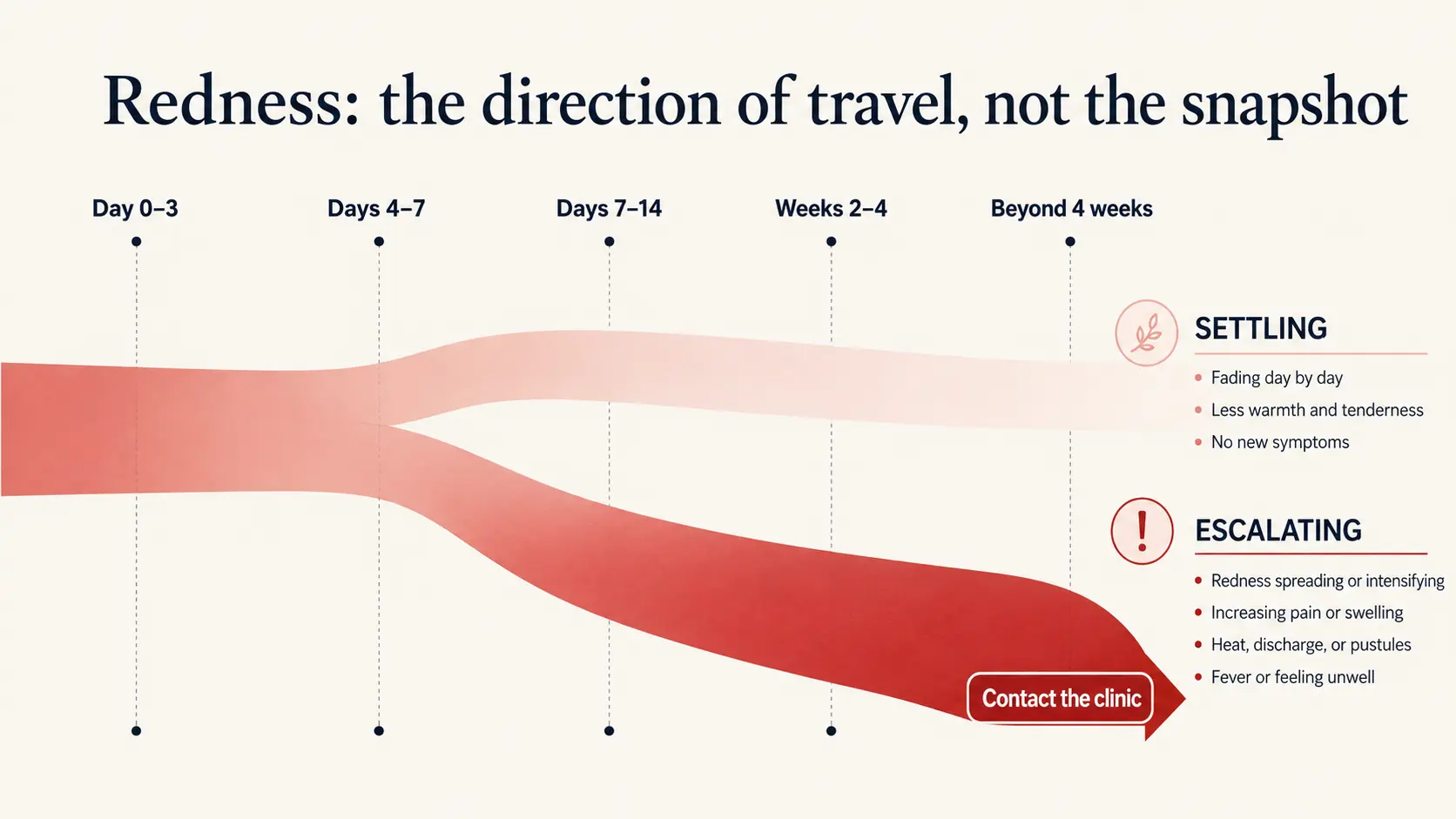
Redness is expected after a hair transplant. Almost every patient gets some, and almost every patient asks about it. The part that actually matters is harder to see in a single photograph: which way it is heading.
A scalp that is pink and calmer each week is telling a different story from one that is getting hotter, sorer and spottier — even when both look red today. So the useful question is never "is there redness?" but "is this redness improving, holding steady, or getting worse?"
This article covers what the recipient and donor areas normally do, how swelling fits alongside it, why darker skin can show something other than pink, and the specific changes that should send you back to your surgeon rather than back to the mirror. We answer the other common recovery questions separately.
- Normal redness or a warning sign?
- Why redness happens after a hair transplant
- How long does redness last after a hair transplant?
- Swelling and redness can happen at the same time
- What about redness in the donor area?
- Skin tone changes what recovery looks like
- Folliculitis, dermatitis and persistent redness
- Does redness affect graft survival?
- What helps redness settle, and what makes it worse
- How to take useful follow-up photos
- What I look for in follow-up
- When to contact the clinic
- Frequently asked questions
Normal redness or a warning sign?
A hair transplant creates a great many small surgical wounds. Early redness reflects blood-vessel dilation, inflammation and the first stages of skin repair. On its own, that appearance does not diagnose infection, dermatitis or graft failure.
I become more concerned when the color change comes with a change in behavior: the area is expanding, pain is building rather than settling, the skin feels increasingly hot, or new discharge and pustules are appearing. Published FUE series generally put postoperative infection below 1%, so infection is not the default explanation for a pink scalp. It stays on the list because when the signs do point that way, delay is what causes harm. A separate scoping review found that complication definitions and reported incidence ranges vary widely across the literature, which is another reason not to diagnose one patient from one headline percentage.
| Usually consistent with early healing | Contact the treating clinic promptly |
|---|---|
| Even pink or red color around the grafts | Redness spreading beyond the treated area |
| Mild tenderness that is improving | Pain, heat or tenderness that is increasing |
| Expected crusts that loosen with the prescribed washing routine | Pus, yellow-green discharge or an unpleasant smell |
| Forehead swelling in the first few days that then settles | Swelling that worsens alongside redness, pain or fever |
| Donor dots becoming less visible over time | Purple-black color, thick dark crust or skin breakdown |
A pattern I see constantly in follow-up: a patient sends two photographs taken ten minutes apart. One is beside a window, the other under a strong bathroom light. The second looks dramatically redder, and the scalp has not changed at all. So I ask for symptoms and comparable photographs before drawing any conclusion. Bathroom mirrors are poor instruments for medical follow-up.
Why redness happens after a hair transplant
During surgery, recipient sites are created so follicular units can be placed at the planned angle, direction and distribution. The skin answers that controlled injury with inflammation: local blood flow increases, immune cells move in, and the barrier starts rebuilding. Redness is that process becoming visible.
How visible it becomes depends on several things:
- The size of the recipient area
- The number and concentration of recipient sites
- Skin sensitivity and baseline scalp inflammation
- Hair length and the contrast between hair and skin
- Flash, direct sunlight and overhead lighting
- Crusting, dryness or irritating products
- Folliculitis or contact dermatitis
A broad frontal, mid-scalp and crown procedure treats far more surface area than a limited hairline case, so early redness is simply more visible. That is not a score for how well the operation went. The crown is especially hard to judge because of its curved surface, whorl and overhead light, which I cover separately in Why Crown Hair Transplant Results Can Take Longer.
Density needs context too. A 2024 multicenter folliculitis study found higher risk with sessions of 4,000 or more grafts and implantation densities above 45 follicular units/cm², among other factors. That does not establish a universal safe density for every scalp, but it supports a principle I plan by: more sites packed into a smaller area is not automatically better.
How long does redness last after a hair transplant?
The most useful published estimate comes from a 2026 review of FUE complications: ordinary recipient-area perifollicular redness settles within two to four weeks in most patients, though some people stay pink for longer. Crusts generally form over the first two or three days and, with appropriate care, clear around days 7 to 10. Thick or persistent crusting beyond roughly two weeks deserves review, because it can reflect delayed healing or sustained inflammation.
The table below separates what the literature supports from how I actually use it in follow-up.
| Time after surgery | What the literature supports | How I use it in follow-up |
|---|---|---|
| Surgery to day 3 | Redness and early crusting are expected. Forehead edema often begins and may peak around days 2 to 3. | I document the baseline appearance and ask about pain, heat, discharge and general wellbeing. |
| Days 4 to 7 | Edema normally starts settling and uncomplicated crusting continues. | Redness can still be striking, but it should not be spreading or becoming more painful. |
| Days 7 to 14 | Crusts usually clear during this period with the prescribed washing routine. | I compare photographs rather than judging one close-up in isolation. |
| Weeks 2 to 4 | Most ordinary recipient-area redness should be fading. | Fair or reactive skin may still look pink. No pain, no pustules and no spread is reassuring. That is my clinical read, not a published percentage. |
| Beyond 4 weeks | Redness around grafts counts as persistent rather than routine early erythema. | I look for folliculitis, dermatitis, product irritation, sun exposure and less common inflammatory causes. |
| Several months | A subset stays red for weeks or months, but this is no longer the standard early course. | Ongoing, unchanged or symptomatic redness should be assessed, not repeatedly photographed and tolerated. |
This is not a promise that every scalp will be clear on a particular day. It is a way to tell whether recovery is moving in the right direction. Healing is a direction, not a snapshot.
Swelling and redness can happen at the same time
Forehead and eyelid swelling runs on its own timetable. Reviews put the peak around the second or third postoperative day, with uncomplicated edema usually resolving within five to seven days. An older prospective study described the common window more broadly as days 2 to 6, and a 2026 multicenter study of 1,167 patients showed that operative fluid-management technique materially changed how often swelling developed at all.
That timing matters, because a patient can look redder and more swollen on day three than on day one without anything being wrong. What I read is the combination:
- Painless, symmetrical swelling that starts early and then improves is usually reassuring.
- Swelling with increasing pain, spreading hot redness, discharge or fever is a different picture entirely.
- Significant swelling that is not improving after the first week deserves review even without other symptoms.
The causes, the prevention data and the day-by-day course are covered in Swelling After a Hair Transplant.
What about redness in the donor area?
Recovery articles often skip the donor area, even though it worries patients more. With FUE, every extracted follicular unit leaves a small circular wound, so early redness, pinpoint scabs, mild tenderness and itching can appear across the whole extraction zone.
The two areas do not look or feel the same:
| Recipient area | Donor area |
|---|---|
| Grafts sit in newly created recipient sites | Follicular units have been individually extracted |
| Redness often outlines the implanted area | Redness may appear as many small dots, or a diffuse blush across the extraction zone |
| Crusts form around implanted grafts | Small extraction scabs form across the donor zone |
| Must be protected from rubbing and pressure during early healing | May feel tighter, itchier or more tender than the recipient area |
Donor redness should also trend toward better. Increasing pain, warmth, swelling, pus, a bad smell, or redness expanding beyond the extraction field needs assessment. Patchy shedding can occur in or around the donor area two to four weeks after FUE and usually regrows over several months, but that is donor-site effluvium, not a redness problem.
Long-term pale white dots are a separate matter from early redness. FUE avoids a linear strip scar, but it is not scarless: every punch makes a tiny wound, and how visible those become depends on punch size, extraction density, spacing, skin tone and hair length.
Skin tone changes what recovery looks like
Fair skin displays vascular redness clearly and can stay visibly pink even when the scalp feels completely comfortable. In more deeply pigmented skin, the same inflammation may be far less obviously red. That does not mean the inflammatory response is milder — only that it is harder to see.
The additional issue in Fitzpatrick skin types IV to VI is post-inflammatory hyperpigmentation: brown, gray or darker color that can follow skin inflammation or a dermatologic procedure. General dermatology research shows it is more common and can be more persistent in darker skin tones. Hair-transplant-specific incidence data do not exist, so I am not going to give anyone a percentage nobody has measured.
Three different things get confused here, so it is worth separating them:
- Erythema is vascular redness or pinkness.
- Post-inflammatory hyperpigmentation is excess pigment left behind after inflammation.
- Hypopigmented donor dots are small pale extraction scars, which is a different process again.
Sun protection matters in every skin tone, and it matters most when redness or pigment change is already present, because ultraviolet exposure can deepen and prolong uneven pigmentation. In Pure Line's current aftercare protocol, patients avoid direct sun on the treated scalp for the first month and continue careful protection for three months. Individual instructions may be stricter when healing or pigmentation is slow.
Folliculitis, dermatitis and persistent redness
Persistent redness is not one diagnosis. The possibilities I work through include uncomplicated prolonged erythema, folliculitis, bacterial infection, irritant or allergic contact dermatitis, a flare of a pre-existing scalp condition, and, much less commonly, an inflammatory or vascular complication.
Folliculitis usually shows up as red bumps or pustules around follicles. In a 2024 multicenter retrospective study of 1,317 hair transplant patients followed for nine months, the overall incidence was 12.11%. Surgery in summer, sessions of 4,000 or more grafts, implantation density above 45 FU/cm², and a first postoperative nursing visit later than three days were among the risk factors identified.
An older study looked at 27 patients who developed recipient-area folliculitis alongside 28 controls. Lesions began anywhere from two days to six months after transplantation, with a mean of 1.44 months. Most involved a small to moderate number of pustules and resolved without scarring or any observed reduction in graft growth.
Those two findings are not in conflict. Folliculitis runs from a handful of self-limited inflammatory pustules to a more extensive process that needs treatment. What a patient should not do is squeeze the bumps, or decide from a photograph whether antibiotics are warranted.
Seborrheic or contact dermatitis can also produce itching, scale and redness without any infection. Early postoperative symptoms overlap with seborrheic dermatitis, particularly if the condition was active before surgery. A new shampoo, topical solution, antiseptic or fragranced product can produce irritant or allergic contact dermatitis just as easily.
So when redness is persistent, itchy or scaling, I want the full product history: what was used, where it was applied, when it started, and whether the symptoms changed afterward. The wider differential is explained in Does Scalp Inflammation Affect Hair Transplant Success?
Does redness affect graft survival?
Ordinary early redness on its own does not show that grafts are failing. Most transplanted hair shafts shed during the postoperative cycle anyway, and visible regrowth takes months rather than weeks.
Persistent recipient-area perifollicular erythema is different enough to have been studied as a complication in its own right. In a 2024 multicenter cohort of 1,090 patients:
- 178 patients (16.33%) had mild recipient-area perifollicular erythema
- 56 (5.14%) had moderate erythema
- 10 (0.92%) had severe erythema
- 244 patients in total (22.39%) met the study's classification
Patients in that group had more hair-shaft shedding and lower graft survival, both statistically significant at P < 0.001. The abstract does not report the survival difference as a percentage, so I am not going to invent one. Nor does it mean that 22.39% of all patients had an infection or lost their grafts — severity and outcome are separate questions.
Folliculitis was strongly associated with this erythema: the odds ratio was 6.061 for mild and 3.397 for moderate cases. That is exactly why I do not wave away redness that persists around individual follicles, particularly when pustules, tenderness or scale are there too.
The right use of that finding is sharper follow-up, not frightening every patient with a pink scalp. Mild early redness that is steadily fading remains ordinary healing.
What helps redness settle, and what makes it worse
Nobody can force skin to heal faster. What patients can do is avoid adding a second injury to a scalp that is already repairing.
Follow the prescribed washing routine. Early, gentle cleansing supports crust removal and limits buildup. Current evidence and expert consensus favor timely postoperative washing, but the exact technique has to come from the clinic that operated, because graft placement, dressings and products differ. Do not compensate for anxiety by scrubbing harder: thick crusts, delayed crust removal and late first washing are all associated with prolonged inflammation and folliculitis, while premature or aggressive handling can traumatize the recipient area.
Do not scratch, pick or squeeze. Itching is common in both areas. Scratching increases irritation and can introduce bacteria; squeezing pustules drives inflammation deeper. If the itch is intense or the bumps are multiplying, send photographs and ask, rather than turning the bathroom into a treatment room.
Do not improvise with products. Until the treating team says the scalp is ready, avoid alcohol-based products, fragranced scalp treatments, exfoliating acids, retinoids, styling gels, hair fibers, dye and any unapproved topical medication. Natural does not mean gentle. Lemon is natural; fresh grafts still do not need a citrus bath.
The same caution applies to medicated shampoos. Ketoconazole is useful for dandruff and seborrheic dermatitis, but the evidence for hair growth is far weaker and the postoperative restart date should be individualized. That distinction is covered in Does Ketoconazole Shampoo Help Hair Loss?
Protect the scalp from sun. Avoid sunburn and follow the clinic's hat and sunscreen instructions. A hat used in early recovery needs to be clean, loose and approved for that stage, and sunscreen should not be rubbed onto fresh recipient sites before the skin is ready.
Do not self-prescribe antibiotic or steroid cream. Redness can be infectious, inflammatory, irritant or vascular in origin, and the treatment for one can be wrong for another. A clinician might choose a topical antibiotic, an oral antibiotic, anti-inflammatory treatment, product withdrawal, a culture or an in-person examination depending on the pattern. That decision should follow an assessment, not a guess.
How to take useful follow-up photos
Color is unusually sensitive to lighting and camera processing, so a comparison is only worth something if it is standardized.
- Use indirect daylight beside a window, and avoid direct sun.
- Turn off flash, portrait filters, beauty modes and automatic color effects wherever possible.
- Photograph dry hair and scalp, unless the clinic has specifically asked for a post-wash image.
- Keep the same distance, angle and camera every time.
- Take one wider photograph for distribution and one close image for detail.
- Include front, both sides, top, crown and donor area when the concern is not clearly localized.
- Add the date and the postoperative day.
- Describe pain, warmth, itching, discharge, smell, fever and any new product. A photograph cannot show those.
If the color looks very different in two settings, send both and say which one is closer to what you see in daylight. And please do not edit the image to correct the redness.
What I look for in follow-up
When I review postoperative photographs, redness is not a yes-or-no finding. I read its pattern and compare it against the previous stage.
- Is it diffuse or sharply localized?
- Is it limited to the treated area, or spreading beyond it?
- Is the color evenly pink, bright red, violaceous, brown, gray or black?
- Is it centered around individual follicles?
- Are there papules, pustules, scale, thick crusts or discharge?
- Is swelling improving on the expected timetable?
- Is pain or tenderness increasing?
- Does the patient report heat, smell, fever or feeling unwell?
- Has a new shampoo, topical medication, fiber, dye or home remedy been used?
- Was there scratching, sun exposure, or a break from the washing protocol?
- Is the donor area heading the same direction as the recipient area?
- Is this photograph genuinely comparable with the earlier one?
A clear image is useful, but it is never the whole assessment. Temperature, pain, smell and how a patient actually feels are clinical information, not pixels.
When to contact the clinic
Contact the clinic that performed your procedure promptly if you notice:
- Redness that is spreading or clearly worsening
- Increasing warmth, throbbing pain or tenderness
- Multiple pustules, or bumps increasing rapidly
- Yellow or green discharge, pus or an unpleasant smell
- Fever, chills or feeling generally unwell
- Swelling that is worsening rather than settling
- A purple, gray or black area
- Thick dark crust, ulceration or skin breakdown
- Bleeding that does not stop with the advised gentle pressure
- Redness still prominent beyond four weeks with no clear improving trend
- Any postoperative change that concerns you in the context of diabetes, immune suppression or another wound-healing risk
Darkening tissue, severe pain, fever or rapidly spreading redness should not wait for the next routine follow-up. If the original clinic cannot assess you quickly, seek local medical care. Nobody has ever regretted asking too early about those particular signs.
For mild redness that is improving, send one standardized update instead of checking it repeatedly under different lights. For redness that is getting worse, do not wait until you have a more convincing photograph.
The point I want patients to remember
Postoperative redness is usually part of healing. In most patients it fades within two to four weeks, while skin tone, treated area, crusting and individual reactivity change how visible it looks along the way.
The presence of redness tells you far less than its direction and the symptoms around it. A comfortable pink scalp that looks calmer each week is a different thing from hot, painful redness with pustules or discharge. The donor area deserves the same attention, and darker skin may show pigment change rather than obvious pinkness.
Patients should not have to work these differences out alone. Good aftercare is partly knowing when to be patient, and partly knowing when to ask.
Frequently Asked Questions
Is redness normal after a hair transplant?
How long does redness last after a hair transplant?
Is donor-area redness normal after FUE?
Does redness mean I have an infection?
Can redness reduce graft survival?
When does swelling go down after a hair transplant?
Can redness become permanent?
Why does my darker skin look brown or gray instead of red?
When can I go into the sun after a hair transplant?
How can I cover redness, and when can I dye my hair?
Can I apply antibiotic cream to a red scalp?
When can I restart ketoconazole or medicated shampoo?
What products should I avoid while the scalp is red?
When should I contact the clinic about redness?
How should I photograph redness for the clinic?
— Dr. Mesut Demir
Concerned about redness after your hair transplant?
Send clear photographs along with your postoperative day, your symptoms, your current washing routine and any products you have used. A case review can help establish whether the pattern looks like ordinary healing or needs a closer look.
Request a Pure Line case review- Romera de Blas C, Vega Díez D, Ricart Vayá JM, Gómez Zubiaur A. Complications in follicular unit excision hair transplantation: current evidence and practical approaches. Frontiers in Medicine. 2026;13:1750989. doi:10.3389/fmed.2026.1750989
- Zhang J, Zhao Y, Zhang J, et al. Risk factors and hazards of recipient-area perifollicular erythema after hair transplantation: a multicenter retrospective cohort study. Aesthetic Plastic Surgery. 2024;48(15):2771–2777. doi:10.1007/s00266-024-04166-z
- Zhou Y, Zhang J, Yi Y, et al. Characterization and risk factors of folliculitis after hair transplantation: a multicenter retrospective study. Plastic and Reconstructive Surgery. 2024;154(6):1115e–1122e. doi:10.1097/PRS.0000000000011175
- Bunagan MJKS, Pathomvanich D, Laorwong K. Recipient area folliculitis after follicular-unit transplantation: characterization of clinical features and analysis of associated factors. Dermatologic Surgery. 2010;36(7):1161–1165. doi:10.1111/j.1524-4725.2010.01601.x
- Garg AK, Garg S. Complications of hair transplant procedures — causes and management. Indian Journal of Plastic Surgery. 2021;54(4):477–482. doi:10.1055/s-0041-1739255
- Sun Y, Xu F, Zhang J, et al. Comprehensive prevention for edema after hair transplantation: a multicenter study of 1,167 patients. Plastic and Reconstructive Surgery. 2026;157(1):49e–57e. doi.org
- Abbasi G, Pojhan S, Emami S. Hair transplantation: preventing post-operative oedema. Journal of Cutaneous and Aesthetic Surgery. 2010;3(2):87–89. doi:10.4103/0974-2077.69018
- Davis EC, Callender VD. Postinflammatory hyperpigmentation: a review of the epidemiology, clinical features, and treatment options in skin of color. Journal of Clinical and Aesthetic Dermatology. 2010;3(7):20–31. PMID 20725554
- Kaufman BP, Aman T, Alexis AF. Postinflammatory hyperpigmentation: epidemiology, clinical presentation, pathogenesis and treatment. American Journal of Clinical Dermatology. 2018;19(4):489–503. doi:10.1007/s40257-017-0333-6
- Liu RH, Xu LJ, McCarty JC, Xiao R, Chen JX, Lee LN. A scoping review on complications in modern hair transplantation: more than just splitting hairs. Aesthetic Plastic Surgery. 2025;49(3):585–595. doi:10.1007/s00266-024-04316-3
- Vañó-Galván S, Bisanga CN, Bouhanna P, et al. An international expert consensus statement focusing on pre and post hair transplantation care. Journal of Dermatological Treatment. 2023;34(1):2232065. doi:10.1080/09546634.2023.2232065