
Quick answer
Scalp inflammation can affect a hair transplant, but not in the simple way the phrase suggests, because the answer depends entirely on what is causing it. There is no good clinical evidence that ordinary scalp inflammation or seborrheic dermatitis reduces graft survival by any specific percentage, and Dr. Mesut Demir does not quote one. Active infection is more straightforward: an elective procedure should wait until it has been properly treated. Scarring alopecias are the real concern, because the disease itself can permanently destroy follicles. Published series show what that means in practice — in 51 patients with frontal fibrosing alopecia operated after a mean of roughly 15 months of stabilization, mean graft survival fell from about 87% at one year to 41% at five, and in a series of 11 patients with folliculitis decalvans, significant disease reactivation occurred in three of them. So the useful question before surgery is not whether inflammation is present, but which condition is causing it and whether that condition is active.
A red, itchy or scaling scalp is a finding. It is not a diagnosis.
Two patients can come to a consultation describing exactly the same problem as “dandruff.”
One may have greasy scale and itching caused by seborrheic dermatitis.
Another may have scale concentrated around individual follicles, burning and areas where normal follicular openings are disappearing.
Those situations should not be treated as equivalent. The second pattern can raise suspicion for a scarring inflammatory disorder, where the disease itself can permanently damage follicles.
That distinction matters much more than the amount of redness I can see on a particular day.
Hair transplantation is elective surgery. If the scalp does not look or feel normal, my first question is not which shampoo to prescribe or how many weeks to delay surgery. It is why the scalp is abnormal in the first place.
- What does “scalp inflammation” actually mean?
- Does inflammation reduce graft survival?
- Seborrheic dermatitis
- Scalp psoriasis
- Folliculitis and active scalp infection
- Folliculitis decalvans
- Lichen planopilaris and frontal fibrosing alopecia
- Central centrifugal cicatricial alopecia
- Traction alopecia
- Other scarring alopecias
- Contact and irritant dermatitis
- What I look for before surgery
- When trichoscopy or biopsy may be useful
- How long should surgery be postponed?
- Frequently asked questions
What does “scalp inflammation” actually mean?
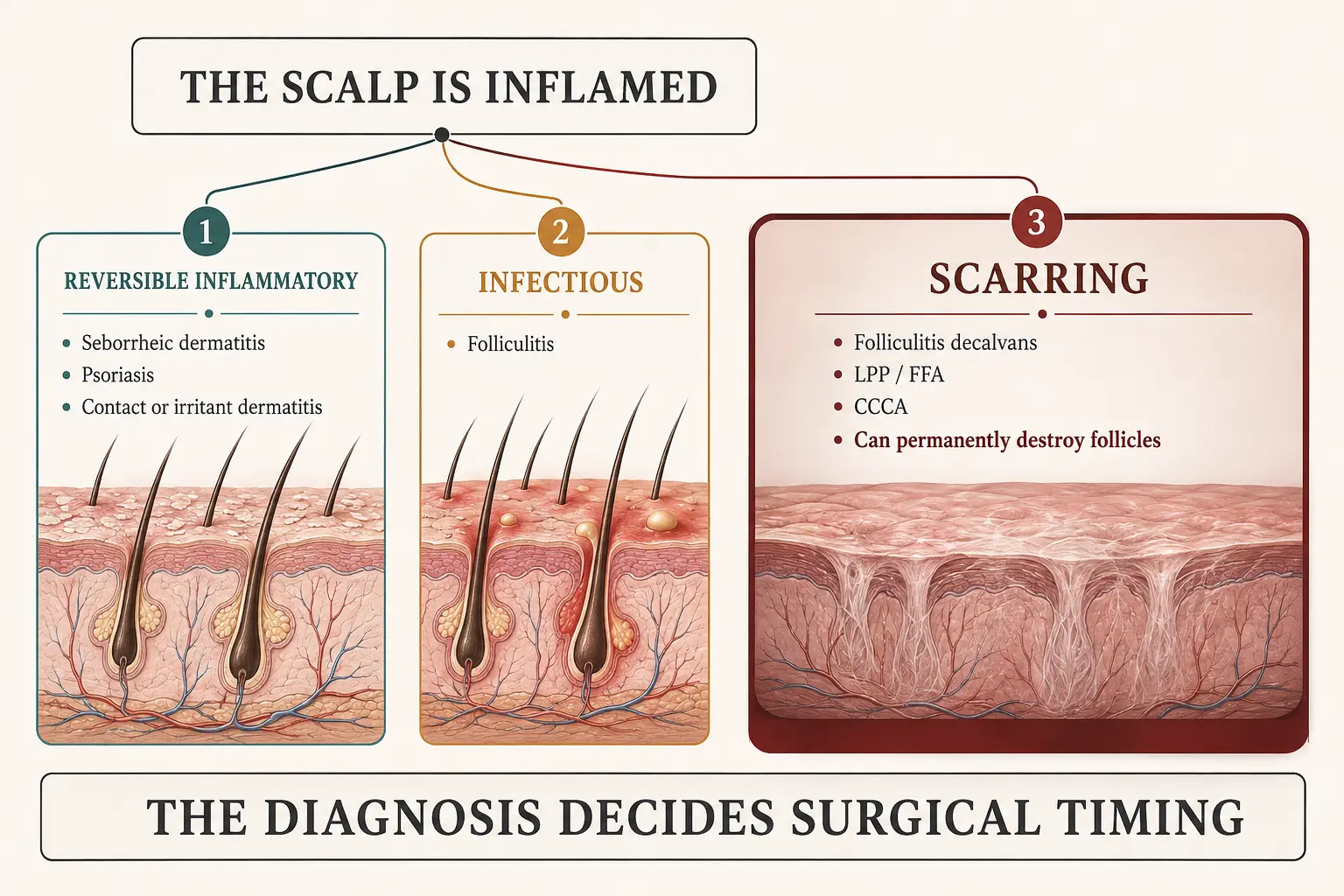
Inflammation is a finding shared by conditions that behave nothing alike.
A patient with mild seborrheic dermatitis, a patient with bacterial folliculitis and a patient with active frontal fibrosing alopecia may all have visible redness. Their diagnoses, treatment and surgical implications are very different.
The clinically useful question is not “does inflammation affect grafts?” It is which condition is causing the inflammation, and whether that condition is active.
Does inflammation reduce graft survival?
This is where the wording needs to be precise.
The honest answer is that we do not have good clinical evidence showing that “scalp inflammation” as one broad category reduces graft survival by a defined amount.
For common inflammatory conditions such as seborrheic dermatitis, I would not tell a patient that graft survival will fall by a particular percentage because good transplant-specific data do not exist.
For active infection, the issue is more straightforward: an elective procedure should wait until the infection has been properly treated.
For scarring alopecias, we have a different problem. Diseases such as lichen planopilaris, frontal fibrosing alopecia, CCCA and folliculitis decalvans can permanently destroy follicles. In selected forms of scarring alopecia, published transplant series also show that disease reactivation and long-term graft loss can occur.
Seborrheic dermatitis
Seborrheic dermatitis is probably the inflammatory scalp condition I see most frequently in otherwise suitable hair transplant candidates.
Typical symptoms include flaking, itching, redness, greasy or yellowish scale and recurrent scalp irritation.
Having seborrheic dermatitis does not automatically make someone unsuitable for transplantation.
If the condition is significantly flaring, I prefer to control it before elective surgery. But there is an important evidence distinction here. There is no good clinical study showing that active seborrheic dermatitis reduces hair transplant graft survival by a specific percentage. I would not invent one.
The practical reason for controlling a flare is simpler. I would rather operate when the existing skin condition is stable, the diagnosis is clear and postoperative itching, redness or scale are less likely to be confused with symptoms that were already present before surgery.
For a deeper discussion, see Can You Have a Hair Transplant With Seborrheic Dermatitis?
Scalp psoriasis
Psoriasis deserves a different discussion.
Scalp psoriasis can cause well-defined red plaques, thick scale, itching and sometimes cracking or bleeding.
Trauma may provoke new psoriatic lesions in susceptible people through the Koebner phenomenon, in which psoriasis develops at sites of skin injury. [1]
Hair transplantation creates thousands of controlled small injuries in both the donor and recipient areas. That does not mean psoriasis automatically rules out surgery, but active disease in those areas deserves attention.
Before proceeding, I want to know:
- whether psoriasis is currently active on the scalp
- whether the planned donor or recipient areas are involved
- how severe and stable the disease has been
- whether previous skin trauma has triggered psoriasis
- whether a dermatologist is already managing the condition
Hair transplant-specific evidence remains limited. A 2026 publication described scalp psoriasis following hair transplantation, but an isolated report cannot tell us how frequently this occurs or predict the risk for an individual patient. [2]
I therefore would not tell someone that psoriasis has been proven to reduce graft survival. I would tell them that active psoriasis should not be treated as ordinary dandruff when planning elective scalp surgery.
Folliculitis and active scalp infection
A few inflamed follicles do not necessarily mean a patient has a significant scalp disease.
Persistent pustules, painful lesions, drainage, crusting or signs of infection are different.
Hair transplant literature includes local infections such as tinea capitis and staphylococcal folliculitis among conditions that should be addressed when considering transplantation. [3]
This is one of the easier decisions in the article. If there is an active infection, I do not see a reason to rush an elective cosmetic procedure. The cause should be identified and treated first.
Afterward, the important question is whether the infection has resolved, not whether an arbitrary number of weeks has passed.
Folliculitis decalvans
The name can make folliculitis decalvans sound like a severe version of ordinary folliculitis.
It is not.
Folliculitis decalvans is a chronic, relapsing neutrophilic scarring alopecia. Once a follicle has been permanently destroyed and replaced by scar tissue, it does not grow back.
A 2025 European Academy of Dermatology and Venereology position statement notes that hair transplantation may be considered in patients with folliculitis decalvans when there are no signs of disease activity. [4]
We also have some direct transplant data. Cova-Martín and colleagues reported 11 patients who underwent hair transplantation after at least six months of clinical stabilization. Mean transplanted follicular-unit survival was approximately 75% after one year and 60% after at least two years, and significant disease reactivation occurred in 3 of the 11 patients. [5]
Eleven patients is a very small dataset, so these numbers should not be presented as a forecast for the next person who walks into a clinic.
What the study does show is more useful: even after a period of apparent stability, the disease can reactivate. That is very different from claiming vaguely that “inflammation reduces graft survival.”
Lichen planopilaris and frontal fibrosing alopecia
Lichen planopilaris (LPP) and frontal fibrosing alopecia (FFA) are lymphocytic scarring alopecias.
In androgenetic alopecia, follicles gradually miniaturize. In scarring alopecia, inflammatory disease can permanently destroy the follicular unit and replace it with scar tissue.
Findings that may raise suspicion include:
- perifollicular redness
- scale concentrated around individual follicles
- itching, tenderness or burning
- smooth or shiny areas of hair loss
- loss of normal follicular openings
- irregular patterns of permanent loss
- frontal recession accompanied by eyebrow loss
None of these findings should be used as an online diagnostic checklist. They are reasons for a closer assessment.
Why FFA can look like ordinary hairline recession
FFA can cause frontal and temporal recession, which means a patient may initially arrive simply asking for a hairline transplant.
Clinical examination and trichoscopy can reveal features such as perifollicular erythema, perifollicular scale and loss of follicular openings. When the diagnosis remains uncertain, scalp biopsy may be required. [6,7]
If the underlying disease is missed, adding grafts does nothing to control it.
This is particularly relevant when evaluating women for hair transplantation, where frontal, temporal and diffuse thinning do not always have the same cause.
What happened in the 51-patient FFA transplant series?
Vañó-Galván and colleagues reviewed 51 patients with frontal fibrosing alopecia who underwent hair transplantation. Surgery was performed after a mean of approximately 15 months of clinical and trichoscopic stabilization, and treatment for FFA continued afterward. [8]
Reported mean graft survival was approximately 87% at 1 year, 71% at 2 years, 60% at 3 years and 41% at 5 years.
The number of patients available at later follow-up was smaller, and this was a retrospective study. Those percentages therefore should not be presented as a universal five-year forecast.
They do demonstrate why transplantation in FFA cannot be treated as equivalent to transplantation for ordinary androgenetic alopecia.
Early growth may look encouraging while long-term durability remains uncertain.
Can hair transplantation trigger LPP or FFA?
A 2026 systematic review identified seven studies containing 66 patients who developed LPP or FFA after hair transplantation or facial surgical procedures. Thirty-four cases followed hair transplantation, and the mean interval between the procedure and diagnosis was 4.88 years. [9]
These reports show a temporal association, not proof that surgery caused the disease. Surgical trauma may act as a trigger in susceptible patients, while some reported patients may already have had subtle or unrecognized disease before the procedure. The available evidence cannot reliably separate those possibilities.
For me, the practical lesson is not that hair transplantation “causes LPP.” It is that unusual scalp findings before surgery deserve to be taken seriously.
Central centrifugal cicatricial alopecia
Central centrifugal cicatricial alopecia, or CCCA, deserves separate attention because it commonly involves the central scalp and vertex and occurs predominantly in women of African descent.
Its location can make the diagnosis easy to underestimate. A patient may initially appear to have female-pattern thinning or ordinary crown loss, but CCCA is a scarring alopecia.
Patients may report burning, tenderness, itching or scale, although some have few symptoms. As the disease progresses, normal follicular openings can disappear from affected areas.
Published transplant evidence is very limited. Callender and colleagues described two African American women with long-standing CCCA who underwent transplantation after assessment that included scalp biopsy and a test transplant session. [12]
That is useful evidence that transplantation can be considered in carefully selected stable disease. It is not enough evidence to create a reliable success percentage.
When central or crown loss in a woman does not behave like ordinary pattern thinning, particularly when symptoms or abnormal scalp findings are present, establishing the diagnosis comes before designing a transplant.
Once the diagnosis is clear and the disease is suitable for surgery, the vertex creates another set of questions around density, donor use and long-term planning. Those are discussed separately in Why Crown Hair Transplant Results Can Take Longer. For the wider surgical assessment of female hair loss, see Female Hair Transplant.
Traction alopecia
Traction alopecia starts with repeated mechanical tension on the hair.
Tight braids, extensions, weaves, tight ponytails and other hairstyles that continuously pull on the same follicles can contribute. [13]
In earlier stages, follicles may still recover if the source of traction is removed. With prolonged exposure, however, the condition can progress to permanent scarring and follicular loss. [13]
That creates two separate questions before surgery. First, can some of the native hair still recover? Second, if part of the loss has become permanent, has the source of traction actually stopped and has the pattern remained stable?
Selected patients with established permanent traction alopecia can be considered for transplantation.
But surgery does not fix an ongoing mechanical cause. If the same damaging traction continues after transplantation, replacing hair without changing the behavior that caused the loss would be a fairly expensive way of ignoring the original problem.
Other scarring alopecias
LPP, FFA, CCCA and folliculitis decalvans are not the entire category.
Other relevant disorders include discoid lupus erythematosus, dissecting cellulitis and several rarer forms of cicatricial alopecia.
A systematic review of transplantation in primary scarring alopecias reported both successful and unsuccessful outcomes, but most of the literature consisted of small series and case reports. [10]
A 2025 systematic review examining procedural treatments in LPP, FFA and discoid lupus reached a similar practical conclusion: selected patients can improve cosmetically, but the evidence remains heterogeneous and long-term durability is an important concern. [11]
That changes the order of a transplant consultation.
With straightforward androgenetic alopecia, I can move relatively quickly toward donor capacity, hairline design and graft allocation. With suspected scarring alopecia, I first need enough confidence in the diagnosis and disease activity to know whether discussing graft numbers makes sense at all.
Contact and irritant dermatitis
Not every inflamed scalp has a disease arising from the follicle. Sometimes the scalp is reacting to something being applied to it.
Possible triggers include hair dye, fragrances, preservatives, styling products, shampoos and topical medications. Allergic reactions to ingredients in topical minoxidil products have also been reported. [14,15]
Scalp allergic contact dermatitis is easy to miss because hair can hide the visible rash and the symptoms may resemble seborrheic dermatitis. [14]
History is therefore important. If redness, itching or burning began after a new hair dye, shampoo, styling product or topical treatment, I want to know.
Patients also increasingly use oils and botanical treatments for hair loss. “Natural” is a marketing category, not a guarantee that a substance cannot irritate the skin. I discuss one commonly used example separately in Does Rosemary Oil Work for Hair Growth?
When allergic contact dermatitis is suspected, patch testing can help identify the responsible allergen. Testing the patient's own products may also be useful in selected cases. [14]
Adding more scalp products before identifying the trigger usually does not make the diagnostic process easier.
Why I do not use “subclinical inflammation” as a catch-all diagnosis
Inflammatory scalp disease can sometimes be subtle. Early scarring alopecia may not look dramatic, and trichoscopy can reveal abnormalities that are difficult to appreciate with the naked eye.
But that does not justify telling an otherwise asymptomatic patient that they have nonspecific “hidden inflammation” without defining what is suspected or how it was identified.
If I suspect a subtle inflammatory disorder, I want to narrow the diagnosis. Depending on the case, this may involve medical and hair-loss history, direct scalp examination, trichoscopy, standardized photographs, dermatology assessment and scalp biopsy in selected cases.
The investigation should become more specific as the suspicion increases.
A generic “scalp inflammation score” is not a substitute for a diagnosis.
What I look for before surgery
Scalp examination is part of hair transplant planning. I pay particular attention to:
- persistent erythema
- heavy or localized scale
- scale concentrated around individual follicles
- pustules or crusted lesions
- pain, tenderness or burning
- unexplained itching
- smooth or shiny areas of hair loss
- loss of normal follicular openings
- irregular or unusual patterns of alopecia
- eyebrow loss accompanying frontal recession
- signs that the donor area may also be affected
The donor area matters just as much as the recipient area. If a disease process is affecting hair that was assumed to be permanent donor hair, the surgical calculation changes.
Patients can also have more than one condition. A person may have androgenetic alopecia and seborrheic dermatitis. Another may have androgenetic alopecia and psoriasis. Occasionally, pattern hair loss can coexist with a scarring process.
When the presentation is straightforward, the discussion can move toward donor capacity, design, graft distribution and the FUE hair transplant procedure itself.
When the findings do not fit, I slow the process down.
When trichoscopy or biopsy may be useful
Not every hair transplant patient needs a scalp biopsy. Most typical androgenetic alopecia can be assessed clinically.
Trichoscopy becomes particularly useful when the pattern of hair loss or the scalp findings are atypical. It allows magnified assessment of follicular openings, perifollicular scale, erythema, hair-shaft variation and other features that can help narrow the diagnosis.
In LPP and FFA, trichoscopy is useful both for diagnosis and for monitoring disease activity. [6,7]
Biopsy becomes relevant when examination and trichoscopy do not provide enough certainty, particularly if confirming or excluding a scarring alopecia would change whether surgery should proceed.
That is a targeted use of biopsy. It is very different from biopsying routine candidates in search of unspecified inflammation.
How long should surgery be postponed?
There is no universal waiting period. A rule such as “treat inflammation for four weeks and then operate” ignores how differently these conditions behave.
Seborrheic dermatitis
A flare may settle relatively quickly with appropriate treatment. Clinical control matters more than reaching an arbitrary date.
Contact dermatitis
The reaction should settle and the likely trigger should be removed or identified where possible.
Active infection
The infection should be appropriately treated and resolved before elective surgery.
Psoriasis
Timing depends on disease activity, scalp involvement, severity, treatment and previous behavior. Dermatology input may be appropriate when scalp disease is active or extensive.
Scarring alopecia
This can require a much longer period of documented stability.
In the 51-patient FFA series, transplantation occurred after a mean of approximately 15 months of clinical and trichoscopic stabilization. [8] In the folliculitis decalvans series, patients had at least six months of clinical stabilization before transplantation. [5]
Those figures describe the study populations. They are not universal waiting-period rules.
A calendar alone cannot prove that a scarring alopecia is inactive.
How I approach these cases
If I see straightforward androgenetic alopecia and a calm scalp, surgical planning can proceed normally.
A significant seborrheic dermatitis flare is usually controlled first. Active infection means surgery waits. Active psoriasis in a planned surgical area deserves more caution and, in some cases, dermatology involvement.
Perifollicular scale, unexplained burning, disappearing follicular openings or an unusual recession pattern changes the consultation more substantially because those findings can raise suspicion for scarring alopecia.
At that point, estimating graft numbers is premature. The cause of the hair loss needs to be understood well enough for surgery to make sense.
Frequently Asked Questions
Can scalp inflammation cause a hair transplant to fail?
Does scalp inflammation reduce graft survival?
Can I have a hair transplant if I have dandruff?
Can I have a hair transplant if my scalp is red or itchy?
Can I have a hair transplant with seborrheic dermatitis?
Does seborrheic dermatitis kill transplanted grafts?
Is scalp inflammation always visible?
Can I have a hair transplant if I have psoriasis?
Can folliculitis delay a hair transplant?
Can someone with folliculitis decalvans have a hair transplant?
What is the most concerning type of inflammation before hair transplantation?
How can a doctor tell whether I have scarring alopecia?
How long should I treat scalp inflammation before surgery?
Can hair transplantation trigger LPP or FFA?
Can CCCA be treated with a hair transplant?
Can traction alopecia be treated with transplantation?
Do all hair transplant patients need trichoscopy?
Conclusion
Scalp inflammation can matter in hair transplantation, but the phrase is too broad to predict whether an individual procedure will succeed.
Controlled seborrheic dermatitis, active psoriasis, bacterial folliculitis and lichen planopilaris should not be grouped into one risk category simply because all of them can produce redness or irritation.
For common dermatitis, the goal is usually to obtain good clinical control before elective surgery. Active infection should be treated. Psoriasis requires attention to disease activity and the possibility of a trauma-related flare. Suspected scarring alopecia deserves a more cautious diagnostic approach because the disease itself can permanently destroy follicles.
When scalp findings do not fit straightforward androgenetic alopecia, I would rather clarify the diagnosis than force a patient into a surgical timetable. In selected cases, that means trichoscopy, dermatology assessment or biopsy before graft planning begins.
Hair transplantation works best when the diagnosis, timing and donor plan make sense together.
— Dr. Mesut Demir
Not sure whether your scalp is ready for surgery?
Send clear photographs of your hairline, crown and donor area together with information about any redness, itching, scaling, pustules, burning or diagnosed scalp conditions. The first review is not only about estimating a graft number. It also helps determine whether routine surgical planning is reasonable or whether the scalp needs closer assessment first.
Request a Pure Line case review- Ji YZ, Liu SR. Koebner phenomenon leading to the formation of new psoriatic lesions: evidences and mechanisms. Bioscience Reports. 2019;39(12):BSR20193266. doi:10.1042/BSR20193266
- Babino G. Adalimumab treatment for scalp psoriasis after hair transplantation. Italian Journal of Dermatology and Venereology. 2026;161(2):174–176. doi:10.23736/S2784-8671.25.08369-0
- Khanna M. Hair transplant with strip harvest: indications, contraindications, and technique. Indian Journal of Plastic Surgery. 2021;54(4):451–455. doi:10.1055/s-0041-1741523
- Waśkiel-Burnat A, Starace M, Iorizzo M, et al. Management of folliculitis decalvans: the EADV task force on hair diseases position statement. Journal of the European Academy of Dermatology and Venereology. 2025;39(8):1385–1394. doi:10.1111/jdv.20687
- Cova-Martín R, Perez-Bootello J, Hermosa-Gelbard A, et al. Hair transplantation in folliculitis decalvans: outcome description in a multicentre series of 11 patients. Journal of the European Academy of Dermatology and Venereology. 2025;39(10):e845–e849. doi:10.1111/jdv.20558
- Fechine COC, Valente NYS, Romiti R. Lichen planopilaris and frontal fibrosing alopecia: review and update of diagnostic and therapeutic features. Anais Brasileiros de Dermatologia. 2022;97(3):348–357. doi:10.1016/j.abd.2021.08.008
- Gowda SK, Errichetti E, Behera B, et al. Trichoscopic features of lichen planopilaris versus frontal fibrosing alopecia: a systematic review. Dermatology Practical & Conceptual. 2025;15(1):4481. doi:10.5826/dpc.1501a4481
- Vañó-Galván S, Villodres E, Pigem R, et al. Hair transplant in frontal fibrosing alopecia: a multicenter review of 51 patients. Journal of the American Academy of Dermatology. 2019;81(3):865–866. doi:10.1016/j.jaad.2019.05.031
- Escudero JL, Moon JY, Fiedler J, Handler M, Zufall A. Lichen planopilaris after hair transplantation and facial surgical procedures: a systematic review. Dermatologic Surgery. Published online 22 July 2026. doi:10.1097/DSS.0000000000005244
- Ekelem C, Pham C, Atanaskova Mesinkovska N. A systematic review of the outcome of hair transplantation in primary scarring alopecia. Skin Appendage Disorders. 2019;5(2):65–71. doi:10.1159/000492539
- Tanha AE, Ghane Y, Jafarzadeh A, Goodarzi A. A systematic review of procedural modalities in the treatment of lichen planopilaris, frontal fibrosing alopecia, and discoid lupus erythematosus. Lasers in Medical Science. 2025;40(1):431. doi:10.1007/s10103-025-04704-4
- Callender VD, Lawson CN, Onwudiwe OC. Hair transplantation in the surgical treatment of central centrifugal cicatricial alopecia. Dermatologic Surgery. 2014;40(10):1125–1131. doi:10.1097/DSS.0000000000000127
- Billero V, Miteva M. Traction alopecia: the root of the problem. Clinical, Cosmetic and Investigational Dermatology. 2018;11:149–159. doi:10.2147/CCID.S137296
- Hwang JC, Beatty CJ, Khobzei K, Kazlouskaya V. Allergic contact dermatitis of the scalp: a review of an underdiagnosed entity. International Journal of Women's Dermatology. 2024;10(3):e167. doi:10.1097/JW9.0000000000000167
- Alajaji AN. Hair product allergy: a review of epidemiology and management. Cureus. 2024;16(4):e58054. doi:10.7759/cureus.58054