
Quick answer
A history of epilepsy is not an automatic refusal, but it cannot be cleared from a questionnaire either. For a current epilepsy diagnosis or ongoing antiseizure medication, Dr. Mesut Demir requires written input from the treating neurologist before confirming elective hair transplantation, and that input informs the surgical decision rather than replacing it. The surgical plan must also account for the total local-anesthetic dose across a six-to-eight-hour operation: lidocaine and other local anesthetics can cause seizures at toxic systemic concentrations, a rare but potentially life-threatening complication called local anesthetic systemic toxicity, or LAST. Product information for infiltrated lidocaine in normal healthy adults lists 4.5 mg/kg without adrenaline, generally capped at 300 mg, and 7 mg/kg with adrenaline, capped at 500 mg — maximum guideposts rather than targets. Antiseizure medicines should not be stopped, delayed or rescheduled without instructions from the prescribing clinician. If seizure control is uncertain, medicine has recently changed, sleep has been disrupted or the anesthetic plan cannot be kept comfortably within a safe range, surgery should wait.
A history of epilepsy isn't an automatic refusal, but it isn't something I clear from a questionnaire either.
For a patient with a current epilepsy diagnosis or ongoing antiseizure medication, I require written input from the treating neurologist before confirming elective hair transplantation. That information supports our assessment; it doesn't replace it.
This article is general medical information, not approval for surgery. A neurologist's letter, an online consultation or a long seizure-free period does not by itself establish that an individual is suitable for a hair transplant.
- Why the diagnosis alone isn't enough
- Why local anesthesia is central to the discussion
- Lidocaine dose limits: the numbers and their limits
- How cumulative dose should change the surgical plan
- Antiseizure medicines and perioperative interactions
- Sleep, flying to Istanbul and the early-morning operation
- What I need to know before discussing surgery
- When I would postpone the procedure
- What happens if a seizure occurs during the procedure
- Does epilepsy affect graft growth?
- Frequently asked questions
Why the diagnosis alone isn't enough
Epilepsy covers very different clinical situations. One person may have been seizure-free for years on a stable single medicine. Another may have had a breakthrough seizure last month, be changing doses or need several medicines and a rescue plan. Treating both as the same because they ticked the same box would be poor medicine.
The International League Against Epilepsy also uses a much stricter meaning of resolved than everyday conversation. Its practical definition says epilepsy may be considered resolved after an age-dependent syndrome has been outgrown, or after ten years without a seizure with at least the last five years off antiseizure medicine. Even “resolved” doesn't mean that a future seizure is impossible. [1]
That definition is useful because it stops us using “I haven't had one for a while” as if it were a complete medical assessment. It doesn't create a waiting period for hair transplantation, though. I can't point to good evidence showing that six, twelve or twenty-four seizure-free months is a universal safe threshold for cosmetic surgery. The treating neurologist needs to interpret the patient's diagnosis, seizure type, recent control, triggers, investigations and treatment history.
My rule is therefore clear: if someone has current epilepsy or still uses antiseizure medicine, I want written input from the clinician managing that condition before I confirm an elective operation. If there was a single remote seizure but no epilepsy diagnosis, I review the records first and decide what clarification is needed. The final decision about whether I will operate remains a surgical and anesthetic decision made after that information is available.
Why local anesthesia is central to the discussion
People often focus first on stress, anxiety and tiredness. They matter, but they are only part of the picture.
FUE hair transplantation usually involves anesthetizing both the donor and recipient areas. A full session commonly takes six to eight hours and can take longer. Local anesthetic may be given at several stages, while diluted tumescent fluid is infiltrated across a relatively broad area of scalp. What matters isn't the size of one syringe; it is the total number of milligrams administered over the whole day, including every solution and every top-up.
At sufficiently high blood concentrations, lidocaine and other local anesthetics can affect the central nervous and cardiovascular systems. Early warning symptoms can include tingling or numbness around the mouth, a metallic taste, tinnitus, dizziness, agitation, confusion or slurred speech. Toxicity can progress to a generalized seizure, reduced consciousness, respiratory compromise, low blood pressure, arrhythmia or cardiac arrest. This clinical picture is known as LAST. [4–6]
A seizure during or soon after local-anesthetic administration must not simply be labeled “the patient's epilepsy”.
LAST has to enter the differential diagnosis immediately because its management is different and delay can be dangerous.
There is a published case report of bupivacaine-induced systemic toxicity during a hair-transplant procedure. The drug in that report was bupivacaine, not lidocaine; bupivacaine is generally more cardiotoxic and has a narrower safety margin, so the report shouldn't be presented as a lidocaine case. One case cannot tell us how often LAST occurs in hair transplantation, and it doesn't mean that the procedure is generally unsafe. It does establish that the risk is not imaginary. [6,7]
There is another distinction worth making. I haven't found evidence that epilepsy by itself automatically lowers the toxic dose of lidocaine in every patient. The safer conclusion is narrower: a patient with epilepsy needs a particularly disciplined anesthetic and rescue plan because a breakthrough epileptic seizure and a toxicity-related seizure can initially overlap, while missed medication, sleep loss and drug interactions may add separate risks.
Lidocaine dose limits: the numbers and their limits
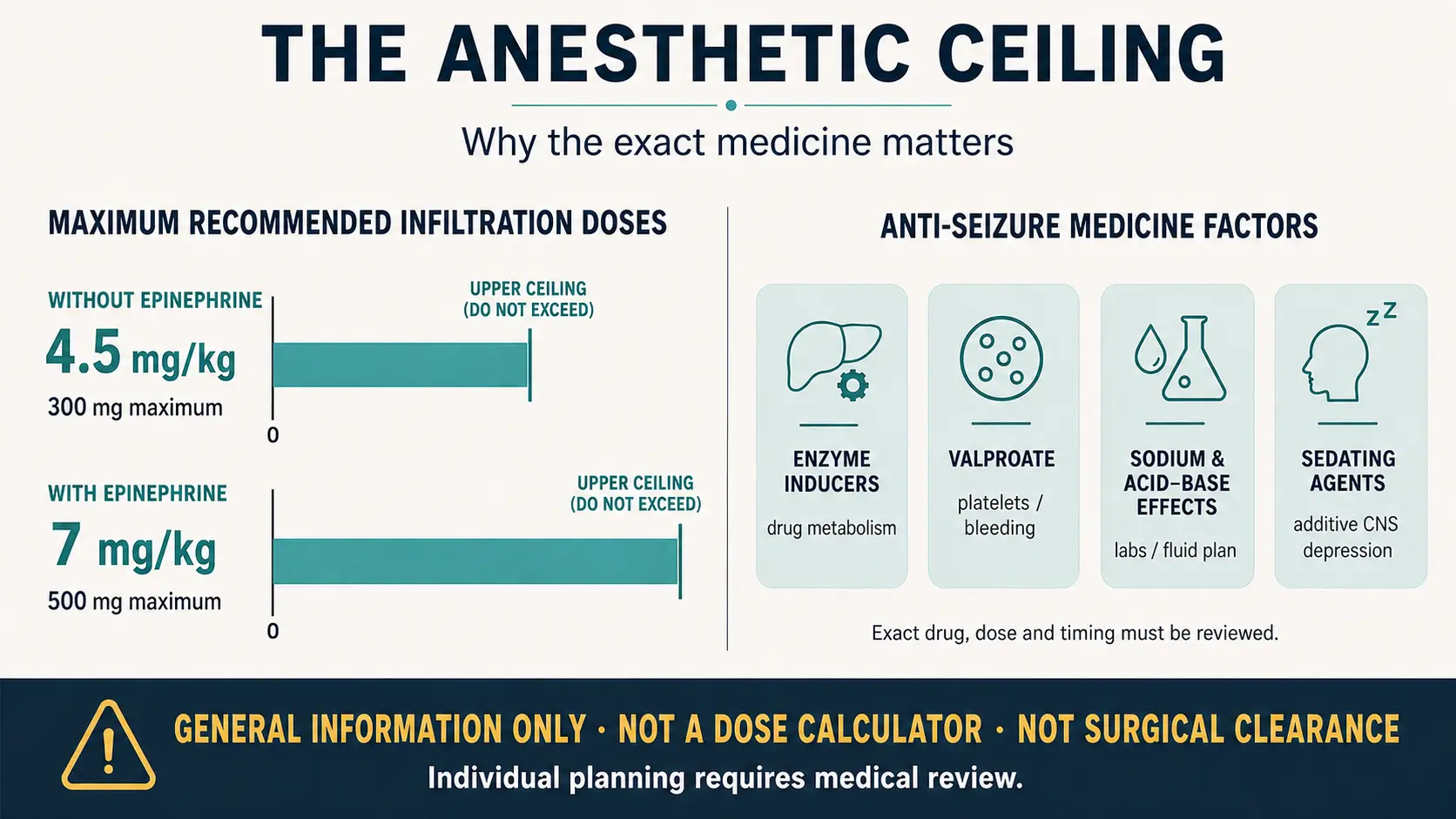
For normal healthy adults, United States product information for infiltrated lidocaine gives the following maximum recommended doses: [4]
| Lidocaine preparation | Label maximum | General total cap |
|---|---|---|
| Without adrenaline (epinephrine) | 4.5 mg/kg | 300 mg |
| With adrenaline (epinephrine) | 7 mg/kg | 500 mg |
These numbers belong beside the safety claim, but they need context.
First, a maximum is not a target. The product information says to use the lowest concentration and smallest dose that produces adequate anesthesia. It also advises dose reduction in elderly or debilitated patients and in people with cardiac or liver disease. Tissue vascularity, injection site and technique, speed of administration, individual health and the use of other local anesthetics all affect risk. Toxic effects from different local anesthetics are additive. [4–6]
Second, dose must be counted in milligrams rather than guessed from volume. One per cent lidocaine contains 10 mg per mL, whereas 0.5% contains 5 mg per mL. Every source used during the day has to be included in one running total.
Third, tumescent anesthesia can involve very dilute lidocaine in a large volume of fluid. Higher dose ranges have been studied mainly in liposuction, where absorption and removal of anesthetic-containing fat create a very different pharmacokinetic situation. Those liposuction figures should not be copied onto scalp surgery as if “tumescent” were a license to exceed standard infiltration limits. Reviews of non-liposuction dermatologic surgery specifically caution that the evidence is more limited. [8]
The patient's own calculation from body weight is therefore not enough. The clinician must know the exact formulation, concentration, volume, timing and other local anesthetics being used, then choose a patient-specific plan below the appropriate ceiling.
How cumulative dose should change the surgical plan
A long operation should have a written anesthetic plan before the first injection, not a total reconstructed from empty vials at the end of the day.
In practical terms, I want the plan to cover:
- the patient's weight and the lowest appropriate dose ceiling
- the concentration and milligrams in every anesthetic solution
- a live cumulative dose record, including top-ups
- incremental rather than rapid large-volume injection where feasible
- aspiration and injection technique intended to reduce accidental intravascular administration
- cardiovascular, respiratory and consciousness monitoring appropriate to the case
- intravenous access and an emergency plan when the clinical assessment requires it
- the patient's usual seizure pattern and prescribed rescue plan
- a clear stopping point if the operation is taking longer or requiring more anesthetic than expected
ASRA's guidance emphasizes prevention, early recognition and a specific resuscitation pathway for LAST. A setting using local anesthetic in amounts capable of causing systemic toxicity should have trained personnel, oxygen, resuscitation equipment, seizure-rescue medication and 20% lipid emulsion immediately available, together with a current LAST checklist. Lipid emulsion is part of emergency treatment for suspected severe LAST; it is not something improvised after a problem begins. [5,6]
When splitting the procedure can make sense
Sometimes the sensible plan is a smaller operation. In other cases, the work can be divided into two shorter days.
Splitting a procedure may reduce the anesthetic burden required in one day, shorten prolonged positioning and fatigue, make usual medicine timing easier to preserve, and allow a night's sleep between stages. It doesn't create permission to use twice as much local anesthetic, and it doesn't remove risk. Each day still needs its own dose calculation, monitoring and stop point.
The trade-off is a second procedural day, another period of local anesthesia and a longer stay. I would consider it when the intended graft plan, expected duration and medical background make one long day less sensible.
Graft count should adapt to the medical plan, not force the medical plan to stretch around a sales number.
Antiseizure medicines and perioperative interactions
The medicine list isn't an administrative detail. It changes the plan.
Antiseizure medicines should generally be continued through the perioperative period, and abrupt withdrawal should be avoided. A dose shouldn't be skipped because the patient is traveling, fasting, nervous or sitting in a procedure chair. If the usual oral schedule cannot be maintained, the prescribing clinician must decide whether timing, formulation or route needs to change. [2,3,9–11]
Different medicines create different considerations:
| Medicine or group | Why it matters around surgery | What the patient should do |
|---|---|---|
| Carbamazepine | A strong enzyme inducer that can alter the effect of benzodiazepines, some opioids, corticosteroids and other perioperative medicines. Macrolide antibiotics can raise carbamazepine concentrations; sodium should also be considered. | Provide the exact product, dose and schedule. Don't stop it. The clinical team must check the complete perioperative medicine list. |
| Phenytoin | A potent enzyme inducer with a narrow therapeutic index and clinically relevant interactions. Caution is described with lidocaine as well as several sedatives, analgesics and antibiotics. | Provide the exact formulation and schedule. Don't switch products or alter timing without specialist advice. |
| Valproate / sodium valproate | Can be associated with thrombocytopenia, impaired platelet function and other coagulation changes; it can also increase exposure to some sedatives. | Don't stop it. Disclose bruising or bleeding history. A full blood count and further coagulation assessment may be appropriate before surgery. |
| Levetiracetam and several newer agents | Often have fewer CYP-mediated interactions than carbamazepine or phenytoin, but dose timing and seizure control still matter. | Include them on the full medication list and take them exactly as directed. |
Carbamazepine and phenytoin are well-established inducers of hepatic drug-metabolizing enzymes, so they can lower exposure to medicines used for sedation, pain control or inflammation. The reverse can also occur: another medicine may raise an antiseizure drug concentration and cause toxicity. [9,10,12]
Valproate deserves separate attention in hair transplantation because the scalp is vascular and surgery creates thousands of small extraction and recipient sites. Valproate-related laboratory changes don't mean every patient will bleed excessively, but they are a reason to ask about bruising or bleeding and to consider a blood count and coagulation evaluation rather than ignoring the medicine name. [11,13]
The complete list also needs to include non-prescription products, alcohol or recreational drug use, and any rescue medicine. Tramadol is a practical example of a drug that should generally be avoided in people with a history of epilepsy because it can increase seizure risk. [9]
Sleep, flying to Istanbul and the early-morning operation
This is where medical advice meets the way international hair transplantation actually happens.
A patient may finish work, take an evening flight, arrive in Istanbul after midnight, sleep badly in an unfamiliar hotel and report to the clinic early in the morning. Time-zone changes can also shift the usual antiseizure-medicine schedule. On paper, the epilepsy may be “controlled”. In reality, the patient has combined several familiar seizure triggers before the first injection.
Sleep deprivation is widely recognized as a seizure trigger, although its effect varies between individuals and epilepsy syndromes. Reviews describe both clinical experience and experimental evidence linking insufficient sleep with increased seizure susceptibility. [14]
The direct research on flying is much smaller. In a 2006 prospective study, only 37 people with epilepsy recorded their seizures for one week before and one week after air travel. Seizures were more common after flying for the group as a whole (p=.02), but none occurred during the flight. The increase was concentrated among people with a higher baseline seizure frequency or a previous pattern of flight-related worsening; none of the ten participants who reported complete seizure control before the trip had a seizure afterward. The study was small, relied on self-report and couldn't separate sleep loss, anxiety, schedule disruption and cabin-related effects, so it shouldn't be turned into a claim that flying itself triggers every patient. [15]
For a patient with epilepsy, I don't want the cheapest flight time or the tightest itinerary deciding the medical condition in which surgery begins. The travel plan should allow normal sleep, regular meals, hydration and on-time medication. Someone crossing time zones should ask the treating clinician how to preserve the dosing interval rather than moving tablets to local clock time by guesswork. Epilepsy travel guidance also recommends planning around disrupted sleep, long delays and medicine timing. [16]
There isn't one arrival rule for everyone, but landing late at night and starting a long elective procedure the next morning is a poor plan for a patient whose seizures are sensitive to sleep loss. A buffer night — or longer after substantial time-zone travel — may be appropriate, and the neurologist's advice should shape that decision.
What I need to know before discussing surgery
Before I discuss graft numbers, I need a medically useful history:
- the exact diagnosis and seizure type
- the date, circumstances and recovery course of the most recent seizure
- usual seizure frequency and whether there are nocturnal seizures
- any history of prolonged seizures, status epilepticus, emergency treatment, hospitalization or intubation
- known triggers, including sleep loss, missed meals, stress, alcohol, flashing light or missed medicine
- every antiseizure medicine, brand or formulation where relevant, dose and exact dosing times
- recent dose changes, missed doses, side effects or breakthrough seizures
- prescribed rescue medicine, when it was last needed and the patient's seizure action plan
- other prescription medicines, supplements, alcohol and recreational drug use
- liver, kidney or cardiac disease and any previous problem with local anesthesia
- bruising or bleeding history, especially with valproate
- flight times, time-zone change and intended arrival date
- the treating neurologist's assessment of elective surgery under local anesthesia
This review happens before non-refundable travel is treated as permission to operate. A booked flight doesn't change a medical decision.
When I would postpone the procedure
I would not proceed simply because the patient has reached Istanbul. Reasons to pause and obtain further assessment or postpone include:
- a recent, recurrent or unpredictable seizure pattern
- a medicine change whose effect hasn't yet been assessed
- missed or delayed antiseizure doses
- no adequate information from the clinician treating current epilepsy
- significant sleep deprivation, acute illness, dehydration, fasting or alcohol withdrawal
- unresolved bruising, bleeding or abnormal blood results where relevant
- an interaction between the antiseizure medicine and the proposed perioperative medicines that hasn't been addressed
- an operation whose expected duration or anesthetic requirement cannot be planned with an adequate margin
- a setting without the monitoring, rescue equipment, lipid emulsion or trained response required for local-anesthetic emergencies
Postponement isn't a judgment about the patient and it doesn't mean surgery will never be possible. It means an elective cosmetic procedure has no justification for borrowing safety from an uncertain day.
What happens if a seizure occurs during the procedure
The procedure stops. The immediate priorities are to protect the patient from injury, assess airway and breathing, provide oxygen as indicated, monitor circulation and identify a reversible cause. The team needs to note the timing in relation to local-anesthetic administration and consider LAST, hypoglycemia, missed medicine and other metabolic or medication-related causes rather than assuming every event is a routine breakthrough seizure. [2,3,5,6]
Treatment depends on the clinical picture and the patient's established rescue plan. A prolonged or recurrent seizure, incomplete recovery, cardiorespiratory abnormality or suspected LAST requires emergency escalation and hospital assessment. In suspected LAST, the resuscitation pathway differs in important ways from standard cardiac life support, which is why a dedicated checklist and immediately available 20% lipid emulsion matter. [5,6]
The operation doesn't resume because the schedule is inconvenient to change. Whether any remaining work can ever continue is a later medical decision made after the patient has recovered and the cause has been assessed.
Does epilepsy affect graft growth?
Epilepsy itself isn't known to prevent a correctly handled follicular graft from growing. The biological outcome still depends on donor quality, graft handling, recipient-site design, blood supply, healing, postoperative care and the future course of the patient's original hair.
The important connection is indirect. A poorly controlled medical condition, a medication-related bleeding problem, a seizure during surgery or an anesthetic emergency can disrupt a procedure and recovery. That is why safety planning comes before density planning.
The same donor principle applies as in any Norwood-stage assessment: the donor supply is finite, and the plan has to make sense beyond one operation. In a medically more complex case, restraint may mean fewer grafts, a shorter session or two carefully planned days.
Scalp health is a separate part of candidacy. Epilepsy doesn't explain active redness, scale, pustules or inflammation; those findings need their own diagnosis. I discuss that in more detail in Does Scalp Inflammation Affect Hair Transplant Success? and Can You Have a Hair Transplant With Seborrheic Dermatitis?
The practical bottom line
I don't treat epilepsy as an automatic refusal, and I don't treat “seizure-free” as automatic clearance.
For a patient with current epilepsy or ongoing antiseizure treatment, I want the treating neurologist's written input before I confirm elective hair transplantation. I then review the medicine interactions, travel and sleep plan, bleeding considerations, expected procedure length and the total local-anesthetic strategy. The anesthetic record has to follow milligrams across the entire day, and the clinical setting must be ready to recognize and treat LAST.
That review may support a conventional one-day procedure. In other cases, the individual medical and surgical assessment supports a shorter session, a two-day plan or postponement until seizure control is clearer.
Frequently asked questions
Can I have a hair transplant if I have epilepsy?
Do I need neurologist approval before a hair transplant?
Can I have a hair transplant while taking epilepsy medicine?
Should I stop or change the time of my epilepsy medicine before surgery?
Is local anesthesia safe for someone with epilepsy?
What are the maximum lidocaine doses?
What is LAST?
What happens if I have a seizure during the procedure?
Should a clinic have lipid emulsion available?
Can the hair transplant be split over two days?
Is general anesthesia safer for a patient with epilepsy?
Is flying or lack of sleep a risk before surgery?
When should a hair transplant be postponed in a patient with epilepsy?
Does epilepsy reduce hair-transplant growth?
— Dr. Mesut Demir
Requesting a medical case review
If you have epilepsy or a previous seizure and are considering hair transplantation, send the diagnosis, date of the last seizure, current medicine names and doses, usual dosing times, known triggers and any rescue plan before booking surgery. I will tell you what additional records or treating-neurologist input are needed before we discuss a surgical date. Submitting information is not medical clearance and does not guarantee that surgery will be offered.
Request a case review- Fisher RS, Acevedo C, Arzimanoglou A, et al. ILAE official report: a practical clinical definition of epilepsy. Epilepsia. 2014;55(4):475–482. doi:10.1111/epi.12550
- Smiley M, Key B, Sawicki CM, Wade SD. Perioperative management of patients with seizure disorders: part II. Anesthesia Progress. 2025;72(3):189–198. doi:10.2344/25-0028
- Perks A, Cheema S, Mohanraj R. Anaesthesia and epilepsy. British Journal of Anaesthesia. 2012;108(4):562–571. doi:10.1093/bja/aes027
- Lidocaine hydrochloride and epinephrine injection, USP — prescribing information. DailyMed, U.S. National Library of Medicine.
- Neal JM, Neal EJ, Weinberg GL. American Society of Regional Anesthesia and Pain Medicine local anesthetic systemic toxicity checklist: 2020 version. Regional Anesthesia and Pain Medicine. 2021;46(1):81–82. doi:10.1136/rapm-2020-101986
- Neal JM, Barrington MJ, Fettiplace MR, et al. The third American Society of Regional Anesthesia and Pain Medicine practice advisory on local anesthetic systemic toxicity: executive summary 2017. Regional Anesthesia and Pain Medicine. 2018;43(2):113–123. doi:10.1097/AAP.0000000000000720
- A&gcaron;açkiran İ, Özdamar Y, İlhan B, Aksu NM. Bupivacaine-induced systemic toxicity in a hair transplantation procedure. Dermatologic Surgery. 2021;47(4):573–574. doi:10.1097/DSS.0000000000002383
- Uttamani RR, Venkataram A, Venkataram J, Mysore V. Tumescent anesthesia for dermatosurgical procedures other than liposuction. Journal of Cutaneous and Aesthetic Surgery. 2020;13(4):275–282. doi:10.4103/JCAS.JCAS_192_19
- Carbamazepine — Handbook of Perioperative Medicines. UK Clinical Pharmacy Association.
- Phenytoin — Handbook of Perioperative Medicines. UK Clinical Pharmacy Association.
- Sodium valproate — Handbook of Perioperative Medicines. UK Clinical Pharmacy Association.
- Perucca E. Clinically relevant drug interactions with antiepileptic drugs. British Journal of Clinical Pharmacology. 2006;61(3):246–255. doi:10.1111/j.1365-2125.2005.02529.x
- Abdallah C. Considerations in perioperative assessment of valproic acid coagulopathy. Journal of Anaesthesiology Clinical Pharmacology. 2014;30(1):7–9. doi:10.4103/0970-9185.125685
- Dell'Aquila JT, Soti V. Sleep deprivation: a risk for epileptic seizures. Sleep Science. 2022;15(2):245–249. doi:10.5935/1984-0063.20220046
- Trevorrow T. Air travel and seizure frequency for individuals with epilepsy. Seizure. 2006;15(5):320–327. doi:10.1016/j.seizure.2006.03.006
- Traveling tips — guidance on time zones, sleep deprivation, delays and medicine access. Epilepsy Foundation.