
Quick answer
A 2026 systematic review of 14 studies and 2,344 people exposed to supplemental androgens found signals of increased androgenetic alopecia in some groups, particularly transgender men receiving testosterone and anabolic-steroid users, but the studies were too different to produce one reliable hair-loss rate for everyone. Before surgery the question is not simply whether testosterone is present: Dr. Mesut Demir needs to know whether native hair is still miniaturizing, whether the donor area is stable, whether blood pressure and hematocrit are acceptable, and whether another high-androgen cycle is planned during recovery. Prescribed testosterone replacement therapy should not be stopped without the clinician who manages it, and non-prescribed anabolic-steroid use needs to be disclosed honestly before elective surgery.
Testosterone gets blamed for hair loss more often than almost anything else I hear in consultation. Sometimes that blame is fair. More often it is aimed at the wrong part of the problem.
Testosterone replacement therapy does not make every patient lose hair, and anabolic steroids do not affect every scalp in the same way. The questions that actually change a surgical plan are narrower than "are you on testosterone": which androgen is being used, at what exposure, how sensitive the follicles are, whether the loss is still moving, and whether the donor area can support a plan that still makes sense years from now.
This article is about that assessment, and about the limits of what the evidence lets me promise. It is a subject where very confident numbers circulate online that no published study supports.
- What does the 2026 systematic review actually show?
- Why testosterone levels alone do not predict hair loss
- TRT and anabolic steroid use are not the same thing
- Which steroids are more concerning for hair?
- Why finasteride does not protect against every steroid
- Finasteride, testosterone and estradiol
- Can minoxidil make up for androgen exposure?
- Why TRT or steroid use changes transplant planning
- Blood pressure, hematocrit and the surgical assessment
- Scalp inflammation and acne also matter
- What if a cycle is planned after surgery?
- Does steroid use damage transplanted grafts?
- What I need patients to tell me
- When I may recommend waiting
- Frequently asked questions
What does the 2026 systematic review actually show?
The strongest recent source on this question is a systematic review by Gupta and colleagues, published in JAAD International in 2026. It brought together 14 studies covering 2,344 people exposed to supplemental androgens, which makes it the broadest synthesis available. It is also, deliberately, a cautious one.
The populations, indications, formulations and hair outcomes varied so much that the authors could not produce one reliable hair-loss rate. That limitation is worth sitting with, because a single percentage is exactly what most patients want from it.
Among 1,383 transgender men receiving androgens for gender-affirming care, androgenetic alopecia was reported in 19.5% after treatment, against 1.9% at baseline. In 285 androgen-deficient women using subcutaneous testosterone, none reported new hair loss at all; of the 76 who already had thinning before treatment, 48 — 63.1% — reported regrowth.
Those two groups are not interchangeable, and neither one stands in for a 45-year-old man on prescribed TRT. Read together, though, they make one point clearly enough: the scalp's response to added androgen is not uniform.
| Finding | What it means clinically |
|---|---|
| 14 studies, 2,344 participants | The broadest recent synthesis available, but not one uniform patient group. |
| Alopecia rose from 1.9% to 19.5% in 1,383 transgender men receiving androgens | Testosterone exposure can reveal or accelerate pattern loss in a susceptible population. |
| No new hair loss reported in 285 androgen-deficient women | The effect of androgen treatment varies with the biological context it lands in. |
| No pooled universal hair-loss percentage | A precise personal risk cannot be calculated from this review, and I will not invent one. |
A separate prospective cohort, the HAARLEM study, followed 100 men through a self-administered anabolic steroid cycle. Self-reported alopecia rose from 2% before the cycle to 12% by the end of it. Hair density was never measured objectively, so I read that as a signal rather than as a risk figure any individual can apply to himself.
Why testosterone levels alone do not predict hair loss
Androgenetic alopecia is a genetically influenced process in which susceptible follicles progressively miniaturize under androgen signaling, largely through dihydrotestosterone, or DHT. The frontal scalp, mid-scalp and crown are usually more vulnerable than the traditional donor zone, and that single difference is the foundation of every FUE hair transplant.
It is also why two men with almost identical serum testosterone can have completely different hair. A blood result cannot tell me how many androgen receptors are active in a particular scalp, how much local 5-alpha-reductase activity there is, or how far miniaturization has already gone. Family history, the age thinning started, how fast things have moved recently and what I see under trichoscopy tell me more about surgical risk than any single hormone value.
The scalp does not care whether the androgen came from a prescription or a training plan. It responds to the androgenic environment and to what the follicle inherited.
A cycle rarely creates the tendency out of nothing. More often it brings forward something that was already waiting. Patients tell me their hair was completely fine before they started, and that is usually true. It just was not going to stay fine indefinitely.
TRT and anabolic steroid use are not the same thing
Prescribed testosterone replacement therapy treats confirmed hypogonadism and aims to hold testosterone within an appropriate physiological range, with diagnosis, dose monitoring and attention to side effects around it. Non-prescribed anabolic-androgenic steroid use usually means supraphysiological exposure, often several compounds, often changing between cycles. Medically those are different situations. For hair, they are different situations too.
Which is why the word "TRT" written on an intake form tells me very little on its own. Stable prescribed testosterone with regular blood tests is not the same thing as testosterone stacked with intermittent drostanolone, stanozolol or trenbolone. Those two histories should not receive the same advice, or the same surgical timing.
I do not reject a patient because testosterone has been prescribed. I also do not accept "TRT" as a complete medication history. The compound, the dose, the frequency, the duration, the monitoring and the plan for next year all matter.
Which steroids are more concerning for hair?
Patients ask me to rank the worst steroid for hair. I understand the question and I cannot answer it honestly. No reliable head-to-head human study ranks commonly used anabolic steroids by their effect on scalp hair. Animal androgenic-to-anabolic ratios, forum cycle reports and a compound's chemical family cannot be converted into a percentage risk for one genetically susceptible human scalp.
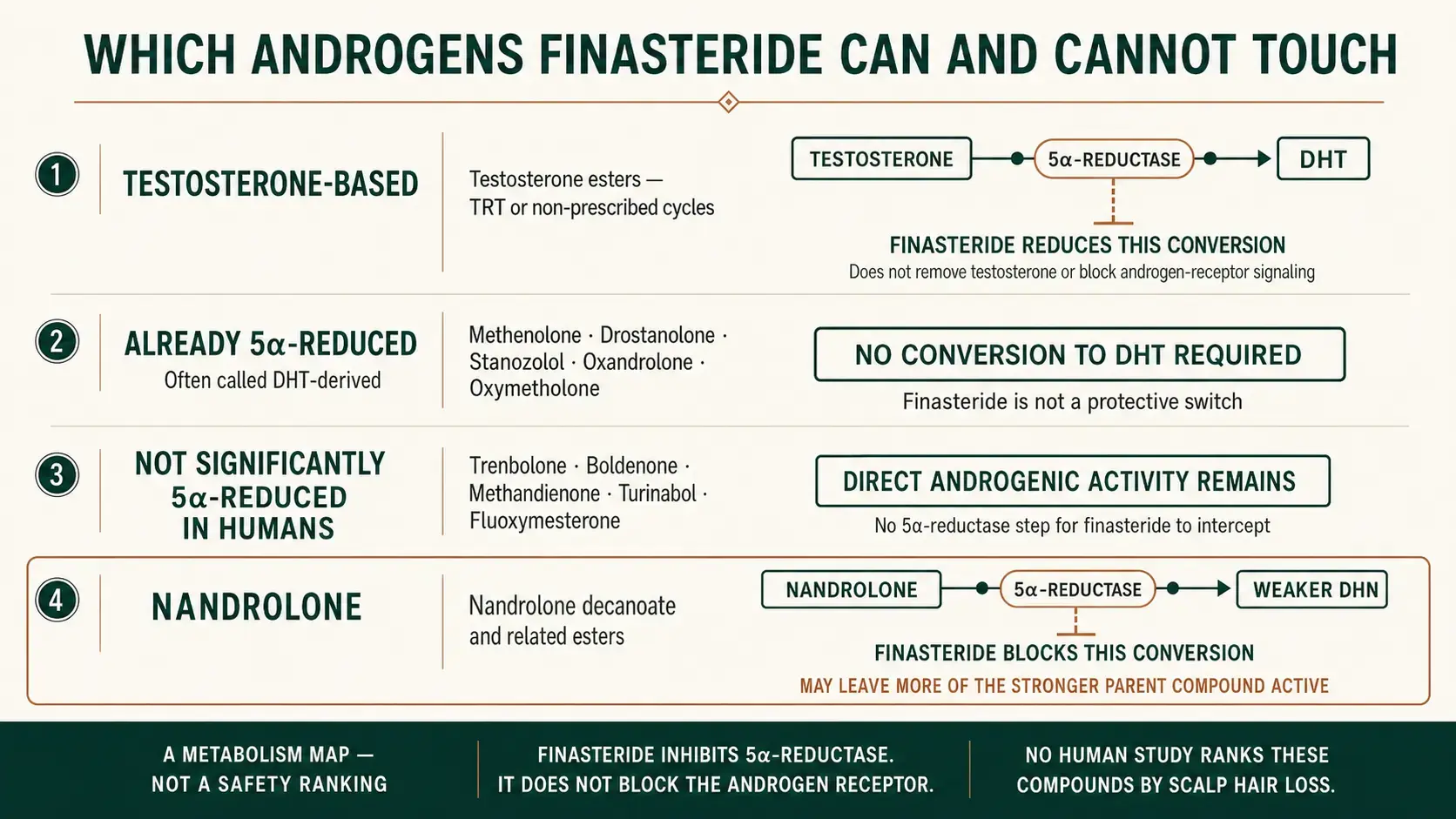
There is one distinction that is genuinely useful, and it is about metabolism rather than ranking. Finasteride inhibits 5-alpha-reductase. It reduces the conversion of testosterone to DHT. It does not block the androgen receptor, and it does not neutralize every synthetic androgen.
| Androgen group | Examples | What finasteride can and cannot do |
|---|---|---|
| Testosterone-based exposure | Testosterone esters used in TRT or in non-prescribed cycles | Reduces conversion of testosterone to DHT. It does not remove testosterone itself, or all androgen-receptor signaling. |
| Already 5-alpha-reduced, often called DHT-derived | Methenolone, drostanolone, stanozolol, oxandrolone, oxymetholone | These do not need conversion to DHT in order to act. Finasteride is not a protective switch against them. |
| Not significantly 5-alpha-reduced in humans | Trenbolone, boldenone, methandienone, turinabol, fluoxymesterone | Finasteride does not block their direct androgenic activity. Trenbolone is not the same pharmacological case as nandrolone. |
| Nandrolone | Nandrolone decanoate and related esters | 5-alpha-reductase converts nandrolone to the weaker androgen dihydronandrolone. Blocking that step may leave more of the stronger parent compound active in androgen-sensitive tissue. |
That table comes from steroid pharmacology, not from transplant outcome trials. Its value is narrow but real: it explains why "I am on finasteride, so my hair is covered" can turn out to be an expensive assumption. What it cannot tell you is that every 5-alpha-reduced compound is worse for hair than every other drug at every dose.
Why finasteride does not protect against every steroid
Finasteride has good evidence in ordinary male androgenetic alopecia. In the two pivotal trials, 1,553 men took finasteride 1 mg or placebo, and the difference against placebo was 107 hairs at one year and 138 hairs at two years within a 5.1 cm² target area. A 2022 network meta-analysis in JAMA Dermatology later compared minoxidil, finasteride and dutasteride across 23 eligible studies.
None of that evidence was generated in men using anabolic steroids, and it should not be stretched to cover them. A major review of anabolic-androgenic steroids describes 5-alpha-reductase inhibitor use alongside high-dose testosterone or other AAS as unproven, because lower DHT can simply be offset by strong androgenic activity from whatever else is circulating.
Nandrolone deserves a warning of its own. Testosterone becomes the more potent androgen when 5-alpha-reductase converts it to DHT. Nandrolone does something close to the opposite: 5-alpha-reduction produces dihydronandrolone, which binds the androgen receptor far more weakly than nandrolone itself. Blocking that step with finasteride or dutasteride may therefore leave more of the stronger parent compound active in androgen-sensitive tissue.
I mention it because patients occasionally discover this halfway through a cycle, having added finasteride specifically to protect their hair. It is a pharmacological warning, not a recipe for a hair-safe nandrolone protocol. Transplant-specific data for any of this simply do not exist.
Trenbolone is a different case again. It acts without conversion to DHT, so finasteride offers no meaningful blockade of its direct androgen-receptor activity. I would not tell any patient that adding finasteride makes trenbolone, stanozolol, oxandrolone or drostanolone safe for native hair.
Finasteride, testosterone and estradiol
Lowering DHT while raising androgen exposure is not a one-line solution, and the hormone side of it is less dramatic than the internet suggests. In a one-year randomized trial, 99 healthy men received dutasteride 0.5 mg, finasteride 5 mg or placebo. Finasteride suppressed serum DHT by 73% and produced a transient rise in testosterone, while serum estradiol did not change significantly over the year.
That trial used 5 mg and excluded men using anabolic steroids, so it does not transfer cleanly to the 1 mg hair-loss dose, to TRT, or to a cycle. For anyone on medically managed TRT, hormone interpretation belongs with the prescribing clinician and that patient's own laboratory results. From the hair side the limitation is simpler than the hormone debate: finasteride lowers one metabolite and leaves the androgen receptor, along with every direct-acting steroid, untouched.
Topical finasteride comes up often with these patients, usually because of concerns about systemic exposure. It is a reasonable option for selected men, but it is not systemically silent. In a 24-week phase III trial of 458 men it improved target-area hair count by 20.2 hairs against 6.7 for placebo; peak plasma concentrations were more than a hundredfold lower than with oral finasteride, yet serum DHT still fell by 34.6%, against 55.6% with the oral drug. No anabolic steroid users were enrolled there either, so it cannot establish protection during a cycle.
Can minoxidil make up for androgen exposure?
Minoxidil can support growth in miniaturizing follicles. It does not block DHT and it does not touch androgen-receptor activation. The 2022 network meta-analysis supports minoxidil, finasteride and dutasteride as monotherapies in male pattern hair loss, but it never tested whether minoxidil can offset supraphysiological androgen exposure. Nothing has.
In practice that means minoxidil may improve the growth signal while the driver keeps running. That can still be worth doing, particularly in the crown. It is not a shield, and I will not describe it as one. Any of these medications should be chosen with a physician who has looked at the diagnosis, the contraindications and the formulation, rather than added quietly around an undisclosed cycle.
The same applies to topical finasteride, oral finasteride and dutasteride. Each carries its own exposure and side-effect profile, and none of them enlarges the donor area. Medical stabilization exists to protect the hair a patient still has, not to justify more aggressive surgery, which is really an argument for treating hair loss as a long-term plan rather than a single procedure.
Why TRT or steroid use changes transplant planning
A hair transplant moves follicular units. It does not stop androgenetic alopecia. Grafts are taken from a more androgen-resistant donor zone, but the native hair around them can carry on miniaturizing, and a result that looked coherent at twelve months can lose its visual support later.
That matters most in a young patient whose pattern is still moving through the stages I describe in The Norwood Scale Explained. A dense frontal band placed in front of an actively thinning mid-scalp can end up isolated. An aggressively treated crown can consume a large share of the donor before anyone knows how far the loss will eventually go.
I have written about the crown separately in Why Crown Hair Transplant Results Can Take Longer. Its whorl, curved surface and direct light exposure mean it asks for a great many grafts in return for a fairly modest visual change. If androgen exposure continues and the native crown hair recedes around the transplant, the area can look thin again even though the grafts grew.
Donor hair is finite, and it is not uniformly immune to androgen-related change. The aim is enough improvement from the fewest grafts that can responsibly achieve it.
So before deciding how much of the donor can be used, I look at density, caliber variation, miniaturization, retrograde loss and the family pattern. In male pattern hair loss, leaving capacity for the future is part of the design, not an afterthought to it.
Blood pressure, hematocrit and the surgical assessment
A TRT or steroid history is not only a hair question. Testosterone can raise hemoglobin and hematocrit, and erythrocytosis is the most frequently reported adverse event in testosterone trials. In the Endocrine Society guideline's evidence review, three trials involving 1,581 men found that testosterone treatment increased the risk of a hematocrit above 54% (relative risk 8.14; 95% confidence interval 1.87–35.40).
The 100-man prospective cohort mentioned earlier also measured cardiovascular change during a cycle: systolic blood pressure rose by an average of 6.87 mmHg, diastolic by 3.17 mmHg, and mean hematocrit by 0.03 L/L. Those measures returned to baseline three months after the cycle in that group, which is reassuring over the medium term and beside the point on the morning of an elective operation.
For a patient using testosterone or anabolic steroids, a recent blood pressure reading and a complete blood count may be clinically relevant before surgery, alongside everything else in the assessment. An abnormal value is not something a hair clinic manages on its own. The prescriber, or another appropriate physician, decides whether the regimen, an underlying cause, or the timing of the operation needs to be reconsidered.
I am not going to set an individual surgical cut-off in a blog article, or tell anyone to reduce, stop or restart testosterone. The point is narrower: "blood pressure history" and "recent blood tests" are not administrative boxes on a form. They can decide whether an elective procedure should go ahead at all.
Scalp inflammation and acne also matter
Androgen exposure can increase sebum production and acne in some patients. An oily scalp is not a contraindication by itself, but pustules, painful lesions, an active infection or an unclear inflammatory diagnosis should be assessed before elective surgery.
Broad labels are unhelpful here. Acne, folliculitis, seborrheic dermatitis and scarring inflammatory disease do not carry the same surgical implications, so the first job is to name the condition and decide whether it is controlled. I go through those distinctions in Does Scalp Inflammation Affect Hair Transplant Success?
Patients using ketoconazole shampoo for oiliness or dandruff should also know what it is and is not doing. It can help control seborrheic dermatitis. It is not a substitute for treating established androgenetic alopecia. The evidence and its limits are in Does Ketoconazole Shampoo Help Hair Loss?
What if a cycle is planned after surgery?
There is no controlled study telling me that a steroid cycle started on a particular postoperative day is safe for graft survival. None at week four, none at month three, none at month six. Any countdown presented online is more confident than the evidence allows.
I sometimes hear the decisive detail at the very end of an assessment, after the donor has been reviewed and a long-term plan discussed. "I am starting another cycle three months after surgery. The protocol I found says that is enough time." The whole conversation changes at that point. Nobody has established what month three means for graft survival, and the native hair around those grafts may still be vulnerable. I would much rather hear about that plan before surgery is booked than during the final medical history.
It also helps to separate two different questions. Early on, the scalp is healing from thousands of small recipient and donor wounds. Later, the concern shifts to continued miniaturization of native hair, scalp inflammation, blood pressure, hematocrit, and whether the result still holds together as a whole.
If a non-prescribed cycle is planned soon after surgery, I would rather postpone the operation than pretend a date on a calendar removes those uncertainties. Prescribed TRT is a different matter: continuation or adjustment should be coordinated with the clinician managing it, and no patient should stop necessary treatment on their own.
Does steroid use damage transplanted grafts?
Direct transplant-specific evidence is missing, and I am not going to quote a graft-survival penalty that no study has established. The documented, biologically plausible concern is progression of androgen-sensitive native hair, not the sudden failure of every transplanted follicle.
Disclosure still matters, because anabolic steroid use tends to travel with other things: raised blood pressure, erythrocytosis, acne, folliculitis, altered lipids. Those affect an elective-surgery assessment. It also changes how likely it is that the surrounding pattern stays stable.
So a transplant can be technically successful while the overall appearance deteriorates, simply because the native hair kept receding. Graft survival, visual density and long-term planning are three different outcomes, and only the first is decided in the operating room.
What I need patients to tell me
The useful version of this history is specific. "Supplements", "TRT" and "something for training" are not enough. Before planning surgery I ask for:
- The exact name of every prescribed or non-prescribed hormone or anabolic steroid
- Dose, route and frequency
- Start date, last use and total duration
- Whether several compounds were combined
- Any post-cycle medication
- The dates and results of recent blood pressure checks and blood tests
- Finasteride, dutasteride, minoxidil or any other hair treatment
- Recent shedding, recession or crown change
- Acne, pustules, itching, scale or scalp pain
- Any planned future cycle, and its timing relative to surgery
This belongs in the medical history for two reasons: a safer elective-surgery assessment, and a more honest estimate of long-term hair risk. I am not asking in order to judge anyone, and I am not asking in order to help design a cycle. Non-prescribed steroid use is neither endorsed nor optimized here.
Patients sometimes brace for a lecture when they tell me. What they get instead is a plan built on what is actually happening, which is the only kind of plan worth having.
When I may recommend waiting
I may suggest medical assessment, a period of observation, or postponement when hair loss is moving quickly, when TRT has recently changed, when steroid use is ongoing, when blood pressure or hematocrit is abnormal, when the scalp is inflamed, or when the donor itself shows miniaturization. The same applies when another cycle is planned during recovery, or when the medication history is still unclear.
Waiting is not a refusal. It buys time to document progression with standardized photographs or trichoscopy, to investigate a health concern properly, and to see whether the proposed medical treatment is tolerated. Published hair transplant practice guidelines put patient selection, diagnosis, donor assessment, medical history and realistic long-term planning ahead of graft numbers, and that order is deliberate.
When surgery is appropriate, I favor a conservative design and a donor budget that leaves room for future loss. The operation should treat the pattern that can be treated responsibly now, without pretending that ongoing androgen exposure has taken the uncertainty out of the next ten years.
My view
Testosterone and anabolic steroids do not reduce to a yes-or-no transplant rule. The same exposure produces different hair outcomes in different people, and compounds that get grouped together as "steroids" behave differently in the 5-alpha-reductase pathway.
My job is to keep what is known separate from what is assumed. The evidence supports real concern about accelerated native-hair loss in susceptible patients, and about systemic issues such as blood pressure and erythrocytosis. It does not provide a universal hair-loss percentage, a hair-safe steroid ranking, or a proven postoperative date for restarting a cycle. Anyone offering those three things is guessing.
For the right patient, a conservative transplant can still be a good decision. For an unstable pattern, an unclear drug history, or a cycle planned straight after surgery, waiting usually preserves more options than operating now.
The best plan is not the biggest plan. It is the one that still makes sense years later, when the donor cannot be topped up.
Frequently Asked Questions
Does testosterone cause hair loss?
Does TRT always cause hair loss?
Which steroids cause hair loss?
Are DHT-derived steroids worse for hair?
Can finasteride help while I use TRT?
Does finasteride work with nandrolone?
Does finasteride protect against trenbolone, stanozolol or drostanolone?
Is minoxidil enough if steroid use is accelerating hair loss?
Will hair grow back after stopping steroids?
I started TRT and my hair began shedding. Should I stop?
Can I have a hair transplant while using TRT?
Should I stop testosterone before a hair transplant?
How long after a hair transplant can I start another steroid cycle?
Do I have to tell the clinic that I use steroids?
— Dr. Mesut Demir
Using TRT or other androgens and considering a hair transplant?
Share your exact medication history, any recent hair changes and whatever blood-test results you have. We will come back with a preliminary view on timing, donor safety and what a realistic long-term plan looks like in your case.
Request a Pure Line case review- Gupta S, Bai JQA, Geng RSQ, Donovan J. The effect of androgen supplementation on hair loss: a systematic review. JAAD International. 2026;26:20–22. doi:10.1016/j.jdin.2026.03.011
- Smit DL, Buijs MM, de Hon O, den Heijer M, de Ronde W. Positive and negative side effects of androgen abuse. The HAARLEM study: a one-year prospective cohort study in 100 men. Scandinavian Journal of Medicine & Science in Sports. 2021;31(2):427–438. doi:10.1111/sms.13843
- Bond P, Smit DL, de Ronde W. Anabolic-androgenic steroids: how do they work and what are the risks? Frontiers in Endocrinology. 2022;13:1059473. doi:10.3389/fendo.2022.1059473
- Trüeb RM. Molecular mechanisms of androgenetic alopecia. Experimental Gerontology. 2002;37(8–9):981–990. doi:10.1016/s0531-5565(02)00093-1
- Ntshingila S, Oputu O, Arowolo A, Khumalo NP. Androgenetic alopecia: an update. JAAD International. 2023;13:150–158. doi:10.1016/j.jdin.2023.07.005
- Tawanwongsri W, Desai DD, Nohria A, Shapiro J, Lo Sicco KI. Hair loss in athletic testosterone use in males: a narrative review. International Journal of Dermatology. 2025;64(4):654–658. doi:10.1111/ijd.17567
- Tóth M, Zakár T. Relative binding affinities of testosterone, 19-nortestosterone and their 5-alpha-reduced derivatives to the androgen receptor and to other androgen-binding proteins. Journal of Steroid Biochemistry. 1982;17(6):653–660. doi:10.1016/0022-4731(82)90567-2
- Kaufman KD, Olsen EA, Whiting D, et al. Finasteride in the treatment of men with androgenetic alopecia. Journal of the American Academy of Dermatology. 1998;39(4 Pt 1):578–589. doi:10.1016/s0190-9622(98)70007-6
- Gupta AK, Venkataraman M, Talukder M, Bamimore MA. Relative efficacy of minoxidil and the 5-alpha reductase inhibitors in androgenetic alopecia treatment of male patients: a network meta-analysis. JAMA Dermatology. 2022;158(3):266–274. doi:10.1001/jamadermatol.2021.5743
- Amory JK, Wang C, Swerdloff RS, et al. The effect of 5-alpha-reductase inhibition with dutasteride and finasteride on semen parameters and serum hormones in healthy men. The Journal of Clinical Endocrinology & Metabolism. 2007;92(5):1659–1665. doi:10.1210/jc.2006-2203
- Piraccini BM, Blume-Peytavi U, Scarci F, et al. Efficacy and safety of topical finasteride spray solution for male androgenetic alopecia: a phase III, randomized, controlled clinical trial. Journal of the European Academy of Dermatology and Venereology. 2022;36(2):286–294. doi:10.1111/jdv.17738
- Bhasin S, Brito JP, Cunningham GR, et al. Testosterone therapy in men with hypogonadism: an Endocrine Society clinical practice guideline. The Journal of Clinical Endocrinology & Metabolism. 2018;103(5):1715–1744. doi:10.1210/jc.2018-00229
- Smit DL, Grefhorst A, Buijs MM, et al. Prospective study on blood pressure, lipid metabolism and erythrocytosis during and after androgen abuse. Andrologia. 2022;54(4):e14372. doi:10.1111/and.14372
- Mysore V, Kumaresan M, Garg A, et al. Hair transplant practice guidelines. Journal of Cutaneous and Aesthetic Surgery. 2021;14(3):265–284. doi:10.4103/JCAS.JCAS_104_20