Quick answer
Forehead swelling after a hair transplant is common, affecting close to half of patients, while swelling around the eyes is much rarer at roughly 3–5%. It comes from tumescent fluid, surgical inflammation, temporarily disrupted lymphatic drainage and gravity — not from the grafts. It usually peaks on the second or third day and settles within about five to seven days. Painless swelling that is improving is reassuring; swelling with increasing pain, spreading redness, warmth, discharge or fever needs prompt assessment by the clinic that performed the procedure.
A patient sends me a photograph a few days after his hair transplant. His forehead looks noticeably fuller than it did the day before. Sometimes the swelling has already started moving toward the eyebrows. Occasionally one or both eyelids are puffy too.
The message underneath is almost always the same three words:
"Is this normal?"
Most of the time, yes.
Swelling after a hair transplant can look far more dramatic than it actually is. In a patient who is otherwise well — no increasing pain, no spreading redness, no warmth, no discharge, no fever — this is usually temporary postoperative edema rather than a sign that something has gone wrong.
What matters is knowing the difference. That is what this article is about.
Is Swelling Normal After a Hair Transplant?
Yes, and it is common. A recent review of complications after follicular unit excision reports frontal swelling in close to half of patients.
What surprises people is how rarely it reaches the eyes. In the same review, periorbital swelling — the puffy-eyelid version everyone worries about — occurs in roughly 3 to 5% of patients.
So the common version is a fuller forehead. The version that makes people panic is the uncommon one.
Swelling also tends to be more pronounced after megasessions, or when dense packing has been done across the frontal scalp. More work in one area means more of everything: more fluid, more inflammation, more response.
I should add one thing here. Reported rates vary quite a lot between studies, because surgical technique, the volume of fluid used, how swelling was defined and the postoperative protocol all differ. So I do not think the simple presence or absence of swelling tells us whether a hair transplant was performed well. The severity, the direction it is heading and the symptoms alongside it are far more useful.
Why Your Forehead Swells
The transplanted grafts are not producing the swelling. Four things are, and they work together.
Tumescent fluid. During surgery we infiltrate the scalp with local anesthetic and tumescent solution. Tumescence helps us stay in the correct tissue plane, control bleeding and create recipient sites more precisely. It is useful. It is also fluid, and it has to go somewhere.
Inflammation. The recipient area has just undergone thousands of very small surgical wounds. The body answers that with an inflammatory response, which temporarily increases fluid in the surrounding tissue.
Lymphatic disruption. Normal drainage in the operated area is temporarily disturbed, so fluid clears more slowly than it otherwise would.
Gravity. The recipient area sits above the forehead, and the forehead sits above the eyelids. Fluid moves downward through soft tissue because that is what fluid does.
So when a patient tells me "the anesthesia moved into my forehead," that is not the whole explanation. But I understand why it feels that way.
Why It Sometimes Reaches the Eyes
The skin and soft tissue around the eyelids are unusually loose, which makes them an easy place for fluid to collect. A patient can have a full-looking forehead in the evening and wake up with puffy eyes.
In more pronounced cases the upper eyelids swell enough that opening the eyes feels uncomfortable. That is frightening to look at in a mirror.
It does not automatically mean infection, and it does not mean something has happened to the grafts. Remember the numbers: this is the 3-to-5% presentation, and most of those patients settle on the normal timeline like everyone else.
Swelling can become visually dramatic without becoming medically dangerous. Those are two separate questions, and patients understandably confuse them.
A Patient From Our Clinic
We recently had a patient contact us because swelling that had started on his forehead was beginning to move lower. He looked in the mirror and, naturally, worried.
We asked for clear photographs and went through his symptoms. No spreading redness. No throbbing pain. No fever, and he otherwise felt completely well. We also found he had been spending far more time than we advise with his head angled down.
Nothing in the picture suggested infection. We kept following him through photographs, reminded him about positioning, and the swelling settled on its own.
I see versions of this every month. The appearance alarms the patient while the clinical picture is entirely reassuring. It is also why I would rather patients message us than try to diagnose themselves from photographs they find online.
When Is Swelling Worst? The Usual Timeline
The pattern is fairly predictable, which is one of the more reassuring things about it.
| When | What usually happens |
|---|---|
| Day of surgery | Often surprisingly little facial swelling |
| Days 1–2 | Forehead begins to look fuller |
| Days 2–3 | Usually the peak; may start moving toward the eyes |
| Days 5–7 | Normally resolving |
| After day 7 | Should be clearly improving — if it is not, have it assessed |
Typical course only. Individual recovery varies, and any swelling accompanied by increasing pain, spreading redness, warmth, discharge or fever should be assessed regardless of which day it is.
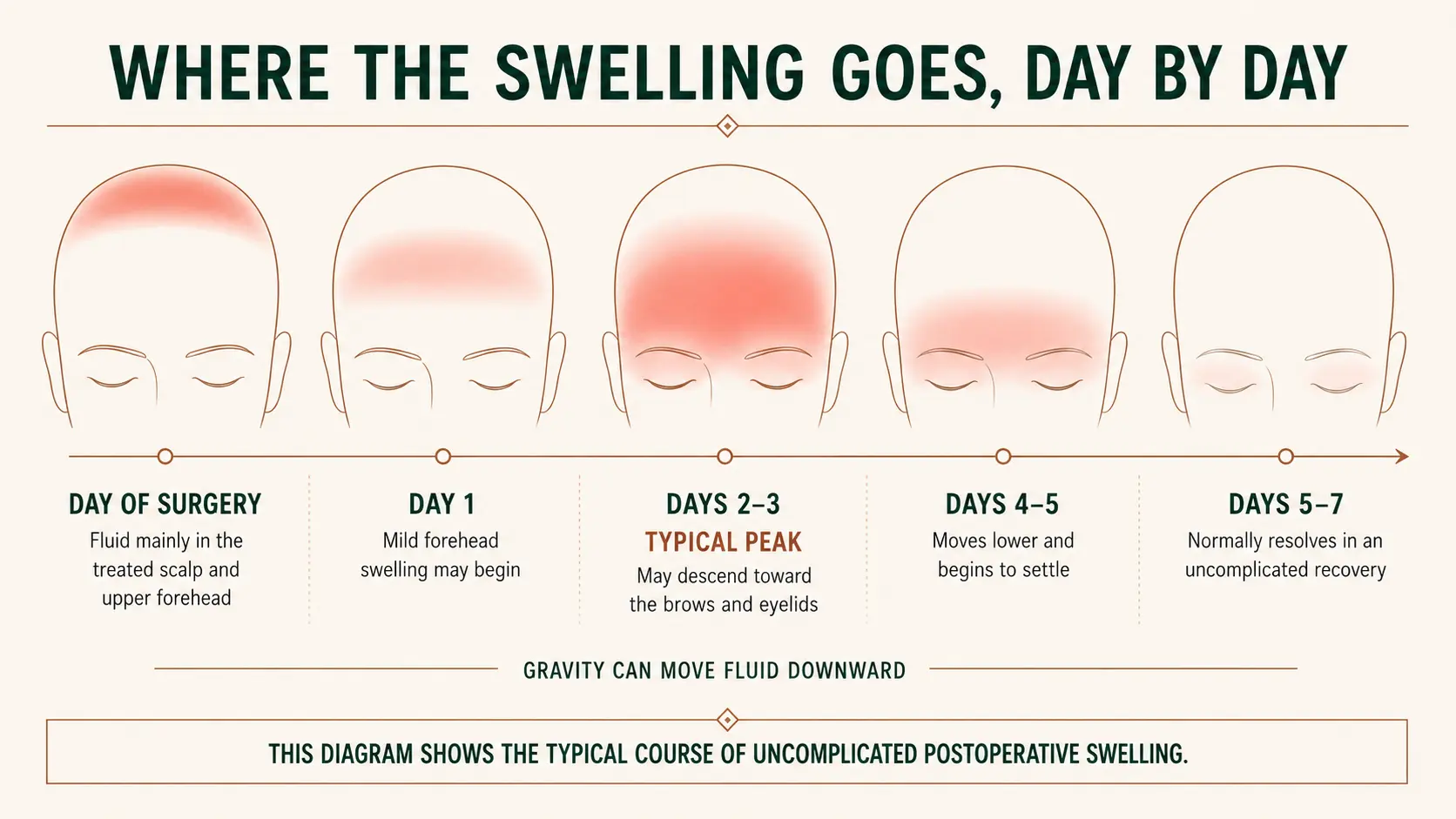
The single most useful thing to watch is not the size of the swelling. It is the direction. Normal postoperative edema should be heading toward better. If yours is becoming more painful, redder and hotter as the days pass, that is a different conversation.
Does Bending Forward Make It Worse?
Spending long stretches with your head down encourages fluid toward the forehead and face, which is why we ask patients to avoid it in the early days.
The important word is long. Bending forward to eat, to use the bathroom, to put your shoes on — none of that concerns me. We are not asking anyone to stop moving their neck.
What I want to avoid is somebody spending four hours looking down at a phone two days after surgery. Use your phone. Just bring it up toward eye level instead of parking your chin on your chest.
How to Sleep After a Hair Transplant
For the first nights we ask patients to sleep on their back with the head elevated, somewhere in the region of 20 to 30 degrees. A neck pillow helps keep things stable.
There are two reasons, and only one of them is swelling.
Elevation may reduce how much fluid travels toward the forehead and eyelids. But sleeping on your back also makes it far less likely that a freshly implanted recipient area meets a pillow in the middle of the night. That second reason matters at least as much.
You do not need an extreme angle. Comfortable elevation and no direct pressure on the recipient area is the whole instruction.
Why We Don't Use Forehead Bands
Walk around Istanbul for a day and you will spot them: patients with tight bands strapped across the upper forehead, several days after surgery.
That is not part of our routine protocol. At Pure Line we use a postoperative bandage on the first day, but we do not routinely ask patients to keep wearing a tight forehead band for days afterward.
My reasoning is simple. I do not want swelling prevention to rest mainly on mechanically blocking fluid from moving down the face, because the evidence says that is the weakest of the available tools.
A prospective study on preventing postoperative edema tested exactly this. Adding triamcinolone to the tumescent anesthetic solution left only 3 of 117 patients with swelling. Physical measures alone — sleeping position, occlusion bands, ice packs — did not produce satisfactory results.
Prevention begins in the operating room. A band on the forehead is trying to solve on day three what should have been handled on day zero.
Does the Amount of Tumescent Fluid Matter?
Yes, and this is probably the most important section in the article.
Tumescence is genuinely useful during a hair transplant. But there is no prize for using more of it than the case requires. How much goes in, which tissue layer it goes into, how evenly it is distributed and how much is left behind afterward all influence how much a patient swells.
A multicenter study published in Plastic and Reconstructive Surgery put numbers on this. Across 1,167 patients at four centers, researchers compared a conventional triamcinolone-containing tumescent protocol against a more complete approach that modified the anesthetic solution, controlled the tissue layer it was delivered into, and removed excess fluid after the recipient sites were made.
- Postoperative edema: 8.94% with the conventional protocol, 2.66% with the comprehensive one
- Severe periorbital edema: 1.4% conventional, and none at all in the comprehensive group
I find that second line the more interesting one. The dramatic, both-eyes-swollen presentation — the one that generates the frightened WhatsApp messages — was the part that disappeared when fluid was managed properly during surgery.
What About Corticosteroids?
Corticosteroids reduce the inflammatory component of swelling, and they have been used in hair transplant surgery for years — either mixed into the tumescent solution or as a short perioperative course, depending on the surgeon and the patient's medical history.
One review reports that adding triamcinolone to the tumescent solution reduced postoperative edema from 40% of cases to 9%.
None of which means a patient should start taking steroids on his own because his forehead looks puffy on day three. Quite the opposite: medication after surgery follows the protocol your medical team prescribed, and that protocol was written with your medical history in front of them.
Ice, Massage, and What Not to Do
Cold compresses can help in the early days, and head elevation with intermittent cold compresses is a standard part of managing swelling once it appears. But they are supportive measures, not the main strategy.
There is one rule here that outranks all of this:
Never apply pressure or ice directly onto freshly implanted grafts. There is no version of reduced swelling that is worth damaged grafts.
If your clinic advises cold application, use it only where and how they instructed.
The same caution applies to forehead massage, which some surgeons have historically suggested to move fluid laterally toward the temples. My concern is not the forehead itself — it is what a patient's fingers might brush against on the way there. In the first days I would much rather patients follow their team's specific instructions than improvise around a fresh hairline. If massage is recommended at all, it should never involve rubbing or pressing on the recipient area.
Can Normal Swelling Damage the Grafts?
Ordinary postoperative facial swelling does not mean your grafts are in trouble. The fluid is sitting in the surrounding soft tissue. It can look dramatic without affecting graft survival at all.
The picture changes when swelling comes with signs of infection or another complication. That is why I never assess a postoperative photograph on the size of the forehead alone. What I actually want to know is:
- Does it hurt, and is the pain increasing?
- Is there redness, and is it spreading?
- Does the skin feel unusually hot?
- Is there any discharge?
- Is there a fever?
- How does the patient feel in himself?
Those six answers tell me considerably more than the photograph does. It is the same reasoning I apply to redness after a hair transplant, where the appearance and the underlying problem also diverge more often than patients expect.
When Should You Actually Worry?
This is the part of the article I would keep if I had to delete the rest.
Painless swelling that appears in the first few days and then gradually improves is usually reassuring. What changes the picture is swelling accompanied by:
- Increasing or throbbing pain
- Spreading redness
- Unusual warmth
- Pus or abnormal discharge
- Fever or chills
- Getting worse rather than better as days pass
Infection after a hair transplant is uncommon, but it is a recognized surgical complication and it needs proper assessment when suspected. Do not spend several days hoping these symptoms go away by themselves. Contact the clinic that performed your procedure — and if the scalp was already inflamed before surgery, mention that too, because it changes how we think about it.
What If It Lasts Longer Than a Week?
Seven days is not a deadline where normal swelling suddenly becomes dangerous. Some people simply recover more slowly.
But swelling that is still significant after the first week deserves another look, particularly if it is not improving. Persistent swelling with increasing redness, warmth, pain, discharge or fever is a very different thing from persistent swelling alone.
That distinction cuts both ways. Do not diagnose yourself with an infection because your forehead is still a bit puffy on day nine. And do not let a painful, red, worsening scalp be dismissed as "normal swelling" either.
What If You Have Diabetes?
Diabetes does not automatically rule out a hair transplant. What matters is whether it is well controlled and whether the patient is otherwise a suitable surgical candidate — which is a preoperative assessment question, not something to work out afterward.
If a patient with diabetes develops worsening redness, significant pain, warmth, discharge or fever after surgery, I want to know immediately rather than at the next scheduled check.
Hair transplantation is usually elective and cosmetic. It is still surgery, and underlying medical conditions should never be an afterthought.
Can Swelling Stop You Flying Home?
For patients traveling to Istanbul for a hair transplant, this is a fair and frequent question.
Mild forehead swelling does not make someone unfit to fly, and plenty of patients travel with a little edema still present. Significant swelling around the eyes can make the journey uncomfortable, which is a different problem.
But if swelling comes with fever, substantial pain or any suspicion of infection, catching the flight is not the priority. Being assessed is.
This is one of the arguments for treating international hair transplant care as something that continues after the operation rather than ending at the clinic door. Our patients keep sending photographs after they fly home, which is how we follow a recovery we can no longer see in person.
Can Swelling Be Prevented Completely?
Not in every patient. Anyone promising zero swelling in every case is promising control over biology that surgeons do not have.
Patients respond differently. Skin differs, recipient areas differ in size and position, the fluid volume needed differs, the inflammatory response differs.
What we can do is reduce how likely and how severe it is: careful tumescent management, atraumatic technique, appropriate perioperative medication, sensible positioning afterward, and follow-up that actually happens.
The direction of the research is consistent on this point. The best strategy is not to wait for severe swelling and then chase it down the forehead with bands and ice. It is to avoid creating unnecessary edema in the first place.
My Advice
If you wake up on day three and your forehead looks different, do not immediately assume something has gone wrong.
Take a clear photograph. Send it to your medical team. And tell them how you actually feel — is it painful, is it red, is it hot, do you have a fever? Or is it simply swollen?
There is a large difference between a swollen forehead and an infected one, and it is almost never visible in the photograph alone.
Most postoperative edema is temporary. When the symptoms fit the normal pattern, reassurance and ordinary aftercare are all that is needed. When they do not fit that pattern, that is exactly when I want to hear about it.
Frequently Asked Questions
Is swelling normal after a hair transplant?
What day is swelling worst after a hair transplant?
How long does swelling last after a hair transplant?
Why are my eyes swollen after a hair transplant?
Is eye swelling dangerous after a hair transplant?
Can swelling damage hair grafts?
Should I wear a forehead band after a hair transplant?
Should I use ice for hair transplant swelling?
Does bending forward cause swelling after a hair transplant?
How should I sleep after a hair transplant to reduce swelling?
Can I fly home with swelling after a hair transplant?
When should I contact my doctor?
— Dr. Mesut Demir
Worried about how your recovery looks?
If you are a Pure Line patient, send us clear photographs and tell us how you feel — pain, redness, warmth, fever. We will tell you honestly whether what you are seeing fits the normal pattern or needs to be looked at properly.
Contact the Clinic- Romera de Blas C, Vega Díez D, Ricart Vayá JM, Gómez Zubiaur A. Complications in follicular unit excision hair transplantation: current evidence and practical approaches. Frontiers in Medicine. 2026. Incidence of frontal and periorbital edema, mechanism, timing and management. doi:10.3389/fmed.2026.1750989
- Abbasi G, Pojhan S, Emami S. Hair transplantation: preventing post-operative oedema. Journal of Cutaneous and Aesthetic Surgery. 2010;3(2):87–89. doi:10.4103/0974-2077.69018
- Sun Y, Xu F, Zhang J, et al. Comprehensive prevention for edema after hair transplantation: a multicenter study of 1,167 patients. Plastic and Reconstructive Surgery. 2026;157(1):49e–57e. doi.org
- Garg AK, Garg S. Complications of hair transplant procedures — causes and management. Indian Journal of Plastic Surgery. 2021;54(4):477–482. doi:10.1055/s-0041-1739255
- Hwang ST. Gravity position to prevent facial edema in hair transplantation. Hair Transplant Forum International. 2009;19(3):77–82. ishrs-htforum.org
- Hair Transplantation. StatPearls, NCBI Bookshelf. Updated 2025. NBK547740
Note on protocols. The postoperative routine described here is ours. Aftercare instructions legitimately differ between surgeons and between procedures, so if the clinic that operated on you told you something different, follow them rather than this article.