
Quick answer
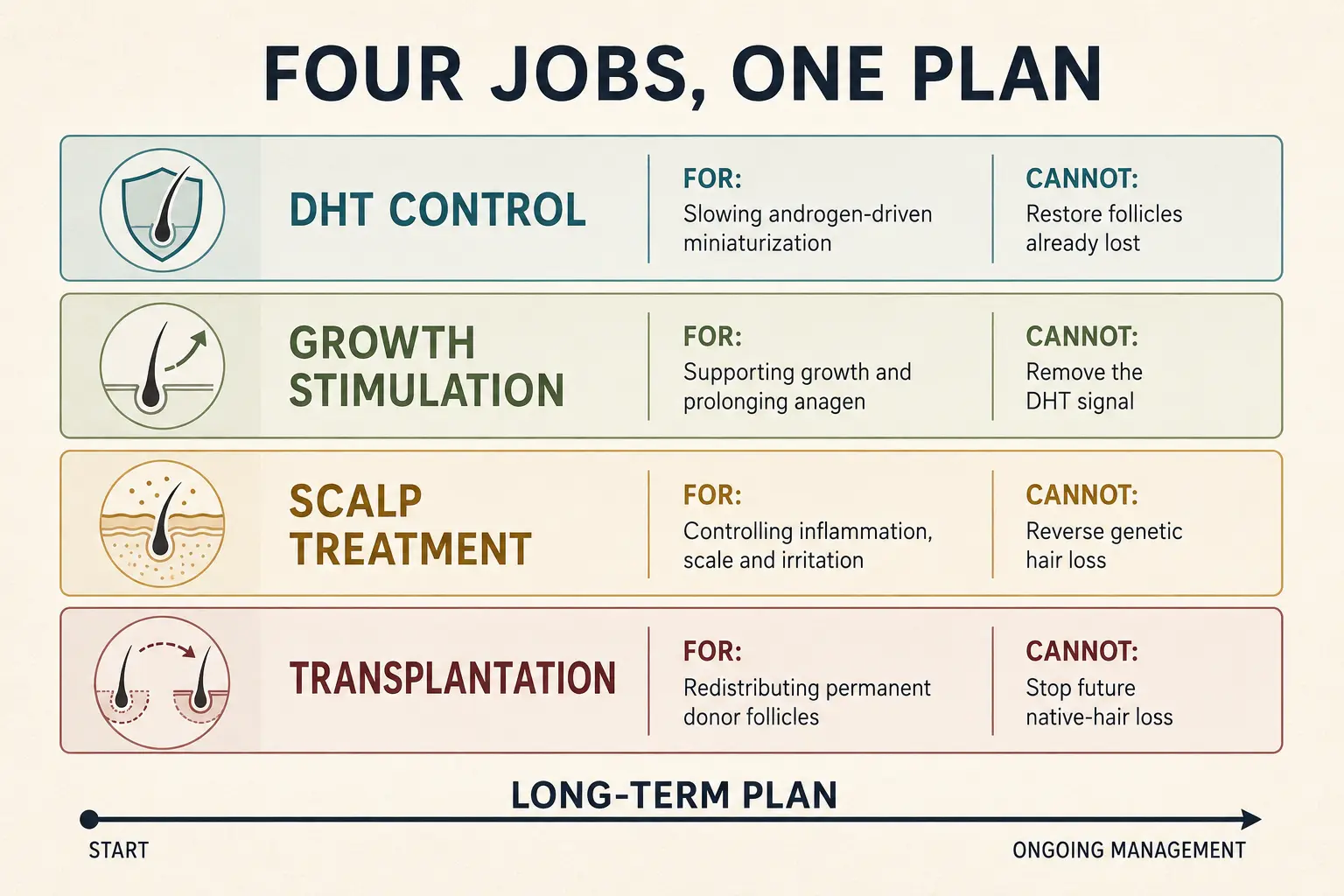
Finasteride, minoxidil, scalp treatment and hair transplantation address different parts of androgenetic alopecia, so they are better understood as parts of one long-term plan than as rivals. Finasteride acts on the androgen pathway behind follicular miniaturization; a five-year analysis of the pivotal trials in 1,553 men aged 18–41 reported a 93% relative reduction versus placebo in the likelihood of developing further visible hair loss. Minoxidil promotes growth by a different mechanism — in a 393-man trial the 5% solution produced 45% more regrowth than 2% at week 48. Scalp treatment applies when seborrheic dermatitis, psoriasis, folliculitis or another disorder is actually present; histological evidence linking inflammation to androgenetic alopecia itself is inconsistent. Hair transplantation redistributes donor follicles into areas where coverage can no longer be achieved medically. It can restore an area of established loss, but it cannot make the remaining native hair immune to future miniaturization, which is why likely future progression belongs inside the graft decision rather than being treated as an afterthought.
People researching hair loss are often asked to choose between treatments that were never designed to do the same job.
Finasteride or minoxidil? Medication or surgery? What about dandruff treatment, ketoconazole shampoo, supplements or low-level laser therapy?
Finasteride, minoxidil, scalp treatment and hair transplantation act on different parts of the problem. Comparing them as if one must defeat the others usually leads to poor questions and, sometimes, poor planning.
At Pure Line in Istanbul we work through long-term hair-loss management in four parts: control continued loss where possible, support follicles that remain viable, deal with scalp disease when it is present, and use surgery where permanent loss makes redistribution of donor hair reasonable.
A patient may need one of these, several of them, or none at a particular point in time. The better starting question is what the patient's hair and scalp are actually doing.
- The four parts of long-term hair loss management
- Finasteride and DHT control
- Minoxidil and growth stimulation
- Where scalp inflammation fits
- What conflicting inflammation studies tell us
- Washing, shedding and the scalp hygiene trap
- Ketoconazole and medicated shampoos
- Low-level light and laser therapy
- Vitamins, supplements and natural treatments
- When hair transplantation enters the plan
- Why future hair loss changes the donor calculation
- Why photographs are useful but limited
- The Pure Line approach in Istanbul
- Frequently asked questions
The Four Parts of Long-Term Hair Loss Management
Treatments become easier to compare once their actual purpose is separated.
| Approach | Main role | Main limitation | Evidence example |
|---|---|---|---|
| Finasteride / 5-alpha-reductase inhibition | Reduce DHT-driven progression in susceptible follicles | Cannot recreate follicles in long-established bald areas | Five-year analysis found a 93% relative reduction vs placebo in the likelihood of developing further visible hair loss |
| Topical minoxidil | Improve growth from responsive follicles | Does not directly suppress the DHT pathway | In a 393-man trial, 5% minoxidil produced 45% more regrowth than 2% at week 48 |
| Scalp treatment | Treat a diagnosed inflammatory, scaling or infectious condition | Does not substitute for established AGA treatment | Histological evidence linking inflammation with AGA is inconsistent |
| Low-level laser therapy | Adjunctive growth stimulation | Cannot reconstruct a bald area | Active groups in one sham-controlled study gained roughly 18.4–25.7 terminal hairs/cm² over 26 weeks |
| Hair transplantation | Redistribute donor follicles into areas of permanent loss | Native susceptible hair may continue to miniaturize | Estimated lifetime donor supply falls as the anticipated future Norwood pattern becomes more extensive |
These numbers come from different populations, endpoints and study designs. They show the scale and purpose of the interventions; they aren't predictions for an individual patient.
Finasteride and DHT Control
Male androgenetic alopecia develops when genetically susceptible follicles progressively miniaturize under androgen influence, particularly dihydrotestosterone, or DHT. Terminal hairs gradually become finer, growth cycles shorten and an area that once looked dense begins to show more scalp.
Finasteride inhibits type II 5-alpha-reductase, reducing the conversion of testosterone to DHT.
The pivotal clinical program enrolled 1,553 men aged 18–41 with male pattern hair loss. Participants received finasteride 1 mg/day or placebo in two one-year trials, with 1,215 continuing into blinded extension studies. Hair counts, investigator assessments, patient assessments and photographic evaluation favored finasteride.
Those 1,553 men were aged 18–41, so the pivotal dataset should not be quoted as though it covered every age group. Other research has included older men, but that is separate evidence.
A later analysis of the five-year photographic data reported a 93% relative reduction compared with placebo in the likelihood of developing further visible hair loss, with a 95% confidence interval of 89–97%.
That 93% is frequently mangled online. It does not mean a patient retains 93% of his hair; it describes the relative treatment effect for a defined trial endpoint compared with placebo.
For transplant planning, finasteride is often more relevant as a preservation treatment than as a promise of dramatic regrowth. Early miniaturization and an area that has been bald for many years are biologically different situations.
We discuss medical treatment only after individual assessment and a risk-benefit conversation. Our broader overview of medical and surgical options is on the male hair transplant page, and we have written separately on how finasteride works and on what the side-effect data actually show. Treatments aimed at pathways other than DHT are still in trials; our review of ABS-201 and prolactin-receptor research covers one of them.
Minoxidil and Growth Stimulation
Minoxidil occupies another part of the plan because it does not work by lowering DHT.
A 48-week randomized, double-blind trial enrolled 393 men aged 18–49 with androgenetic alopecia. Participants used 5% topical minoxidil, 2% topical minoxidil or placebo twice daily.
At week 48, 5% topical minoxidil performed significantly better than both 2% minoxidil and placebo across the principal efficacy measures. The investigators reported 45% more hair regrowth with 5% than with 2% topical minoxidil, with the higher concentration also producing an earlier response.
A patient can therefore improve the growth and appearance of surviving follicles while still having an underlying tendency toward androgen-driven miniaturization. Twelve-month density tells us how the hair responded during those twelve months; it cannot by itself answer what untreated susceptible follicles would have done five years later.
Where Scalp Inflammation Fits
Androgenetic alopecia remains primarily an androgen- and genetics-related disorder. Histological research has nevertheless found perifollicular inflammation and fibrosis in some AGA specimens.
Whiting's 1996 study included 412 patients with androgenetic alopecia, 193 men and 219 women, alongside chronic telogen effluvium patients and normal controls. Significant degrees of inflammation and fibrosis were reported in 37% of AGA cases, versus roughly 10–12% of chronic telogen effluvium cases and normal controls.
That 37% is the study's threshold for significant inflammation and fibrosis. Count milder grades and prevalence figures change substantially, which is one reason percentages from different pathology studies can be misleading when placed side by side without their grading criteria.
Jaworsky, Kligman and Murphy had earlier identified activated T-cell infiltrates around parts of the follicle in male pattern alopecia, including the region of the follicular bulge — though that was a four-patient series, which is worth keeping in mind before it is quoted as settled. El-Domyati and colleagues later examined 40 men with AGA and 15 controls and described perifollicular inflammation as almost constant in early disease, with fibrosis becoming more marked in advanced cases.
If those were the only studies available, the inflammatory component would look relatively straightforward. They aren't.
What Conflicting Inflammation Studies Tell Us
Valdebran, Mo, Elston and Doan examined histological sections from pattern-hair-loss specimens and non-balding controls and found almost the opposite of what a simple "AGA equals inflammation" theory would predict.
Perifollicular inflammatory infiltrates were present in approximately 73% of pattern-hair-loss specimens and 84% of controls. Fibrosis was reported in approximately 68% of pattern-hair-loss specimens and 82% of controls.
Both features were numerically more common in the non-balding controls, and the authors reported no difference between the two groups. Either way, the finding does not support inflammation as the thing that distinguishes a balding scalp from a non-balding one.
Why the literature disagrees this sharply has itself been examined. A 2021 review argues that three variables are inadequately controlled across these studies: biopsy location, hair diameter diversity, and how far the sampled follicles have already miniaturized. Sample the wrong part of a scalp, or compare specimens at different stages of miniaturization, and two honest studies can reach opposite conclusions.
Inflammation may accompany androgenetic alopecia in some scalps. Current evidence does not establish it as the explanation for androgenetic alopecia.
The clinical issue is narrower. A patient with obvious patterned miniaturization can still have seborrheic dermatitis, psoriasis, folliculitis or another scalp disorder at the same time. Persistent scaling, erythema, burning, tenderness or pustules deserve their own diagnosis.
If the scalp is actively inflamed or the diagnosis is uncertain, we would rather postpone an elective transplant than operate simply because a date has already been booked. The reasoning is set out in more detail in our article on scalp inflammation before a hair transplant.
Washing, Shedding and the Scalp Hygiene Trap
A patient starts shedding. Then comes the shower.
There are hairs in the hands, hairs on the fingers and hairs around the drain. Washing gets blamed, so shampooing becomes less frequent.
Four days later they wash again.
Now several days of loose hairs come out together, which makes the second shower look worse than the first.
Many of those hairs were already completing the shedding phase. The longer interval changed when they became visible, not necessarily how many were being lost.
For somebody with significant dandruff or seborrheic dermatitis, avoiding scalp cleansing because seeing loose hairs is frightening can also leave scale and oil harder to control. We don't give every scalp the same washing schedule; hair texture, sebum production, sensitivity and the condition being treated all matter.
The hair in the drain tells you when you saw the shedding. It doesn't tell you what caused it.
Ketoconazole and Medicated Shampoos
When a scalp disorder is present, shampoo can become part of treatment for that disorder.
Ketoconazole is commonly used in seborrheic dermatitis because of its antifungal activity. Other presentations may require selenium-based products, keratolytic ingredients such as salicylic acid or prescription anti-inflammatory treatment.
Putting these products in the same treatment category as finasteride or minoxidil causes unnecessary confusion. Someone treating seborrheic dermatitis with an antifungal shampoo is treating seborrheic dermatitis, even if that patient also happens to have androgenetic alopecia.
The distinction becomes clinically relevant before transplantation. Surgeons operate through actual donor and recipient skin, and significant redness, scaling, pustules or another active process should be understood before grafts are extracted or implanted.
Our separate guide on seborrheic dermatitis and hair transplantation deals with that surgical question in more detail.
Low-Level Light and Laser Therapy
Low-level light or laser therapy sits in an awkward place because controlled clinical research and widely varying consumer products share the same LLLT label.
Jimenez and colleagues conducted multicenter, randomized, sham-device-controlled, double-blind trials using several comb-style laser devices. 128 male and 141 female participants were randomized, with treatment performed three times a week for 26 weeks.
In the efficacy analysis, mean terminal hair-density increases in active groups were approximately 18.4, 20.2, 20.6, 20.9 and 25.7 hairs/cm², depending on the treatment group.
The sham groups are worth reading too. Three of them changed very little — 1.6, 2.8 and 3.0 hairs/cm² — but two gained 9.4. A sham response of that size is a reminder of how much a measured hair count can move without an active treatment, and of why uncontrolled before-and-after photographs from device manufacturers deserve little weight.
Those results also belong to the devices and dosing protocols actually studied. Wavelength, energy delivery, treatment schedule and adherence vary considerably between products sold under the broad "laser hair growth" label.
For selected patients, LLLT can sit reasonably alongside other treatments as a non-drug adjunct. The evidence is good enough to discuss it seriously and not good enough to treat every red-light device as equivalent. The same measured reading applies to Regenera Activa, another procedure patients ask about in this category.
Vitamins, Supplements and Natural Treatments
Vitamin D, zinc, iron and other micronutrients are necessary for normal physiology and normal hair production. Genuine deficiencies can contribute to hair problems and should be corrected when identified.
A nutrient being necessary for hair growth doesn't mean more of it treats androgenetic alopecia in somebody who was never deficient.
The same problem appears with "natural" treatments. Curcumin, rosemary preparations and numerous antioxidant or botanical products have plausible mechanisms, preliminary studies or anti-inflammatory effects. None of those facts automatically establishes durable preservation of genetically susceptible follicles in progressive AGA.
Patients are free to prefer non-prescription approaches, but the evidence should be labeled accurately. We investigate suspected deficiencies when the history or clinical picture gives us a reason, correct genuine deficiencies and keep nutritional support in proportion to the diagnosis.
When Hair Transplantation Enters the Plan
Hair transplantation becomes relevant when permanent loss has reached a point where preservation or stimulation cannot provide the coverage a patient wants.
The operation redistributes hair. Susceptible follicles behind or around the transplanted area carry on following their own biology.
Surgery fills in the pothole; it doesn't stop the development of the next pothole.
That problem becomes more important in younger patients.
A low, dense frontal reconstruction can look excellent at twelve months while the surrounding native hair continues to thin over the next decade. At that point, the quality of the original decision depends partly on how much donor hair remains and whether the original hairline still makes sense inside the new pattern. It is the same argument I make about designing a hairline too low.
For that reason, maximum grafts has never been a medical objective for us. Diagnosis, miniaturization, donor quality, age, future progression and remaining donor reserve have to survive the operation too.
Why Future Hair Loss Changes the Donor Calculation
A 2013 survey by Unger, Unger and Wesley gives a concrete sense of how future pattern can affect donor planning.
The authors asked 34 highly experienced hair-transplant surgeons to estimate the number of follicular units containing likely permanent hair in hypothetical 30-year-old male patients with below-average, average or above-average donor density who were expected to progress to Type V or Type VI male pattern baldness.
| Expected future pattern | Below-average density | Average density | Above-average density |
|---|---|---|---|
| Type V | 4,963 FU | 6,404 FU | 7,904 FU |
| Type VI | 4,204 FU | 5,393 FU | 6,661 FU |
These were expert estimates for hypothetical patients, not measured biological limits. Hair caliber, donor dimensions, follicular-unit density, miniaturization, previous harvesting and scarring vary too much for the table to function as an individual graft calculator.
The direction of the estimates is more informative than any single number. With average donor density, estimated lifetime yield fell from 6,404 FU for anticipated Type V loss to 5,393 FU for Type VI. With below-average density it fell from 4,963 to 4,204 FU.
The more extensive the expected future pattern, the smaller the area that can confidently be treated as permanent donor hair.
Before we discuss a final graft number, we want answers to questions such as:
- What is the diagnosis?
- How far has the current loss progressed?
- Is it stable or still moving?
- How much miniaturization is present in the native hair?
- What is the donor density and caliber?
- Is there donor miniaturization?
- Has the donor already been harvested?
- Is the scalp healthy?
- How old is the patient?
- What future Norwood pattern is plausible?
- How much donor supply should remain available for another operation?
Graft count is downstream of diagnosis, donor assessment and long-term planning.
Our surgical approach is explained in more detail on the FUE hair transplant page, and the reasoning behind our schedule in why we operate on one patient a day.
Why Photographs Are Useful but Limited
International hair transplantation depends heavily on remote assessment. Good photographs can show recession pattern, crown involvement, visible donor coverage, old scars and enough general information to decide whether a surgical conversation makes sense.
A camera is less good at showing subtle perifollicular scale, early loss of follicular openings, some inflammatory changes or donor miniaturization. Lighting, hair length and styling can make the same donor look surprisingly different from one image to another.
Symptoms add information that photographs cannot capture. Burning, marked tenderness, recurrent pustules, severe itching, rapid changes or an unusual history can shift an apparently straightforward case into one that deserves direct examination or trichoscopy.
Online assessment works well as screening. When something does not fit, pretending the photographs answered the question does not make the uncertainty disappear.
Our preliminary assessment process follows the same principle: photographs and history can guide the first opinion, but final diagnosis, graft number and surgical suitability depend on the complete clinical picture.
The Pure Line Approach in Istanbul
Pure Line has worked with a one-patient-per-day surgical model since 2018.
For us, that schedule protects the time needed to treat one operation as one complete case rather than a slot squeezed between overlapping procedures. It also leaves room for the plan to change when the examination on the day does not match what the photographs suggested.
Patients understandably want a graft number early. It's concrete, easy to compare and appears more precise than "we need to examine the donor first." But precision isn't always the same thing as accuracy.
We'd rather reach the number after looking at the type of hair loss, native miniaturization, donor quality and what may happen next.
We do not currently publish a percentage of online consultations postponed for scalp assessment, or a count of cases in which another alopecia is suspected during remote screening. Those figures would be valuable once properly extracted and audited from clinical records. Until then, we would rather leave them unpublished than manufacture a statistic because a number makes a medical page look more authoritative.
That is also how we think about uncertainty in an individual case. If more examination is needed, saying so is part of the assessment.
For international patients comparing a hair transplant in Turkey, graft count, package price and technique name are the easy things to compare. Donor strategy, diagnosis, who performs each stage and whether today's operation will still make sense after further hair loss require more attention.
Frequently Asked Questions
Can scalp inflammation cause hair loss?
Does dandruff cause male pattern baldness?
Does washing my hair make hair loss worse?
Do finasteride and minoxidil do the same thing?
What age group was studied in the pivotal finasteride trials?
What does the 93% finasteride statistic mean?
How effective was 5% topical minoxidil in the 48-week trial?
Can a hair transplant stop future hair loss?
How many grafts does a person have available for life?
Is an online consultation enough to approve a hair transplant?
Should scalp inflammation be controlled before a hair transplant?
— Dr. Mesut Demir
Considering a hair transplant in Istanbul?
Send us your hair-loss history together with clear photographs of the hairline, mid-scalp, crown and donor area. The first review decides whether the visible pattern and donor characteristics make surgical planning reasonable, and whether anything in the history should be examined more closely before a graft plan is made.
Request a Case Review- Kaufman KD, Olsen EA, Whiting D, et al. Finasteride in the treatment of men with androgenetic alopecia. Journal of the American Academy of Dermatology. 1998;39(4 Pt 1):578–589. 1,553 men aged 18–41; 1,215 continued into extension studies. doi:10.1016/s0190-9622(98)70007-6
- Kaufman KD, Rotonda J, Shah AK, Meehan AG. Long-term treatment with finasteride 1 mg decreases the likelihood of developing further visible hair loss in men with androgenetic alopecia. European Journal of Dermatology. 2008;18(4):400–406. 93% relative reduction, 95% CI 89–97%. doi:10.1684/ejd.2008.0436
- Kaufman KD, et al. Long-term (5-year) multinational experience with finasteride 1 mg in the treatment of men with androgenetic alopecia. European Journal of Dermatology. 2002;12(1):38–49. PMID 11809594
- Olsen EA, Dunlap FE, Funicella T, et al. A randomized clinical trial of 5% topical minoxidil versus 2% topical minoxidil and placebo in the treatment of androgenetic alopecia in men. Journal of the American Academy of Dermatology. 2002;47(3):377–385. 393 men aged 18–49. doi:10.1067/mjd.2002.124088
- Whiting DA. Chronic telogen effluvium: increased scalp hair shedding in middle-aged women. Journal of the American Academy of Dermatology. 1996;35(6):899–906. Comparison group of 412 AGA patients; significant inflammation and fibrosis in 37% of AGA versus 10–12% of CTE and controls. doi:10.1016/s0190-9622(96)90113-9
- Jaworsky C, Kligman AM, Murphy GF. Characterization of inflammatory infiltrates in male pattern alopecia: implications for pathogenesis. British Journal of Dermatology. 1992;127(3):239–246. Four-patient ultrastructural and immunohistochemical series. doi:10.1111/j.1365-2133.1992.tb00121.x
- El-Domyati M, Attia S, Saleh F, Abdel-Wahab H. Androgenetic alopecia in males: a histopathological and ultrastructural study. Journal of Cosmetic Dermatology. 2009;8(2):83–91. 40 men with AGA and 15 controls. doi:10.1111/j.1473-2165.2009.00439.x
- Valdebran M, Mo J, Elston DM, Doan L. Pattern hair loss: assessment of inflammation and fibrosis on histologic sections. Journal of the American Academy of Dermatology. 2020;82(3):757–758. Research letter. doi:10.1016/j.jaad.2019.09.013
- English R, Ruiz S. Conflicting reports regarding the histopathological features of androgenic alopecia: are biopsy location, hair diameter diversity, and relative hair follicle miniaturization partly to blame? Clinical, Cosmetic and Investigational Dermatology. 2021;14:357–365. doi:10.2147/CCID.S306157
- Jimenez JJ, Wikramanayake TC, Bergfeld W, et al. Efficacy and safety of a low-level laser device in the treatment of male and female pattern hair loss: a multicenter, randomized, sham device-controlled, double-blind study. American Journal of Clinical Dermatology. 2014;15(2):115–127. 128 male and 141 female subjects randomized. doi:10.1007/s40257-013-0060-6
- Unger WP, Unger RH, Wesley CK. Estimating the number of lifetime follicular units: a survey and comments of experienced hair transplant surgeons. Dermatologic Surgery. 2013;39(5):755–760. Survey of 34 surgeons. doi:10.1111/dsu.12108
Note on the figures quoted here. These studies used different populations, endpoints, biopsy methods and grading thresholds. The numbers describe what was measured in those specific trials and series; they are not predictions for an individual patient, and prescription treatment requires appropriate clinical assessment.