Quick answer
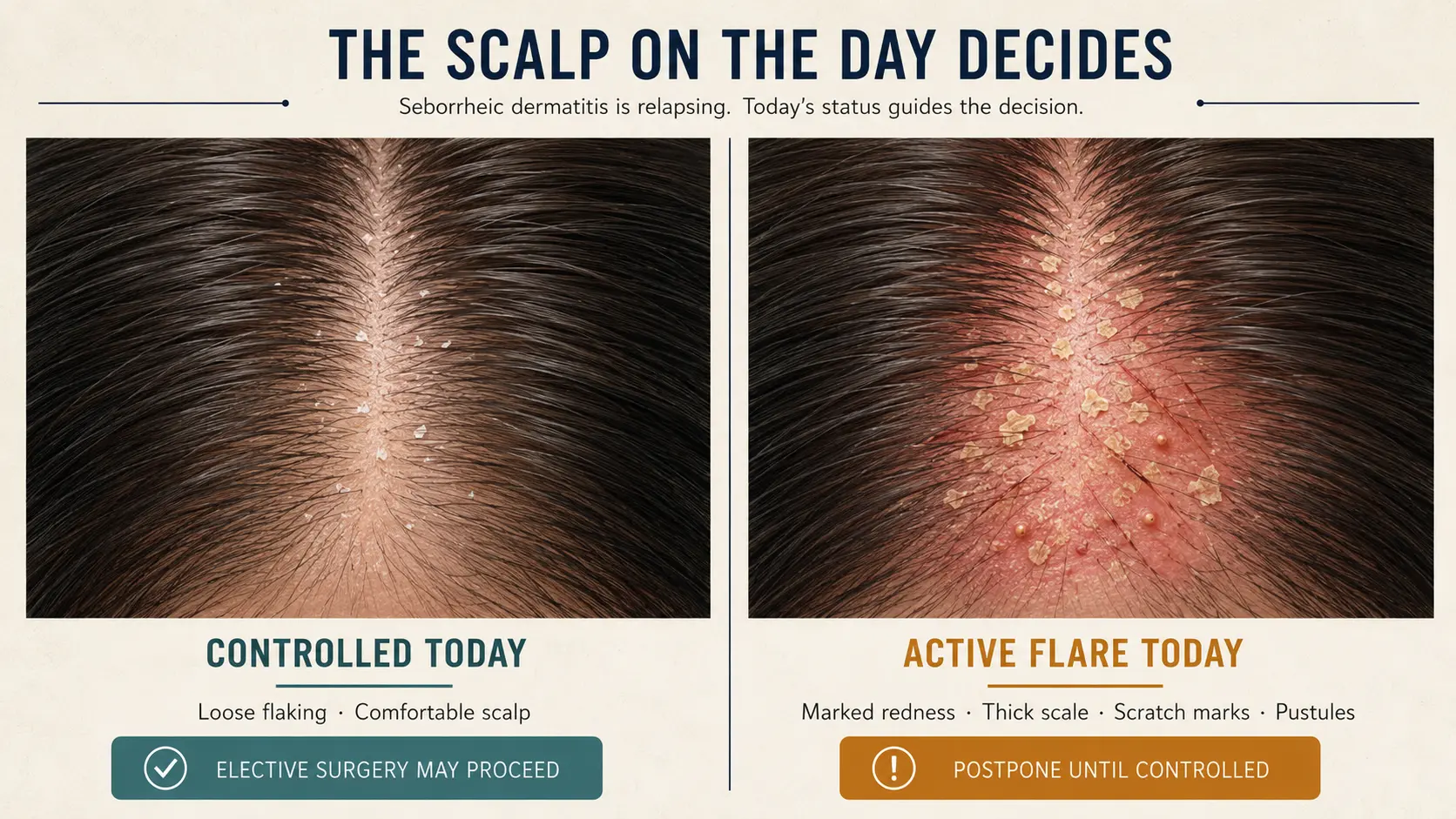
Seborrheic dermatitis usually does not prevent someone from having a hair transplant. The question that matters is whether the scalp is reasonably calm on the day of surgery: mild loose flaking on a comfortable scalp is very different from marked redness, thick scale, uncontrolled itching, scratch marks or pustules. The two conditions often coexist — in a 2025 cross-sectional study of 311 adults with androgenetic alopecia, 42.1% also had seborrheic dermatitis. No good clinical study shows that an active flare reduces graft survival by any specific percentage, and Dr. Mesut Demir does not quote one. The reason for delaying surgery during a significant flare is more practical: FUE already creates thousands of small wounds and brings its own temporary redness, crusting and itching, with folliculitis a recognized complication, so adding uncontrolled inflammation to an elective procedure offers no advantage. Seborrheic dermatitis is relapsing rather than curable, so the realistic goal before surgery is clinical control, not a permanently flake-free scalp.
One of the questions I hear regularly at Pure Line is some version of:
“I have seborrheic dermatitis. Can I still have a hair transplant?”
Most of the time, yes.
But I don't make that decision from the words seborrheic dermatitis written on a medical form. I look at the scalp, ask how it behaves over time, and try to understand what happens when treatment stops.
Sometimes the scalp in the photographs looks completely clear because the patient washed it aggressively that morning. Then we speak and I find out that two days earlier it was red, itchy and covered in scale.
That history matters more than one clean photograph.
I also ask whether the patient scratches without realizing it. If the answer is something like, “I don't even notice I'm doing it,” that becomes very relevant when we're discussing the first few days after transplantation.
There is also no good clinical study showing that active seborrheic dermatitis reduces graft survival by a specific percentage. I wouldn't invent one. My reason for delaying surgery during a significant flare is much simpler: FUE already creates thousands of tiny wounds and comes with temporary redness, crusting, itching and a recognized risk of folliculitis. Adding uncontrolled scalp inflammation to that situation doesn't make much sense for an elective procedure. [1–4]
- How common is seborrheic dermatitis?
- Can seborrheic dermatitis stop a hair transplant?
- Does it affect graft survival?
- What if you've already flown to Istanbul?
- Not every flaky scalp is seborrheic dermatitis
- What does preparation actually involve?
- How long should the scalp be controlled first?
- Do winter and stress matter?
- What if it comes back after the transplant?
- When can ketoconazole be restarted?
- Frequently asked questions
How common is seborrheic dermatitis?
It's common enough that this isn't an unusual transplant consultation.
A 2024 systematic review and meta-analysis included 121 studies and 1,260,163 people. The pooled global prevalence of seborrheic dermatitis was 4.38%, rising to 5.64% in adults. [5]
Seborrheic dermatitis is a chronic, relapsing inflammatory skin condition that commonly affects the scalp, eyebrows, nasolabial folds, ears and other sebum-rich areas.
On the scalp, Malassezia restricta and Malassezia globosa are among the species most frequently associated with seborrheic dermatitis and dandruff. They are normal inhabitants of human skin rather than foreign organisms that appear only when disease begins. [1,2]
The condition seems to involve an interaction between the microbiome, sebum, skin-barrier function and the individual's immune response.
So I don't think of seborrheic dermatitis as simply “a fungal scalp.”
Treatment isn't an attempt to sterilize the skin. The useful goal is clinical control.
Is seborrheic dermatitis common in people with androgenetic alopecia?
The two conditions often coexist.
A 2025 cross-sectional study examined 311 adults with androgenetic alopecia and found seborrheic dermatitis in 131 of them, or 42.1%. SD severity scores were also higher in patients with more advanced AGA. [6]
That doesn't prove causation. The study was cross-sectional, so it can't tell us whether one condition contributes to the other or whether they simply share risk factors.
Clinically, the useful point is simpler: a patient can have both conditions at the same time.
Treating the dermatitis may improve the scalp without stopping androgen-driven miniaturization.
For the longer-term medical side of hair loss, see Hair Loss Treatment Is a Long-Term Plan, Not a Single Procedure. For more on DHT and pattern hair loss, see What Is Finasteride for Hair Loss and How Does It Work?.
Does seborrheic dermatitis stop you from having a hair transplant?
Usually, no.
A history of seborrheic dermatitis by itself isn't a contraindication to FUE. I'm much more interested in the current state of the scalp.
| What I see | How I think about surgery |
|---|---|
| Previous SD, scalp currently clear and comfortable | Surgery may be reasonable after normal assessment |
| Mild loose flaking with little or no redness | Often manageable; examine individually |
| Persistent redness, obvious scale or significant itch | Usually control the flare first |
| Thick adherent scale or scratch marks | I would normally delay elective surgery |
| Pustules, drainage, pain or open lesions | Establish the diagnosis before operating |
| Scarring, loss of follicular openings or unusual perifollicular redness | Investigate for another inflammatory or scarring alopecia |
Why don't I like operating during an active flare?
I want to be careful here because hair-transplant websites often become much more certain than the evidence deserves.
There isn't a good trial showing that active seborrheic dermatitis reduces FUE graft survival by 10%, 20% or any other convenient number.
What we do know is that hair transplantation already has its own healing process. Temporary erythema, crusting, itching and postoperative effluvium can occur, while folliculitis and infection are recognized complications. [3,4]
If the scalp is already significantly inflamed, intensely itchy and heavily scaling, I don't see a medical advantage in adding elective surgery that day.
Itching is a very practical problem
Freshly placed grafts shouldn't be scratched, rubbed or picked.
That sounds obvious in a consultation room. At 3 a.m., when somebody scratches the scalp half asleep because they've been doing it automatically for years, things become less philosophical.
A patient in the middle of an SD flare may already be scratching before surgery. Transplantation then adds temporary crusting and itch of its own.
I would rather reduce that problem before surgery than explain afterward why scratching fresh grafts was a poor experiment.
Heavy scale complicates aftercare
Some crusting around implanted grafts is normal.
Pre-existing seborrheic scale is different.
When the two overlap, patients may struggle to tell what should remain untouched, what should gradually wash away and what represents recurrent dermatitis.
That's often when people start washing or rubbing too aggressively because something “looks dirty.”
Good preparation removes some of that uncertainty.
Does active seborrheic dermatitis reduce graft survival?
We don't have enough direct evidence to put a number on it.
Transplanted follicles depend on normal recipient-site healing, and excessive trauma, vascular compromise and recipient-site necrosis can threaten graft survival. [3]
It is reasonable to be cautious about adding surgery to a scalp that is already significantly inflamed, but the literature doesn't give us a reliable SD-specific graft-survival penalty.
So I wouldn't tell a patient that active seborrheic dermatitis reduces survival by 10%, 20% or any other figure that sounds conveniently precise.
My concern is more practical: uncontrolled inflammation, itching, scratching, heavy scale and a more confusing postoperative course are all good reasons to calm the scalp before elective surgery.
What if I've already flown to Istanbul and my scalp is flaring?
This matters much more in real life than it does in most articles.
A patient may have booked the flight, hotel and time off work months earlier. The scalp looked good in the photographs sent to us, and then travel, stress, weather or a change in routine triggers a flare just before surgery.
What happens next depends on what I see.
A little loose flaking with no meaningful redness, pain, scratching or inflammation doesn't automatically cancel surgery.
A markedly red scalp with substantial scale, excoriations, pustules or an uncertain diagnosis is a different situation. In that case, I may recommend treatment first and postpone the procedure.
Sometimes the scalp can be reassessed during the same trip. Sometimes it makes more sense to treat it properly and arrange surgery for another visit.
I can't promise one outcome in advance because the decision depends on the severity and the diagnosis.
This is why I want patients to tell us when the scalp changes before they board the plane, rather than trying to make it look perfect for preoperative photographs.
A booked operation date isn't a medical indication.
Not every flaky scalp is seborrheic dermatitis
This is one of the places where an in-person scalp examination earns its keep.
Psoriasis, irritant or allergic contact dermatitis, tinea capitis and inflammatory scarring alopecias can all cause redness or scale. [1,2,7]
In women, one diagnosis I particularly don't want to miss is frontal fibrosing alopecia (FFA).
FFA can present with frontal or temporal recession, perifollicular redness and scale, eyebrow loss and disappearance of follicular openings. It is a scarring alopecia, which gives it very different implications for transplantation. [7]
Hair transplantation in FFA is usually considered only in carefully selected patients after sustained disease stabilization, and long-term graft survival can decline even after apparently successful surgery. [7]
So if a woman has frontal recession plus eyebrow loss, burning, perifollicular scale or loss of follicular openings, I don't want to call it “dandruff” and move on.
Other findings that make me investigate further include:
- thick, sharply defined plaques
- marked pain or burning
- pustules or drainage
- broken hairs
- unusual patchy loss
- scarring
- disappearance of follicular openings
- persistent perifollicular inflammation
For more on female thinning, see Female Hair Loss and Hair Restoration at Pure Line.
Sometimes the most useful thing we do in a transplant assessment is decide that we're not talking about the transplant yet.
Can seborrheic dermatitis itself cause hair loss?
Significant scalp inflammation can be associated with increased shedding, and seborrheic dermatitis has been discussed in relation to telogen effluvium. [2]
But I don't like using SD as a convenient explanation for every thinning scalp.
A man can have a flaky, inflamed scalp and classic androgenetic alopecia at the same time.
Treating the SD may improve scalp comfort and reduce inflammation. It doesn't automatically reverse genetic miniaturization.
This is where old photographs, pattern recognition and trichoscopic examination become useful. I want to know whether we're dealing with temporary shedding, progressive miniaturization or both.
Patients who have been using oils because their scalp feels itchy may also find this relevant: Does Rosemary Oil Work for Hair Growth?
What does preparation before surgery actually involve?
The goal isn't to create a scalp that will never flake again.
Seborrheic dermatitis is a relapsing condition. Someone can remain clear for months and then flare again.
I'm looking for sensible clinical control.
Treatment commonly includes topical antifungals such as ketoconazole or ciclopirox. Short courses of topical corticosteroids or calcineurin inhibitors may also be used in selected cases to control inflammation. [1,2]
There is solid evidence behind ketoconazole 2% shampoo for scalp SD.
In a multicenter double-blind trial, 575 patients with moderate to severe scalp seborrheic dermatitis or dandruff used ketoconazole 2% shampoo twice weekly for two to four weeks. An excellent response was reported in 88% of participants. [8]
Responders then entered a six-month maintenance phase, where once-weekly active treatment also reduced relapse compared with placebo. [8]
That doesn't mean every transplant patient should copy the study protocol.
It means ketoconazole 2% is an established treatment rather than a random shampoo recommendation copied from a clinic message template. Whether it also helps the hair itself is a separate question, and I have gone through that evidence in Does ketoconazole shampoo help hair growth? There is more on medicated shampoos generally in Does Caffeine Shampoo Really Help Hair Loss?
How long should seborrheic dermatitis be controlled before a hair transplant?
There isn't one evidence-based waiting period.
I don't use a rule such as “14 days of ketoconazole means you're ready for surgery.”
Some patients settle quickly. Others improve, stop treatment and flare again almost immediately.
What matters to me is whether meaningful redness has settled, scale is minimal and manageable, itching is controlled, there are no excoriations or suspicious lesions, and the diagnosis itself makes sense.
I also want to know whether the patient has a realistic maintenance plan, because SD can return after transplantation.
If those things look good, I don't require someone to remain completely flake-free for six months.
If the disease is still visibly active, moving the procedure is usually the more sensible decision.
Do winter and stress matter when choosing a surgery date?
They can.
Seborrheic dermatitis often behaves seasonally.
An Istanbul study reviewed 5,316 adults with SD and found that the condition accounted for 7.3% of dermatology visits in December and 7.1% in February, compared with 3.8% in June and 3.9% in July. Lower temperatures were significantly associated with higher SD frequency. [9]
Stress is relevant too. A prospective study of 82 patients found that stressful events commonly preceded episodes, and patients frequently identified stress as an important trigger. [10]
I wouldn't turn those findings into a rule that everyone with SD should have surgery in summer.
But if you already know that your scalp reliably flares every January, or every time work becomes chaotic, that history is worth considering when choosing an elective surgery date.
Your own pattern can be surprisingly useful clinical information.
What if seborrheic dermatitis comes back after the transplant?
It can, because transplantation doesn't cure SD.
We're moving follicles. We're not replacing the biology of the scalp.
A flare months or years later doesn't mean the transplant failed.
The awkward period is early recovery because normal postoperative symptoms can overlap with dermatitis.
Some redness, crusting and itching are expected after transplantation. Recurrent SD can also produce redness, itching and scale. Contact irritation from a new product or folliculitis can create another similar-looking picture.
Several different problems can therefore produce the same patient message:
“My scalp is red. Is this normal?”
That's why photographs, timing and context matter.
Does seborrheic dermatitis increase infection risk after FUE?
We don't have good data showing that an SD patient has a specific X-times higher postoperative infection rate.
Seborrheic dermatitis itself isn't a bacterial infection.
Hair transplantation generally has a low infection rate when performed under appropriate conditions, although folliculitis and infection are recognized complications. [3,4]
If I see pustules, drainage, open scratch wounds, pain or another feature that makes me question the diagnosis, I'm not proceeding with elective scalp surgery until I understand what's happening.
I think that's a much more defensible position than claiming SD doubles infection risk without evidence.
What about shedding after surgery?
Temporary shedding can happen after hair transplantation.
Recipient-site effluvium, often called shock loss, may affect native hair around the transplanted region. Transplanted shafts themselves also commonly shed before new growth begins. [3,4]
If somebody also has inflammatory scalp disease, the picture can become more confusing.
A patient may see hair in the shower a few weeks after surgery and immediately assume the grafts are gone.
Often, that's not what's happening.
This is something I'd rather explain before surgery than for the first time in a worried message at week four.
When can ketoconazole shampoo be restarted after a hair transplant?
There is no single evidence-based postoperative day that applies to every scalp.
Early after transplantation, the priority is the prescribed gentle washing protocol and protection of the recipient area.
Once healing is progressing normally, medicated shampoo can be reintroduced when the treating team considers the recipient skin ready.
That decision depends on how much crusting remains, whether redness is settling, which product is being restarted and how severe the patient's SD has historically been.
So I wouldn't turn “day 10” or “day 14” into a universal law.
And I definitely wouldn't turn ketoconazole shampoo into a test of bravery on day three.
For more on the surgical side of recovery, see FUE Hair Transplant at Pure Line.
What I actually want to see before saying yes
I don't need somebody to have a scalp that has never experienced seborrheic dermatitis. I want it to look sensible to operate on.
That means no significant uncontrolled inflammation, no heavy adherent scale, no constant scratching and no doubt that we may actually be looking at another condition.
The history matters just as much as the photograph. I want to know how often the scalp flares, whether winter or stress tends to trigger it, what happens when treatment stops, whether the donor area is affected too, whether a dermatologist has formally diagnosed it, and which treatments have genuinely helped.
Those answers tell me much more than a scalp that was shampooed aggressively ten minutes before the photographs were taken.
The honest bottom line
Seborrheic dermatitis usually doesn't close the door on hair transplantation.
It changes how I think about timing and preparation.
We don't have high-quality studies proving that an active SD flare reduces graft survival by a particular percentage, so I wouldn't scare patients with a number that doesn't exist.
We do know that SD is common, relapsing and influenced by factors such as climate and stress. We also know that FUE recovery already involves inflammation, crusting and itching of its own. [1–4,9,10]
If the scalp is calm, the diagnosis is clear and the patient has a sensible plan for recurrence, a history of SD alone usually isn't what stops surgery.
If the scalp is actively red, heavily scaling and constantly being scratched, there is rarely a good reason to force an elective procedure through it simply because the calendar says surgery day.
Frequently Asked Questions
Can I have a hair transplant if I have seborrheic dermatitis?
Why won't a surgeon operate during an active flare-up?
Does seborrheic dermatitis reduce graft survival?
What does preparation before surgery involve?
What if I fly to Istanbul and my seborrheic dermatitis flares before surgery?
How long should seborrheic dermatitis be controlled before surgery?
Is seborrheic dermatitis worse in winter?
Can stress trigger seborrheic dermatitis?
Can I use ketoconazole before a hair transplant?
When can I restart ketoconazole after a hair transplant?
Can seborrheic dermatitis cause hair loss?
Is seborrheic dermatitis common in people with AGA?
Is dandruff the same as seborrheic dermatitis?
What if I have frontal recession and scale but it isn't seborrheic dermatitis?
Can a hair transplant permanently worsen seborrheic dermatitis?
Is shedding a few weeks after surgery a sign the transplant failed?
— Dr. Mesut Demir
Before choosing a surgery date
If your scalp regularly becomes red, itchy or heavily flaky, tell us during the assessment rather than waiting until the morning of surgery. Clear photographs are useful, but the history matters just as much: when the last flare happened, what usually triggers it, which treatments you're using, whether the scalp is painful or itchy, and whether a dermatologist has formally diagnosed the condition. If your scalp changes significantly after your initial photographs, send updated images.
Request a Pure Line case review- Navarro Triviño FJ, Velasco Amador JP, Rivera Ruiz I. Seborrheic dermatitis revisited: pathophysiology, diagnosis, and emerging therapies — a narrative review. Biomedicines. 2025;13(10):2458. doi:10.3390/biomedicines13102458
- Leroy AK, Cortez de Almeida RF, Obadia DL, Frattini S, Melo DF. Scalp seborrheic dermatitis: what we know so far. Skin Appendage Disorders. 2023;9(3):160–164. doi:10.1159/000529854
- Romera de Blas C, Vega Díez D, Ricart Vayá JM, Gómez Zubiaur A. Complications in follicular unit excision hair transplantation: current evidence and practical approaches. Frontiers in Medicine. 2026;13:1750989. doi:10.3389/fmed.2026.1750989
- Garg AK, Garg S. Complications of hair transplant procedures — causes and management. Indian Journal of Plastic Surgery. 2021;54(4):477–482. doi:10.1055/s-0041-1739255
- Polaskey MT, Chang CH, Daftary K, Fakhraie S, Miller CH, Chovatiya R. The global prevalence of seborrheic dermatitis: a systematic review and meta-analysis. JAMA Dermatology. 2024;160(8):846–855. doi:10.1001/jamadermatol.2024.1987
- Mentešo&gcaron;lu D, Kurmuş GI, Kartal SP. The possible bidirectional relationship between disease severity in androgenetic alopecia and seborrheic dermatitis: a cross-sectional study in a tertiary care hospital. Indian Dermatology Online Journal. 2025;16(4):571–575. doi:10.4103/idoj.idoj_730_24
- Porriño-Bustamante ML, Fernández-Pugnaire MA, Arias-Santiago S. Frontal fibrosing alopecia: a review. Journal of Clinical Medicine. 2021;10(9):1805. doi:10.3390/jcm10091805
- Peter RU, Richarz-Barthauer U. Successful treatment and prophylaxis of scalp seborrhoeic dermatitis and dandruff with 2% ketoconazole shampoo: results of a multicentre, double-blind, placebo-controlled trial. British Journal of Dermatology. 1995;132(3):441–445. doi:10.1111/j.1365-2133.1995.tb08680.x
- Ozkok Akbulut T, Suslu H, Atci T. Is the frequency of seborrheic dermatitis related to climate parameters? Medical Bulletin of Sisli Etfal Hospital. 2022;56(1):91–95. doi:10.14744/SEMB.2021.67503
- Misery L, Touboul S, Vinçot C, et al. Stress and seborrheic dermatitis. Annales de Dermatologie et de Vénéréologie. 2007;134(11):833–837. doi:10.1016/s0151-9638(07)92826-4