
Quick answer
Finasteride lowers DHT by inhibiting type II 5-alpha-reductase, which slows the follicular miniaturization that drives male pattern hair loss. The standard dose is 1 mg daily; clinical trials found 5 mg adds little extra DHT suppression and no meaningful extra hair benefit. It mainly preserves existing hair rather than regrowing a fully bald area, and its effect reverses within about a year of stopping.
Finasteride is one of the most studied treatments we have for male pattern hair loss.
It is also one of the most misunderstood.
Most men first hear about it through an online forum, a friend, or a hair transplant consultation, and the conversation jumps straight to fear, expectations, or dramatic before-and-after photos. Before any of that, there is a more useful question.
What does finasteride actually do to the biological process that causes male pattern hair loss?
Finasteride does not create new follicles. It does not move hair from one area to another, the way a hair transplant does. It does not simply make hair grow faster.
Its job is to reduce the hormonal pressure that gradually causes genetically susceptible follicles to shrink.
That distinction matters. In my consultations, I explain finasteride mainly as a hair-preservation treatment. Some patients also see thicker hair and visible density improvement, but protecting the hair that is still there is usually the more important goal.
Finasteride in One Sentence
Finasteride is a prescription medication that inhibits the type II 5-alpha-reductase enzyme, reducing the conversion of testosterone into dihydrotestosterone, better known as DHT.
That is the scientific definition. Let me put it in plainer terms.
What Is DHT?
DHT stands for dihydrotestosterone. It is an androgen hormone produced when an enzyme called 5-alpha-reductase converts testosterone into DHT.
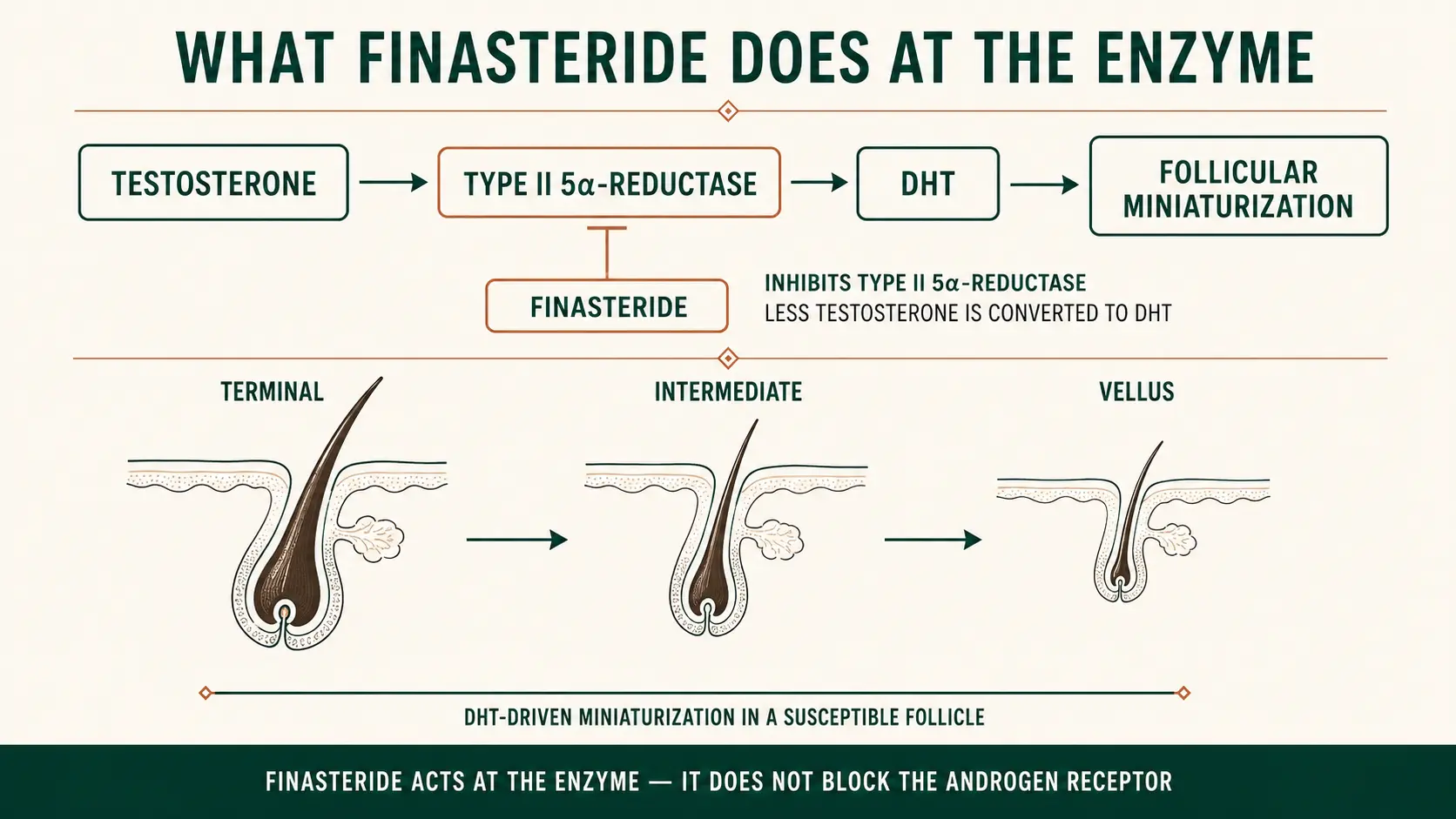
The process, simplified: testosterone becomes DHT through 5-alpha-reductase. Finasteride interferes with that step — testosterone is still there, but less of it gets converted, so less DHT is produced.
Finasteride does not directly block testosterone, and it does not block androgen receptors throughout the body. Its main action is inhibiting the type II form of 5-alpha-reductase, an enzyme found in tissues that include the hair follicles, prostate, and liver.
There is also a type I form of the enzyme, which finasteride largely leaves alone. That is the main pharmacological difference between it and dutasteride, which inhibits both forms and suppresses considerably more DHT.
After a single oral dose of 1 mg, serum DHT levels can fall by roughly 65% within 24 hours. Testosterone itself may rise slightly, since less of it is being converted, but average levels stay within the normal physiological range.
Why Does DHT Cause Hair Loss in Some Men but Not Others?
DHT is present in virtually every adult man. Yet not every man develops the same degree of hair loss.
The difference is largely genetic.
In androgenetic alopecia, certain follicles are genetically more sensitive to DHT. These are usually concentrated in the hairline, frontal scalp, mid-scalp, and crown, though the exact pattern varies from one person to another.
When a susceptible follicle is repeatedly exposed to DHT, its growth cycle gradually changes:
- The active growth phase becomes shorter
- The resting phase becomes relatively longer
- Each new hair may grow finer than the one before it
- Thick terminal hairs slowly become thinner, shorter, and less pigmented
- The follicle eventually becomes too small to produce a cosmetically useful hair
This process is called follicular miniaturization.
The change is gradual. A follicle does not disappear after one exposure to DHT — it weakens over a number of hair cycles. This is why many men first notice their hair feels less dense, or that the scalp is more visible, before they ever see large amounts of hair actually falling out.
Finasteride aims to slow this process by reducing DHT in the scalp and blood. In men genetically predisposed to androgenetic alopecia, that interrupts one of the central mechanisms driving miniaturization.
How Finasteride Works at the Enzyme Level
The chemistry is more interesting than it sounds, which is admittedly a low bar for enzyme chemistry.
Finasteride binds to 5-alpha-reductase and forms a stable complex with the enzyme and a molecule called NADP+. This complex turns over very slowly — the type II enzyme complex has an estimated half-life of around 30 days.
That helps explain an important point: how much finasteride is circulating in the blood, and how long its biological effect lasts, are not the same thing. Finasteride itself has a plasma half-life of roughly five to six hours in younger and middle-aged men, yet its effect on DHT production lasts considerably longer because of the stable complex it forms with the enzyme.
None of this means patients should invent their own dosing schedules based on half-lives found online. Human beings have already demonstrated considerable creativity in cutting tablets into microscopic fragments and building elaborate weekly calendars. A treatment plan should still be based on a proper diagnosis and medical assessment, not a spreadsheet.
Does Finasteride Regrow Hair?
It can improve hair growth, but I would not call regrowth its only, or even its most important, purpose.
Finasteride can help in several ways:
- It may slow or stop the progression of hair loss
- It may protect hairs that have started to miniaturize
- Some miniaturized hairs may become thicker
- Overall scalp coverage may improve
- The progression of visible thinning may be delayed
What it cannot reliably do is restore a completely bald area to its original density.
When a follicle has been severely miniaturized for a long time, the chance of a dramatic recovery is lower. Finasteride tends to offer more value when there are still many living, active but vulnerable follicles left to protect — which is why early treatment can matter so much. A young man with diffuse thinning and thousands of miniaturizing hairs may have more to gain from medical treatment than someone with a smooth, completely bald area where most follicles are already gone.
In two-year clinical trials, finasteride 1 mg slowed the progression of male pattern hair loss and increased hair growth compared with placebo. Five-year follow-up data found durable improvements in the finasteride group, while untreated participants kept losing hair progressively.
If your hair looks unchanged after a year, while your genetic hair loss would otherwise have progressed, that may be a successful result. The absence of further loss is not the absence of an effect.
Why Is Finasteride 1 mg Used for Hair Loss?
The standard oral dose studied and approved for male pattern hair loss is 1 mg once daily. The 5 mg tablet is mainly used for benign prostate enlargement.
Patients sometimes assume 5 mg must be five times more effective for hair, since it contains five times as much medication. That is not how the dose-response curve works.
Clinical dose-ranging trials compared finasteride doses between 0.01 mg and 5 mg per day. Doses of 0.2 mg and above showed activity, but 1 mg and 5 mg produced similar clinical results, and researchers concluded 1 mg per day was the optimal dose for male pattern hair loss.
A separate 42-day study measured how much scalp DHT fell at each dose: 0.01 mg reduced it by roughly 15%, 0.05 mg by around 62%, 0.2 mg by about 57%, 1 mg by 64%, and 5 mg by 69%. The exact numbers varied between dose groups, but the broader point holds — the relationship is not linear. Going from 1 mg to 5 mg did not produce anywhere near a fivefold increase in scalp DHT suppression.
For hair loss, taking more medication does not automatically produce more hair. The goal is not to prescribe the highest possible dose — it is to use the lowest dose with strong, consistent clinical evidence. For most suitable male patients, that dose is 1 mg daily.
Can Lower Doses of Finasteride Still Work?
Lower doses can reduce DHT and may offer some clinical benefit. Research has shown activity at doses of 0.2 mg per day and above. But when researchers weighed hair counts, clinical photographs, investigator assessments, and patient evaluations together, 1 mg offered a more dependable balance of efficacy than the lower doses.
In clinical practice, a lower dose or a less-frequent schedule may sometimes be considered for selected patients — that decision should be individual, not copied from another patient's routine. Two men can have similar-looking hair loss but very different ages, family histories, degrees of miniaturization, medical backgrounds, and long-term goals.
The standard starting point remains 1 mg daily because that is the dose backed by the strongest clinical data. A lower dose is a modification of the standard approach, not proof that the standard dose was unnecessary to begin with.
Who May Be a Good Candidate for Finasteride?
Finasteride is mainly considered for adult men with a confirmed diagnosis of androgenetic alopecia. In my practice, it is particularly relevant for a few types of patients.
Men with early or moderate hair loss. Finasteride tends to be most useful when there is still a meaningful amount of hair to preserve — a receding hairline, early crown thinning, or diffuse loss through the frontal and mid-scalp while thousands of miniaturizing follicles are still there. Those follicles are often more realistic treatment targets than a completely bald area.
Men whose hair loss is still progressing. Some patients are not especially bothered by their current hairline but can clearly see it changing from year to year. Here, the point of finasteride is not to improve today's photograph — it is to influence what the scalp looks like five or ten years from now, which matters most in men in their twenties and early thirties, when androgenetic alopecia can move quickly.
Younger men considering a hair transplant. A hair transplant can replace hair in a thinning or bald area, but it cannot stop the patient's existing, non-transplanted hair from continuing to miniaturize. This is one of the most important parts of responsible transplant planning. If I transplant a patient's frontal hairline while the native hairs immediately behind it are already thinning, the graft may grow well, but the untreated native hair can keep disappearing. Years later, the patient may be left with a transplanted frontal section and an increasingly thin area behind it — not a failure of graft growth, but a failure to plan for continuing loss. A controlled study in hair transplant patients found that finasteride 1 mg, started four weeks before surgery and continued for 48 weeks afterward, improved the surrounding non-transplanted scalp hair and increased overall density compared with placebo.
Men who have already had a hair transplant. Finasteride may still be useful afterward, because the native hairs surrounding the transplanted follicles can remain sensitive to DHT. It is not primarily prescribed to "protect the grafts" — properly selected permanent-zone grafts are expected to keep much of their original resistance to androgenetic hair loss. The more immediate concern is usually the patient's remaining natural hair. Preserving those hairs can help the transplant blend more naturally and may reduce the need to chase continuing loss with repeated procedures.
Selected patients with donor-area miniaturization. The donor area is often described as completely permanent, but real patients are less tidy than textbook diagrams. Some men develop retrograde alopecia, thinning around the upper or lower margins of the donor region, or progressive crown expansion that shrinks the available safe donor zone. In these patients, medical treatment may help preserve DHT-sensitive hairs around the donor area. It cannot turn an unstable donor area into a perfect one, and it does not make every follicle permanent — but it can be part of a more conservative long-term donor strategy.
Who Is Finasteride Not Automatically Suitable For?
Not every type of hair loss is caused by DHT. Finasteride specifically targets androgenetic alopecia — it is not a universal tablet for every person who notices hair in the shower.
Before prescribing treatment, the pattern and cause of loss need to be assessed. Sudden shedding, circular bald patches, scalp inflammation, pain, heavy scaling, or scarring may point toward a different diagnosis, including:
- Telogen effluvium
- Alopecia areata
- Thyroid disorders
- Iron or nutritional deficiencies
- Inflammatory scalp disease
- Medication-related shedding
- Scarring alopecia
Reducing DHT will not correct a cause that has nothing to do with DHT.
Finasteride 1 mg is officially indicated for male pattern hair loss in men and is not indicated for women or children. Women who are pregnant or may become pregnant should not handle crushed or broken finasteride tablets, because of the potential risk to a male fetus. Patients with liver disease, or those undergoing PSA monitoring, should also discuss finasteride use with their physician, since the medication is extensively metabolized in the liver and can affect how PSA results are interpreted.
How Long Does Finasteride Take to Work?
The hormonal effect begins quickly. The visual effect does not.
DHT can fall within the first day, but hair grows on a slow biological cycle — a follicle needs time to move through its current cycle and produce a new hair with a potentially improved diameter. A realistic timeline usually looks like this:
- First 24 hours — DHT suppression begins
- First three months — some patients notice less shedding, though this is not universal
- Around six months — early photographic or density changes may become easier to assess
- Around 12 months — a more meaningful evaluation can usually be made
- Beyond one year — hair preservation, and further thickening in responsive patients, may continue
The prescribing information notes that at least three months of daily use is generally needed before benefit is observed, and long-term trials show the value of treatment becomes clearer when results are followed over years rather than a few impatient weeks.
I prefer to assess progress with standardized photographs — same hairstyle, similar lighting and, when available, magnified examination of miniaturization. Memory is a poor measuring instrument. Bathroom lighting is worse.
What Happens If Finasteride Is Stopped?
Finasteride controls a continuing genetic process. It does not permanently remove the follicle's genetic sensitivity.
Once the medication is stopped, DHT production returns toward its untreated level and androgenetic hair loss can resume. The prescribing information states that withdrawal of treatment leads to reversal of its effect within approximately 12 months.
That does not mean every protected hair falls out on a particular date — it means the patient gradually loses the advantage the treatment was providing. Finasteride should be understood as a long-term treatment, not a short course.
Is Finasteride the Same as Minoxidil?
No. They work through different mechanisms.
Finasteride mainly addresses the androgen-driven mechanism behind male pattern hair loss by lowering DHT. Minoxidil does not meaningfully reduce DHT — its main value is supporting the growth phase and improving the diameter or activity of susceptible follicles.
- Finasteride reduces DHT and helps slow ongoing miniaturization
- Minoxidil stimulates and supports hair growth through a different pathway
- A hair transplant moves suitable donor follicles into areas of loss
- PRP and microneedling may stimulate follicular activity in selected patients
These should not automatically be viewed as competitors. In a suitable patient, they can address different parts of the same problem. Minoxidil can improve fullness, but it is not an exact substitute for a treatment that targets DHT — and finasteride cannot replace a transplant in an area where too much hair has already been lost.
Does Every Hair Transplant Patient Need Finasteride?
No. I do not believe every patient should be pushed into the same medication plan. It depends on age, pattern, family history, donor stability, existing density, and how much DHT-sensitive hair remains. A man with an established mature pattern and very little ongoing loss may be assessed very differently from a 24-year-old with active miniaturization across the frontal and mid-scalp.
Patients should still understand what surgery can and cannot do. A hair transplant redistributes a limited number of donor follicles — it does not treat the biological process affecting the rest of the scalp. When a patient has a large amount of existing hair at risk, ignoring that hair can compromise the long-term appearance of an otherwise successful transplant.
Medical treatment protects the foundation. Hair transplantation builds on top of it.
A Note About Finasteride Side Effects
Finasteride is a prescription medication, and possible side effects deserve a serious, balanced discussion — more than a nervous paragraph tacked onto the end of an article about DHT.
I have covered that separately in how common finasteride side effects really are — the actual rates seen in controlled trials, why the placebo groups also reported symptoms, lower-dose strategies, topical finasteride, and how I approach treatment when a patient develops symptoms.
This article has deliberately focused on how finasteride works, why the standard hair-loss dose is 1 mg, and which patients may benefit from it.
My Final View
Finasteride is not a miracle treatment, and I do not present it as one.
It is a well-studied medication that targets one of the main biological drivers of male pattern hair loss: the conversion of testosterone into DHT.
For the right patient, its greatest value is often not dramatic regrowth. It is keeping vulnerable hair from becoming visibly thinner over the years ahead. That is also why I treat it as one part of a longer treatment plan rather than a decision taken on its own.
The standard dose for male pattern hair loss is 1 mg daily. Research shows that increasing the dose to 5 mg adds relatively little DHT suppression and does not produce five times the hair benefit.
The patients who often have the most to gain are those who still have a substantial amount of hair left — men with early thinning, active miniaturization, or native hair that needs protecting around a planned transplant.
The earlier we recognize that hair preservation and hair replacement are two different jobs, the better we can plan a natural result that still makes sense many years later.
Frequently Asked Questions
Does finasteride reduce testosterone?
Is 5 mg finasteride better than 1 mg for hair loss?
Can finasteride restore a completely bald hairline?
Does finasteride work on the frontal scalp?
Does finasteride work on the crown?
Can finasteride replace minoxidil?
Is finasteride only useful before a hair transplant?
How soon should I judge the result?
— Dr. Mesut Demir
Considering finasteride or a hair transplant?
Share your pattern, timeline, and goals with us. We will give you an honest assessment of whether medical treatment, surgery, or both make sense for your specific case.
Request a Free Analysis- DailyMed. Finasteride Tablets, Full Prescribing Information. U.S. National Library of Medicine. dailymed.nlm.nih.gov
- Roberts JL, Fiedler V, Imperato-McGinley J, et al. Clinical dose ranging studies with finasteride, a type 2 5α-reductase inhibitor, in men with male pattern hair loss. Journal of the American Academy of Dermatology. 1999. PMID 10495375
- Drake L, Hordinsky M, Fiedler V, et al. The effects of finasteride on scalp skin and serum androgen levels in men with androgenetic alopecia. Journal of the American Academy of Dermatology. 1999. PMID 10495374
- Kaufman KD, Olsen EA, Whiting D, et al. Finasteride in the treatment of men with androgenetic alopecia. Journal of the American Academy of Dermatology. 1998. doi:10.1016/s0190-9622(98)70007-6
- Finasteride Male Pattern Hair Loss Study Group. Long-term (5-year) multinational experience with finasteride 1 mg in the treatment of men with androgenetic alopecia. European Journal of Dermatology. 2002. PMID 11809594
- Leavitt M, Perez-Meza D, Rao NA, Barusco M, Kaufman KD, Ziering C. Effects of finasteride (1 mg) on hair transplant. Dermatologic Surgery. 2005. doi:10.1111/j.1524-4725.2005.31202
- Leyden J, Dunlap F, Miller B, et al. Finasteride in the treatment of men with frontal male pattern hair loss. Journal of the American Academy of Dermatology. 1999. doi:10.1016/s0190-9622(99)70081-2