
Quick answer
Ketoconazole shampoo can help control dandruff and seborrheic dermatitis, and it may have a supporting role when either condition accompanies androgenetic alopecia. Evidence that the shampoo itself regrows hair is much weaker. A 2020 systematic review found only five prospective human studies, involving 318 participants in total, and called for proper randomized controlled trials. The frequently repeated claim that 2% ketoconazole performed like minoxidil largely comes from a 1998 paper whose direct comparison involved eight men — four using ketoconazole shampoo and four using 2% minoxidil — which is an interesting pilot signal rather than evidence of equivalence. In a separate six-month study of 150 men, three 1% anti-dandruff shampoos all reduced shedding and improved some hair measurements, yet hair density did not increase with any of them. Claims that ketoconazole shampoo clinically blocks scalp DHT remain unproven in humans. Dr. Mesut Demir regards it as reasonable treatment when the scalp gives a reason, and as an optional adjunct rather than a substitute for established treatment or a proper diagnosis.
Several years ago, I recorded a video about ketoconazole shampoo and hair loss. The central distinction still holds: improving a scalp condition is not the same thing as reversing follicular miniaturization.
Some of the shorter explanations in that video have aged less well. I gave a small, exploratory hair-growth signal more confidence than the underlying studies justified, and I didn't put the most important limitation beside the claim: the direct ketoconazole-versus-minoxidil comparison involved four men in each group.
Medicine should leave room for revision. Otherwise, we would still be repeating every confident sentence we once said into a camera, which would be a fairly alarming way to practice. This article is the fuller answer I would give now.
- The short evidence map
- What is ketoconazole shampoo actually for?
- Does ketoconazole shampoo regrow hair?
- What did the 1998 ketoconazole study actually find?
- What did the 2002 anti-dandruff shampoo study add?
- What did the 2020 systematic review conclude?
- Is there evidence for women with pattern hair loss?
- What do current guidelines and expert panels say?
- Does ketoconazole shampoo block DHT?
- Who is most likely to benefit?
- Is 1% or 2% ketoconazole better?
- How should ketoconazole shampoo be used?
- Can it be used with minoxidil or finasteride?
- What side effects can it cause?
- Can I use it after a hair transplant?
- Where ketoconazole fits in my treatment hierarchy
- Frequently asked questions
The short evidence map
| Question | Best current answer | Confidence |
|---|---|---|
| Does ketoconazole treat dandruff and seborrheic dermatitis? | Yes. This is its clearest, labeled role. | Moderate |
| Can it reduce shedding when dandruff is also present? | Possibly. One six-month study found less shedding with several anti-dandruff shampoos, including ketoconazole. | Low to moderate |
| Does it regrow hair in androgenetic alopecia? | It may improve some measured hair variables, but the human evidence is small and methodologically weak. | Low |
| Is it as effective as minoxidil? | This has not been established. The comparison most often quoted was four men versus four men. | Very low |
| Does it block DHT in the scalp? | A local anti-androgen effect is biologically plausible, but clinically meaningful scalp DHT reduction has not been demonstrated in humans. | Very low |
| Can it replace finasteride or minoxidil? | No reliable evidence supports using it as a replacement. | Moderate |
Ketoconazole is a useful example of how a cautious research finding can grow into a much larger internet claim. “May help” becomes “blocks DHT,” and a tiny exploratory comparison becomes “as effective as minoxidil.” The original methods rarely travel with the headline.
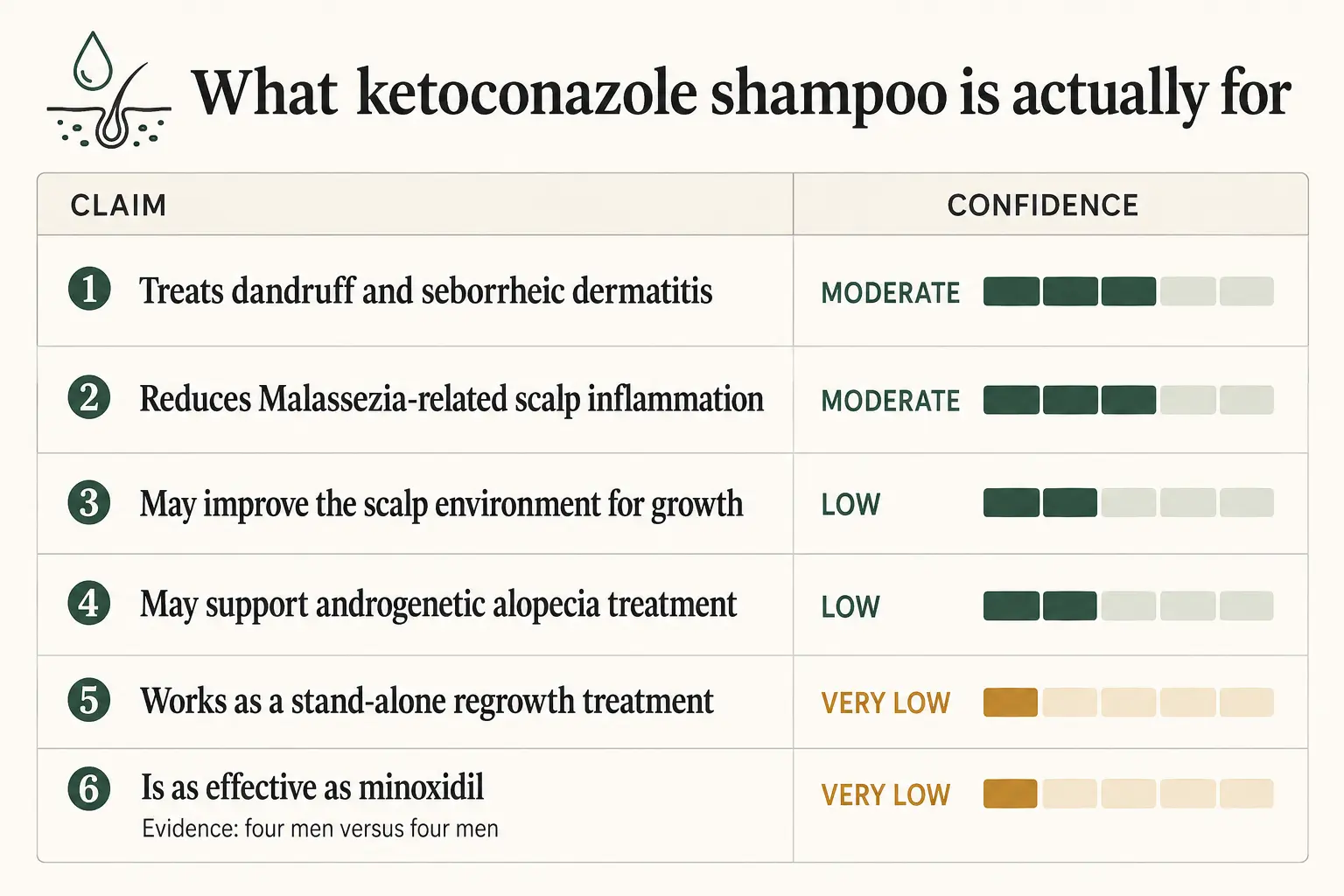
I prefer to put the limiting detail next to the claim. If an apparent minoxidil comparison involved four men in each group, the number belongs in the same paragraph as the result.
If a study used a leave-on preparation rather than a shampoo, the formulation belongs there too. Evidence changes, and old claims need to be checked against their original sources.
The aim here is to separate what ketoconazole shampoo reliably does for the scalp from what it might do for pattern hair loss, then show exactly how much confidence each conclusion deserves.
What is ketoconazole shampoo actually for?
Ketoconazole is an imidazole antifungal medicine. In shampoo form, its established role is to treat conditions associated with Malassezia yeasts, particularly dandruff and seborrheic dermatitis.
That distinction matters because dandruff, scalp inflammation and androgenetic alopecia are often bundled together under the vague heading of “scalp health”. They can occur in the same person, but they aren't the same process.
Androgenetic alopecia progressively miniaturizes genetically susceptible follicles. In men this commonly appears as recession, frontal or mid-scalp thinning and crown loss. In women it more often produces reduced density across the central scalp, although patterns vary. Ketoconazole isn't licensed as a primary treatment for that miniaturization.
Seborrheic dermatitis produces recurrent scale, itching, redness and sometimes a greasy scalp. Reducing Malassezia activity can improve that condition, and this is where ketoconazole has a much firmer evidence base.
A Cochrane review included 51 trials of topical antifungals for seborrheic dermatitis, with 9,052 participants overall. Forty-five trials followed patients for five weeks or less. Across eight ketoconazole-versus-placebo studies involving 2,520 participants, 2% ketoconazole reduced the risk of failing to achieve clearance by 31% at four weeks (risk ratio 0.69, 95% confidence interval 0.59–0.81). The evidence was rated low quality, heterogeneity was substantial (I² = 74%), and 24 of the 51 studies had some pharmaceutical-company involvement. [1]
The review supports ketoconazole's role in seborrheic dermatitis. Hair regrowth is a separate claim with a much smaller evidence base.
The bottle on the desk
Versions of this conversation have happened often enough that the sequence is familiar. A patient puts a ketoconazole bottle on the desk between us and says, “I read on Reddit that this works as well as minoxidil.” I turn the bottle around to check the label and ask whether it is 1% or 2%. He doesn't know.
When I ask how he uses it, he shows me by running his hands through the ends of his hair. Very little of the shampoo is reaching the scalp. He rinses it away almost immediately because nobody has told him about the three-to-five-minute contact time. Then comes the detail that matters most: his dandruff has disappeared, so he assumes the shampoo must also be stopping his hair loss.
The dandruff improvement is genuine. Under magnification, however, I may see a much calmer scalp while thick terminal hairs still sit beside progressively finer, miniaturized hairs. The shampoo has worked on one problem. That does not prove it has controlled the other.
A quieter scalp and continuing androgenetic alopecia can exist at the same time.
Does ketoconazole shampoo regrow hair?
The honest answer is that it might improve certain hair measurements in some people, but we don't yet have strong evidence that it produces reliable, cosmetically meaningful regrowth in androgenetic alopecia.
The distinction between a measured change and visible restoration is important. Hair studies may report:
- the percentage of hairs in anagen, the active growth phase
- mean hair-shaft diameter
- hair density within a measured area
- shedding observed during washing
- investigator or participant photographs
- subjective satisfaction
All of these can be useful. None automatically tells us how much denser a person will look in ordinary lighting six or twelve months later.
The best way to understand the ketoconazole story is to look at the studies individually rather than letting the word “systematic review” make a small evidence base sound larger than it is.
What did the 1998 ketoconazole study actually find?
The 1998 paper by Piérard-Franchimont and colleagues is the source behind many modern claims about ketoconazole shampoo and hair growth. It contained two small studies. [2]
The 21-month comparison
The first study included 39 men aged 21–33 with Hamilton–Norwood III Vertex androgenetic alopecia and no dandruff or seborrheic dermatitis during the previous six months.
- 27 men used 2% ketoconazole shampoo two to four times weekly
- 12 men used an unmedicated shampoo
- follow-up continued for 21 months
- an additional 22 men without androgenetic alopecia acted as non-balding controls
The main outcome was a “pilary index”, calculated by multiplying the percentage of hairs in anagen by the mean hair-shaft diameter. The index began to rise after six months in the ketoconazole group and appeared to plateau at around 15 months, while it gradually declined in men using the unmedicated shampoo.
The finding is a positive signal, but it came from a nonrandomized comparison with uneven group sizes, no placebo shampoo matched to the medicated product and an outcome most patients have never heard of. A pilary index isn't the same thing as a standardized terminal hair count or a blinded judgment of visible regrowth.
The authors reported that the medicated shampoo was used two to four times weekly and the control shampoo “in a similar way.” They didn't report a standardized contact time. In the smaller minoxidil comparison, both shampoos were used ad libitum. The study therefore tested rinse-off shampoo regimens without tightly controlling how long the products remained on the scalp.
Where the “as good as minoxidil” claim came from
The same paper included a second, six-month pilot comparison:
- four men used 2% ketoconazole shampoo
- four men used 2% minoxidil once daily with an unmedicated shampoo
Hair density increased by 18% in the ketoconazole group and 11% in the minoxidil group. Median hair-shaft diameter increased by 7% in both groups. Those numbers are interesting, but each treatment group contained four people.
The comparison also used 2% minoxidil once daily. It didn't test the 5% preparations commonly used for male androgenetic alopecia, and it wasn't designed or powered to establish that the treatments were equivalent.
Saying “ketoconazole was comparable to minoxidil” removes nearly everything a reader needs in order to judge the sentence. Four versus four is the detail that belongs beside the claim, not several paragraphs later.
What did the 2002 anti-dandruff shampoo study add?
A later study randomized 150 men with androgenetic alopecia, dandruff and associated shedding to shampoos containing 1% ketoconazole, 1% piroctone olamine or 1% zinc pyrithione. They used the assigned shampoo two to three times per week for six months. [3]
All three shampoos rapidly improved dandruff and itching. By the end of the study:
| Shampoo | Shedding | Anagen % | Shaft diameter | Hair density |
|---|---|---|---|---|
| Ketoconazole 1% | −17.3% | +4.9% | +5.4% | No change |
| Piroctone olamine 1% | −16.5% | +7.9% | +7.7% | No change |
| Zinc pyrithione 1% | −10.1% | +6.8% | −2.2% | No change |
The result supports a practical point: treating a dandruff-prone scalp may reduce visible shedding and improve some hair measurements. It doesn't isolate a unique regrowth effect for ketoconazole.
Piroctone olamine deserves more than a passing mention. Its shedding result was similar to ketoconazole's, while its increases in anagen percentage (+7.9%) and mean shaft diameter (+7.7%) were numerically larger than ketoconazole's (+4.9% and +5.4%). This comparison doesn't prove that piroctone olamine is a hair-growth treatment; it shows that the observed changes weren't unique to ketoconazole. Improving dandruff, itch, scalp oil or the local inflammatory environment may explain part of the signal.
Interestingly, the two ingredients have not ended up in the same place. The 2025 Canadian consensus panel discussed below placed ketoconazole shampoo among its near-consensus recommendations while listing piroctone olamine shampoo among the interventions it did not recommend. [8] Similar numbers in one 2002 study did not translate into similar standing two decades later.
The most important endpoint is also the least dramatic: after six months, hair density had not increased with any of the three shampoos.
The paper specified frequency but didn't provide a standardized residence time in its published report. A separate 2003 split-scalp study, designed around dandruff rather than hair growth, found that both 1% ketoconazole and 1% piroctone olamine reduced scale and yeast colonization more when left on for five minutes than when rinsed without a residence period. [4] Contact time clearly matters for anti-dandruff efficacy. It still doesn't turn a rinse-off shampoo into a leave-on hair-loss drug.
This is useful evidence for scalp treatment. Calling it proof that ketoconazole reverses male pattern baldness would ask the study to answer a question it didn't answer.
What did the 2020 systematic review conclude?
The only dedicated systematic review of topical ketoconazole for androgenetic alopecia screened 47 papers and included seven prospective studies: two animal studies and five human studies involving 318 participants in total. [5]
The human studies reported improvements in hair-shaft diameter, the pilary index, photographic assessments or subjective evaluations. The review described topical ketoconazole as a promising adjunct or alternative and ended with the line that matters most: randomized controlled trials are needed.
The review was a qualitative synthesis, not a meta-analysis producing a pooled increase in hairs per square centimeter. Its 318 participants also didn't all receive the same formulation, concentration, schedule or comparison treatment.
That leaves us with a coherent signal, but not a dependable effect size. I can't tell a patient that ketoconazole shampoo will add a specific number of hairs, reduce progression by a certain percentage or preserve a follicle for a defined number of years. The literature doesn't provide those answers.
Is there evidence for women with pattern hair loss?
There is some newer female evidence, but it is often described inaccurately.
A 2019 study randomized 40 women with female pattern hair loss to either 2% minoxidil solution or a compounded 2% ketoconazole microemulsion for six months. Twenty women were assigned to each group. Both groups improved on clinical and trichoscopic measures, while the ketoconazole response appeared later. Reported treatment-related side effects were 10% with ketoconazole and 55% with minoxidil. [6]
The ketoconazole product was a leave-on microemulsion prepared for the study. It wasn't a commercial rinse-off shampoo. There was also no vehicle-only or placebo arm.
The groups differed in disease severity at baseline as well, which makes a clean comparison between the two treatments more difficult.
This trial makes topical ketoconazole in female pattern hair loss worth studying further. It doesn't prove that an ordinary ketoconazole shampoo regrows hair in women, and its safety comparison cannot simply be transferred to every shampoo or minoxidil formulation.
Women can, of course, use ketoconazole shampoo for an appropriate scalp indication. The separate question is whether patterned thinning, diffuse shedding, iron deficiency, thyroid disease, traction, medication, a postpartum change or hyperandrogenism is actually causing the hair complaint. A shampoo label can't make that distinction.
What do current guidelines and expert panels say?
They show cautious interest rather than settled agreement.
The 2017 Japanese guideline, published in English in 2018, gave topical ketoconazole a C1 grade, meaning “permissible” on weak evidence. Its commentary relied mainly on one nonrandomized study and two case series, described the evidence for male pattern hair loss as weak and noted that ketoconazole wasn't approved in Japan as a hair-growth agent. [7]
A 2025 Canadian modified-Delphi consensus asked 11 clinicians to assess multiple androgenetic alopecia interventions. Ketoconazole shampoo received 73% support, categorized as “near consensus” because the panel's threshold for full consensus was 75%. The paper placed it as an adjunct and again called for more robust randomized trials. [8]
Seventy-three percent is reasonably supportive. Under the study's predefined threshold, it remained near consensus.
For established androgenetic alopecia treatment, broader evidence-based guidelines give much stronger support to interventions such as topical minoxidil and, for appropriate male patients after individual counseling, finasteride. [9] The treatments don't need to compete. A person may use ketoconazole for seborrheic dermatitis and an evidence-based therapy for follicular miniaturization within the same long-term plan.
Our fuller guide to long-term hair-loss treatment explains how scalp treatment, medical management and hair transplantation solve different parts of the problem.
Does ketoconazole shampoo block DHT?
This is the point at which a plausible mechanism often becomes an advertised fact.
Ketoconazole can affect steroid synthesis when it reaches sufficient systemic concentrations. That is well established for oral ketoconazole and helps explain why the oral medicine has very different risks and uses. It doesn't prove that a rinse-off scalp shampoo lowers follicular DHT enough to alter androgenetic alopecia.
Topical ketoconazole may have local anti-inflammatory activity, and laboratory or indirect evidence has raised the possibility of anti-androgen effects. I haven't found a controlled human study showing a clinically meaningful reduction in scalp DHT after ketoconazole shampoo, nor a dose–response study linking DHT change to preserved hair.
The UK product information for one 2% shampoo reports that ketoconazole was not detectable in plasma after chronic shampooing, including in 39 people using it four to ten times weekly for six months. [10] Low systemic exposure is reassuring for topical safety. It also shows why we shouldn't casually borrow the endocrine effects of oral ketoconazole and assign them to a shampoo.
A local effect could still exist without measurable blood levels. Clinically relevant scalp DHT suppression, however, has not been demonstrated in people using the shampoo.
I would describe ketoconazole as an antifungal shampoo with anti-inflammatory properties and a possible adjunctive effect on pattern hair loss. “Proven topical DHT blocker” goes beyond the evidence.
Who is most likely to benefit?
Pattern hair loss with dandruff or seborrheic dermatitis
This is the clearest use case. The patient has a reason to treat the scalp condition even if the additional effect on androgenetic alopecia turns out to be small.
Typical features include recurrent flaking, itching, erythema, greasy or yellowish scale and symptoms that improve then return. Ketoconazole may be one part of treatment, although scalp psoriasis, allergic contact dermatitis and other conditions can resemble seborrheic dermatitis.
An oily, itchy scalp with increased shedding
Treating active dandruff may reduce shedding that becomes visible during washing. The 2002 study supports that possibility, but it doesn't mean every shed hair was caused by Malassezia or that every oily scalp needs an antifungal.
A healthy scalp with progressive miniaturization
Ketoconazole is lower priority here. Somebody may still choose it as a tolerated adjunct, but I wouldn't let a shampoo trial delay assessment while the frontal scalp or crown continues to thin.
New diffuse shedding without a diagnosis
This is a poor situation for guessing. Telogen effluvium, nutritional deficiency, thyroid disease, illness, medication, alopecia areata and several inflammatory or scarring disorders require different approaches. A medicated shampoo can make the scalp feel cleaner while leaving the actual cause untouched.
Is 1% or 2% ketoconazole better?
For severe dandruff and seborrheic dermatitis, there is direct evidence favoring 2% over 1%.
In a randomized study of 66 people, both concentrations were used through a four-week treatment phase. The 2% shampoo produced significantly greater reductions in flaking and Malassezia density at two and four weeks, with a trend toward fewer relapses during follow-up. [11]
That study addressed dandruff, not hair regrowth.
For androgenetic alopecia, we don't have a robust head-to-head trial showing how much more hair, if any, 2% produces than 1%. Different countries also regulate the concentrations differently: 1% may be available over the counter in one market while 2% requires a prescription in another.
The sensible concentration is the one that fits the diagnosed condition, local product information and the person's tolerance. More concentrated doesn't automatically mean more useful for every scalp.
How should ketoconazole shampoo be used?
The product label and the clinician treating the scalp should take priority because formulations and approved schedules vary.
For adult dandruff and seborrheic dermatitis, UK product information for one 2% shampoo gives the following schedule: [10]
- Wet the hair and scalp thoroughly.
- Apply enough shampoo to lather across the scalp.
- Massage gently and leave it in contact with the scalp for three to five minutes.
- Rinse thoroughly.
- Use twice weekly for two to four weeks.
- For prevention after control is achieved, use once every one to two weeks.
The three-to-five-minute contact time matters, as does the word gently. Vigorous scrubbing adds irritation without adding treatment value.
Ketoconazole can dry the hair shaft, particularly in longer, curly, coily, bleached or otherwise fragile hair. Apply it primarily to the scalp rather than repeatedly working it through the ends, and use a suitable conditioner on the lengths if needed. A mild non-medicated shampoo can be used on other wash days.
Daily use isn't automatically more effective. It may simply produce more dryness or irritation, and the common labeled schedule for seborrheic dermatitis is not daily.
Can ketoconazole be used with minoxidil or finasteride?
They may be used within the same treatment plan because they have different purposes.
Ketoconazole shampoo is rinsed away and is usually used for scalp disease or as an adjunct. Topical minoxidil is a leave-on treatment applied to a dry scalp. A practical routine is to wash, rinse and dry the scalp fully before applying minoxidil according to its instructions.
There are no clinical trials proving that adding ketoconazole shampoo to minoxidil produces a specific extra percentage of regrowth. The 1998 paper compared regimens; it didn't test a properly powered ketoconazole-plus-minoxidil group against minoxidil alone.
If somebody is already irritated, I prefer not to introduce several new topical products on the same day. Additions made one at a time are easier to assess. Persistent burning, redness or scale may come from minoxidil vehicle ingredients, shampoo ingredients, the underlying scalp condition or a combination of them.
Oral finasteride doesn't require shampoo timing. Whether finasteride is appropriate is a separate medical decision involving expected benefit, contraindications and adverse-effect counseling.
What side effects can ketoconazole shampoo cause?
Most people tolerate ketoconazole shampoo, but “topical” doesn't mean incapable of causing a reaction.
The UK 2% shampoo information lists possible effects including:
- scalp dryness, irritation, itching or burning
- rash or application-site redness
- folliculitis
- changes in hair texture
- contact dermatitis or hypersensitivity
- rare hair-color change
- alopecia, listed as an uncommon adverse reaction
Across 22 trials involving 2,980 people in the product's pooled safety data, no adverse reaction occurred at a frequency of 1% or higher. [10]
If shedding begins after starting ketoconazole, I wouldn't automatically call it a beneficial “initial shed”. That explanation belongs to certain hair-growth treatments and shouldn't be attached to every product that happens to be used on the scalp. Stop and seek advice if there is marked burning, swelling, a spreading rash, pustules or clearly worsening hair loss.
Avoid the eyes. Anyone with a known allergy to ketoconazole or another ingredient in the formulation shouldn't use it.
Can it be used during pregnancy or breastfeeding?
This deserves more precision than a simple “safe”.
The UK product information states that ketoconazole 2% shampoo wasn't detected in plasma after chronic scalp use and is not contraindicated during pregnancy or lactation, while still advising caution. [10]
The information is reassuring for shampoo used on the scalp. It doesn't provide universal clearance for every ketoconazole formulation, application over large or damaged skin areas or every individual pregnancy. A pregnant or breastfeeding patient should check the exact product and intended use with the clinician responsible for their care.
Oral ketoconazole is a different exposure with a very different safety profile. It should not be mentally filed beside the shampoo merely because the active ingredient has the same name.
Can I use ketoconazole shampoo after a hair transplant?
Not on freshly transplanted grafts unless the treating team specifically instructs you to do so.
The early recipient area is healing, and postoperative cleansing has a different purpose from ordinary dandruff treatment. Timing depends on epithelial healing, crust removal, irritation, the condition being treated and the clinic's protocol. Restarting a medicated shampoo on a fixed internet date without looking at the scalp is needlessly rigid.
Before surgery, significant active redness, scale, pustules or another unexplained scalp problem should be assessed and brought under control. Seborrheic dermatitis doesn't automatically prevent hair transplantation, but elective surgery makes more sense on a calm scalp.
Our separate articles explain how I approach seborrheic dermatitis before and after hair transplantation and why the diagnosis behind scalp inflammation matters more than the word “inflammation” by itself.
The division between these pages is deliberate. If the question is whether a flaky or inflamed scalp should be controlled before transplantation, the seborrheic dermatitis article is the better destination. If the question is whether ketoconazole shampoo itself can regrow miniaturizing hair, this is the relevant evidence review.
Where ketoconazole fits in my own treatment hierarchy
I think about the scalp in layers.
First, identify the hair-loss diagnosis. Then look for a scalp condition that needs treatment in its own right. After that, decide whether an adjunct is worth the time, cost and irritation risk it adds.
| Clinical situation | Role of ketoconazole shampoo | What I would not promise |
|---|---|---|
| AGA with active dandruff or seborrheic dermatitis | Reasonable treatment for the scalp condition; possible additional hair benefit | Reliable regrowth or DHT control |
| AGA with a healthy scalp | Optional, lower-priority adjunct | Replacement for established treatment |
| Unexplained diffuse shedding | Only if a separate ketoconazole-responsive scalp condition is present | Diagnosis or treatment of the underlying shedding by shampoo alone |
| Active scalp inflammation before transplantation | May be used when seborrheic dermatitis is the diagnosis | A universal solution for all causes of redness and scale |
| Early recovery after transplantation | Use only according to the treating team's instructions | A universal restart day for every patient |
This is also why I don't rank every hair product on one ladder. Finasteride, minoxidil, antifungal shampoo and hair transplantation do different jobs. A good plan doesn't need one of them to be declared the winner.
Frequently asked questions
Does Nizoral shampoo regrow hair?
Is ketoconazole shampoo a DHT blocker?
Is ketoconazole shampoo as effective as minoxidil?
How often should I use ketoconazole shampoo for hair loss?
How long should ketoconazole shampoo stay on the scalp?
Is ketoconazole 1% or 2% better for hair loss?
Can women use ketoconazole shampoo for thinning hair?
Can I use ketoconazole shampoo with minoxidil?
Does ketoconazole cause an initial shed?
Can I use ketoconazole shampoo every day?
Can ketoconazole shampoo be used after a hair transplant?
Can ketoconazole replace finasteride or minoxidil?
My conclusion
Ketoconazole shampoo occupies a sensible but limited place in hair-loss care.
For dandruff and seborrheic dermatitis, there is a clear reason to use it. When those conditions accompany androgenetic alopecia, improving the scalp may reduce irritation and shedding, and small studies leave open the possibility of an additional effect on hair caliber or cycling.
The leap from that evidence to “ketoconazole blocks DHT and works like minoxidil” is too large. The famous minoxidil comparison was four men against four. The systematic review found only five prospective human studies across several formulations. Guidelines and expert panels allow or discuss ketoconazole as an adjunct, while continuing to describe the evidence as weak or in need of better trials.
I'm comfortable recommending a useful supporting treatment when the scalp gives us a reason. I'm less comfortable asking a shampoo to carry a progressive hair-loss plan by itself.
— Dr. Mesut Demir
Not sure whether the problem is your scalp, your follicles, or both?
Send clear photographs of the hairline, mid-scalp, crown and donor area, together with a short history of any itching, scale, redness, pustules, medicines and recent shedding. A remote review is preliminary and doesn't replace an in-person diagnosis, but it can help us tell you whether a surgical discussion makes sense or whether the scalp and ongoing hair loss need attention first.
Request a Pure Line case review- Okokon EO, Verbeek JH, Ruotsalainen JH, Ojo OA, Bakhoya VN. Topical antifungals for seborrhoeic dermatitis. Cochrane Database of Systematic Reviews. 2015;(5):CD008138. doi:10.1002/14651858.CD008138.pub3
- Piérard-Franchimont C, De Doncker P, Cauwenbergh G, Piérard GE. Ketoconazole shampoo: effect of long-term use in androgenic alopecia. Dermatology. 1998;196(4):474–477. doi:10.1159/000017954
- Piérard-Franchimont C, Goffin V, Henry F, Uhoda I, Braham C, Piérard GE. Nudging hair shedding by antidandruff shampoos: a comparison of 1% ketoconazole, 1% piroctone olamine and 1% zinc pyrithione formulations. International Journal of Cosmetic Science. 2002;24(5):249–256. doi:10.1046/j.1467-2494.2002.00145.x
- Piérard-Franchimont C, Uhoda E, Loussouarn G, Saint-Léger D, Piérard GE. Effect of residence time on the efficacy of antidandruff shampoos. International Journal of Cosmetic Science. 2003;25(6):267–271. doi:10.1111/j.1467-2494.2003.00195.x
- Fields JR, Vonu PM, Monir RL, Schoch JJ. Topical ketoconazole for the treatment of androgenetic alopecia: a systematic review. Dermatologic Therapy. 2020;33(1):e13202. doi:10.1111/dth.13202
- El-Garf A, Mohie M, Salah E. Trichogenic effect of topical ketoconazole versus minoxidil 2% in female pattern hair loss: a clinical and trichoscopic evaluation. Biomedical Dermatology. 2019;3:8. Not indexed in PubMed; verified against the publisher's version of record. doi.org
- Manabe M, Tsuboi R, Itami S, et al. Guidelines for the diagnosis and treatment of male-pattern and female-pattern hair loss, 2017 version. Journal of Dermatology. 2018;45(9):1031–1043. doi:10.1111/1346-8138.14470
- Landells I, Chow E, Gupta AK, et al. A Canadian consensus on androgenetic alopecia: approach and management. Journal of Cutaneous Medicine and Surgery. 2025;29(5 Suppl):5S–14S. doi:10.1177/12034754251368849
- Kanti V, Messenger A, Dobos G, et al. Evidence-based (S3) guideline for the treatment of androgenetic alopecia in women and in men — short version. Journal of the European Academy of Dermatology and Venereology. 2018;32(1):11–22. doi:10.1111/jdv.14624
- Ketoconazole 2% w/w shampoo — summary of product characteristics. Electronic Medicines Compendium.
- Piérard-Franchimont C, Piérard GE, Arrese JE, De Doncker P. Effect of ketoconazole 1% and 2% shampoos on severe dandruff and seborrhoeic dermatitis: clinical, squamometric and mycological assessments. Dermatology. 2001;202(2):171–176. doi:10.1159/000051628