
Quick answer
Hair thinning during menopause often begins during perimenopause, years before menstrual periods stop completely. Declining estrogen levels change the hormonal environment around hair follicles and can make an inherited tendency toward female pattern hair loss more noticeable. The main causes to investigate are female pattern hair loss, telogen effluvium, hair-shaft breakage, and scarring conditions such as frontal fibrosing alopecia. Some women experience more than one condition at the same time. For female pattern hair loss, topical minoxidil and selected prescription medications are established treatments. Hair transplantation can improve localized thinning in suitable patients, provided the hair loss is sufficiently stable and the donor area is healthy. Widespread miniaturization and active scalp inflammation can make surgery unsuitable.
Why women notice hair changes around menopause
A smaller ponytail is one of the clearest descriptions of reduced hair volume.
The hairline may look unchanged and no bald patch is visible, yet the volume gathered together is noticeably smaller than before.
Other changes include a widening middle part, increased scalp visibility under overhead lighting, heavier shower shedding, or thinning frontal corners.
When assessing these concerns, I pay attention to where the change began and how quickly it progressed. Gradual loss of hair caliber suggests a different process from a sudden increase in shedding.
Hair changes frequently begin during perimenopause, when ovarian hormone levels fluctuate. After menopause, ovarian estrogen production falls substantially.
A 2025 review in Maturitas describes changes in hair density, shaft diameter, texture, and growth-cycle activity during this transition. The authors also discuss female pattern hair loss, telogen effluvium, and frontal fibrosing alopecia as important conditions affecting women around and after menopause.[1]
Female pattern hair loss becomes more common with age. A 2026 clinical review in the Canadian Medical Association Journal estimated its prevalence at approximately 25% by age 50 and 41–50% among women aged 70 or older.[2]
These are age-related estimates, not rates of hair loss directly caused by menopause.
What happens to hair follicles when estrogen declines?
Each scalp follicle follows a repeating growth cycle.
During the anagen phase, a follicle produces an actively growing hair shaft, often for several years. It subsequently passes through a short transitional phase called catagen, followed by the telogen resting phase. The old hair is eventually shed as the cycle continues.
Estrogen participates in biological signaling associated with hair growth. Experimental research suggests that estrogen affects follicular activity and growth-cycle regulation, although the precise mechanisms in human menopausal hair loss remain incompletely understood.[1]
Changes in estrogen levels alter the hormonal environment around follicles. In women with an inherited tendency toward pattern thinning, this transition can coincide with progressively finer hair.
Does menopause increase DHT?
Dihydrotestosterone (DHT) is an androgen involved in follicle miniaturization in susceptible individuals.
Miniaturization means that a follicle gradually produces shorter, finer hair shafts. The scalp becomes more visible because those hairs provide less coverage, even while the follicle continues producing hair.
DHT is important in androgenetic alopecia, but female pattern hair loss is not explained entirely by elevated circulating androgens.
In a 2026 review, Anderson and colleagues found that research had not established a consistent correlation between blood testosterone concentrations and the prevalence of female androgenetic alopecia.[3]
Many affected women have normal circulating androgen levels.
Genetic susceptibility and local follicular characteristics help explain why changing hormonal balance affects women differently.
I would not diagnose elevated DHT from a widening part alone. The pattern of loss, scalp findings, and medical history provide more useful information than an isolated hormone result.
Metabolic health and hair thinning
Anderson and colleagues describe associations between female pattern hair loss, insulin resistance, higher body mass index, metabolic syndrome, and hormones produced by adipose tissue.[3] These associations do not demonstrate that metabolic disease directly causes an individual's hair loss or that correcting it will reverse established miniaturization.
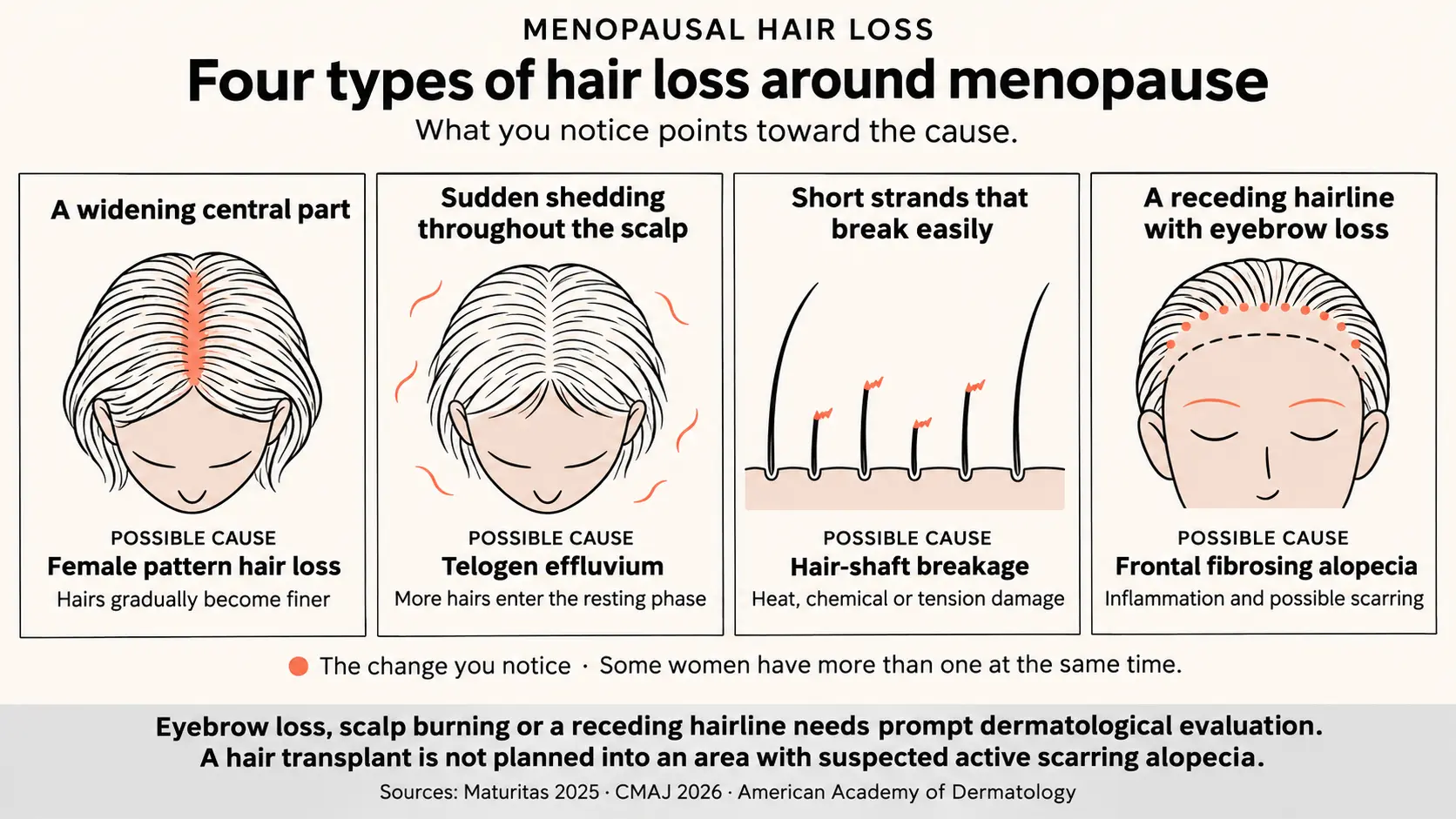
Four types of hair loss that can appear during menopause
The phrase “my hair is getting thinner” can describe different problems. Their onset, distribution, and scalp findings point toward different diagnoses.
| What you notice | Possible cause | Main process |
|---|---|---|
| Gradually widening central part and reduced crown coverage | Female pattern hair loss | Progressive follicle miniaturization |
| Sudden shedding throughout the scalp | Telogen effluvium | Increased entry into the resting phase |
| Short, damaged strands that break easily | Hair-shaft breakage | Mechanical or chemical damage |
| Receding frontal hairline with eyebrow loss, redness, or burning | Frontal fibrosing alopecia | Inflammation and potential follicular scarring |
Female pattern hair loss
Female pattern hair loss commonly affects the central scalp. The middle part becomes wider as hairs gradually lose caliber, and reduced density extends toward the crown.
The frontal hairline often remains recognizable. Magnification shows variation in shaft diameter, with thicker terminal hairs alongside miniaturized ones.
A woman can lose considerable coverage without dramatic daily shedding. I examine remaining hair caliber rather than judge progression by what collects after washing. I also distinguish thinning at the frontotemporal corners from loss at the temples themselves. Patients often call both areas “the temples,” although the anatomical sites and their implications for hairline design are different.
Telogen effluvium
Telogen effluvium causes widespread shedding, often beginning two to three months after illness, severe stress, rapid weight loss, medication changes, or nutritional deficiency.
Shedding often settles after the trigger resolves, although regaining length and volume takes longer. It can also overlap with female pattern hair loss, making existing thinning suddenly more apparent.
Hair-shaft breakage
Bleaching, heat styling, chemical treatments, and tension damage the shaft. Hair loses length and apparent volume even when shedding is normal. Reducing that damage is the starting point when breakage is the main problem.
Frontal fibrosing alopecia
Frontal fibrosing alopecia (FFA) is an inflammatory scarring condition that commonly affects the frontal hairline and eyebrows.
It is diagnosed particularly often in postmenopausal women, although younger women and men can also develop it.
FFA frequently presents with progressive frontal recession. Additional findings include eyebrow loss, perifollicular redness or scale, itching, burning, and tenderness.
As inflammation damages follicles, normal follicular structures can be replaced by scar tissue. Established scarring leaves little prospect of natural regrowth.
The American Academy of Dermatology explains that early treatment can sometimes produce regrowth and help prevent further hair loss. Once a follicle has been destroyed by scarring, it cannot resume normal growth.[4]
FFA's cause remains uncertain; an association with menopause does not prove estrogen withdrawal causes it. Hairline recession accompanied by eyebrow loss or inflammatory symptoms warrants dermatological assessment, with trichoscopy and sometimes biopsy.
I would not plan elective transplantation into an area with suspected active scarring alopecia.
A patient whose transplant I postponed
A postmenopausal woman came to our clinic because she wanted to restore her receding frontal hairline. On examination, I noticed eyebrow hair loss and redness around individual follicles at the frontal hairline. Together, these findings raised concern for frontal fibrosing alopecia, so I postponed her transplant pending further assessment of a possible inflammatory scarring condition. The examination findings justified delaying surgery; they did not establish an FFA diagnosis.
The patient gave consent for this account to be published, and identifying details have been omitted.
How menopausal hair loss is investigated
I start with the history of the hair loss: when it began, how quickly it progressed, and which areas changed first.
I also ask about recent illness, medication changes, nutrition, family history, and scalp symptoms.
Trichoscopy and follicle miniaturization
Trichoscopy allows closer examination of hair-shaft diameter, follicular openings, scaling, and inflammation.
Variation in shaft diameter supports female pattern hair loss; perifollicular inflammation or disappearing follicular openings raises concern for scarring alopecia.
For women considering transplantation, the examination must extend to the donor region at the back and sides of the scalp.
Why donor assessment matters
At Pure Line, the initial case review asks for photographs of the hairline, mid-scalp, crown, and donor area. A close-up of the thinning region cannot establish whether the patient has enough suitable donor hair for surgery.
Occipital follicles are generally more resistant to androgenetic loss, but some women develop diffuse miniaturization there as well.
A donor area can appear reasonably dense in ordinary photographs while containing a substantial proportion of fine hairs. Extracting those follicles reduces the remaining donor reserve and can produce less dependable long-term coverage.
Before estimating graft numbers, I need to establish whether the donor region contains enough stable follicles for the proposed restoration. Photographs are the starting point, not a substitute for examining hair caliber and distribution in person. A donor assessment that ignores widespread miniaturization can make a large graft number look reassuring on paper while reducing the chance of lasting coverage.
Hair-pull testing
A hair-pull test provides additional information when active shedding is suspected.
The clinician gently pulls a small bundle of scalp hairs and observes how many are released. The 2026 CMAJ review describes six or more easily released hairs as a positive result.[2]
A positive test suggests active shedding without identifying its cause; technique, recent washing, and scalp region affect the result.
Which blood tests are useful?
Laboratory testing should follow the clinical findings.
Ferritin and thyroid-stimulating hormone (TSH) are common investigations when iron deficiency or thyroid dysfunction is suspected.
A complete blood count and other nutritional tests are appropriate when the history suggests anemia, dietary restriction, malabsorption, or a possible deficiency.
Androgen testing becomes more relevant when hair loss is accompanied by signs of androgen excess, including new facial hair growth, significant acne, or other endocrine symptoms.
Rapid hair loss with virilization requires prompt medical investigation.
The CMAJ review recommends targeted testing for suspected alternative causes rather than extensive routine screening of every woman with pattern thinning.[2]
Normal androgen results do not exclude female pattern hair loss.
Hair loss and quality of life
Hair loss can affect self-esteem, cause anxiety, and change daily styling habits, as described in the Maturitas review and the British Association of Dermatologists' leaflet.[1,5]
For early pattern loss, stabilization may be the main goal. With visible central thinning, improved shaft caliber can reduce scalp visibility, depending on how many responsive follicles remain.
Medical treatment for menopausal hair loss
Topical minoxidil
Topical minoxidil can increase the diameter of responsive miniaturized hairs.[6] According to the British Association of Dermatologists, it can also slow progression and produce partial regrowth in some women.[5]
Preparations include 2% and 5% formulations; licensing and instructions differ by country.
Visible improvement generally requires several months. A meaningful assessment often takes six to twelve months.
Temporary increased shedding can occur during the first four to six weeks. I explain this possibility because stopping treatment during an early shedding phase can prevent a patient from reaching the stage when improvement becomes visible.
Minoxidil generally needs to be continued to maintain its benefit.[5]
Spironolactone
Spironolactone is an off-label antiandrogen included alongside topical minoxidil among first-line options in the 2026 CMAJ review.[2]
It reduces androgen activity and can help selected women control progressive miniaturization. Combination treatment with minoxidil is also used when medically appropriate.
Spironolactone requires supervision. Blood pressure, kidney function, medication interactions, and potassium-related risks should be reviewed, with monitoring tailored to the individual.
It is contraindicated during pregnancy. Perimenopausal women can still become pregnant and require appropriate reproductive counseling.
Oral minoxidil compared with topical minoxidil
Low-dose oral minoxidil is prescribed off-label for hair loss in many countries.
A tablet avoids scalp application, which can suit patients who struggle with topical irritation or adherence.
In 2024, Asilian and colleagues studied 65 men and women with androgenetic alopecia. Both oral and topical minoxidil improved hair-shaft diameter over six months, with no statistically significant difference between treatments. Photographic hair-density improvement was statistically significant within the topical group, but not within the oral group.[6]
A second trial, published in September 2026 by Chaudhry and colleagues, enrolled 100 adults aged 18–50, including men and women. Ninety participants completed the 24-week follow-up.[7]
Clinician-assessed photographic improvement occurred in approximately 67% of the oral group and 73% of the topical group. The difference was not statistically significant (p = 0.652).
The study was designed to detect a difference between treatments. It was not powered to establish that the treatments were equivalent or non-inferior.
Only two between-group adverse-effect differences reached statistical significance:
- Hypertrichosis: unwanted facial or body hair occurred in 30.4% of the oral group versus 9.1% of the topical group (p = 0.011).
- Contact dermatitis: occurred in 0% of the oral group versus 11.4% of the topical group (p = 0.025).
In the oral group, tachycardia was reported in 8.7% and pedal edema in 4.3%. Four participants experienced mild orthostatic hypotension.
The differences in cardiovascular adverse events were not statistically significant. However, only 46 participants completed treatment in the oral group, so the study cannot exclude clinically important risks.
No serious adverse events were reported, but the study excluded people with cardiovascular disease and included men and women aged 18–50. Results cannot be directly generalized to older postmenopausal patients.
Oral minoxidil requires an assessment of cardiovascular history, blood pressure, other medications, and individual risk factors before treatment.
I discuss these findings and other clinical studies in my oral minoxidil guide.
Finasteride and dutasteride
Finasteride and dutasteride are sometimes prescribed off-label for selected women with female pattern hair loss, particularly after menopause.
Evidence in women is more limited than in men. Both drugs are contraindicated during pregnancy because of fetal risk; medical history, reproductive status, adverse effects, and contraception must be addressed.
Hormone replacement therapy
Menopausal hormone therapy is used for established menopausal indications, but evidence does not support prescribing it solely for female pattern hair loss. Women already receiving it still need progressive thinning investigated.
PRP and low-level light therapy
Platelet-rich plasma (PRP) and low-level light therapy have produced encouraging findings in some studies. Evidence remains inconsistent, particularly because PRP preparation and treatment protocols vary. They can be considered adjuncts for selected patients, not automatic replacements for established medicines.
Shampoo, supplements, and scalp care
Gentle styling can reduce breakage. Ketoconazole shampoo treats dandruff or seborrheic dermatitis in selected patients, but evidence for hair regrowth is much weaker than for minoxidil. Our ketoconazole review examines this distinction.
Caffeine shampoos have limited evidence for reliable regrowth; our caffeine shampoo review discusses the trials.
Iron, zinc, vitamin D, and other nutrients are important when deficient. High-dose supplements without an indication can be harmful and do not reliably reverse pattern loss.
When should treatment results become visible?
I compare standardized photographs rather than relying on daily impressions of density. Hair length, moisture, lighting, and styling can make the same scalp look considerably different. I advise comparing dry hair with dry hair, keeping the part in the same position, and using similar light and camera distance. A photograph taken every two or three months is usually more informative than checking the part after every wash.
Document the central part, frontal hairline, frontotemporal corners, crown, and the donor region if considering surgery.
| Time | What to assess |
|---|---|
| Before treatment | Diagnosis, treatment suitability, baseline photographs |
| Weeks 1–6 | Tolerability, side effects, possible early minoxidil shedding |
| Months 2–3 | Adherence and changes in shedding |
| Months 4–6 | Early stabilization or improvement in coverage |
| Months 6–12 | Overall response and long-term treatment planning |
When does hair transplantation make sense after menopause?
Hair transplantation can improve localized areas of stable thinning when the donor region contains enough suitable follicles.
I am more cautious when thinning extends across the frontal scalp, central part, crown, and donor region.
Preserving donor hair
A transplant redistributes existing follicles. Before choosing a graft count, I assess both the donor region and the surrounding native hair.
Follicles that are already miniaturizing in the donor region provide less reliable coverage. Extracting them also reduces a reserve that cannot be replaced.
Surrounding native hair can keep thinning after an initially satisfactory operation, so medical preservation remains part of the plan.
At Pure Line, an unclear diagnosis, an inadequate donor reserve, or active scalp disease is a reason to investigate further or postpone a proposed procedure rather than proceed with a graft estimate based only on photographs.
Female hairline restoration
In localized frontotemporal recession, surgical restoration can improve the framing of the face when the underlying condition is stable.
At the leading edge of the hairline, single-hair grafts, correct direction, and subtle irregularity help avoid an artificial-looking border.
Future hair loss also affects how much donor hair should be committed to the frontal region.
Our female hair transplant guide explains patient selection and surgical planning in greater detail.
Can hair transplantation be followed by scarring alopecia?
Lichen planopilaris (LPP), including frontal fibrosing alopecia, has been reported after hair transplantation and facial surgical procedures.
In July 2026, Lázaro Escudero and colleagues published a systematic review examining those reports. The literature search covered studies available through March 2023.[8]
The authors identified seven studies involving 66 patients: 34 with LPP reported after hair transplantation and 32 after facial surgical procedures.
The mean age at diagnosis was 55.7 years. The average interval between surgery and disease onset was about 4.9 years.
In cases with sufficient localization information, LPP began in the transplanted area. Approximately 44% of patients also had involvement elsewhere.
The authors proposed surgical trauma as a possible trigger, without establishing causation. Unrecognized disease before surgery or unrelated later onset remain possible. Because these were case reports and series, no incidence rate can be calculated.
For surgical planning, unexplained scalp inflammation, perifollicular scale, burning, or loss of follicular openings requires diagnostic attention before elective transplantation.
What happens to transplanted hair in established LPP and FFA?
A separate 2026 systematic review by Palacios-Diaz and Lasheras-Pérez examined 13 studies involving 113 patients with classic LPP or frontal fibrosing alopecia who underwent hair transplantation.[9]
The subtype of disease was reported or could be determined in 105 patients. Of these, 68 (64.8%) had FFA and 37 (35.2%) had classic LPP.
In ten studies involving 101 patients, surgery was performed when the disease was described as clinically inactive. The reported duration of inactivity varied from zero to 60 months.
Graft survival was generally reported as:
- 80–100% at six to twelve months
- 71–100% up to 24 months
Among the 62 patients with survival data beyond 24 months, 55 (88.7%) had graft survival of 41% or lower.
The small, heterogeneous studies used different follow-up periods and survival measures; no prospective trials were identified.
Some clinical recommendations suggest waiting one to two years after disease activity has ceased, without ongoing treatment, before considering transplantation. The 2026 review notes that this timeframe is not supported by robust statistical evidence.[9]
A period of apparent stability therefore offers no guarantee that transplanted follicles will remain unaffected.
The 51-patient FFA series
One of the studies included in the 2026 review was a multicenter retrospective series published by Vañó-Galván and colleagues in 2019. It examined 51 patients with FFA who underwent hair transplantation.[10]
Table 2 of the 2026 systematic review reports mean graft survival in that cohort of 87% at 12 months, 71% at 24 months, 60% at 36 months, and 41% at 60 months.[9,10] These figures concern the same 51 patients included in the review, not a second independent cohort.
Specialist assessment and explicit discussion of uncertain survival are essential. Active FFA or LPP is generally unsuitable for elective transplantation.
Our article on scalp inflammation and hair transplant success examines the Vañó-Galván series and other inflammatory conditions relevant to transplantation.
Frequently asked questions
Can menopausal hair loss grow back?
Why is my middle part getting wider?
Can hair loss begin during perimenopause?
Does low estrogen mean high DHT?
What is the best treatment for menopausal hair thinning?
Is oral minoxidil better than topical minoxidil?
Can hormone replacement therapy reverse hair loss?
Can women over 50 or 60 have a hair transplant?
Can a hair transplant worsen frontal fibrosing alopecia?
My advice
If your central part has widened, your ponytail has become noticeably smaller, or your hairline has changed over the previous six months, arrange a scalp assessment.
Bring older photographs if you have them. A record of when the changes began, recent illnesses, medications, and treatments already attempted helps clarify the diagnosis.
Sudden shedding requires a different assessment from gradual miniaturization. Eyebrow loss, scalp burning, or progressive frontal recession warrants prompt dermatological evaluation.
For women with female pattern hair loss, appropriate treatment can preserve functioning follicles and improve density over time.
When transplantation is being considered, I want to see a sufficiently stable pattern and a donor area capable of supporting the planned restoration. I also want to preserve the native hair that contributes to the final result.
— Dr. Mesut Demir
Arrange a scalp assessment
Send Pure Line photographs of your hairline, mid-scalp, crown and donor area, with a note of when the changes began and the treatments you have already tried.
Request a Case Review- Gupta AK, Economopoulos V, Mann A, Wang T, Mirmirani P. Menopause and hair loss in women: Exploring the hormonal transition. Maturitas. 2025;198:108378. DOI: 10.1016/j.maturitas.2025.108378. PMID: 40318238.
- McMullen E, Aldien AS, Sibbald C, Donovan J. Female pattern hair loss. CMAJ (Canadian Medical Association Journal). 2026;198(8):E295. DOI: 10.1503/cmaj.251058. PMID: 41771564. Full text.
- Anderson A, Konopelski P, Skorzewska K, Kuchnicka A, Waskiel-Burnat A, Rudnicka L. The role of hormones in female androgenetic alopecia: focus on menopause. Climacteric. Published online September 18, 2026:1–8. DOI: 10.1080/13697137.2026.2699762. PMID: 42755697.
- American Academy of Dermatology Association. Hair loss types: Frontal fibrosing alopecia diagnosis and treatment. Last updated August 3, 2022. AAD patient guidance. Accessed November 13, 2026.
- British Association of Dermatologists. Hair loss female pattern (androgenetic alopecia). Patient information leaflet, updated October 2024. Patient information leaflet. Patient information PDF. Accessed November 13, 2026.
- Asilian A, Farmani A, Saber M. Clinical efficacy and safety of low-dose oral minoxidil versus topical solution in the improvement of androgenetic alopecia: A randomized controlled trial. Journal of Cosmetic Dermatology. 2024;23(3):949–957. Published online November 29, 2023. DOI: 10.1111/jocd.16086. PMID: 38031516.
- Chaudhry MAE, Muneeb B, Aamir S, Saeed ZA, Ashraf S, Ashraf S. Low-Dose Oral Versus Topical Minoxidil in Androgenetic Alopecia: A Randomized, Double-Blind, Double-Dummy Controlled Trial. Journal of Cosmetic Dermatology. 2026;25(10):e71198. Published September 21, 2026. DOI: 10.1111/jocd.71198. Full text.
- Lázaro Escudero J, Moon JY, Fiedler J, Handler M, Zufall A. Lichen Planopilaris After Hair Transplantation and Facial Surgical Procedures: A Systematic Review. Dermatologic Surgery. Published online July 22, 2026. DOI: 10.1097/DSS.0000000000005244. PMID: 42484473.
- Palacios-Diaz RD, Lasheras-Pérez MA. Systematic review of efficacy of hair transplantation in patients with classic lichen planopilaris and frontal fibrosing alopecia: revisiting the current evidence. Anais Brasileiros de Dermatologia. 2026;101(5):501426. DOI: 10.1016/j.abd.2026.501426. PMID: 42586001. Full text.
- Vañó-Galván S, Villodres E, Pigem R, et al. Hair transplant in frontal fibrosing alopecia: a multicenter review of 51 patients. Journal of the American Academy of Dermatology. 2019;81(3):865–866. DOI: 10.1016/j.jaad.2019.05.031. PMID: 31350039.