
Quick answer
Low-dose oral minoxidil can improve hair growth in selected patients with pattern hair loss. It is prescribed off-label for this purpose. A tablet may be useful when topical application is difficult or poorly tolerated, but comparative trials have not established that oral treatment consistently produces better results. Unwanted facial or body hair is more common with oral treatment; dizziness, fluid retention and changes in heart rate also need consideration. The choice depends on the diagnosis, medical history, response and ability to maintain treatment.
For someone who struggles to apply minoxidil every day, a tablet has an obvious attraction. There is no liquid to work through the hair, no residue to style around and no application to fit into the morning routine.
That convenience can matter. A treatment that repeatedly gets skipped has little chance of showing what it can do. But changing the route also changes the side effects and the medical assessment needed before treatment.
Before considering oral minoxidil, I want to understand why the topical treatment has been difficult: irritation, an impractical routine, disappointing growth, or a diagnosis that needs another look. Those situations call for different decisions.
- What oral minoxidil does
- How it compares with topical minoxidil
- What a switch can solve, and pet safety
- Doses used in hair-loss treatment
- Results, shedding and follow-up
- Side effects and medical assessment
- Women, pregnancy and breastfeeding
- Other treatments and hair transplantation
- Frequently asked questions
- References
What is oral minoxidil, and how does it help hair grow?
Minoxidil was developed as a blood-pressure medicine. Hair growth observed during treatment led to the development of preparations applied directly to the scalp.
Its effect on hair involves the growth cycle and activity within the follicle. Responsive follicles can spend longer in the growing, or anagen, phase, and some finer hairs can become thicker. Several cellular pathways appear to contribute; increased blood flow alone is an incomplete explanation.[5]
The drug needs conversion to an active metabolite, minoxidil sulfate. Sulfotransferase enzymes participate in this process, and their activity varies between people. This is one reason response differs, alongside the diagnosis, remaining follicles, formulation and treatment use.[5,6]
In the United States, particular topical formulations are FDA-approved for male or female pattern hair loss. Oral minoxidil is not FDA-approved for hair loss. A prescription for that purpose is an off-label use of the medicine. The tablet's approved US indication is severe hypertension that has not responded adequately to other treatment.[1,8]
This article focuses on adults with androgenetic alopecia, also called male or female pattern hair loss. Clinicians sometimes use oral minoxidil for other diagnoses, including persistent telogen effluvium. In inflammatory or scarring alopecia, any growth-supporting role belongs alongside treatment of the disease affecting the follicles.[1]
Is oral minoxidil better than topical minoxidil?
The most useful evidence comes from trials that compare them directly. Improvement within an oral-treatment group tells us less about this choice than the difference between the oral and topical groups.
A meta-analysis of four randomized trials involving 279 patients found no significant differences in hair density or shaft diameter between the routes, while unwanted facial or body hair was more frequent with oral treatment. Its evidence predates the 2026 trial below.[15]
| Randomized trial | Treatments compared | Main finding |
|---|---|---|
| Penha and colleagues, 2024: 90 men enrolled; 68 completed 24 weeks | Oral 5 mg daily versus topical 5% twice daily | Oral treatment did not demonstrate superiority on the primary hair-density comparison. A secondary photographic assessment favored oral treatment at the crown, but not the frontal scalp.[2] |
| Asilian and colleagues, 2024: 65 patients; six months | Oral 1 mg daily versus topical 5% | Both groups improved hair diameter. The study detected no significant between-group difference in the assessed outcomes.[3] |
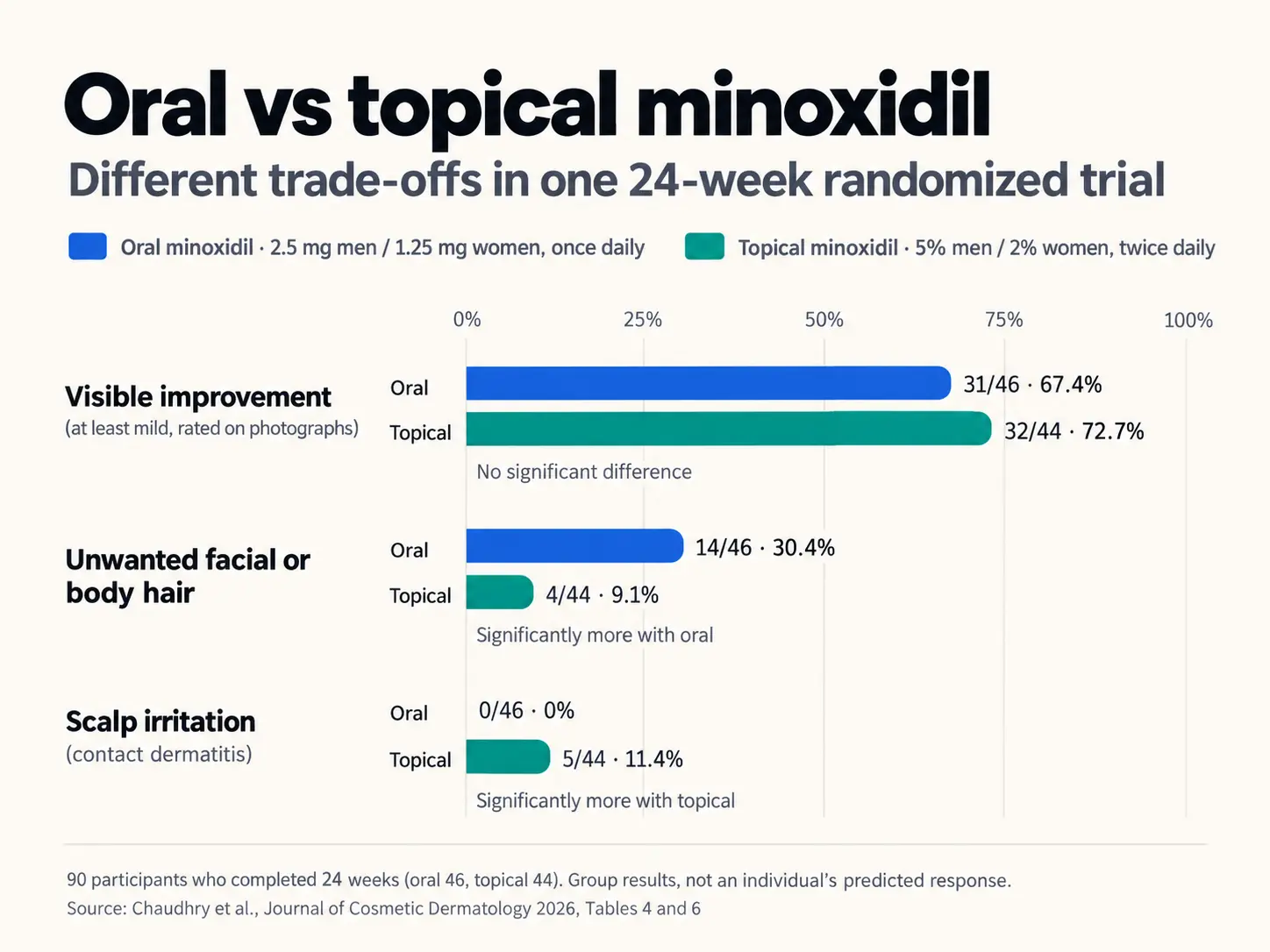
| Chaudhry and colleagues, September 2026: 100 randomized; 90 completed 24 weeks | Oral 2.5 mg in men or 1.25 mg in women versus topical 5% in men or 2% in women | At least mild photographic improvement occurred in 67.4% with oral and 72.7% with topical treatment. The difference was not statistically significant.[4] |
The 2026 percentages describe people crossing a photographic improvement threshold, rather than the percentage of hair each person regrew. Contact dermatitis affected 5/44 topical participants (11.4%) and 0/46 oral participants (p = 0.025). That matters when scalp irritation is the reason for considering a switch. A positive patient-satisfaction score was reported by 80.4% with oral treatment and 70.5% with topical treatment; that difference was not statistically significant (p = 0.332).[4]
This single-center trial followed a South Asian cohort aged 18–50 for 24 weeks. It assessed photographs rather than measured hair density and analyzed only participants who completed follow-up. Women received 2% topical minoxidil. The study was not designed to establish equivalence or long-term safety.[4]
Oral versus topical minoxidil: side-by-side comparison
| Measure | Oral minoxidil | Topical minoxidil |
|---|---|---|
| US FDA status for hair loss | Off-label; the oral tablet is approved for treatment-resistant severe hypertension, not hair loss. | Certain products and strengths are FDA-approved for pattern hair loss. |
| Regimen in the 2026 trial | 2.5 mg once daily for men; 1.25 mg once daily for women. | 5% twice daily for men; 2% twice daily for women. |
| At least mild photographic improvement at 24 weeks | 31/46 (67.4%) | 32/44 (72.7%) |
| Increased facial or body hair | 14/46 (30.4%) | 4/44 (9.1%) |
| Contact dermatitis | 0/46 (0%) | 5/44 (11.4%) |
| Low blood pressure on standing | 4/46 (8.7%) | 1/44 (2.3%) |
| Assessment and follow-up | Review medical history, medicines, blood pressure, pulse and systemic symptoms; tailor further tests and monitoring. | Assess scalp irritation, application technique, consistency and response; review symptoms or reactions when indicated. |
The percentages come from the 90 participants who completed the 2026 trial, not from all minoxidil users. The 24-week trial was not designed to prove the treatments equivalent or to measure rare long-term adverse effects. The oral regimens listed are studied doses, not prescribing instructions.[1,4,8]
There is also a practical detail in the trial design. To keep participants blinded, both the Penha and Chaudhry trials gave everyone an oral tablet and a scalp preparation, with one containing placebo. They compared treatment effects without directly testing the convenience of a tablet-only routine.[2,4]
For a patient who tolerates topical minoxidil and uses it consistently, these findings provide little reason to change simply because a tablet sounds stronger.
What can switching from topical to oral minoxidil actually solve?
When someone tells me topical minoxidil has not worked, I want to know whether they were able to use it consistently and for how long. Scalp irritation, residue in the hair and the effort of daily application can make that difficult. I also look for a scalp condition that needs attention before deciding what to change.
| The difficulty | What needs clarifying before a switch |
|---|---|
| Applications are regularly missed | Whether a tablet would make sustained treatment realistic, and whether the medical history allows it. |
| The scalp becomes itchy, red or flaky | Whether the cause is the formulation, minoxidil itself, or a separate scalp condition. A different topical vehicle may sometimes be enough. |
| Treatment was consistent but growth was disappointing | The original diagnosis, treatment duration, standardized photographs and continuing hair-loss progression. Oral treatment may still be considered, with uncertain additional benefit. |
| Shedding is sudden, patchy, painful or associated with scalp changes | The cause of the loss. Choosing a formulation comes after identifying what is happening. |
Solutions can contain propylene glycol, which may contribute to irritation. Some foam formulations avoid it. A reaction to a vehicle and an allergy to minoxidil require different handling, so a significant rash deserves assessment before changing preparations.[5,8]
An apparently poor response also cannot tell us, by itself, what someone's enzyme activity is. A small study of 41 patients found that lower follicular sulfotransferase activity was associated with a better response to oral minoxidil. That finding complicates the idea that the same enzyme limitation must make both routes fail.[6]
In practice, the question is what would change. A tablet can remove an application problem. It leaves the need for a correct diagnosis and realistic expectations in place.
Can topical minoxidil harm cats or dogs?
Topical minoxidil can be dangerous, sometimes fatally so, to pets, particularly cats. In a poison-control series of 211 reported dog and cat exposures to topical minoxidil, accidental contact during an owner's own treatment, including licking treated skin or pillowcases, was a common exposure circumstance for cats; 8 of the 62 cats that developed clinical signs died (12.9%). Keep pets away from treated skin, pillows and spills, store both topical products and oral tablets securely, and seek urgent veterinary advice after any suspected exposure.[16,17]
What counts as a low dose of oral minoxidil?
Published hair-loss studies have used daily doses around 0.25–5 mg. These are substantially lower than the doses traditionally used for severe hypertension. “Low dose” describes the amount used; it does not establish that the medicine is suitable for everyone.[9]
A 2026 review describes commonly reported adult starting doses of 1.25 mg for women and 2.5 mg for men, with prescribing individualized to the patient. Those figures describe clinical practice, rather than an approved hair-loss dose or a starting instruction for a reader.[13]
The trial regimens in the comparison above show why dose belongs in context: researchers have tested different amounts in different populations. A result with 5 mg in men cannot determine what a lower dose will achieve in a particular woman.
Dose decisions take account of response, blood pressure, other medication and tolerability. Increasing the dose also increases exposure to adverse effects. A follow-up conversation should therefore consider both visible benefit and what the patient is experiencing between appointments.[8,13]
How long does oral minoxidil take to work?
Hair growth takes months to assess. Early shedding or a few new short hairs can attract attention long before there is enough change to judge coverage.
Allow around three to six months to assess the developing response. The international consensus places the earliest expected benefit around three months; people with temporary shedding at the start may not notice benefit until about six months. The main comparisons discussed here assessed treatment over approximately six months. An early review looks for developing benefit; later comparisons help establish the trend.[1,2,3,4]
An early review after a month or two is mainly about tolerability. Hair growth may still be difficult to judge. I would rather check symptoms, blood pressure where appropriate and how the treatment is being taken before treating an unchanged photograph as a reason to increase the dose.
Dizziness, swelling or palpitations deserve contact with the prescriber before a scheduled review.
Can oral minoxidil cause initial shedding?
Yes. A temporary increase in shedding can occur after starting minoxidil. The Gloucestershire Hospitals patient leaflet describes this as usually settling within the first six weeks. Timing varies, and a noticeable shed is neither required for benefit nor a measure of how much hair will eventually grow.[10]
Persistent, unusually heavy or symptomatic shedding warrants reassessment. It can be difficult to separate a treatment-related change from the hair-loss condition that prompted treatment in the first place.
What counts as a useful result from oral minoxidil?
The aim might be less visible scalp at the parting, better crown coverage, thicker existing hairs or stabilization of an area that had been getting thinner. These are more useful goals than expecting the same transformation as an unrelated before-and-after photograph.
Progress photographs need the same angles, lighting, hair length and styling as far as possible. A dry, freshly styled photograph and a wet-hair baseline can create a misleading impression. The Penha trial specifically asked participants to maintain hairstyle, color and length for photographic assessment.[2]
What are the side effects of oral minoxidil?
The most common is hypertrichosis: increased facial or body hair outside the intended scalp area. How acceptable this feels can be very different for two people with the same amount of scalp improvement.
Good tolerability in a published study is not a promise to the person sitting in front of me. I discuss possible adverse effects before prescribing and ask about them again at follow-up, even when hair growth seems to be improving.
A retrospective study of 1,404 patients treated for at least three months reported the following:[7]
| Reported adverse effect | Patients affected |
|---|---|
| Increased facial or body hair | 15.1% |
| Lightheadedness | 1.7% |
| Fluid retention | 1.3% |
| Tachycardia, or a fast heart rate | 0.9% |
| Headache | 0.4% |
Overall, 1.7% stopped because of adverse effects. The study had no untreated control group and reviewed routine clinical records, so these percentages are best read as experience from that cohort.[7]
Rates vary considerably with dose, population and how investigators collect symptoms. In the 5 mg oral arm of the Penha trial, hypertrichosis was reported in 49%, substantially more often than in the larger retrospective series.[2]
What are the serious cardiovascular risks of oral minoxidil?
The oral minoxidil label carries a boxed warning that includes pericardial effusion, a collection of fluid around the heart that can occasionally progress to tamponade. The label concerns its use for severe hypertension. Its reported event rates cannot be used as the incidence for otherwise healthy people taking low doses for hair loss.[8]
Low-dose studies are reassuring about common tolerability in selected patients, but longer-term and rare-event evidence remains limited. A small trial without a serious event offers little precision about an uncommon complication.[7,13]
Chest pain, breathlessness, fainting or a persistent fast or irregular heartbeat need urgent medical assessment. New ankle or facial swelling, or rapid unexplained weight gain, should be reported promptly to the prescriber.[8,10]
What should be checked before prescribing oral minoxidil?
The assessment includes the hair-loss diagnosis, current medicines and relevant cardiovascular or kidney history. Low blood pressure, previous fainting, rhythm problems, heart failure or pericardial disease can materially change the decision. Other medicines that lower blood pressure also belong in that review.[8,10]
Blood pressure and pulse provide useful baseline information. Additional investigations and follow-up depend on the history and findings. The international consensus does not require routine blood tests or an ECG in every otherwise suitable patient without identified precautions.[1]
A later retrospective monitoring study also supports tailoring ongoing tests to the patient, particularly when kidney impairment is present. This is different from assuming that a prescription needs no follow-up.[9]
Oral minoxidil in women: what deserves separate consideration?
Female pattern hair loss can involve gradual widening of the parting and reduced density over the central scalp. Persistent shedding may coexist with it, which can make a simple “growth treatment” discussion incomplete.[12]
History and examination guide whether tests for an underlying disease, deficiency or hormonal problem are useful. A panel of supplements is not a substitute for that assessment, and supplements make sense when there is a reason to use them.[12]
Unwanted facial hair may be a particularly important trade-off. Minoxidil for hair loss is generally avoided during pregnancy, including topical preparations. Oral treatment is also generally avoided during breastfeeding; anyone trying to conceive needs to discuss treatment beforehand.[5,10]
Topical treatment during breastfeeding requires a more specific discussion. LactMed considers maternal topical minoxidil acceptable once breastfeeding is established, while emphasizing prevention of infant contact with treated skin. It advises caution with oral use because information is limited, particularly with a newborn. This is a reason for individual advice, rather than a blanket statement that topical minoxidil is safe throughout breastfeeding.[11]
Can oral minoxidil be combined with other hair-loss treatments?
It can form part of a broader plan, but the reason for each treatment matters.
In male pattern hair loss, finasteride acts on the DHT pathway. Minoxidil supports growth through other mechanisms. The role of minoxidil remains growth support whether it is applied or swallowed.[5,14]
For men who are already taking finasteride and remain dissatisfied with the growth, adding low-dose oral minoxidil is one of the options I discuss. I look at what they are already using and how they have responded before deciding what to add.
For some women, an antiandrogen such as spironolactone may also be considered. Its suitability, effects on blood pressure and reproductive precautions need their own assessment. Adding medicines simply because each is described as a hair treatment can make the plan harder to tolerate and harder to evaluate.[1,12]
Does combining oral and topical minoxidil improve hair growth?
Additional benefit is uncertain. The trials above primarily compare one route with the other; they do not establish the benefit of taking both together. A prescriber may arrange an overlap when switching, but the transition should have a stated purpose and follow-up plan.
How does minoxidil fit into hair transplant planning?
Minoxidil and transplantation address different needs. Medication can support responsive existing follicles. A transplant redistributes donor follicles to improve coverage in an area of established loss.
In the Pure Line long-term treatment framework, growth support sits alongside management of ongoing loss, treatment of diagnosed scalp disease and surgical planning where appropriate. That distinction is especially relevant when native hair remains around a proposed recipient area.
Someone considering male hair transplantation or female hair transplantation needs a plan for that existing hair as well as the grafts. Oral minoxidil is an individual medical option within that discussion. The timing of starting, continuing or restarting it around surgery belongs with the treating team.
If finasteride is not part of the plan, our guide to hair transplantation without finasteride explains how continuing native hair loss affects the hairline, crown and donor decisions over time.
When can minoxidil be restarted after a hair transplant?
A 2026 international consensus among hair transplant surgeons suggests that low-dose oral minoxidil can generally be taken 1–3 days after surgery and topical minoxidil can be applied to the grafted area after 7–14 days. These are consensus recommendations, not results from a trial comparing restart dates, and the abstract does not establish when either formulation should be stopped before surgery. For a patient already using minoxidil, I want a specific plan agreed with the surgical team and, when relevant, the prescribing clinician, rather than a timetable copied from an article.[18]
Making the choice useful
I would start with what has already happened: the type of loss, the treatment actually used, how consistently it was used and the problem the patient wants a tablet to solve.
If daily scalp application has become an obstacle, oral minoxidil may make a workable treatment easier to sustain. If topical treatment is comfortable and effective, its advantages remain valuable. When growth has been disappointing despite consistent treatment, the diagnosis and the treatment record deserve another look before assuming that a different route will provide the missing improvement.
A useful consultation ends with a clear goal, an agreed way to assess progress and a plan for managing side effects. Those details are what make the prescription practical over time.
— Dr. Mesut Demir
Frequently asked questions
Can oral minoxidil work if topical minoxidil did not?
Is oral minoxidil a lifelong treatment?
Will I lose the hair growth gained with minoxidil if I stop?
Does oral minoxidil lower testosterone or DHT?
Do I need a blood test or ECG before starting oral minoxidil?
Can oral minoxidil lower blood pressure?
Can I take oral minoxidil with finasteride?
Can a woman take oral minoxidil while planning pregnancy?
Can oral minoxidil replace a hair transplant?
Discuss your own options
Contact Pure Line with a short treatment history: what you used, how long you used it and what made you stop or consider a change.
Request a Case Review- Akiska YM, Mirmirani P, Roseborough I, et al. Low-Dose Oral Minoxidil Initiation for Patients With Hair Loss: An International Modified Delphi Consensus Statement. JAMA Dermatology. 2025;161(1):87–95. Published online November 20, 2024. DOI: 10.1001/jamadermatol.2024.4593. PMID: 39565602. Open repository PDF.
- Penha MA, Miot HA, Kasprzak M, Müller Ramos P. Oral Minoxidil vs Topical Minoxidil for Male Androgenetic Alopecia: A Randomized Clinical Trial. JAMA Dermatology. 2024;160(6):600–605. DOI: 10.1001/jamadermatol.2024.0284. PMID: 38598226. Full text.
- Asilian A, Farmani A, Saber M. Clinical efficacy and safety of low-dose oral minoxidil versus topical solution in the improvement of androgenetic alopecia: A randomized controlled trial. Journal of Cosmetic Dermatology. 2024;23(3):949–957. Published online November 29, 2023. DOI: 10.1111/jocd.16086. PMID: 38031516.
- Chaudhry MAE, Muneeb B, Aamir S, Saeed ZA, Ashraf S, Ashraf S. Low-Dose Oral Versus Topical Minoxidil in Androgenetic Alopecia: A Randomized, Double-Blind, Double-Dummy Controlled Trial. Journal of Cosmetic Dermatology. 2026;25(10):e71198. Published September 21, 2026. DOI: 10.1111/jocd.71198. Full text.
- Suchonwanit P, Thammarucha S, Leerunyakul K. Minoxidil and its use in hair disorders: a review. Drug Design, Development and Therapy. 2019;13:2777–2786. DOI: 10.2147/DDDT.S214907. PMID: 31496654. Full text.
- Jimenez-Cauhe J, Vaño-Galvan S, Mehta N, et al. Hair follicle sulfotransferase activity and effectiveness of oral minoxidil in androgenetic alopecia. Journal of Cosmetic Dermatology. 2024;23(11):3767–3773. DOI: 10.1111/jocd.16473. PMID: 39034734.
- Vañó-Galván S, Pirmez R, Hermosa-Gelbard A, et al. Safety of low-dose oral minoxidil for hair loss: A multicenter study of 1404 patients. Journal of the American Academy of Dermatology. 2021;84(6):1644–1651. DOI: 10.1016/j.jaad.2021.02.054. PMID: 33639244.
- DailyMed, US National Library of Medicine. MINOXIDIL tablet. US prescribing information; boxed warning, indications, contraindications and precautions. Label. Accessed October 28, 2026.
- Cummins DM, Alramthan A, Raja H, et al. The Requirement to Monitor Low-dose Oral Minoxidil in the Management of Hair Loss. International Journal of Trichology. 2025;17(3):191–196. DOI: 10.4103/ijt.ijt_8_24. PMID: 41346548. Full text.
- Gloucestershire Hospitals NHS Foundation Trust. Minoxidil for hair loss. Dermatology patient information, GHPI1647_01_24; review due January 2027. Patient information. Accessed October 28, 2026.
- US National Library of Medicine. Minoxidil. Drugs and Lactation Database (LactMed). Revised May 15, 2026. LactMed entry. Accessed October 28, 2026.
- American Academy of Dermatology Association. Hair loss: Diagnosis and treatment. Patient guidance. Accessed October 28, 2026.
- Ong MM, Li Y, Lipner SR. Oral Minoxidil for Alopecia Treatment: Risks, Benefits, and Recommendations. American Journal of Clinical Dermatology. 2026;27(1):101–119. Published online October 21, 2025. DOI: 10.1007/s40257-025-00990-4. PMID: 41118052.
- British Association of Dermatologists. Hair loss male pattern (androgenetic alopecia). Patient information leaflet, June 2024. Patient guidance. Accessed October 28, 2026.
- Sobral MVS, Moreira JLML, Rodrigues LK, et al. Efficacy and safety of oral minoxidil versus topical solution in androgenetic alopecia: a meta-analysis of randomized clinical trials. International Journal of Dermatology. 2025;64(3):479–484. Published online October 19, 2024. DOI: 10.1111/ijd.17524. PMID: 39425514.
- Tater KC, Gwaltney-Brant S, Wismer T. Topical Minoxidil Exposures and Toxicoses in Dogs and Cats: 211 Cases (2001–2019). Journal of the American Animal Hospital Association. 2021;57(5):225–231. DOI: 10.5326/JAAHA-MS-7154. PMID: 34370845.
- American Society for the Prevention of Cruelty to Animals (ASPCA). Minoxidil and Pets: What You Need to Know. Published February 26, 2026. Veterinary poison-control guidance. Accessed October 29, 2026.
- Gupta AK, Talukder M, Williams G, et al. Low-dose oral minoxidil (LDOM) and topical minoxidil: consensus recommendations for managing male and female pattern hair loss in hair transplant patients using a modified Delphi process. Expert Opinion on Pharmacotherapy. 2026;27(3):253–261. Published online March 16, 2026. DOI: 10.1080/14656566.2026.2642216. PMID: 41782304.