
Quick answer
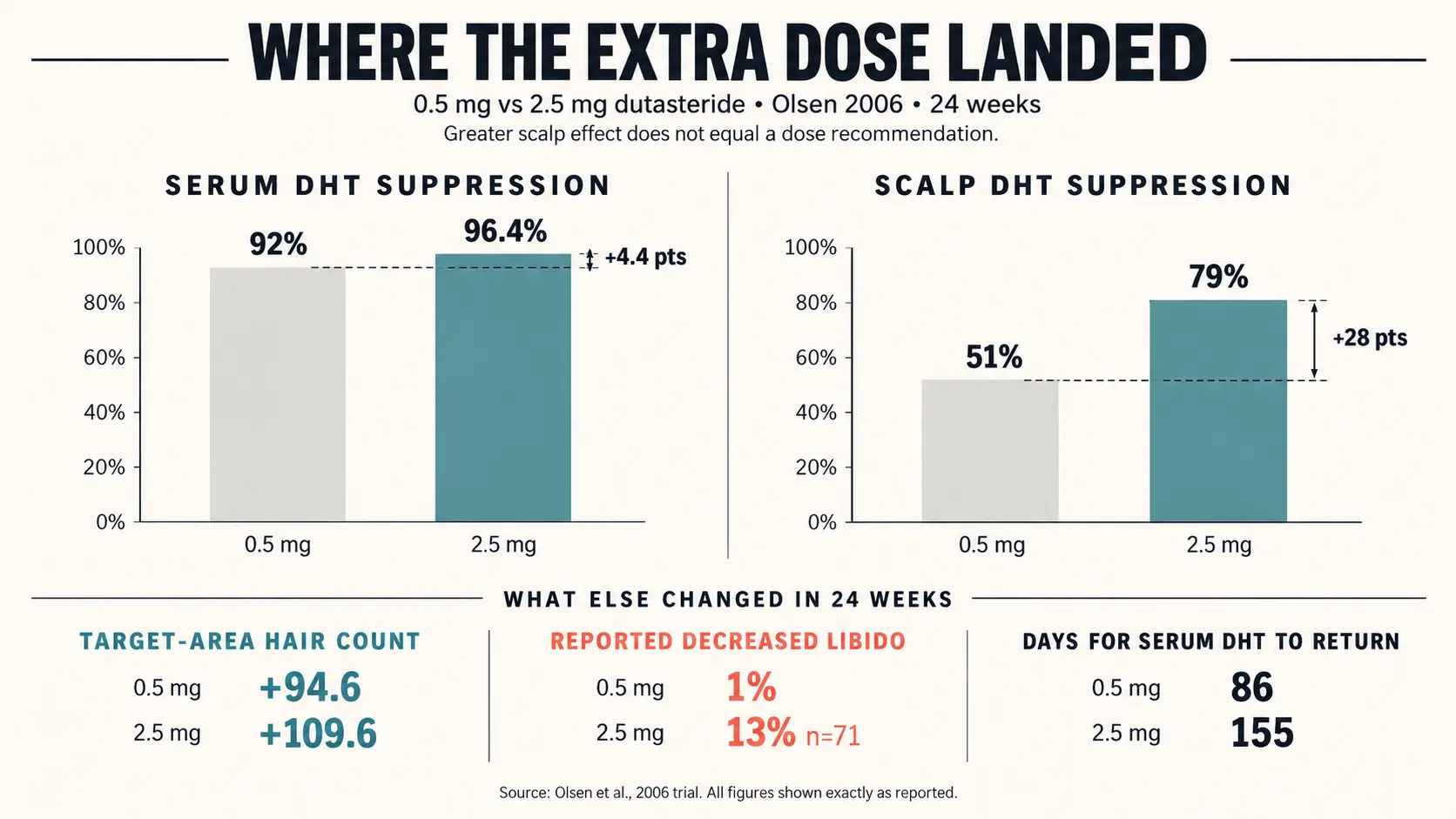
In a 24-week randomized dose-ranging trial, dutasteride 2.5 mg daily increased target-area hair count more than 0.5 mg dutasteride or 5 mg finasteride (+109.6 versus +94.6 and +75.6 hairs), and suppressed scalp DHT by about 79% against roughly 51% at 0.5 mg — even though serum DHT was already near-maximally suppressed at the lower dose (96.4% versus 92%). Decreased libido was reported by 13% of the 71 men taking 2.5 mg, against 1% at 0.5 mg, and serum DHT took a median 155 days to return toward baseline after stopping 2.5 mg versus 86 days after 0.5 mg. Dr. Mesut Demir reads this as evidence about scalp-level DHT, not as a dosing instruction: dutasteride is licensed in Türkiye for benign prostatic hyperplasia rather than hair loss, 2.5 mg is not an approved hair-loss dose anywhere, and there is no five-year androgenetic-alopecia dataset at 2.5 mg comparable to the one that exists for 0.5 mg.
The question sounds simple. If 0.5 mg of dutasteride can help male pattern hair loss, and one study found better results with 2.5 mg, why not simply take more?
That is where a useful research finding can very quickly turn into bad medical advice.
A dose-ranging trial published in 2006 did find that 2.5 mg of dutasteride produced more hair growth than 0.5 mg dutasteride and 5 mg finasteride over 24 weeks.[1] The interesting part, though, is not just the extra hairs. It is where DHT changed, how the researchers measured the improvement, and what happened when the drug was stopped.
Those details make the study much more useful than the headline.
Regulatory note for readers in Türkiye. Dutasteride is not licensed for androgenetic alopecia here. The Turkish product information lists benign prostatic hyperplasia as its approved indication, at 0.5 mg once daily.[6] The 2.5 mg dose discussed below comes from clinical research and is not an approved hair-loss dose. This article reviews published evidence and is not a dosing recommendation.
What Did the 2.5 mg Dutasteride Study Actually Test?
Olsen and colleagues enrolled 416 men aged 21 to 45 with mild-to-moderate male pattern hair loss — the kind of vertex thinning described by the Hamilton-Norwood scale. Participants were randomized to placebo, four different dutasteride doses ranging from 0.05 to 2.5 mg, or finasteride 5 mg, and were followed for 24 weeks.[1]
The primary outcome was not somebody looking at a photograph and deciding the hair seemed thicker. The investigators repeatedly measured a defined one-inch target area near the vertex, using a small tattoo to return to the same location at each assessment.
At week 24, the mean changes in target-area hair count were approximately:
| Daily treatment | Hair-count change at 24 weeks |
|---|---|
| Placebo | −32.3 |
| Dutasteride 0.05 mg | About +25 |
| Dutasteride 0.1 mg | +78.5 |
| Dutasteride 0.5 mg | +94.6 |
| Dutasteride 2.5 mg | +109.6 |
| Finasteride 5 mg | +75.6 |
The 2.5 mg dutasteride group significantly outperformed the finasteride group at both 12 and 24 weeks.[1]
There is another result here that gets much less attention. Dutasteride 0.1 mg and finasteride 5 mg produced remarkably similar hair-count changes: +78.5 versus +75.6 hairs.
That does not mean dutasteride is “50 times stronger” simply because 0.1 mg is one-fiftieth of 5 mg. Drug potency cannot be calculated that way. What it does show is how differently the two drugs behave pharmacologically, which fits what we already know about their different effects on 5-alpha-reductase.
Counting More Hairs Is Not the Same as Looking Better
This is one of the easiest places to get fooled by a hair-loss study.
Androgenetic alopecia gradually miniaturizes follicles. A scalp can therefore contain thick terminal hairs, partially miniaturized hairs and extremely fine hairs that contribute very little to visible density.
If a study counts enough extremely fine hairs, a treatment can produce an impressive-looking numerical improvement without producing an equally impressive cosmetic change.
That is why I would not judge this study from the hair-count graph alone.
Olsen's group also used standardized frontal and vertex photographs assessed by a blinded expert panel. The photographic results followed the same general dose-response pattern as the hair counts. At 24 weeks, 78% of the 2.5 mg group were judged to have improved vertex hair growth, compared with 63% in the 0.5 mg group and 57% in the finasteride group.[1]
The frontal photographs pointed in the same direction: 61% of men receiving 2.5 mg were judged improved, compared with 48% with 0.5 mg and 45% with finasteride.[1]
When hair counts, standardized photographs and investigator assessments all move in the same direction, the argument becomes much stronger than a microscopic hair-count change on its own.
The Scalp DHT Result Is the Most Interesting Part
Dutasteride and finasteride both reduce dihydrotestosterone, or DHT. But Olsen's team did something particularly useful: they measured DHT not only in blood but also in scalp tissue.
The results were very different depending on where you looked.
| Treatment | Serum DHT reduction | Scalp DHT reduction |
|---|---|---|
| Finasteride 5 mg | About 73% | About 41% |
| Dutasteride 0.1 mg | About 70% | About 32% |
| Dutasteride 0.5 mg | 92% | 51% |
| Dutasteride 2.5 mg | 96.4% | 79% |
Going from 0.5 mg to 2.5 mg barely changed the already heavily suppressed serum DHT level: roughly 92% became 96.4%.
Inside the scalp, however, the difference was much larger. Scalp DHT suppression went from 51% to 79%.
That may help explain why the 2.5 mg group continued to show better hair-growth measurements even though circulating DHT was already close to maximally suppressed at the lower dose.[1] The investigators also found an inverse relationship between scalp DHT change and target-area hair-count change.
This is probably the most interesting lesson from the entire study. A blood DHT result does not necessarily tell us everything happening around the follicle.
A Later 917-Man Study Strengthens the Lower-Dose Evidence
The 2006 trial is not the only dose-ranging dutasteride study.
In 2014, Gubelin Harcha and colleagues randomized 917 men to placebo, finasteride 1 mg, or dutasteride at 0.02, 0.1 or 0.5 mg daily.[2]
Again, hair count and hair width improved in a dose-dependent manner with dutasteride. The 0.5 mg group significantly outperformed finasteride 1 mg in hair count, hair width and frontal photographic assessment at 24 weeks.[2]
This matters because it means the general dutasteride dose-response story does not rest entirely on one study from 2006.
It also highlights an important limitation of the 2.5 mg discussion: we have considerably more subsequent clinical evidence around 0.5 mg than around 2.5 mg.
What About Side Effects at 2.5 mg?
This is where the study becomes less convenient.
There were no statistically significant differences between groups in overall adverse events, serious adverse events or withdrawal rates. But decreased libido deserves its own look. It was reported in:
| Treatment | Decreased libido |
|---|---|
| Placebo | 3% |
| Finasteride 5 mg | 4% |
| Dutasteride 0.5 mg | 1% |
| Dutasteride 2.5 mg | 13% |
The 2.5 mg group contained only 71 men, so these percentages should not be interpreted as “13 out of every 100 men will experience this.” A few patients can move the percentage substantially in a group that size.
At the same time, dismissing the difference because the sample was small would be equally unhelpful.
Nine men in the 2.5 mg group reported decreased libido. None discontinued study treatment because of that adverse event. Four reported resolution while treatment continued, and another two resolved after treatment ended.[1]
That is useful context, but it does not turn a 24-week study into long-term safety data.
The Drug Does Not Disappear When You Stop Taking It
This is another part of the study that I think patients should understand before discussing dutasteride, not after.
After treatment was stopped at week 24, the researchers continued measuring serum DHT in participants whose levels had not returned close to baseline.
For the 0.5 mg dutasteride group, the median time for serum DHT to return to within 25% of baseline was 86 days. For 2.5 mg, it was 155 days. Some individuals took considerably longer.[1]
So an unwanted effect does not necessarily disappear shortly after the last capsule. Dutasteride has a long pharmacological tail — the Turkish product information puts its half-life at three to five weeks — and greater exposure can make that particularly relevant.[6]
This is one reason the question should never be reduced to “Which dose grows the most hair?”
Fertility Deserves More Than a Footnote
The Olsen trial was not designed to answer fertility questions, and good semen data specifically for 2.5 mg in young men with androgenetic alopecia are limited.
We do, however, have controlled data for 0.5 mg dutasteride, and it is worth separating two datasets that often get merged online.
Amory and colleagues randomized 99 healthy men to dutasteride 0.5 mg, finasteride 5 mg or placebo for one year. Total sperm count fell significantly at 26 weeks in both treatment groups, but the difference from baseline was no longer significant at 52 weeks or at the 24-week follow-up. Semen volume and sperm motility also declined modestly. The authors concluded that the reductions were mild and appeared reversible after the drug was stopped.[3]
Turkish product information describes a separate 52-week study in healthy volunteers. After adjustment for placebo changes, mean total sperm count, semen volume and sperm motility were reduced by approximately 23%, 26% and 18% respectively. Sperm concentration and morphology were unaffected. Mean values stayed within normal ranges at every time point, but two volunteers had reductions in sperm count greater than 90% at week 52, with partial recovery over the follow-up period.[6]
Neither dataset proves that dutasteride causes infertility in a typical user, and neither set of numbers can simply be transferred to the 2.5 mg dose. What they do show is that fertility should not be buried in a generic “possible side effects” sentence, particularly in younger men planning a pregnancy. It is the same conversation I have with patients who ask about testosterone and anabolic steroids, where reproductive effects are also treated as an afterthought far too often.
Three Practical Warnings People Often Miss
Dutasteride discussions online tend to revolve around libido and erections. Three other points receive far less attention.
- Blood donation. Turkish product information states that men receiving dutasteride should not donate blood until at least six months after their final dose. The reason is to prevent exposure of a pregnant transfusion recipient.[6]
- PSA testing. Dutasteride reduces mean serum PSA by approximately 50% after six months of treatment. A man taking dutasteride needs his prescribing or treating physician to know about it when PSA results are interpreted, because the expected baseline changes.[6]
- Pregnancy exposure. Under the current Turkish product information, dutasteride is contraindicated in women, children and adolescents. Because dutasteride is absorbed through the skin, women should also avoid contact with leaking capsules.[6]
These are not particularly exciting facts, which is presumably why social media algorithms have shown little interest in them. They are still clinically important.
So Does 2.5 mg Work Better Than 0.5 mg?
In the Olsen trial, yes.
It produced a larger increase in target-area hair count, stronger photographic improvement and substantially greater scalp DHT suppression over 24 weeks.[1]
The harder question is whether the additional improvement is worth the additional drug exposure for a particular person. The trial does not answer that.
We do not have anything comparable to the long-term evidence base available for standard-dose dutasteride. Dutasteride 0.5 mg has been approved for male androgenetic alopecia in South Korea since 2009, and five-year data published in 2024 followed 99 Korean men on that dose, reporting improvement in 89.9% and prevention of further progression in 93.9%.[5]
There is no comparable five-year androgenetic-alopecia dataset for 2.5 mg daily.
That difference in evidence matters.
A Study Result Is Not a Dosing Instruction
Imagine a man who has taken 0.5 mg dutasteride for a year, tolerated it well and then sees the Olsen graph online.
His question is predictable: “If 2.5 mg grew more hair, why wouldn't I just increase it?”
The graph cannot answer that question for him.
Before even discussing a change in prescription treatment, a physician needs to know whether the diagnosis is actually androgenetic alopecia, whether the condition is still progressing, how much response has already occurred, whether other treatments are being used, what adverse effects have occurred, whether fertility is relevant and what other medical issues or medications need to be considered.
This is not a Turkish peculiarity. The Spanish Academy of Dermatology and Venereology's 2024 consensus on androgenetic alopecia opens by noting that many of the treatments in routine use do not list androgenetic alopecia among their approved indications at all.[4] Prescribing outside a licensed indication is common in this field, which is exactly why the individual assessment behind it has to be real.
A randomized trial can tell us what happened to a group. It cannot tell us what one person should take.
And No, 2.5 mg Does Not “Solve” Every Case of Male Pattern Hair Loss
Even very strong DHT suppression does not reset every follicle to its original state.
Androgenetic alopecia is a progressive miniaturization process. Follicles that still produce miniaturized hairs may have more potential to improve than areas that have been severely depleted for many years.
Not every case of thinning is androgenetic alopecia either. Telogen effluvium, inflammatory scalp disease, nutritional issues and other causes of hair loss require a different diagnostic approach.
Increasing DHT suppression cannot correct the wrong diagnosis.
That is why I keep coming back to the same order: diagnosis first, treatment strategy second, dose last.
What I Take From the 2.5 mg Dutasteride Study
The study is genuinely interesting.
It gives us evidence that stronger scalp DHT suppression can translate into greater measurable and visible hair growth, even when serum DHT is already heavily suppressed. It also shows why scalp measurements can sometimes tell us more than blood values alone.
But it does not establish 2.5 mg dutasteride as a routine long-term dose for male pattern hair loss, and it certainly does not mean that everybody taking 0.5 mg should increase their dose.
There is a large difference between identifying the most powerful intervention in a study and identifying the most sensible treatment for the person sitting in front of you.
For me, that is the more useful lesson.
Frequently Asked Questions
Does 2.5 mg dutasteride grow more hair than 0.5 mg?
How much does 2.5 mg dutasteride reduce scalp DHT?
Does 2.5 mg dutasteride reduce blood DHT much more than 0.5 mg?
Is dutasteride approved for hair loss in Türkiye?
Can dutasteride affect fertility?
Does dutasteride affect PSA?
Can I donate blood while taking dutasteride?
How long does dutasteride stay in the body after stopping?
Should someone increase dutasteride from 0.5 mg to 2.5 mg?
— Dr. Mesut Demir
Wondering whether your treatment is actually doing its job?
Send us your photos, your age and what you are currently taking. We will tell you honestly whether your hair loss looks controlled, whether the plan needs revisiting, and whether surgery belongs in the conversation at all.
Request a Case Review- Olsen EA, Hordinsky M, Whiting D, Stough D, Hobbs S, Ellis ML, Wilson T, Rittmaster RS; Dutasteride Alopecia Research Team. The importance of dual 5alpha-reductase inhibition in the treatment of male pattern hair loss: results of a randomized placebo-controlled study of dutasteride versus finasteride. Journal of the American Academy of Dermatology. 2006;55(6):1014–1023. doi:10.1016/j.jaad.2006.05.007
- Gubelin Harcha W, Barboza Martínez J, Tsai TF, et al. A randomized, active- and placebo-controlled study of the efficacy and safety of different doses of dutasteride versus placebo and finasteride in the treatment of male subjects with androgenetic alopecia. Journal of the American Academy of Dermatology. 2014;70(3):489–498.e3. doi:10.1016/j.jaad.2013.10.049
- Amory JK, Wang C, Swerdloff RS, et al. The effect of 5alpha-reductase inhibition with dutasteride and finasteride on semen parameters and serum hormones in healthy men. Journal of Clinical Endocrinology & Metabolism. 2007;92(5):1659–1665. doi:10.1210/jc.2006-2203
- Vañó-Galván S, Fernandez-Crehuet P, Garnacho G, et al. Recommendations on the Clinical Management of Androgenetic Alopecia: A Consensus Statement From the Spanish Hair Disorders Group of the Spanish Academy of Dermatology and Venererology (AEDV). Actas Dermo-Sifiliográficas. 2024;115(4):T347–T355. doi:10.1016/j.ad.2023.10.043
- Choi S, Kwon SH, Sim WY, Lew BL. Long-term efficacy and safety of dutasteride 0.5 mg in Korean men with androgenetic alopecia: 5-year data demonstrating clinical improvement with sustained efficacy. The Journal of Dermatology. 2024;51(5):684–690. doi:10.1111/1346-8138.17138
- Türkiye İlaç ve Tıbbi Cihaz Kurumu (TİTCK). AVODART 0,5 mg yumuşak kapsül — Kısa Ürün Bilgisi. Sections 4.1 (indication), 4.2 (posology), 4.3 (contraindications), 4.4 (PSA, special warnings), 4.6 (blood donation, fertility) and 5.2 (half-life). titck.gov.tr. The currently effective version is published in the TİTCK KÜB/KT registry.
Medical note. Dutasteride is a prescription medication. It is not licensed for androgenetic alopecia in Türkiye, and 2.5 mg daily is not an approved hair-loss dose anywhere. The doses and results discussed above are drawn from published clinical research and are described for education, not as a treatment plan. Prescription decisions belong to the physician responsible for a patient's medical care, after an appropriate assessment.