
Quick answer
Caffeine shampoo may have a supporting role, but it should not replace better-established treatments for pattern hair loss. Several clinical studies report encouraging findings with topical caffeine, and the evidence has improved: a 24-week double-blind placebo-controlled trial in 154 men and a randomized shampoo study in 84 participants both favored the active product. The limitations matter as much as the results. The most-quoted 2017 trial compared minoxidil with a 0.2% caffeine leave-on liquid applied twice daily rather than a shampoo, was open-label, and used the change in anagen hair percentage as its endpoint. The recent shampoo trials tested caffeine combined with adenosine or DMG-Na, so the effect cannot be assigned to caffeine alone, and a 2025 systematic review of nine studies found only two reported the actual caffeine concentration. Women made up roughly 4.4% of the pooled study population. Dr. Mesut Demir treats caffeine shampoo as an optional addition for a tolerant scalp, not as the main treatment for hair that is clearly miniaturizing.
If you are losing hair, there is a good chance you have already come across a caffeine shampoo.
The promise is usually simple: caffeine “stimulates” the follicle, improves circulation and helps hair grow. Some products go further and suggest they can reduce hereditary hair loss.
It sounds plausible. The useful question is whether the clinical evidence actually supports those claims.
This is something patients ask me quite often during consultations at Pure Line in Istanbul. My answer is not that caffeine shampoo is useless. There is real research behind topical caffeine. But there is still a large gap between showing an effect on a hair follicle in a laboratory and proving that a shampoo can control progressive androgenetic alopecia over several years.
Several clinical studies have reported encouraging findings with topical caffeine products, including shampoos. The studies vary a lot in quality, formulation and design.
If you like using a caffeine shampoo and your scalp tolerates it, I have no problem with that. I become more concerned when it is the only thing being used while the hair is clearly continuing to thin.
- When should hair loss be medically evaluated?
- Why is caffeine added to hair-loss shampoos in the first place?
- What do human studies on caffeine and hair loss show?
- Can caffeine shampoo stop male pattern hair loss?
- What about caffeine shampoo for women?
- Does caffeine shampoo block DHT?
- What about ketoconazole and other medicated shampoos?
- What shampoo do I usually recommend for hair loss?
- How should caffeine or medicated shampoo be used?
- When should you expect results?
- Does washing your hair every day cause hair loss?
- Can an oily scalp or “clogged follicles” cause male pattern baldness?
- Is caffeine shampoo safe?
- What I usually see in consultations
- Frequently asked questions
- My view
When should hair loss be medically evaluated?
Hair loss should be assessed when the speed, pattern or accompanying symptoms suggest something beyond ordinary shedding.
I would not spend another six months testing shampoos if you notice:
- rapidly increasing loss of density,
- clear bald or patchy areas,
- scalp pain, persistent redness or sores,
- scaling that does not settle,
- sudden-onset shedding,
- hair loss that started alongside illness, weight loss or fatigue,
- irregular menstrual cycles in women,
- or new or increased facial or body hair in women.
Women with diffuse thinning also need a little more diagnostic caution. Widespread thinning can come from several different problems, and they do not all need the same treatment.
Why is caffeine added to hair-loss shampoos in the first place?
The interest in caffeine did not appear out of nowhere.
One of the most frequently cited studies was published by Fischer and colleagues in 2007. Researchers cultured human scalp hair follicles from men with androgenetic alopecia and exposed them to testosterone and different concentrations of caffeine.
Under those laboratory conditions, caffeine stimulated follicular growth and counteracted some of the growth-suppressing effects associated with testosterone.
But this was an in vitro hair-organ study. Nobody in that experiment washed his hair with caffeine shampoo for 30 seconds every morning and suddenly grew his temples back.
Laboratory studies can show that a substance is worth investigating. They cannot tell us what a bottle of shampoo will do on a real scalp.
What do human studies on caffeine and hair loss show?
Human studies suggest caffeine may have an effect, but the evidence is still much less solid than the marketing often implies.
The study I see quoted most often is the 2017 Dhurat trial.
Researchers randomized 210 men with androgenetic alopecia to either a 0.2% caffeine-based topical liquid or 5% topical minoxidil for six months.
You will sometimes see this reduced online to “caffeine worked as well as minoxidil.” There are a few reasons I would be careful with that interpretation.
First, the study was open-label. Both the participants and the researchers knew which treatment was being used.
Second, the caffeine product was a leave-on liquid applied twice daily, not a shampoo.
Third, the primary outcome was not simply the number of new hairs. Researchers measured the change in the percentage of hairs in the anagen, or active growth, phase. The improvement was 10.59% with caffeine and 11.68% with minoxidil, allowing the caffeine liquid to meet the trial's predefined non-inferiority criterion.
The study was funded by Dr. Kurt Wolff GmbH & Co. KG. One author was an employee of the sponsor and another was a consultant. Industry involvement does not invalidate a trial, but it belongs in the conversation when we judge how much weight to give the result.
The rest of the recent evidence is easier to compare side by side:
| Study | Design | Main finding | What to keep in mind |
|---|---|---|---|
| Chen 2024 | 84 participants enrolled, 77 completed; randomized, single-blind; 3 months | A shampoo with 0.4% caffeine + 0.2% adenosine increased mean hair density from about 118 to 130 hairs/cm². Overall satisfaction was about 71% vs 66% with control. | It was a combination product, so the effect cannot be assigned to caffeine alone. |
| Celleno 2025 | 154 men; 24-week, double-blind, randomized, placebo-controlled trial | Hair-pull-test change was −2.8 hairs with active shampoo vs +0.6 with placebo (p<0.001). | The shampoo contained caffeine + DMG-Na, again making it impossible to isolate caffeine's contribution. |
| Szendzielorz & Spiewak 2025 | Systematic review of 9 studies, 684 participants | All nine studies reported findings favoring topical caffeine in at least one outcome. Evidence quality was moderate in 3, low in 1 and very low in 5. | Only 2 of 9 studies reported the actual caffeine concentration. Study designs and products varied widely. |
| Ly et al. 2025 | Systematic review of 9 studies | Topical caffeine studies generally reported improved hair-growth or hair-loss outcomes with few adverse effects. | None used a tattooed or permanently marked scalp area for repeated hair counts. Larger standardized trials are still needed. |
The table is encouraging, especially now that we have better-controlled shampoo trials. It also shows why I am not comfortable treating every caffeine shampoo on a pharmacy shelf as though it has proven the same effect.
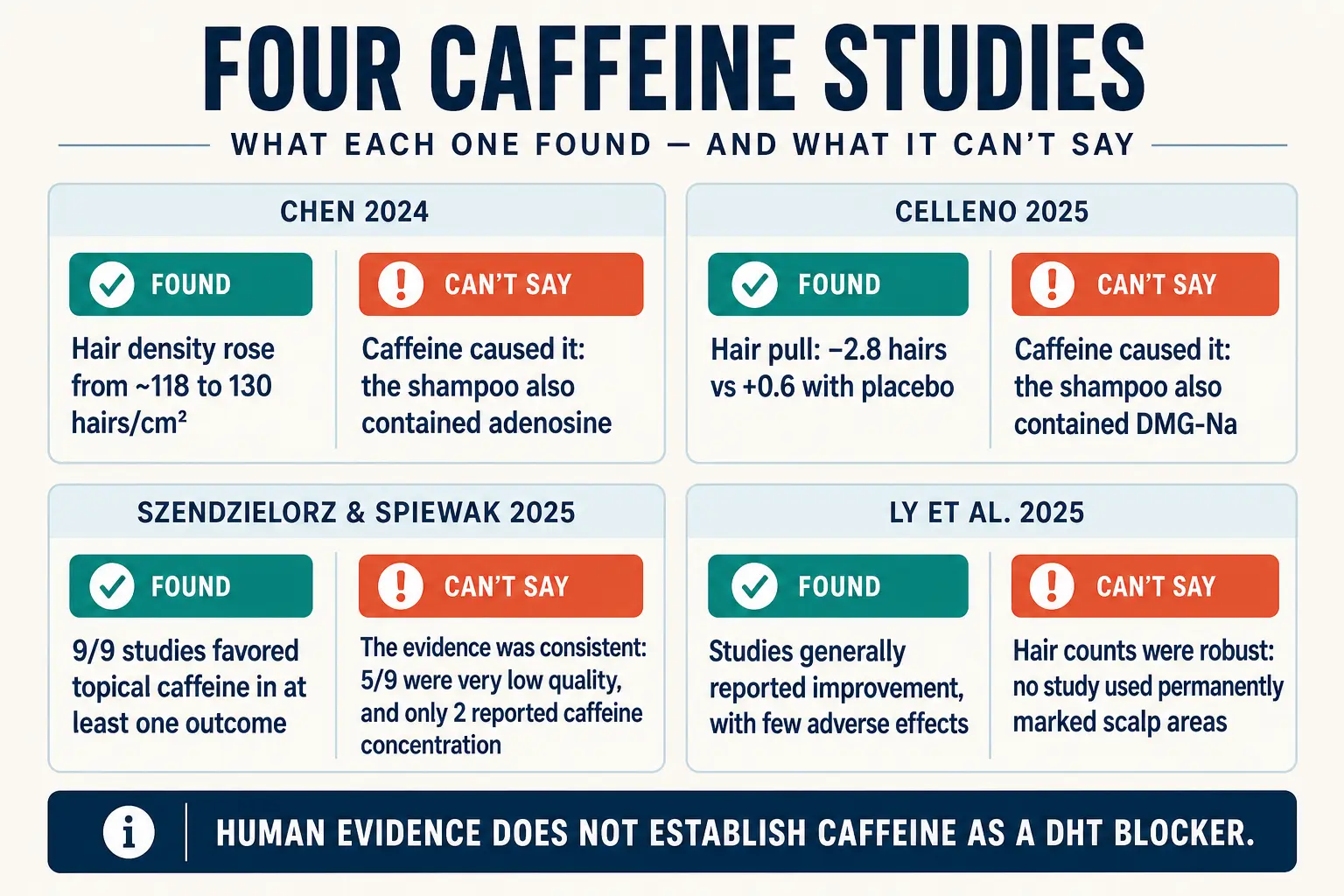
Formulation matters. Study design matters. And an effect seen with caffeine plus another active ingredient does not automatically belong to caffeine itself.
Can caffeine shampoo stop male pattern hair loss?
No. Caffeine shampoo should not be expected to stop progressive male pattern hair loss on its own.
Male pattern hair loss, or androgenetic alopecia, happens when genetically susceptible follicles gradually miniaturize under androgen signaling, especially the effects associated with dihydrotestosterone, or DHT.
Over time, thick terminal hairs become finer, shorter and less visible.
Finasteride has been studied in large controlled trials and has shown an ability to slow progression and improve hair growth in men with androgenetic alopecia. Topical minoxidil also has controlled evidence showing better hair growth than placebo.
Caffeine shampoo does not have that depth of evidence yet.
I would view it as an optional addition, not the main treatment for someone whose hair is clearly miniaturizing.
What about caffeine shampoo for women?
The evidence in women is much thinner than the overall caffeine literature makes it look.
In the 2025 review of 684 participants, 388 were reported as male and only 30 as female. Women therefore made up about 4.4% of the total study population. The sex of another 266 participants was not reported.
The review authors themselves highlighted this imbalance.
There is also a randomized double-blind trial by Bussoletti and colleagues in women with androgenetic alopecia. After six months, the phyto-caffeine shampoo group had a larger improvement in the hair-pull test than the control group (−3.1 vs −0.5 hairs, p<0.001).
That study is useful, but the overall female evidence base is still small.
There is another reason I am careful with shampoo recommendations in women: diffuse thinning does not have one single diagnosis.
Female pattern hair loss, telogen effluvium, iron deficiency, thyroid problems, hormonal changes, traction and inflammatory scalp disease can all present as thinning.
The first question is often not “Which shampoo?” but “Why is the hair thinning?”
Does caffeine shampoo block DHT?
There is not enough human evidence to call caffeine shampoo a proven DHT blocker.
You will see that claim quite often online.
Laboratory research has suggested several ways caffeine might influence follicular signaling and the hair-growth cycle. That is interesting from a biological point of view.
It is not the same as showing that shampooing the scalp produces meaningful DHT suppression in humans.
I would not describe caffeine shampoo to a patient as a DHT-blocking treatment based on the evidence we have now.
What about ketoconazole and other medicated shampoos?
Some people with hair loss also have dandruff, seborrheic dermatitis, itching, redness or heavy scaling.
In those cases, treating the scalp problem makes sense even if the underlying hair loss is androgenetic.
Ketoconazole shampoo has a well-established role in dandruff and seborrheic dermatitis. There is also older research suggesting it may have a supporting role in androgenetic alopecia.
A 1998 study reported improvements in several hair parameters during long-term use of 2% ketoconazole shampoo.
I would not use that study to tell someone that ketoconazole replaces finasteride, minoxidil or a proper assessment of progressive hair loss. If the scalp is inflamed, itchy and covered in scale, treating that problem is still worthwhile.
What shampoo do I usually recommend for hair loss?
There is no single shampoo that every person with thinning hair needs.
I usually divide it into four situations.
1. The scalp is healthy
If there is no major dandruff, itching or inflammation, a mild shampoo that you can use regularly without irritation is usually enough.
If you enjoy a caffeine shampoo and it suits your scalp, you can use it. I just would not expect the shampoo itself to carry the whole treatment.
2. There is dandruff or seborrheic dermatitis
Treat the scalp condition first.
A proper anti-dandruff or medicated shampoo may be more useful here than choosing something simply because “caffeine” is printed on the front of the bottle.
3. You are already using minoxidil, finasteride or another treatment
Then shampoo is mostly scalp care.
A caffeine shampoo can sit alongside the treatment if it does not irritate you.
The shampoo should support the treatment plan. It should not become the treatment plan.
4. Shampoo is the entire plan
This is the situation that worries me more.
If someone has clear progressive miniaturization but has spent six or twelve months relying only on an expensive “hair-growth shampoo,” the real question is whether the hair loss itself is being treated. The same applies to the other product I am asked about most often, rosemary oil.
Price is not a good shortcut either.
Caffeine shampoos range from inexpensive supermarket products to premium cosmetic products. The price can reflect fragrance, packaging, extra ingredients, formulation, branding and marketing.
The 2025 systematic review found that most studies did not even report the exact caffeine concentration of the tested product. Paying more does not automatically buy more caffeine, better evidence or a stronger effect.
How should caffeine or medicated shampoo be used?
How often you should wash depends on your scalp, the product and what you are trying to treat.
Someone with an oily scalp may wash every day. Someone else may wash less often. There is no prize for forcing yourself into one schedule.
For medicated shampoos, contact time can matter.
A study comparing immediate rinsing with a five-minute contact time found better anti-dandruff effects when the shampoo stayed on the scalp for several minutes.
A simple trick is to wet your scalp, apply the shampoo, then brush your teeth before rinsing it out.
There is little point buying a medicated shampoo and treating it like hand soap.
Always follow the instructions for the specific product, especially if it contains a medicated active ingredient.
If you use topical minoxidil, wash first, let the scalp dry, then apply the minoxidil to the dry scalp.
When should you expect results?
Most caffeine studies run for about three to six months, so judging a product after a few weeks tells you very little.
Take a clear baseline photograph before you start.
Try to keep the hairstyle, lighting, camera distance and angle similar each month. Memory is terrible at judging gradual hair changes, and bathroom lighting has probably caused more unnecessary panic than caffeine ever will.
Compare the baseline with the six-month image.
There is also some real seasonality in human hair cycling. Studies in the UK, France and Switzerland have independently found seasonal patterns, with more telogen hair or shedding around late summer and early autumn and lower levels during winter or early spring.
Seasonal variation is another reason not to judge a treatment from one bad week in the shower.
Does washing your hair every day cause hair loss?
No, not in the way most people fear.
Washing your hair does not create androgenetic alopecia.
Many of the hairs you see in your hands or around the shower drain were already at the shedding stage of their cycle.
If you wash every day, you may see a smaller number each time. If you wash every four days, several days of shed hairs may appear all at once.
That can look dramatic without meaning your hair suddenly started falling out faster.
Daily washing is fine for many people, especially if the scalp gets oily, as long as the shampoo is not drying or irritating the skin.
Can an oily scalp or “clogged follicles” cause male pattern baldness?
This idea gets marketed because it sounds easy to understand.
Sebum is normal. It is not dirt, and it does not physically choke the follicle.
An oily scalp, dandruff or seborrheic dermatitis can cause discomfort and may need treatment. They do not explain the genetic androgen sensitivity behind androgenetic alopecia.
DHT is not sitting trapped inside a dirty pore waiting for the right detox shampoo to rescue the follicle.
A clean scalp is good. Turning scalp cleansing into an explanation for hereditary baldness is marketing.
Is caffeine shampoo safe?
Caffeine shampoos are usually well tolerated, but the rest of the formula can still irritate the scalp.
In the 2024 Chen study, no major skin reactions related to the test products were reported. Some participants complained of dry hair.
That makes sense. A shampoo contains much more than caffeine.
Fragrance, preservatives, surfactants and other ingredients can all cause problems in someone with sensitive skin.
If a new shampoo causes burning, persistent redness or worsening scaling, stop using it. Do not assume irritation is a sign that the product is “working.”
What I usually see in consultations
A patient comes in after using a hair-loss shampoo for six months.
Under magnification, I can see thick terminal hairs sitting next to much finer, miniaturized hairs.
I ask, “What are you using at the moment?”
They tell me the name of the shampoo.
“Anything else?”
Sometimes the answer is no.
The patient has not necessarily been careless. Often the product was sold or presented in a way that made it sound much closer to a complete hair-loss treatment than it really is.
When I show someone the thick hair and the miniaturized hair side by side under magnification, the process usually becomes much easier to understand.
The shampoo may be making the scalp feel cleaner or the hair feel better. Meanwhile, some follicles are still getting smaller.
This becomes even more important before a hair transplant.
A transplant redistributes existing follicles. It does not stop untreated native hair from continuing to miniaturize.
Sometimes the most useful thing we can do before surgery is improve the long-term management of the existing hair.
Frequently Asked Questions
Does caffeine shampoo regrow hair?
Is caffeine shampoo good for male pattern baldness?
Is caffeine shampoo as effective as minoxidil?
Can I use caffeine shampoo with finasteride or minoxidil?
How long does caffeine shampoo take to work?
Does caffeine shampoo have side effects?
Why do caffeine shampoos vary so much in price?
Does drinking coffee help hair growth?
What shampoo is best for thinning hair, and where does ketoconazole fit?
My view
Caffeine shampoo has enough research behind it that I would not dismiss it as nonsense.
The clinical evidence has improved. We now have human trials, controlled shampoo studies and systematic reviews rather than just laboratory experiments.
The limitations are still important. Several studies test combination products, many do not clearly report caffeine concentration, women are poorly represented and study quality varies.
If you already use a caffeine shampoo and like it, there is usually no reason to throw it away just because the evidence is imperfect.
Just understand what role it is playing.
Take a clear reference photo today and compare it with another standardized photo at six months.
If the hair loss is rapidly worsening, patchy, painful, inflamed, sudden or associated with the warning signs listed earlier, do not wait six months to see what the shampoo does.
— Dr. Mesut Demir
Not sure whether a shampoo is enough?
Send us clear photographs of your hairline, mid-scalp, crown and donor area along with your hair-loss history. We will tell you what the pattern suggests, whether the hair is actively miniaturizing, and what a realistic plan looks like.
Request a Case Review- Fischer TW, Hipler UC, Elsner P. Effect of caffeine and testosterone on the proliferation of human hair follicles in vitro. International Journal of Dermatology. 2007;46(1):27–35. doi:10.1111/j.1365-4632.2007.03119.x
- Dhurat R, Chitallia J, May TW, et al. An open-label randomized multicenter study assessing the noninferiority of a caffeine-based topical liquid 0.2% versus minoxidil 5% solution in male androgenetic alopecia. Skin Pharmacology and Physiology. 2017;30(6):298–305. doi:10.1159/000481141
- Chen D, Yu F, Wang C, et al. Anti-hair loss effect of a shampoo containing caffeine and adenosine. Journal of Cosmetic Dermatology. 2024;23(9):2927–2933. doi:10.1111/jocd.16347
- Celleno L, Bussoletti C, Tolaini MV, et al. A novel approach against male pattern hair loss with topical dimethylglycine sodium salt (DMG-Na) and caffeine: efficacy of a 24-week, double-blind, randomized, placebo-controlled trial. Journal of Cosmetic Dermatology. 2025;24(8):e70390. doi:10.1111/jocd.70390
- Szendzielorz E, Spiewak R. Caffeine as an active ingredient in cosmetic preparations against hair loss: a systematic review of available clinical evidence. Healthcare. 2025;13(4):395. doi:10.3390/healthcare13040395
- Ly N, Paiewonsky B, Fruechte S, et al. Caffeine supplementation and hair: a systematic review. Journal of Drugs in Dermatology. 2025;24(11):1070–1074. doi:10.36849/JDD.8902
- Kaufman KD, Olsen EA, Whiting D, et al. Finasteride in the treatment of men with androgenetic alopecia. Journal of the American Academy of Dermatology. 1998;39(4):578–589. doi:10.1016/s0190-9622(98)70007-6
- Olsen EA, Dunlap FE, Funicella T, et al. A randomized clinical trial of 5% topical minoxidil versus 2% topical minoxidil and placebo in the treatment of androgenetic alopecia in men. Journal of the American Academy of Dermatology. 2002;47(3):377–385. doi:10.1067/mjd.2002.124088
- Piérard-Franchimont C, De Doncker P, Cauwenbergh G, Piérard GE. Ketoconazole shampoo: effect of long-term use in androgenic alopecia. Dermatology. 1998;196(4):474–477. doi:10.1159/000017954
- Piérard-Franchimont C, Uhoda E, Loussouarn G, Saint-Léger D, Piérard GE. Effect of residence time on the efficacy of antidandruff shampoos. International Journal of Cosmetic Science. 2003;25(6):267–271. doi:10.1111/j.1467-2494.2003.00195.x
- Bussoletti C, Tolaini MV, Celleno L. Efficacy of a cosmetic phyto-caffeine shampoo in female androgenetic alopecia. Giornale Italiano di Dermatologia e Venereologia. 2020;155(4):492–499. doi:10.23736/S0392-0488.18.05499-8
- Randall VA, Ebling FJG. Seasonal changes in human hair growth. British Journal of Dermatology. 1991;124(2):146–151. doi:10.1111/j.1365-2133.1991.tb00423.x
- Courtois M, Loussouarn G, Hourseau S, Grollier JF. Periodicity in the growth and shedding of hair. British Journal of Dermatology. 1996;134(1):47–54. PMID 8745886
- Kunz M, Seifert B, Trüeb RM. Seasonality of hair shedding in healthy women complaining of hair loss. Dermatology. 2009;219(2):105–110. doi:10.1159/000216832