
Quick answer
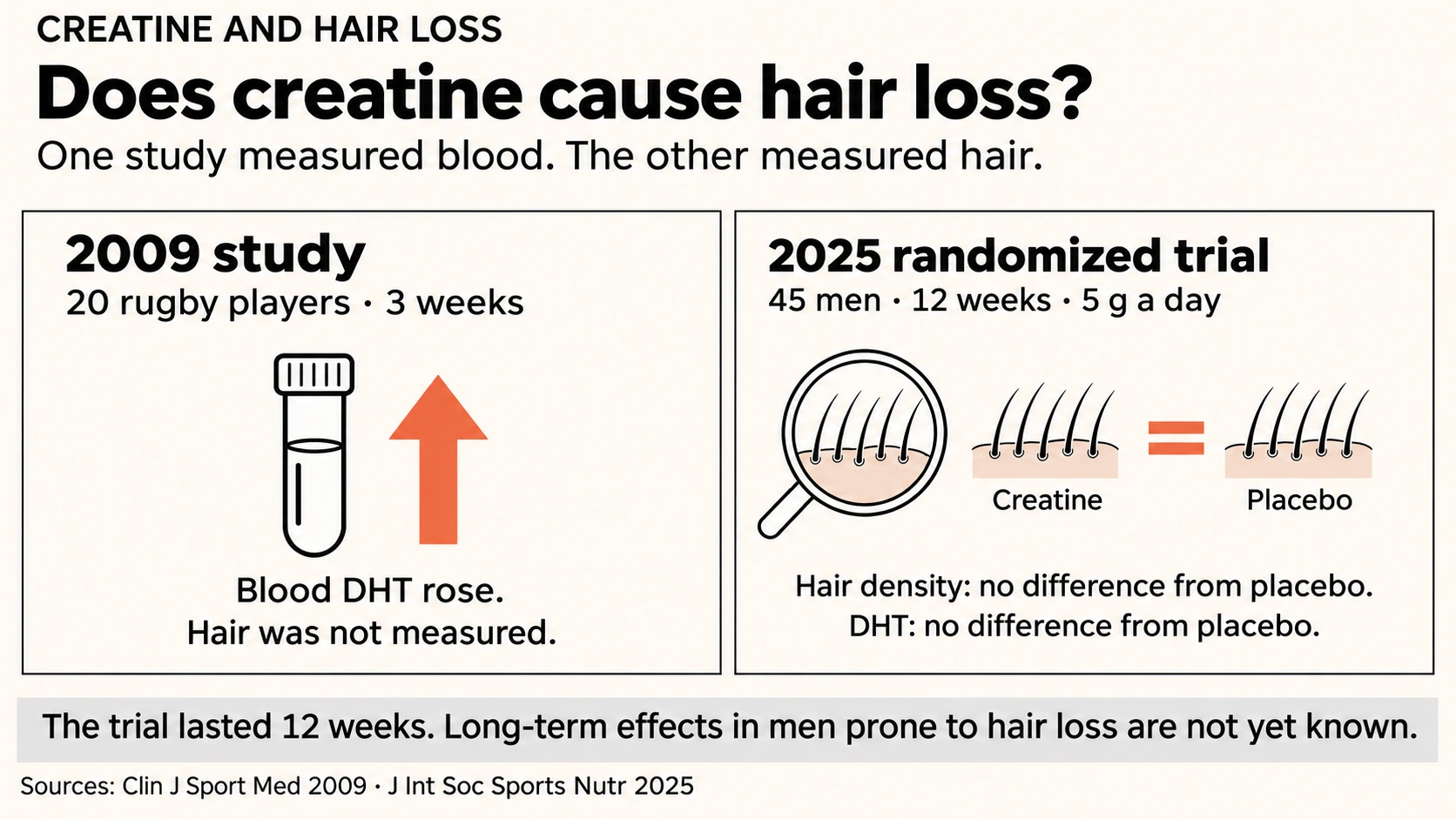
Current clinical evidence has not demonstrated that creatine monohydrate causes hair loss. A 2009 study involving 20 rugby players reported increased blood levels of dihydrotestosterone (DHT), but it did not examine their hair. In 2025, a randomized controlled trial recruited 45 resistance-trained men; 38 completed the 12-week study and 37 had usable hair measurements. Taking 5 g of creatine daily produced no statistically significant difference from placebo in DHT, hair density, follicular-unit counts or cumulative hair thickness. The trial addresses a conventional dose over three months. It cannot tell us whether years of use change the course of androgenetic alopecia in someone genetically predisposed.
If you take creatine and have started to notice recession at your temples, an article about rising DHT levels is bound to get your attention. The difficult part is separating what happened to a hormone in a blood sample from what happened to the hair itself. The studies behind those two questions are quite different.
When someone asks me whether creatine is responsible for their hair loss, I start by asking what they have actually noticed. More hair in the shower is different from a hairline that has crept backward over a year. I want to know when the change began, whether older photographs show the same pattern and what else has changed in their training, weight or medication routine. Without that history, a discussion about DHT can distract from the diagnosis.
- What creatine does, and why DHT entered the conversation
- The 2009 rugby study
- The 2025 randomized trial
- Gym products more likely to matter
- Shedding after starting creatine
- Creatine and a hair transplant
- Creatine, finasteride and minoxidil
- Creatine, collagen and skin
- Daily use and kidney tests
- What changes the decision in a consultation
- Frequently asked questions
- References
What Creatine Does—and Why DHT Entered the Conversation
Creatine is a naturally occurring compound involved in cellular energy metabolism; the body makes it, and smaller amounts come from meat and fish. Most of it sits in skeletal muscle, where it helps regenerate ATP, the molecule cells use as an immediate energy source. During repeated high-intensity efforts such as heavy sets or short sprints, ATP is used up quickly and the phosphocreatine system replenishes it.
Creatine monohydrate has a substantial body of evidence behind its use for repeated high-intensity exercise and, when combined with resistance training, improvements in strength and lean mass.[3] A conventional maintenance dose is 3–5 g daily. Loading protocols use more at the beginning, but loading is optional. The evidence for sports performance is much larger than the evidence concerning scalp hair.
DHT is produced when 5-alpha-reductase converts testosterone into dihydrotestosterone. In people susceptible to androgenetic alopecia, androgen signaling contributes to gradual miniaturization of certain follicles. Those follicles produce finer, shorter hair over successive cycles, and the scalp becomes increasingly visible. The temples, frontal hairline and crown are common sites of loss in men.
A blood DHT result cannot tell us precisely what is happening inside an individual follicle. Genetic factors, local androgen signaling and differences between scalp regions influence the response; men with similar circulating DHT can have very different patterns of loss. Local susceptibility is also part of the reason finasteride can help manage male pattern hair loss.
The first creatine study, however, measured hormones rather than hair.
The 2009 Rugby Study: A Hormone Result, Not a Hair-Loss Result
The creatine-and-baldness concern largely traces back to a 2009 paper in the Clinical Journal of Sport Medicine.[1] Twenty college-aged male rugby players in South Africa took part in a double-blind, placebo-controlled crossover study, with a six-week washout between study periods. In the creatine phase, they received 25 g of creatine plus 25 g of glucose daily for seven days, followed by 5 g of creatine plus 25 g of glucose daily for 14 days. The placebo contained glucose without creatine.
DHT rose by approximately 56% after the loading phase and remained about 40% above baseline during maintenance, without a corresponding significant change in testosterone. Quoted as percentages, the change looks dramatic. The absolute DHT concentrations, as summarized by Lak and colleagues,[2] were:
| Time point | Mean DHT in the creatine group |
|---|---|
| Before supplementation | 0.98 nmol/L |
| After seven days of loading | 1.53 nmol/L |
| After 14 days of maintenance | 1.38 nmol/L |
Lak and colleagues pointed out that all three values were within the stated reference interval for healthy adult men of 0.8–3.5 nmol/L.[2] That range does not predict how a genetically susceptible follicle will respond to androgen exposure. It does show that the reported 56% increase did not move the group's average DHT outside the cited interval.
The researchers measured hormones over three weeks in a small group of rugby players. There were no hair-density counts, trichoscopic examinations or photographs tracking hairline recession, so the study could not determine whether creatine affected hair growth or miniaturization. In a hair consultation, that missing information is exactly what I need: evidence of whether the follicles are changing, not only a percentage change in the bloodstream.
The 2025 Randomized Trial Measured Hair Directly
In April 2025, Lak and colleagues published Does creatine cause hair loss? A 12-week randomized controlled trial in the Journal of the International Society of Sports Nutrition.[2] The authors describe it as the first study to directly assess hair-follicle quality and quantity after creatine supplementation.
Forty-five resistance-trained men aged 18–40 were randomized to 5 g of creatine monohydrate or 5 g of maltodextrin placebo daily for 12 weeks. They continued their usual exercise and diets. Researchers measured total testosterone, free testosterone and DHT, alongside FotoFinder-based hair parameters such as density, follicular-unit counts and cumulative hair thickness. Thirty-eight men finished the trial, with hair data available for 37.
The exclusion criteria narrow who the findings apply to. Men who had undergone a hair transplant or other hair-restoration procedure were excluded, as were those with past finasteride or minoxidil use, recent creatine supplementation or anabolic steroid/hormonal-enhancement use within the preceding six months. The trial therefore cannot answer postoperative questions or questions about men already using medical treatments for hair loss.
What happened to DHT, testosterone and hair density?
There was no statistically significant difference between groups in changes to DHT, the DHT-to-testosterone ratio, hair density, follicular-unit counts or cumulative hair thickness. Total testosterone rose in both groups, which matters when someone quotes the increase in the creatine arm alone.
| Change over 12 weeks | Creatine group | Placebo group |
|---|---|---|
| Total testosterone | +124 ± 149 ng/dL | +216 ± 203 ng/dL |
| Free testosterone | −9.0 ± 8.7 pg/mL | −9.0 ± 6.4 pg/mL |
Neither comparison represented a significant creatine-specific effect. The authors mentioned seasonal variation as one possible explanation for hormone changes observed in both groups, since sampling took place around late summer and autumn. Their design could not establish what caused those shifts.
Where the result stops
Androgenetic alopecia usually evolves over years, while this intervention lasted three months. The hair imaging focused on the vertex rather than measuring recession separately at the temples and frontal hairline. Women were not studied. The researchers also did not record participants’ family history of hair loss, and androgen levels were measured in blood, not scalp tissue.
Within those limits, the trial supplies direct controlled evidence that 5 g daily did not worsen the hair measures used over 12 weeks. It leaves the long-term course of androgenetic alopecia in genetically predisposed users unanswered. If someone already has a progressively receding hairline, I would still examine and document it instead of treating the trial as a reason to ignore the change.
Funding and competing interests
The investigators reported no specific funding for the study. The creatine product was supplied as BPI Sports Nutrition creatine, however, and the acknowledgments thanked Tose’e Sabz Company, the regional representative of BPI Sports USA.
Scott Forbes and Jose Antonio disclosed scientific advisory roles with creatine or sports-nutrition brands. Forbes also reported receiving donated creatine for research, while Grant Tinsley disclosed support from nutrition companies and paid consultancy services to supplement manufacturers through his business. Jose Antonio is CEO and co-founder of the International Society of Sports Nutrition, which publishes the journal. These relationships are part of the paper's published disclosure statement.[2]
The Gym Products More Likely to Matter for Hair Loss
Creatine is often taken alongside other supplements, but the names on a gym shelf conceal very different pharmacology. A protein powder, a caffeinated pre-workout, a product labeled “testosterone booster,” a prohormone, a selective androgen receptor modulator (SARM) and an anabolic-androgenic steroid are not interchangeable.
Pure creatine monohydrate does not supply testosterone. Anabolic steroids increase androgen exposure and can accelerate miniaturization in a genetically susceptible scalp. A useful product history therefore includes everything being taken, the actual ingredients, doses, when each product was started and whether it was prescribed.
A 2026 systematic review by Gupta and colleagues included 14 studies and 2,344 people exposed to forms of androgen supplementation.[4] In one subgroup of 100 male anabolic steroid users, reported alopecia prevalence increased from 2% at baseline to 12% across follow-up periods of two to 52 weeks. The subgroup was small and heterogeneous, so those figures are not a universal risk estimate. In someone reporting rapid pattern thinning during a bodybuilding cycle, androgen exposure is a much more plausible line of investigation than a normal maintenance dose of creatine.
SARMs act on androgen receptors and are marketed in some settings as bodybuilding products. The FDA states that SARMs are not approved for any use and cannot legally be sold as dietary supplements, and it links them to liver injury and cardiovascular events.[5] “Testosterone boosters” are a less defined category: many contain ordinary dietary ingredients, while others have been found to contain undeclared or hormonally active substances.
The ingredient list and the actual product matter more than the words on its front label.
Prescribed testosterone replacement therapy is a separate clinical situation from non-medical steroid use. Both belong in a medication history, but the indication, dosing and monitoring are different. Pure Line has a dedicated article on Testosterone, Steroids, and Hair Transplantation: What Patients Should Understand Before Surgery.
I would not rely on the question “Do you take any medication?” to uncover everything used in the gym. Patients may think of a pre-workout, a “testosterone booster” or a SARM as a training product rather than a drug. I ask for the actual product names and, where possible, the ingredient lists. An androgenic substance changes how I interpret rapid thinning and how cautiously I plan around vulnerable native hair.
What if the Shedding Began After You Started Creatine?
Record when creatine was started, when the shedding began and what else changed during the preceding months. Then look at the pattern. Increased daily shedding and the gradual production of finer hairs are different processes, even though patients commonly describe both as “losing hair.”
With telogen effluvium, more hairs may come away in the shower or during brushing, sometimes across the entire scalp. Illness, rapid weight loss, substantial calorie restriction, certain medications and physiological stress are established potential triggers, and shedding commonly begins weeks to months later. A change in training and nutrition around the time creatine is introduced belongs in the history.
Androgenetic alopecia usually looks different: the temples recede gradually, the crown shows more scalp, and trichoscopy reveals hairs of differing diameters in affected areas. The two conditions can coexist. An episode of diffuse shedding can make previously subtle pattern hair loss much more noticeable.
Family history, older photographs, recent weight change, illnesses, medicines and scalp symptoms help decide what additional assessment is needed. Pain, persistent redness, pustules, patchy loss or signs of scarring should not be attributed to ordinary androgenetic alopecia without examination. A negative group-level result over 12 weeks does not exclude an individual reaction, so a genuine change in shedding still warrants proper assessment.
Does Creatine Affect a Hair Transplant?
No controlled clinical trial has measured graft survival or wound healing in hair-transplant patients taking creatine. The 2025 trial excluded men with previous hair-restoration procedures, so its reassuring hair measurements do not directly answer questions about postoperative recovery.
Donor follicles are usually obtained from relatively androgen-resistant regions of the scalp and retain much of their behavior after transplantation. The native hair surrounding them can still miniaturize. This is why a transplanted hairline can remain intact while density behind it declines over time—and why a good one-year result needs a plan for the next several years.
A documented Pure Line case involving 3,612 grafts illustrates the planning problem. The patient had broad frontal and mid-scalp thinning with many miniaturized native hairs before surgery, so a possible second session was discussed from the beginning. After transplantation, he reported using finasteride and minoxidil consistently. At the ten-month review, the response was better than I had expected from his starting pattern. He did not feel he needed another operation at that point, and we left the option open. The photographs cannot separate the contribution of graft growth from changes in native hair, and the case did not assess creatine use.
What about supplements before and after surgery?
Pure Line's published patient guidance asks people to disclose medications and supplements before surgery. Pure creatine monohydrate and a multi-ingredient pre-workout have different ingredient profiles; stimulants or hormonal substances in the latter require separate consideration.
Before surgery, I want the full name and formulation of each supplement, along with the patient's medical history and preoperative blood tests. Creatinine is part of our preoperative assessment, so I also want to know about creatine use when interpreting that result. I separate a simple creatine monohydrate powder from a combination product containing stimulants or hormonal compounds. The plan for pausing or restarting supplements belongs to the individual surgical assessment; a study of hair density in healthy gym users cannot supply a universal postoperative timetable.
Published research provides no creatine-specific timeline for postoperative graft survival. The surgical team's instructions should account for the full product formula, the patient's health and the course of recovery.
Does Creatine Interfere With Finasteride or Minoxidil?
Finasteride inhibits type II 5-alpha-reductase and lowers DHT production; minoxidil supports hair growth through another pathway. Creatine's established role is in exercise performance and cellular energy metabolism.
No direct trial tells us whether taking finasteride changes any potential hair-related response to creatine. Decisions about prescribed hair-loss medication still depend on the diagnosis, response to treatment and the patient's medical history.
Patients who prefer transplantation without ongoing medication face a different long-term planning question, covered in Hair Transplant Without Finasteride.
Creatine, Collagen and Skin: What the Smaller Studies Show
Creatine also appears in skincare research because skin cells depend on cellular energy systems. Laboratory studies have reported effects on fibroblast activity and collagen-related pathways, but those outcomes do not prove that an oral supplement makes skin firmer or reduces wrinkles.
A September 2026 narrative review summarized topical and oral creatine research relating to skin firmness; its literature search had been conducted in March 2025.[6] The human studies were generally small, short and concerned topical combination products. In one, Peirano and colleagues tested a formula containing creatine, guarana and glycerol in 43 men over six weeks.[7] In another, Fischer and colleagues examined creatine combined with folic acid in 36 women over five weeks.[8] Improvements were reported in selected skin-aging or elasticity measurements.
Both research groups included authors affiliated with Beiersdorf, a skincare manufacturer. Neither human study tested creatine as an isolated active ingredient, and neither established durable benefits over months or years. The review identified no direct human clinical trial showing that taking creatine orally improves dermal collagen, skin firmness or wrinkles. That remains a claim without direct clinical support, even though topical formulations are being investigated.
Is Creatine Safe Every Day? A Note About Kidney Tests
Creatine monohydrate is generally well tolerated by healthy adults at commonly studied maintenance doses of 3–5 g/day.[3] Larger single doses can cause gastrointestinal discomfort. People with kidney disease, abnormal kidney results or medicines that affect renal function need an individual discussion with their treating clinician.
Creatine is partly converted to creatinine, a molecule used to estimate kidney filtration from blood tests. Supplementation can alter serum creatinine without necessarily causing kidney injury. In Lak's 12-week hair trial, creatinine and estimated glomerular filtration rate (eGFR) did not change significantly.[2]
A 2026 systematic review and meta-analysis combined 26 studies involving 1,036 participants.[9] Across its pooled analyses, serum creatinine increased by 0.14 mg/dL (95% CI 0.05–0.22), while creatinine-based eGFR decreased by 10.75 mL/min (95% CI −17.48 to −4.02). A creatinine-independent Cr-EDTA assessment found no statistically significant difference (P = 0.06).
The creatinine analysis showed very high heterogeneity (I² = 93.9%). The pooled studies included healthy people and patients with chronic kidney disease, including hemodialysis populations. These figures therefore should not be treated as a uniform response in a healthy gym user, or used to dismiss an abnormal test in someone with kidney disease. Tell your clinician if you take creatine so laboratory results can be interpreted in context.
What Changes the Decision in a Hair Consultation
Gradually finer hairs along the frontal scalp suggest androgenetic alopecia; diffuse shedding after illness or major calorie restriction prompts a different investigation. Redness, scale or evidence of scarring changes the priorities again. Those findings determine whether the immediate discussion should be about medical treatment, further testing, monitoring or surgery.
I pay particular attention to the native hair still present in the proposed recipient area. Fine, miniaturized hairs across the frontal scalp call for a different plan from a completely bare area: some may be worth preserving with medical treatment before deciding how many grafts to place. When the crown is still progressing, I am cautious about spending donor hair there simply to make every area look fuller in the first session. I sometimes prefer to leave part of the crown for later so there is donor capacity available if the frontal and mid-scalp regions change.
For a possible transplant, dated photographs help establish the pace of change; trichoscopy helps show how much native hair is already miniaturizing. Age and donor supply also shape the decision. I am comfortable recommending medical treatment, further investigation or observation when moving grafts is not the best next step. That approach is explained more fully in Hair Loss Treatment Is a Long-Term Plan.
— Dr. Mesut Demir
Frequently Asked Questions
Does creatine cause male pattern baldness?
Does creatine increase DHT?
Should I stop creatine if my hairline is receding?
Can I use creatine after an FUE or DHI hair transplant?
What if I take creatine and finasteride together?
Can creatine still be involved if shedding started soon after I took it?
Unsure what is behind the thinning?
Send Pure Line photographs of your hairline, crown and donor area, with a list of every supplement and medicine you take and when the change began.
Request a Case Review- van der Merwe J, Brooks NE, Myburgh KH. Three weeks of creatine monohydrate supplementation affects dihydrotestosterone to testosterone ratio in college-aged rugby players. Clinical Journal of Sport Medicine. 2009;19(5):399–404. DOI: 10.1097/JSM.0b013e3181b8b52f. PMID: 19741313.
- Lak M, Forbes SC, Ashtary-Larky D, et al. Does creatine cause hair loss? A 12-week randomized controlled trial. Journal of the International Society of Sports Nutrition. 2025;22(Suppl 1):2495229. Published online April 23, 2025. DOI: 10.1080/15502783.2025.2495229. PMID: 40265319. Full text.
- National Institutes of Health, Office of Dietary Supplements. Dietary Supplements for Exercise and Athletic Performance: Health Professional Fact Sheet. NIH fact sheet. Accessed November 16, 2026.
- Gupta S, Bai JQA, Geng RSQ, Donovan J. The effect of androgen supplementation on hair loss: A systematic review. JAAD International. 2026;26:20–22. DOI: 10.1016/j.jdin.2026.03.011. PMID: 42027981. Full text.
- US Food and Drug Administration. FDA Warns of Use of Selective Androgen Receptor Modulators (SARMs) Among Teens, Young Adults. Consumer update; content current as of April 26, 2023. FDA consumer update. Accessed November 16, 2026.
- Werpachowski N, Susla L, Stein M, Lal K. The Effects of Topical and Oral Creatine on Skin Firmness and Resilience: A Review. Journal of Clinical and Aesthetic Dermatology. 2026;19(9):67–72. PMID: 42877881. Full text.
- Peirano RI, Achterberg V, Düsing HJ, et al. Dermal penetration of creatine from a face-care formulation containing creatine, guarana and glycerol is linked to effective antiwrinkle and antisagging efficacy in male subjects. Journal of Cosmetic Dermatology. 2011;10(4):273–281. DOI: 10.1111/j.1473-2165.2011.00579.x. PMID: 22151935.
- Fischer F, Achterberg V, März A, et al. Folic acid and creatine improve the firmness of human skin in vivo. Journal of Cosmetic Dermatology. 2011;10(1):15–23. DOI: 10.1111/j.1473-2165.2010.00543.x. PMID: 21332911.
- de Souza Almeida A, da Silva LOD, Takahasi BNA, et al. Impact of creatine supplementation on kidney health: a systematic review and meta-analysis. International Urology and Nephrology. 2026;58(12):5423–5434. Published online July 27, 2026. DOI: 10.1007/s11255-026-05287-x. PMID: 42507286. Full text.