
Quick answer
There is real human research behind rosemary oil, but it does not yet show that rosemary can control progressive androgenetic alopecia. The most-quoted study, a six-month randomized single-blind trial in 100 men, compared a standardized rosemary lotion with 2% minoxidil: mean hair count rose from 122.8 to 129.6 in the rosemary group, an increase of 6.8 hairs in an area whose size and location were never reported. There was no placebo or vehicle-only arm, the comparator was 2% rather than the better-evidenced 5% minoxidil, and failing to detect a difference between two active treatments is not the same as proving equivalence. A 2025 double-blind three-arm trial in 90 adults did include a control, but both active arms combined rosemary with other ingredients — one with castor oil, the other with nine oils plus vitamin E — so the effect cannot be assigned to rosemary alone, and it ran for only 90 days. Rosemary is not a proven human DHT blocker. Dr. Mesut Demir treats it as an optional adjunct for a tolerant scalp rather than a reason to postpone assessment while miniaturization continues.
I get some version of the rosemary oil question almost every day now.
Sometimes a patient brings the bottle. More often, he hands me his phone and opens a video with some version of, “Can you have a look at this?”
One patient had written a date on his bottle so he wouldn't forget when he'd started using it. There wasn't much else on the label. I remember thinking that, from my point of view, the date was probably more useful than the bottle.
Because the question I hear most isn't really, “Does rosemary oil work?”
It's usually:
“How many more months should I give it?”
The slightly unusual part is that rosemary oil isn't something I routinely use in my own practice. I don't sell a rosemary product, and I don't have one to defend. That gives me very little reason to make the evidence sound better or worse than it is.
I also hear another sentence quite often:
“I'll try this first. If it doesn't work, I'll get a hair transplant.”
When I hear that, I'm not really hearing a product choice. I'm hearing the beginning of a one- or two-year plan, whether the patient realizes it or not.
That's why I take the question seriously.
There is real research behind rosemary oil, and there is more human evidence now than there was only a few years ago. But there's still a large difference between showing that a topical product may help and showing that it can reliably control progressive androgenetic alopecia.
When follicles are already miniaturizing, the calendar matters almost as much as the product.
One six-month trial compared a standardized rosemary lotion directly with 2% minoxidil. A newer 90-day controlled trial also produced positive results, including an arm using rosemary essential oil diluted in castor oil. That's more clinical evidence than most botanical hair products ever receive, but it still doesn't prove that rosemary can replace established treatment for androgenetic alopecia. [1,2]
- What does the research on rosemary oil actually show?
- What did the 2015 rosemary study find?
- What does the +6.8 hair count actually mean?
- Why does the lack of a placebo group matter?
- What does “single-blind” mean in this study?
- Why does the 2% minoxidil comparison matter?
- Did rosemary have any advantages in the 2015 study?
- What does the newer 2025 trial add?
- What about the 1998 aromatherapy study?
- The part I worry about more in consultations
- Does rosemary oil block DHT?
- Why might rosemary oil still help?
- Does scalp massage affect the rosemary oil evidence?
- Is rosemary water the same as rosemary oil?
- What about rosemary oil for women?
- Can you use rosemary oil during pregnancy or breastfeeding?
- How should you use rosemary oil for hair growth?
- Rosemary vs minoxidil vs finasteride
- Rosemary after a hair transplant
- Frequently asked questions
What does the research on rosemary oil actually show?
For years, almost every clinical discussion about rosemary oil and androgenetic alopecia came back to one paper published in 2015.
That's no longer the whole story.
A second randomized controlled human study was published in 2025. It looked at rosemary-containing oil formulations in 90 men and women who reported thinning and increased hair fall. [2]
So if I'd written this article a year or two earlier, I probably would have said that almost the entire human case for rosemary rested on one clinical trial.
I can't say that anymore.
Before getting into the limitations, though, rosemary deserves the strongest fair version of its case.
Most botanical hair products have never been compared with an established hair-loss treatment. Rosemary has. In 2015, a standardized rosemary lotion was compared directly with 2% minoxidil and didn't produce significantly worse hair-count results over six months. Ten years later, another research group studying rosemary-containing formulations also reported positive hair and scalp outcomes. [1,2]
That's more evidence than exists for many oils and supplements sold for hair growth.
The real question is how far that evidence allows us to go.
What did the 2015 rosemary oil study actually find?
Panahi and colleagues conducted a six-month randomized, single-blind trial involving 100 men aged 18 to 49 with androgenetic alopecia. Fifty used a rosemary lotion and fifty used 2% topical minoxidil. [1]
Participants applied 1 mL of their assigned preparation twice daily, roughly 12 hours apart, to the frontoparietal and vertex areas of the scalp with gentle massage. [1]
The rosemary lotion was standardized to contain at least 3.7 mg of 1,8-cineole per mL. [1]
The investigators also took standardized professional microphotographs at baseline, three months and six months. Changes in those photographs were scored independently by two dermatologists who didn't know which treatment had been administered. [1]
The reported hair counts were:
| Treatment | Baseline | Six months | Change |
|---|---|---|---|
| Rosemary lotion | 122.8 ± 48.9 | 129.6 ± 51.2 | +6.8 |
| Minoxidil 2% | 138.4 ± 38.0 | 140.7 ± 38.5 | +2.3 |
At three months, neither group showed a significant increase in hair count. By six months, both had improved significantly compared with baseline, and the difference between the groups wasn't statistically significant. [1]
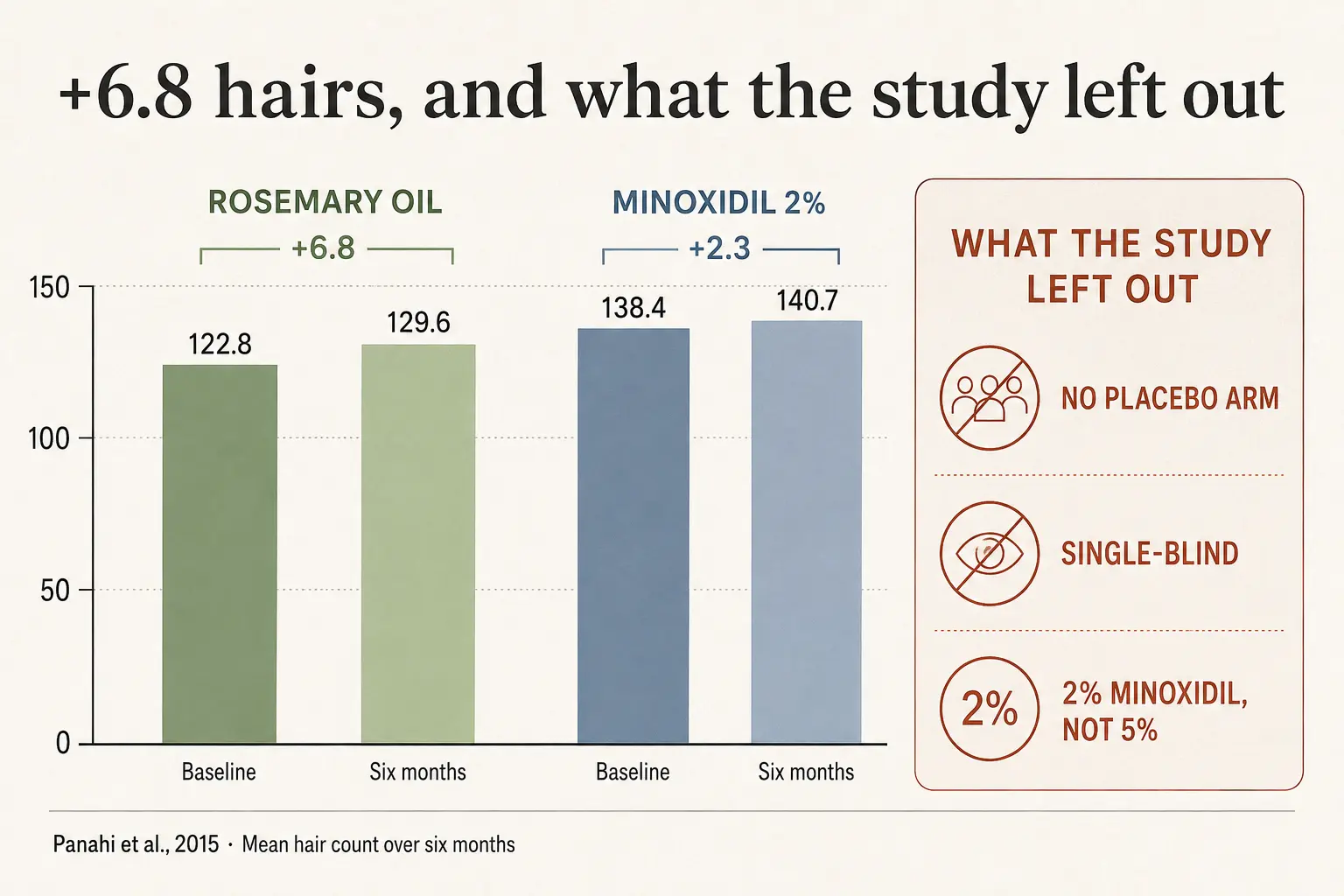
That's the result behind most of the headlines claiming rosemary works “as well as minoxidil.”
It needs context.
What does the +6.8 hair count actually mean?
The rosemary group went from an average count of 122.8 to 129.6, an increase of 6.8 hairs in the area the researchers counted. [1]
A 2025 review by Gupta and colleagues points out an important omission in the original study: the size and location of the hair-count area weren't reported. [7]
That makes the number difficult to translate into real life.
I can't take +6.8 and honestly tell somebody that it represents a particular percentage improvement in visible scalp density. We know how the researchers' count changed. We don't know enough about the area being counted to say what that change would look like under normal bathroom light.
The numerical increase itself is modest. Whether it produced a cosmetically obvious difference is harder to answer from the published data.
Why does the lack of a placebo group matter?
The 2015 study compared two active groups: rosemary and 2% minoxidil.
There wasn't an untreated group or a vehicle-only control group. [1]
Hair counts aren't perfectly static. Hair follicles move through different growth phases, measurements vary, and somebody who suddenly starts applying something to the scalp twice a day may change other aspects of scalp care at the same time.
The participants were also massaging the treatment into their scalps.
A vehicle-only group would have helped separate the effect of rosemary from the lotion base, massage, measurement variation and normal hair-cycle changes.
That doesn't make the study useless. It limits how much we can conclude from it.
There's another statistical problem with the way the result is commonly described. Failing to find a statistically significant difference between two treatments doesn't prove that they're equivalent.
A true equivalence or non-inferiority trial is designed specifically around that question.
The 2015 rosemary study wasn't.
What does “single-blind” mean in this study?
The authors describe the trial as single-blind, and the full paper tells us where part of that blinding occurred.
The standardized photographs were assessed independently by two dermatologists who didn't know which treatment each patient had received. [1]
That's a genuine methodological strength because it reduces observer bias in the photographic assessment.
It still isn't the same thing as a large double-blind, placebo-controlled trial. The study also included patient satisfaction measures, where expectations can have more influence.
There's no reason to make the study sound weaker than it was. It was randomized and single-blind.
There's equally no reason to upgrade it into a stronger design than it actually had.
Why does the 2% minoxidil comparison matter?
The rosemary trial used 2% topical minoxidil.
For men with androgenetic alopecia, 5% minoxidil has stronger efficacy data.
In a randomized 48-week study involving 393 men, the 5% formulation produced an earlier response and approximately 45% more regrowth than 2% minoxidil. [4]
So when somebody tells me, “Rosemary was proven to work as well as minoxidil,” quite a lot of information has disappeared from the sentence.
The more accurate version is that one relatively small six-month study compared a standardized rosemary lotion with 2% minoxidil and didn't detect a statistically significant difference in hair count between the groups.
It didn't demonstrate equivalence with 5% minoxidil.
For the bigger question of where minoxidil fits alongside DHT control, scalp treatment and surgery, I've covered that separately in Hair Loss Treatment Is a Long-Term Plan, Not a Single Procedure.
Did rosemary have any advantages in the 2015 study?
Yes.
Scalp itching increased from baseline in both groups, but it was significantly more frequent in the minoxidil group at three and six months. Dry hair, greasy hair and dandruff weren't significantly different between the groups. [1]
That belongs in the discussion.
If I'm going to spend several paragraphs explaining the limitations of a study, I don't want to quietly remove the findings that favored rosemary.
My reading of the 2015 paper is fairly positive, just more restrained than most online headlines. It produced a clinical signal worth investigating further.
And eventually, someone did.
What does the newer 2025 trial add?
When I first saw the 2025 study, I was pleased.
For years, one obvious weakness in the rosemary evidence was the absence of a control arm in the main AGA study. Now there was another randomized controlled trial.
Then I looked at what was actually in the bottles.
That doesn't make the study bad. It changes the question we're asking.
The 2025 trial randomized 90 adults aged 18 to 55 into three groups for 90 days. Fifty-four were women and 36 were men at enrollment. Eight participants were lost to follow-up, leaving 82 people in the per-protocol analysis, including 50 women. [2]
The three groups used:
- a multi-ingredient rosemary and lavender oil formulation
- rosemary essential oil combined with cold-pressed castor oil
- coconut oil as the control [2]
The products were applied three times per week. Participants used 15 mL, massaged it into the scalp for five to ten minutes, and left it on for at least four hours or overnight before washing. [2]
The rosemary-containing groups showed improvements in several measured outcomes, including hair growth rate, thickness, density and hair fall. [2]
That's useful human evidence.
It's also important to be precise about what was tested.
What did the 2025 trial actually test?
The first active formulation was nowhere near rosemary alone. It contained castor, sesame, coconut, rosemary, olive, amla, lavender, jojoba and juniper oils, plus vitamin E. [2]
If a ten-ingredient formula improves a hair measurement, we can't simply give rosemary all the credit because that's the ingredient we're interested in.
The second active arm is more interesting.
It used rosemary essential oil blended with cold-pressed castor oil. [2]
That's much closer to what people actually do at home: buy rosemary essential oil, dilute it in a carrier oil and apply it to the scalp.
So I wouldn't dismiss the newer trial by saying rosemary itself wasn't really tested. That would be too harsh.
Rosemary still wasn't isolated, though.
The participants received rosemary and castor oil together. If that combination performs better than coconut oil, we learn something about the combination, but we still can't calculate how much of the effect came from rosemary and how much, if any, came from castor oil.
The population was also different from the 2015 study.
Participants weren't recruited specifically because they had clinically diagnosed androgenetic alopecia. They were otherwise healthy men and non-pregnant, non-breastfeeding women reporting thinning and defined levels of hair fall. [2]
That makes the study relevant to general hair and scalp outcomes.
It's less direct evidence that rosemary controls DHT-driven follicular miniaturization in diagnosed AGA.
Was coconut oil really a placebo?
The authors describe coconut oil as the placebo. [2]
When I'm explaining the study to a patient, I'd probably call it the control oil.
Coconut oil isn't completely inert from a hair-care perspective. Earlier research has shown that it can penetrate the hair shaft and reduce protein loss from damaged and undamaged hair. [9]
That doesn't mean coconut oil treats androgenetic alopecia.
It does mean that “inactive placebo” gives a slightly cleaner picture of the comparison than what actually happened.
What about the commercial connection?
The paper discloses that the trial was funded by the company behind the tested commercial formulation and that one of the authors worked for that company. [2]
I don't think industry funding makes a study invalid. If we applied that rule consistently, we'd have to discard a very large part of pharmaceutical research as well.
It does make independent replication more valuable, particularly when a proprietary multi-ingredient formulation is being tested.
The study also lasted 90 days.
Three months can provide useful information about shedding, shaft characteristics, growth rates and scalp measurements, but androgenetic alopecia is a chronic process measured over years. I wouldn't use a 90-day trial to make strong claims about long-term stabilization.
Overall, the 2025 trial strengthens the case that rosemary-containing formulations deserve more research.
It doesn't establish rosemary as a replacement for established AGA treatment.
What about the 1998 aromatherapy study?
Another paper appears regularly in rosemary articles.
It was published in 1998 and involved 86 patients with alopecia areata. [3]
That's already a major distinction. Alopecia areata is an autoimmune disease. Androgenetic alopecia has different biology.
The active group also didn't use rosemary alone. They used a combination of thyme, rosemary, lavender and cedarwood essential oils in jojoba and grapeseed carrier oils. [3]
The essential-oil mixture performed better than the carrier oils.
That's legitimate positive aromatherapy research.
It doesn't show that rosemary alone treats androgenetic alopecia, and because four essential oils were used together, it doesn't even tell us which oil drove the result in alopecia areata.
A review article isn't another clinical trial
A 2024 paper by Bin Rubaian and colleagues is also cited frequently in rosemary discussions. [8]
It's a useful paper.
It's a review, not a new clinical trial.
I've seen reviews presented online almost as though another independent research group treated another set of patients and reproduced the 2015 result.
They didn't.
A review collects and interprets existing evidence. It doesn't create another rosemary-treated patient group.
This sounds painfully obvious until citations begin traveling from one commercial page to the next, at which point apparently all bets are off.
The part I worry about more in consultations
When somebody tells me he's using rosemary oil, the first thing I want to know usually isn't the brand.
I want to know when the hair loss started, when he started treating it, and what happened in between.
The bottle doesn't give me a diagnosis. The timeline often tells me much more.
Family history comes up early too. I ask about the father, brothers and maternal side of the family.
Family history doesn't diagnose androgenetic alopecia by itself, but if a 29-year-old man has slowly receding temples and several men in his family followed a similar pattern, that information matters considerably more to me than whether his rosemary came in a dropper or a spray bottle.
Then I look at the hair itself.
A patient can still look reasonably dense from across the desk. When I separate the first few centimeters of frontal hair, I sometimes see two different populations sitting beside each other: strong terminal hairs and much finer hairs that are already miniaturizing.
I'll sometimes ask the patient to look at that area with me rather than judging it only in the mirror. They can be surprisingly different views.
Old phone photographs help too.
Nobody spends five years taking standardized clinical photographs of his own hairline, understandably. But an old holiday picture, wedding photograph or random selfie can sometimes show a slow change more clearly than either of us remembered it.
That's also where I hear:
“I'll try this for a bit longer. If it doesn't work, I'll just have a transplant.”
I understand the logic, but a hair transplant isn't a reset button.
If native hair continues to miniaturize during those extra years, the surgical plan at the end of that period may be different from the one we could have made at the beginning.
I don't mind that somebody tried an oil.
I mind when the oil becomes a reason not to notice what the hair is doing.
Does rosemary oil block DHT?
We don't have convincing human evidence showing that topical rosemary oil meaningfully reduces scalp DHT.
There is relevant laboratory and animal research.
A 2013 study involving Rosmarinus officinalis leaf extract reported 5-alpha-reductase inhibitory activity and identified 12-methoxycarnosic acid as one potentially relevant compound. [5]
That's biologically interesting, but it's a different experiment from somebody applying a retail rosemary essential oil to a human scalp.
The 2025 trial doesn't solve this question either. It measured hair and scalp outcomes, not human scalp DHT, and both active preparations contained ingredients besides rosemary. [2]
If DHT-driven miniaturization is what we're trying to control, I wouldn't describe rosemary as a proven natural DHT blocker.
For a more detailed explanation of the pathway itself, see What Is Finasteride for Hair Loss and How Does It Work?.
Why might rosemary oil still help?
Rosemary contains compounds with antioxidant, anti-inflammatory and antimicrobial properties. [8]
Those effects may matter to scalp health even if they don't directly control androgen-driven miniaturization.
Patients also don't arrive with one perfectly isolated problem. Somebody can have androgenetic alopecia and seborrheic dermatitis at the same time. Another patient may have itching, scaling or irritation alongside a separate pattern of genetic thinning.
Improving an irritated scalp can still be worthwhile.
For more on that distinction, see Can You Have a Hair Transplant With Seborrheic Dermatitis?
There's also a less glamorous explanation for some positive experiences.
Oil can improve the hair shaft itself. It affects lubrication, moisture and the way strands sit against each other. Hair may look smoother or fuller without any new follicles appearing.
That's still a real benefit.
It's just not the same thing as reversing follicular miniaturization.
Does scalp massage affect the rosemary oil evidence?
It makes the picture harder to separate.
Participants in the 2015 study applied their treatments with gentle massage. [1]
In the 2025 trial, participants massaged the oils into their scalps for five to ten minutes three times per week. [2]
Scalp massage has a very small evidence base of its own.
In a 2016 study involving only nine men, four minutes of standardized daily massage for 24 weeks was associated with an increase in average hair thickness from around 0.085 mm to 0.092 mm. Hair density didn't show a similar improvement. [6]
Nine people is nowhere near enough to establish scalp massage as a treatment for hair loss.
It does illustrate why before-and-after stories are messy.
A person starts rosemary oil, begins massaging the scalp every night, changes shampoo, improves his diet, starts supplements and perhaps adds another hair-loss treatment.
Six months later, there's one photograph and several new variables.
Humans are extremely good at changing five things at once and giving the sixth all the credit.
Is rosemary water the same as rosemary oil?
No.
Neither the 2015 AGA trial nor the 2025 controlled study investigated homemade rosemary water. [1,2]
The older trial used a standardized rosemary lotion. The newer study used oil-based formulations.
Rosemary water made by boiling or steeping leaves can vary according to the amount of plant material, temperature, preparation time, water volume and storage.
I haven't found comparable controlled human evidence showing that homemade rosemary water treats androgenetic alopecia.
That's worth mentioning because quite a few people who tell me they're “using rosemary” aren't actually using an oil. They're spraying rosemary water onto the scalp.
There's nothing wrong with calling that rosemary water.
We just shouldn't borrow the evidence from another formulation and call it the same treatment.
What about rosemary oil for women?
The evidence is a little better than it was before 2025.
The 2015 androgenetic alopecia study involved men only. [1]
The newer trial did include women. Fifty of the 82 people in the final per-protocol analysis were female. [2]
That's useful new human data.
But it wasn't specifically a trial of female pattern hair loss, and the active treatments contained other ingredients.
So I wouldn't say there's no female human evidence anymore.
There is.
Rosemary-specific evidence for female androgenetic alopecia is still limited.
Female thinning also has a broader diagnostic picture. Female pattern hair loss, telogen effluvium, iron deficiency, thyroid disease, postpartum shedding and inflammatory scalp conditions can overlap.
The diagnosis matters before deciding that an oil is the answer.
For more on that, see Female Hair Loss and Hair Restoration at Pure Line.
Can you use rosemary oil during pregnancy or breastfeeding?
I wouldn't recommend self-directed medicinal use of concentrated rosemary essential oil for hair growth during pregnancy or breastfeeding.
The main issue is the lack of good pregnancy-specific safety data.
UKTIS notes that there are no epidemiological or evidence-based studies establishing the safety of essential oils during pregnancy. [11]
The European Medicines Agency's herbal monograph for rosemary oil also states that safety during pregnancy and lactation hasn't been established and that use isn't recommended when sufficient safety data are absent. [12]
Normal culinary exposure to rosemary is a very different situation from repeatedly applying concentrated essential oil as a treatment.
Pregnancy and postpartum hair loss also deserve diagnostic caution. Postpartum shedding is commonly telogen effluvium rather than androgenetic alopecia, so I'd want to understand what's causing the shedding before deciding what to put on the scalp.
How should you use rosemary oil for hair growth?
If someone wants to try rosemary as an adjunct, a properly formulated scalp product with clear instructions is simpler than applying neat essential oil.
Pure rosemary essential oil is concentrated. It can irritate the skin and cause allergic contact dermatitis. [12]
There isn't a clinically validated homemade dilution for treating androgenetic alopecia.
For a healthy adult who's determined to prepare a DIY mixture, around 1% is a conservative topical starting point rather than a proven hair-growth dose. [13]
That's an important distinction.
A rough 1% dilution is about one drop of essential oil in 5 mL of carrier oil if a drop is assumed to be approximately 0.05 mL. Drop size isn't standardized, so this is an approximation rather than a laboratory recipe.
It also isn't the formulation studied in 2015 or 2025.
Patch-testing a new preparation first is sensible.
If the scalp becomes persistently red, burns, develops a rash, swells or becomes increasingly itchy, stop using it.
I wouldn't increase the concentration because the scalp doesn't tingle.
Tingling isn't a hair-growth endpoint.
How often should rosemary oil be used?
There isn't one scientifically proven schedule.
The standardized rosemary lotion in the 2015 study was used twice daily. [1]
The rosemary-containing oil formulations in the 2025 trial were used three times per week. [2]
Different products, different protocols.
That alone should make us skeptical when somebody online presents one exact rosemary schedule as “the clinical protocol.”
For a properly formulated commercial product, follow its instructions. Applying a homemade mixture more frequently doesn't create stronger evidence and may simply create more irritation.
What happens if you stop using rosemary oil?
We don't have a good controlled discontinuation study.
The 2015 trial ended at six months and the 2025 study at 90 days. Neither established whether any improvement persisted after treatment was stopped. [1,2]
If somebody has progressive androgenetic alopecia, the underlying process may continue regardless.
Beyond that, I'd rather say we don't know than invent a rosemary-specific rebound effect.
Rosemary oil vs minoxidil vs finasteride
These aren't three versions of the same treatment.
| Rosemary oil | Minoxidil 5% | Finasteride 1 mg | |
|---|---|---|---|
| Main role | Possible supportive scalp and hair-growth effects | Supports follicular growth and anagen | Reduces DHT through 5-alpha-reductase inhibition |
| Human AGA evidence | Limited | Strong | Strong in men |
| Long-term evidence | Very limited | Decades | Decades |
| Proven human DHT reduction | No | No | Yes |
| Typical assessment period | Months | Several months | Several months |
| Relevant adverse effects | Irritation, itching, allergic contact dermatitis | Scalp irritation, early shedding, unwanted facial/body hair; systemic effects can occur with greater absorption | Reduced libido, erectile and ejaculatory problems can occur; EU safety information also addresses mood changes and suicidal ideation with oral tablets |
| Would I rely on it alone for progressive male AGA? | No | Depends on the patient and treatment goal | Can be appropriate in selected men after individual medical assessment |
The finasteride row is deliberately specific.
In 2025, the European Medicines Agency confirmed suicidal ideation as an adverse reaction for oral finasteride 1 mg and 5 mg tablets. Its frequency is classified as not known, meaning the available data don't allow a reliable incidence estimate. EMA also concluded that the benefits of finasteride and dutasteride continue to outweigh their risks for approved uses. [10]
The same European review found no evidence establishing a link between suicidal ideation and finasteride skin sprays, and no corresponding suicidal-ideation warning was added to those topical spray product documents. [10]
That doesn't make topical finasteride automatically risk-free.
It does mean oral tablets and topical sprays shouldn't be discussed as though their safety evidence is identical.
For the actual clinical rates and a fuller discussion of risk, see How Common Are Finasteride Side Effects, Really?.
Can rosemary oil and minoxidil be used together?
They can sometimes sit within the same overall treatment plan.
I wouldn't casually pour essential oil into a bottle of minoxidil, though.
Starting several topical products at once increases the chance of irritation and makes it harder to work out which product caused a reaction.
If three things were added on Monday and the scalp is red by Friday, we've created three suspects.
Introducing changes separately is usually easier to assess.
The same principle applies to other adjuncts. I've discussed one of the more popular ones separately in Microneedling for Hair Loss: Does It Work and Is It Safe?.
Can you use rosemary oil after a hair transplant?
I wouldn't use rosemary oil on freshly transplanted grafts.
During early healing, the priority is following the postoperative washing and scalp-care protocol rather than adding extra cosmetic products.
Once the scalp has healed, rosemary or another scalp product can be reconsidered individually.
There's a larger issue here too.
A hair transplant moves suitable follicles from the donor area. It doesn't stop susceptible native hair from continuing to miniaturize over the years that follow.
Someone can have an excellent transplant and still need to think about the hair surrounding it five or ten years later.
For more on the surgical side of that distinction, see FUE Hair Transplant at Pure Line.
Where I stand on rosemary oil
I don't routinely use rosemary oil in my practice, and I don't sell a rosemary product.
That doesn't make me anti-rosemary.
The evidence is better than it was a few years ago. We have the 2015 minoxidil comparison, a newer controlled study involving rosemary-containing formulations, older aromatherapy research in a different type of alopecia, and laboratory work suggesting plausible biological mechanisms.
I'd still be careful with the sentence “rosemary oil works,” because every word after it matters.
Which formulation? For what type of hair loss? In whom? Compared with what? And for how long?
The homemade rosemary water someone sprays onto the scalp every morning isn't the same treatment as the standardized lotion tested in 2015. Neither is identical to rosemary essential oil mixed with castor oil or a multi-ingredient formulation tested in 2025.
And that brings me back to the bottle with the handwritten date.
The patient had written it there because he wanted to remember how long he'd given the treatment.
That's actually a good instinct.
Hair loss is a timeline problem as much as it's a treatment problem.
If somebody likes rosemary oil, tolerates it well and understands the limitations, I don't have a reason to tell them to stop.
I just don't want “I'll give it another six months” to quietly become another year, and then another one, while obvious miniaturization continues.
Sometimes the expensive part of hair loss isn't the product you bought. It's the time you lost.
Frequently Asked Questions
Does rosemary oil really regrow hair?
Is rosemary oil as effective as minoxidil?
Was there a placebo-controlled rosemary study in 2025?
How much did hair count increase in the 2015 study?
Does rosemary oil block DHT?
How long does rosemary oil take to work?
How often should rosemary oil be used?
How should rosemary oil be diluted?
Is rosemary water proven to regrow hair?
Can women use rosemary oil for hair loss?
Can rosemary oil be used during pregnancy or breastfeeding?
What happens when you stop using rosemary oil?
Can rosemary oil replace finasteride?
Can rosemary oil and minoxidil be used together?
Can rosemary oil be used after a hair transplant?
— Dr. Mesut Demir
Before choosing another hair-loss product
When somebody contacts us because their hair is thinning, we don't begin by deciding which product they should use. We want to know when the change started, how it has progressed, whether miniaturization appears to be present, what the donor area looks like and what older photographs show. Sometimes surgery isn't the next step at all. An online review is preliminary and doesn't replace an in-person medical assessment.
Request a Pure Line case review- Panahi Y, Taghizadeh M, Tahmasbpour Marzony E, Sahebkar A. Rosemary oil vs minoxidil 2% for the treatment of androgenetic alopecia: a randomized comparative trial. SKINmed. 2015;13(1):15–21. PMID 25842469
- Patel MN, Tuli N, Patel N, Merja A. Rosmagain as a natural therapeutic for hair regrowth and scalp health: a double-blind, randomized, three-armed, placebo-controlled clinical trial. Cureus. 2025;17(6):e85906. doi:10.7759/cureus.85906
- Hay IC, Jamieson M, Ormerod AD. Randomized trial of aromatherapy: successful treatment for alopecia areata. Archives of Dermatology. 1998;134(11):1349–1352. doi:10.1001/archderm.134.11.1349
- Olsen EA, Dunlap FE, Funicella T, et al. A randomized clinical trial of 5% topical minoxidil versus 2% topical minoxidil and placebo in the treatment of androgenetic alopecia in men. Journal of the American Academy of Dermatology. 2002;47(3):377–385. doi:10.1067/mjd.2002.124088
- Murata K, Noguchi K, Kondo M, et al. Promotion of hair growth by Rosmarinus officinalis leaf extract. Phytotherapy Research. 2013;27(2):212–217. doi:10.1002/ptr.4712
- Koyama T, Kobayashi K, Hama T, Murakami K, Ogawa R. Standardized scalp massage results in increased hair thickness by inducing stretching forces to dermal papilla cells in the subcutaneous tissue. Eplasty. 2016;16:e8. PMID 26904154
- Gupta AK, Wang H, Wang T, Talukder M. Do non-prescription products help in managing androgenic alopecia? Skin Appendage Disorders. 2025;11(3):270–281. doi:10.1159/000542880
- Bin Rubaian NF, Alzamami HFA, Amir BA. An overview of commonly used natural alternatives for the treatment of androgenetic alopecia, with special emphasis on rosemary oil. Clinical, Cosmetic and Investigational Dermatology. 2024;17:2495–2503. doi:10.2147/CCID.S470989
- Rele AS, Mohile RB. Effect of mineral oil, sunflower oil, and coconut oil on prevention of hair damage. Journal of Cosmetic Science. 2003;54(2):175–192. PMID 12715094
- European Medicines Agency. Measures to minimise risk of suicidal thoughts with finasteride and dutasteride medicines — Article 31 referral. EMA/202053/2025, 22 August 2025. ema.europa.eu
- UK Teratology Information Service. Use of essential oils in pregnancy. Version 4, December 2023.
- European Medicines Agency. Rosmarini aetheroleum: European Union herbal monograph. ema.europa.eu
- Alliance of International Aromatherapists. Essential oil safety and dilution guidance.