
Quick answer
Scalp microneedling may improve hair count or caliber in some people, mainly as an adjunct to topical minoxidil rather than a replacement for it, and results across trials are inconsistent. It does not remove the androgen-related cause of pattern hair loss, no device is FDA-authorized for treating hair loss, and depth, sterility and the underlying diagnosis matter more than any protocol copied online.
Clinics offer it for the face and scalp. Dermarollers and electric pens are sold online for home use. Social media is full of people running needles over their scalp and applying minoxidil immediately afterwards.
The claims are impressive.
Microneedling is said to regrow hair, improve wrinkles, tighten skin, reduce acne scars, fade pigmentation and help topical products work more effectively.
That is quite a list for a device made of small needles.
Some of these claims are supported by reasonable evidence. Others run far ahead of what the research actually shows. The most important details, including treatment depth, sterility, patient selection and the risk of repeated injury, often disappear from the conversation entirely.
So, is microneedling a useful treatment?
It can be.
Is everybody who is not microneedling missing out on a revolutionary treatment?
No.
And should people be repeatedly puncturing their scalp at home because somebody online gave them a needle length and a weekly schedule?
I would be very careful with that.
What is microneedling?
Microneedling is also known as percutaneous collagen induction therapy.
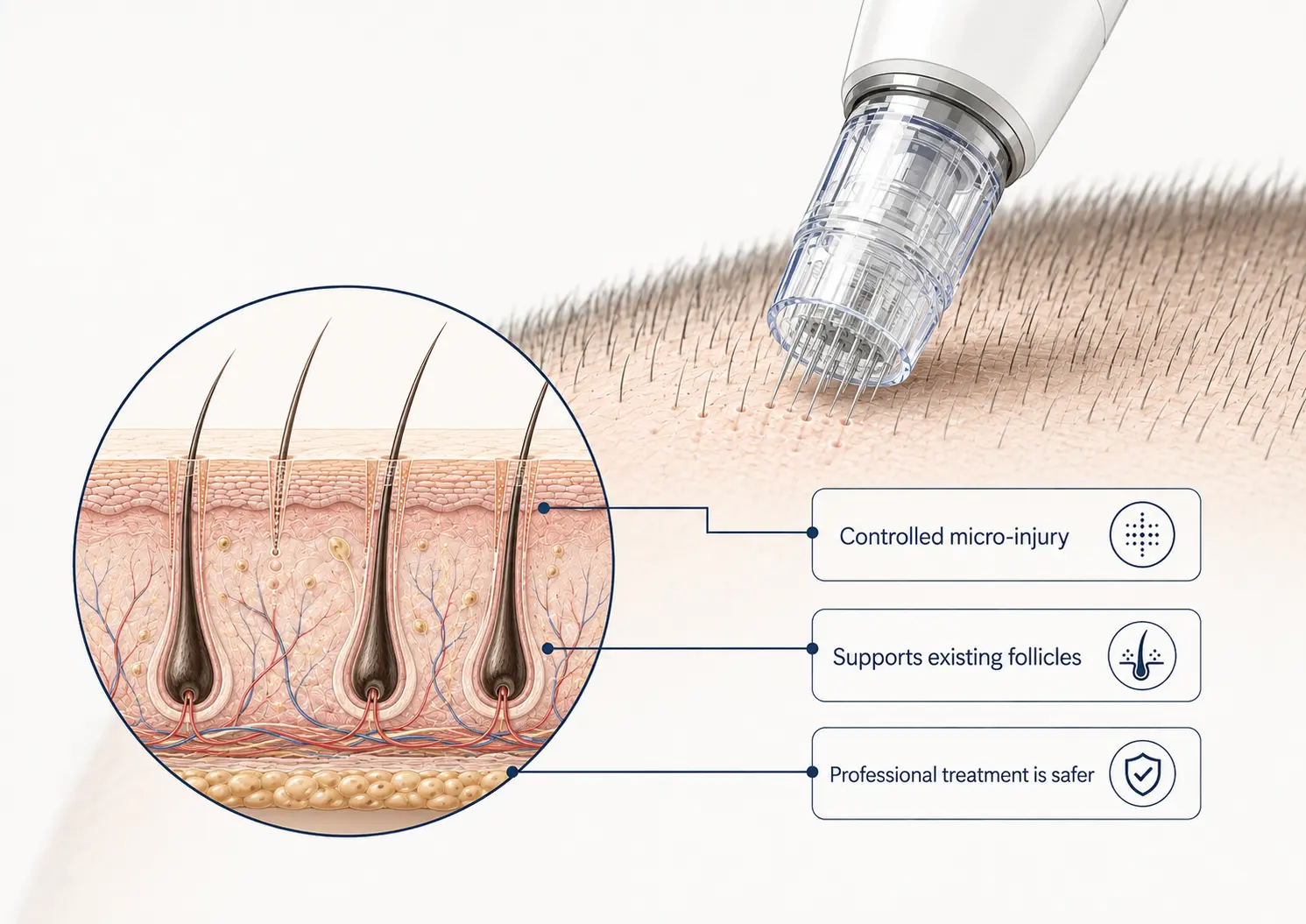
During treatment, multiple fine needles repeatedly enter and leave the skin, creating a pattern of microscopic injuries. These controlled injuries trigger the body's wound-healing response.
The process is usually described in three overlapping stages:
- Injury and inflammation: the small punctures signal that tissue repair is needed.
- Cellular repair: platelets, inflammatory cells and other repair mechanisms become active.
- Remodeling: new collagen and elastin are produced as the treated tissue heals.
This is the basic principle behind using microneedling for skin rejuvenation and certain types of scarring. FDA-authorized microneedling devices have specific indications for improving the appearance of facial acne scars, facial wrinkles and abdominal scars in adults aged 22 and older. The FDA has not authorized a microneedling device for every skin condition, every body area or every combination treatment advertised online.
A 2025 systematic review of facial rejuvenation studies found high overall patient satisfaction and relatively low reported rates of adverse effects. However, the authors also noted substantial variation in treatment schedules and a lack of standardized measures for judging cosmetic improvement. In other words, the results are encouraging, but the research is not as uniform as marketing pages often suggest.
How might microneedling affect hair growth?
The theory is slightly different on the scalp.
Controlled injury may stimulate signaling pathways involved in wound healing, increase the local release of growth factors and affect cells around the hair follicle. Microneedling may also increase the penetration of topical products through the temporary channels created in the skin.
These mechanisms could help some miniaturized follicles produce thicker or more visible hairs.
But there is an important distinction here:
Making existing follicles perform better is not the same as stopping the underlying cause of progressive hair loss.
In androgenetic alopecia, genetically sensitive follicles gradually become smaller under androgen-related influence. Microneedling does not remove that genetic sensitivity, and it should not be treated as a direct replacement for established medical options such as minoxidil or, in appropriate male patients, finasteride. Current reviews continue to place minoxidil and finasteride among the main evidence-based treatments for androgenetic alopecia, with treatment selected according to the individual patient. We cover how these medications fit around surgery in our FAQ.
I prefer to think of scalp microneedling as a possible adjunct — one item inside a long-term hair loss plan, not a treatment that carries the plan on its own.
It may help certain patients improve hair caliber or density. It should not be presented as a treatment that permanently stops male pattern hair loss.
Does microneedling actually regrow hair?
The honest answer is that the evidence is promising but inconsistent.
Several studies have reported better hair-count or hair-density outcomes when microneedling was added to topical minoxidil. A 2024 meta-analysis included 13 randomized trials involving 696 patients and found that combined microneedling treatment could improve outcomes in androgenetic alopecia compared with a single treatment alone.
A separate 2025 systematic review and meta-analysis examined 12 randomized trials involving 631 patients. It also found an improvement in hair count when microneedling was combined with minoxidil. However, there was substantial variation between the studies, and the analysis did not find a clear advantage for depths above 1 mm compared with shallower protocols.
That last point matters.
The internet tends to assume that deeper treatment must be more effective. The available evidence does not show such a simple relationship.
There is also newer research that makes the picture less tidy.
A 2026 randomized trial followed 245 women with mild-to-moderate androgenetic alopecia. The participants used 2% topical minoxidil alone or combined it with microneedling every two or four weeks. After 24 weeks, all groups improved, but microneedling did not provide a significant additional clinical benefit over minoxidil alone.
This does not prove that microneedling never helps.
It tells us that the outcome may depend on the patient, treatment protocol, device, depth, frequency, type of hair loss and medical treatment being used alongside it.
That is less exciting than saying, "Use this roller once a week and regrow your hair."
It is also more accurate.
Why do some studies show strong results while others do not?
Microneedling studies use very different protocols.
Across the literature, researchers have used:
- Rollers, stamps and motorized pens
- Different needle configurations
- Depths ranging from approximately 0.5 to 2.5 mm
- Weekly, fortnightly or monthly sessions
- Different numbers of passes
- Different definitions of the desired treatment endpoint
- Microneedling alone or combined with minoxidil, PRP and other agents
A systematic review of microneedling for hair-loss disorders found wide variation in needle depth, devices and session frequency. It also noted that the overall quality of many studies was limited.
That makes it difficult to give every patient one universal protocol.
We do not yet have a scientifically established answer saying that every man with androgenetic alopecia should use one precise needle depth at one exact interval.
When you see somebody online presenting a single depth and schedule as the proven answer for everybody, that level of certainty is not coming from the research.
Is deeper microneedling better?
Not necessarily.
The purpose of microneedling is to create a controlled injury, not the deepest injury a patient can tolerate.
Going deeper may increase inflammation and reach deeper tissue. It may also increase pain, bleeding, recovery time and the risk of unwanted tissue damage.
The 2025 meta-analysis comparing microneedling plus minoxidil with minoxidil alone did not find that protocols deeper than 1 mm produced significantly better hair-count results than protocols using depths of 1 mm or less.
This does not mean that depth never matters.
It means that "deeper is better" is not a safe conclusion.
The correct depth can vary according to:
- The treatment area
- Skin thickness
- Device design
- Needle configuration
- Scalp condition
- Existing inflammation or scarring
- The intended clinical endpoint
- The experience of the provider
Pressure also matters. A device set to a particular depth does not guarantee that every needle enters the tissue to exactly that depth. Technique, angle and movement can change what actually happens in the skin.
That is one reason copying a protocol from a video is unreliable.
Microneedling and minoxidil
Microneedling is frequently combined with topical minoxidil.
There are two possible reasons for doing this.
First, each treatment may stimulate hair growth through a different mechanism. Second, temporary channels in the skin may increase the penetration of topical products.
However, increased penetration is not automatically an advantage.
Many liquid minoxidil formulations contain alcohol or propylene glycol. Applying them to freshly needled skin may cause significantly more burning and irritation. Disrupting the skin barrier may also change how much of a topical product is absorbed.
The FDA has not authorized microneedling devices for delivering drugs, cosmetic solutions, vitamins, PRP or other substances into the skin. It also states that the risks of combining microneedling devices with products that have not been evaluated for that use are not known.
For that reason, I would not apply minoxidil immediately after an aggressive microneedling session unless this is part of a specific protocol given by the clinician managing the treatment.
"Microneedling helps absorption" should not be interpreted as permission to put any product into freshly injured skin.
Can microneedling be combined with PRP?
It is sometimes combined with platelet-rich plasma, or PRP, with the aim of adding concentrated platelet-derived growth factors to the treatment. The same questions apply to other regenerative options, including Regenera Activa.
Some hair-loss studies have reported improvement when microneedling was used with PRP or other topical growth-factor preparations. However, treatment protocols, PRP preparation methods and outcome measurements differ considerably between studies.
There is also a regulatory point worth understanding.
The FDA has not authorized microneedling devices specifically for delivering PRP or blood products into the skin. This does not mean that every combined treatment is automatically inappropriate. It means the combination should not be described as though the FDA has evaluated and approved it as a standard microneedling indication.
If PRP and microneedling are being considered together, the treatment should be performed within a medically controlled protocol rather than improvised at home.
Does microneedling work for every type of hair loss?
No.
Most of the research concerns androgenetic alopecia — male pattern hair loss and female pattern hair loss.
There are smaller studies involving alopecia areata and other hair-loss conditions, but the evidence is less established and treatment must be based on the diagnosis.
Hair shedding can be caused by many different conditions, including:
- Androgenetic alopecia
- Telogen effluvium
- Alopecia areata
- Nutritional deficiencies
- Thyroid disorders
- Medication-related shedding
- Inflammatory scalp disease
- Scarring alopecia
These conditions are not interchangeable.
A person with active inflammatory or scarring alopecia does not need a stronger dermaroller. They need the correct diagnosis.
Repeatedly needling an inflamed or infected scalp without understanding the underlying condition can make a complicated problem even more complicated.
What are the risks of scalp microneedling?
Microneedling is often described as minimally invasive, which is reasonable.
Minimally invasive does not mean risk-free.
Expected short-term effects may include:
- Redness
- Tenderness
- Burning or stinging
- Itching
- Mild swelling
- Pinpoint bleeding
- Temporary dryness or flaking
The FDA also lists bruising, crusting and discomfort among commonly reported effects. Less common complications include changes in pigmentation, infection, reactivation of herpes and swollen lymph nodes.
A systematic review of microneedling safety found that most reported reactions were temporary. However, persistent complications including post-inflammatory pigmentation, tram-track scarring and granulomatous reactions have been reported. Risk may be greater in people with active infections, darker skin types or metal allergies.
On the scalp, additional practical problems can include:
- Irritation caused by combining treatment with topical products
- Mechanical breakage or tangling of existing hair, particularly with rollers
- Excessive inflammation from repeated or aggressive sessions
- Infection caused by poor cleaning or reused cartridges
- Injury to skin that already has an inflammatory condition
- Scarring after treatment that is too deep or poorly controlled
The greater the injury, the more seriously we should take the recovery and complication risk.
Can repeated microneedling affect a future hair transplant?
This is an area where I am more cautious than many online guides.
During FUE hair transplant surgery, the quality of the recipient tissue matters. We pay attention to bleeding, elasticity, resistance and the way the scalp accepts the recipient sites and grafts.
In some patients with a history of repeated aggressive scalp treatments, the tissue can feel different during surgery. It may be firmer, less elastic or more difficult to work with.
I need to be clear about the limit of this observation:
We do not currently have strong clinical studies proving that previous microneedling causes poor hair-transplant growth. I would not make that claim.
However, repeatedly creating deep injuries in an area that may later need thousands of precisely planned recipient sites does not make sense unless there is a clear reason and a controlled protocol.
A mild, professionally planned treatment is not the same as aggressively rolling the scalp every few days for years.
If you are considering a future hair transplant, tell your surgeon:
- Which device you have used
- The needle depth
- How frequently you used it
- How many years or months you used it
- Whether you experienced prolonged redness, bleeding, crusting or infection
- Which topical products you applied afterwards
The information is more useful than simply saying, "I have done microneedling."
What about microneedling for the skin?
Microneedling has a stronger regulatory and clinical foundation for certain skin indications than it currently has for hair loss.
The FDA has authorized specific devices for improving the appearance of facial acne scars, facial wrinkles and abdominal scars in adults. It has not authorized microneedling devices for every scar, every area of the body or every rejuvenation claim.
Clinical reviews suggest that microneedling can improve facial texture, signs of aging and some atrophic acne scars, with most reported reactions being temporary. However, treatment schedules and outcome measurements remain inconsistent.
Not every scar should be treated in the same way.
The type of scar matters:
- Atrophic scars
- Hypertrophic scars
- Keloid scars
- Surgical scars
- Pigmented marks that are not actually scars
Needling the wrong scar, or treating an area with a tendency toward abnormal scarring, may create a worse problem.
This is another situation in which diagnosis should come before the device.
Microneedling is not the same as RF microneedling
Traditional microneedling creates mechanical punctures.
Radiofrequency microneedling places needles into or under the skin and delivers RF energy, producing controlled heat within the tissue.
These should not be treated as interchangeable procedures.
In October 2025, the FDA issued a safety communication after reports of serious complications associated with certain uses of RF microneedling. Reported problems included burns, scarring, fat loss, disfigurement, nerve damage and cases requiring further medical or surgical treatment. The FDA emphasized that RF microneedling is a medical procedure and should not be performed at home.
RF microneedling may have appropriate uses in experienced hands.
It is not simply ordinary microneedling with an extra feature switched on.
Why I am cautious about at-home microneedling
I understand why people do it.
A home device is inexpensive. Appointments cost money. Treatment looks simple in a thirty-second video.
You roll or stamp the skin, create some redness and wait for improvement.
The problem is that the part you see in the video is not the difficult part.
The difficult part is knowing:
- Whether the diagnosis is correct
- Whether the scalp should be needled at all
- Which device is reliable
- Whether the needles are damaged or contaminated
- How deep the device is actually penetrating
- How much pressure is being applied
- How many passes are appropriate
- Whether treatment is becoming too frequent
- Whether the skin has healed properly
- Which products are safe to apply afterwards
- Whether an early complication is developing
The FDA has not authorized any medical microneedling devices for over-the-counter sale. It also states that it is aware of microneedling devices that are not legally marketed and whose safety and effectiveness have not been reviewed. Microneedling devices have not been FDA-authorized for treating hair loss.
That does not mean every superficial cosmetic roller sold online will cause damage.
It means consumers should not assume that a device is medically evaluated simply because it is available for purchase.
There is also a practical difference between rollers and pens.
A roller enters and leaves the skin along a curved path. It can catch, pull or break existing hairs and may create less controlled entry angles. A stamping or motorized pen moves more vertically, although its safety still depends on the device and operator.
Sterility is another concern.
A cartridge that has entered living skin should not be shared. FDA guidance states that needle cartridges should not be reused between patients and recommends a new cartridge for every patient and every session.
Personally, I do not recommend trying to reproduce medical scalp microneedling at home.
The small amount of money saved is not worth permanent pigmentation, scarring, infection or damage to existing hair.
Who should avoid or postpone microneedling?
Microneedling is not suitable for everyone.
The FDA recommends medical assessment or avoidance in people with several conditions, including:
- Active bacterial, viral or fungal skin infection
- Active rash or herpes outbreak
- Bleeding or clotting disorders
- Anticoagulant treatment
- Uncontrolled diabetes
- Immune deficiency or immunosuppression
- A history of keloid scars
- Certain autoimmune or inflammatory skin diseases
- Allergy to stainless steel or local anesthetic
- Current or recent isotretinoin use
- Pregnancy or breastfeeding
- Active cancer treatment
Individual devices have their own approved indications and contraindications, so the correct advice may vary according to the treatment being considered.
For scalp treatment specifically, I would also postpone microneedling if there is unexplained redness, scaling, pustules, pain or active shedding that has not yet been diagnosed.
Putting needles into an undiagnosed scalp condition is not a treatment plan.
What should you expect from an in-office treatment?
A proper consultation should begin with the diagnosis and treatment goal.
The provider should then select the device, cartridge, depth, treatment area and session interval according to the patient rather than using the same settings for everybody.
During treatment, topical anesthetic may be used. The device is passed over the area in a controlled pattern, with redness and sometimes pinpoint bleeding used as clinical endpoints depending on the protocol.
The number of sessions varies. Most skin-rejuvenation studies use a series rather than one isolated treatment, and hair-loss research has used intervals ranging from weekly to monthly. There is no single schedule supported for every indication.
The clinic should be able to explain:
- Which device is being used
- Why that device is appropriate
- Whether it is authorized for the intended use
- Which cartridge is being used
- Whether the cartridge is new
- How infection control is maintained
- What products will be applied
- What side effects are expected
- Which symptoms require medical review
If these questions are treated as inconvenient, the clinic has already given you useful information.
Aftercare
The skin barrier is temporarily disrupted after treatment.
For that reason, aftercare should be simple.
Follow the protocol provided by the clinician who performed the procedure. In general, avoid applying irritating or unapproved products to freshly treated skin. Retinoids, glycolic acid, alcohol-containing products and some sunscreens or cosmetics may sting while the skin is recovering. The FDA specifically advises patients to ask which skincare products are appropriate because treated skin may temporarily become more sensitive.
Seek medical advice if you develop:
- Increasing pain rather than gradual improvement
- Spreading redness
- Pus or significant crusting
- Fever
- Blisters
- Persistent swelling
- New areas of darkening or lightening
- Redness that does not begin to settle
- Any reaction that feels unusual or severe
Do not simply perform another session to "push through" a bad response.
How I discuss microneedling with hair-loss patients
When a patient asks whether microneedling is worthwhile, I do not begin with the needle depth.
I begin with the diagnosis.
If the patient has androgenetic alopecia, we discuss whether the underlying hair loss is being treated appropriately. Microneedling may then be considered as an additional option rather than the foundation of the entire plan.
If the patient has unexplained shedding, inflammation or a possible scarring condition, I would not recommend starting needling before the cause is understood.
If the patient is likely to need a hair transplant, I also want to know how the scalp has been treated previously. Occasional controlled microneedling is very different from years of frequent, deep and unsupervised injury.
The treatment should solve a real problem.
It should not be performed simply because everybody else online seems to be doing it.
Frequently Asked Questions
Does microneedling regrow hair?
Is microneedling better than minoxidil?
Can microneedling stop male pattern hair loss?
What is the best needle depth for hair loss?
How often should scalp microneedling be performed?
Can I use minoxidil immediately after microneedling?
Is scalp microneedling FDA-approved for hair loss?
Is at-home microneedling safe?
Can microneedling cause scarring?
Can microneedling affect a future hair transplant?
Is RF microneedling safer or more effective?
My final view
Microneedling is not nonsense.
It has credible uses in skin treatment and may help some patients with hair loss.
It is also not the universal answer that social media sometimes makes it appear to be.
The evidence for androgenetic alopecia is encouraging in some studies and disappointing in others. We still do not have one standard device, depth, frequency or combination protocol that can be applied to everybody.
For the right patient, performed with the right device and as part of a sensible treatment plan, microneedling can be useful.
For the wrong diagnosis, performed too deeply, too frequently or with an unregulated home device, it can create an entirely new problem.
If your goal is to preserve your hair, begin by finding out why you are losing it. Then choose the treatment. Not the other way around.
— Dr. Mesut Demir
Not sure whether microneedling fits your case?
Send us your photos and hair loss history. We will start with the diagnosis, tell you honestly whether any treatment is worth adding, and explain what we would do differently.
Request a Case Review- U.S. Food and Drug Administration. Microneedling Devices. fda.gov
- U.S. Food and Drug Administration. Microneedling Devices: Getting to the Point on Benefits, Risks and Safety. fda.gov
- U.S. Food and Drug Administration. Potential Risks with Certain Uses of Radiofrequency Microneedling — Safety Communication. 2025.
- Pei D, et al. Efficacy and safety of combined microneedling therapy for androgenic alopecia: a systematic review and meta-analysis of randomized clinical trials. Journal of Cosmetic Dermatology. 2024. doi:10.1111/jocd.16186
- Ahmed KMA, et al. Evaluating the efficacy and safety of combined microneedling therapy versus topical minoxidil in androgenetic alopecia: a systematic review and meta-analysis. Archives of Dermatological Research. 2025. doi:10.1007/s00403-025-04032-1
- Liu Y, Luo H, Yang S, et al. Microneedle frequency adjunct to 2% minoxidil in female androgenetic alopecia: a randomized controlled trial. Journal of the American Academy of Dermatology. 2026. doi:10.1016/j.jaad.2026.03.123
- Fertig RM, et al. Microneedling and its use in hair loss disorders: a systematic review. Dermatologic Therapy.
- Gowda A, et al. A systematic review examining the potential adverse effects of microneedling. Journal of Clinical and Aesthetic Dermatology. PMID 33584968
- Foppiani JA, et al. Microneedling for facial rejuvenation: a systematic review. Aesthetic Plastic Surgery. 2025. doi:10.1007/s00266-025-04972-z