
Quick answer
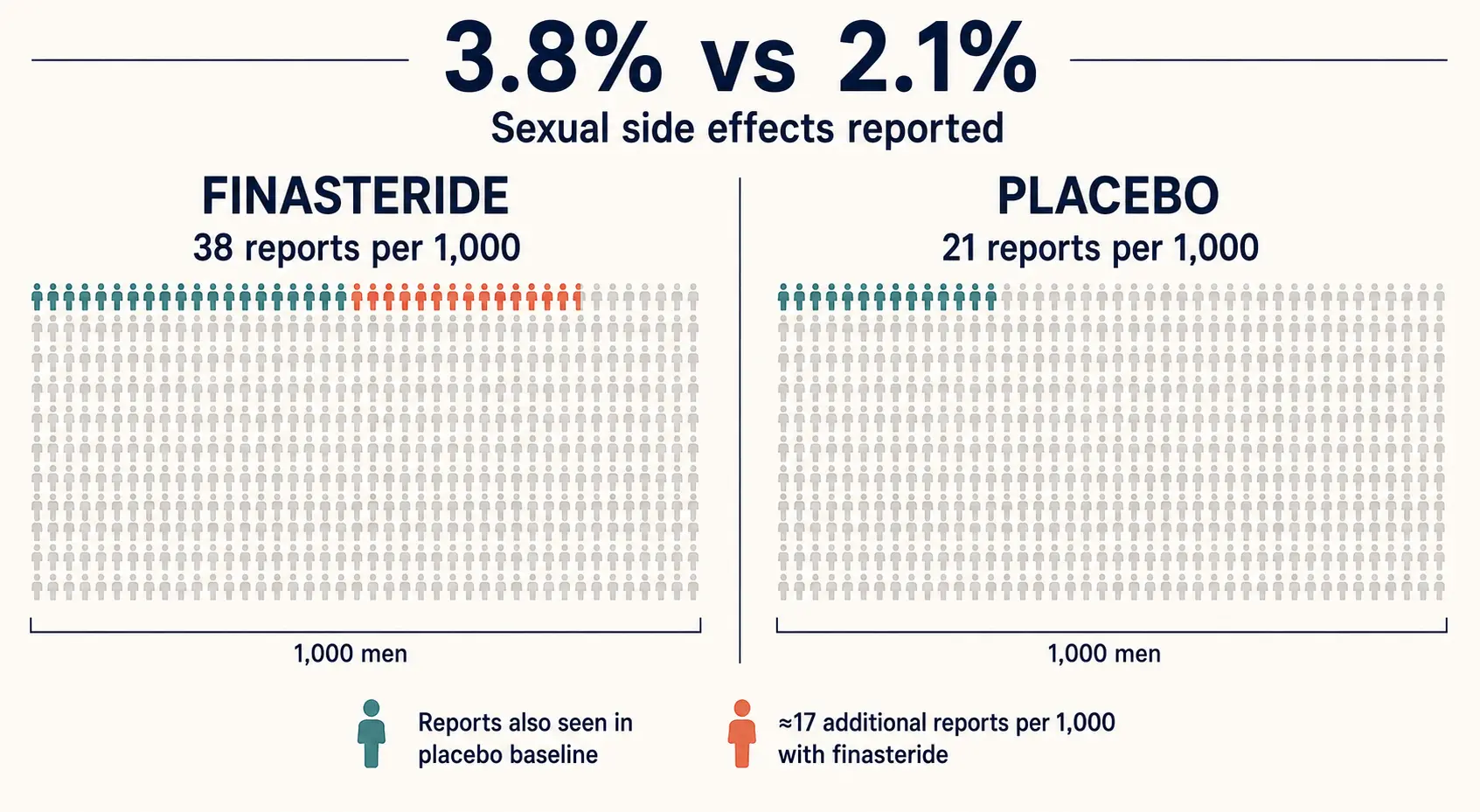
In the finasteride 1 mg trials for hair loss, one or more sexual side effects were reported by 3.8% of men on finasteride and 2.1% on placebo — about 17 extra reports per 1,000 men treated. Symptoms resolved in men who stopped and in most who continued. Persistent symptoms after stopping have been reported post-marketing but cannot be reliably quantified. Lower doses and topical formulations are options for patients who do not tolerate 1 mg.
Spend an evening reading about finasteride online and you come away with two incompatible pictures.
In one, starting the medication is a decision that changed a man's life in ways he never expected. In the other, men have taken it for years, kept most of their hair, and noticed nothing at all.
Both groups exist. Both deserve to be heard. But a collection of individual stories, good or bad, cannot tell us how often something actually happens across thousands of patients.
As a hair transplant doctor, the question I am asked most often is not whether finasteride works. Most patients already accept that it can help preserve hair — I have written separately about how finasteride works and why the standard dose is 1 mg.
What they actually want to know is simpler and more personal.
How likely am I to get a side effect, and what happens to me if I do?
Finasteride is not free of risk. No prescription medication is. But the evidence also does not support the idea that sexual side effects are inevitable, or that they affect anything close to half the men who take it.
So let me go through the numbers honestly, explain why online discussion makes the risk look far larger than it is, and describe what I actually do when a patient does not tolerate — or is too anxious to even begin — the standard dose.
The Short Answer
In the main clinical trials of finasteride 1 mg for male pattern hair loss, one or more treatment-related sexual side effects were reported by 3.8% of men taking finasteride and 2.1% of men taking placebo.
That is a difference of 1.7 percentage points — roughly 17 additional reports for every 1,000 men treated.
The effects most commonly reported were reduced libido, erectile dysfunction, and changes related to ejaculation. Symptoms resolved in the men who stopped treatment because of them, and also in most of the affected men who chose to continue. By the fifth year, the incidence of each newly reported sexual side effect had fallen to 0.3% or less.
None of that makes side effects unimportant. It means the risk is real, but considerably smaller than most patients expect after an evening on the forums.
Why Does Finasteride Cause So Much Anxiety?
There is a structural problem with using forums to estimate medical risk.
A man who takes finasteride, feels completely normal, and gets on with his life does not write a detailed post about it. A man who is frightened, or who is genuinely experiencing a problem, is highly motivated to write about it and to search for others in the same position.
So negative experiences become loud and visible, while the much larger group of uneventful ones stays silent. Reading twenty alarming posts tells you a great deal about those twenty men and almost nothing about your own odds.
Expectation also affects how symptoms get noticed and reported.
In one study of men taking finasteride 5 mg for an enlarged prostate, 43.6% of those who had been specifically counseled about sexual side effects reported at least one, compared with 15.3% of men given the same medication without that detailed warning.
That study used an older population and a 5 mg dose, not the 1 mg dose used for hair loss, so the percentages should not be transferred directly onto a younger hair-loss patient. What it does demonstrate is that expectation shapes reporting. This is the nocebo effect.
I want to be careful here, because this argument gets misused. It does not mean finasteride side effects are imaginary, and it is not a reason to wave away what a patient tells me. It means that fear, close self-monitoring, and expectation can change how strongly someone notices or interprets the ordinary variation in their own sexual function.
The answer is not to hide side effects from patients. It is to describe them accurately, without making a man feel that a problem is practically guaranteed.
A Short Reminder of What Finasteride Does
Male pattern hair loss is driven partly by how sensitive genetically vulnerable follicles are to dihydrotestosterone, better known as DHT.
Over time, DHT contributes to the miniaturization of those follicles. The shaft gets thinner, the growth phase gets shorter, and each new hair may come through weaker than the one before it. Eventually hairs that once gave real coverage become fine enough that the scalp shows through.
Finasteride inhibits type II 5-alpha reductase, one of the enzymes that converts testosterone into DHT. Lowering DHT slows that miniaturization process. The same logic explains why testosterone therapy and anabolic steroids can accelerate loss in susceptible men.
A second drug in the same class, dutasteride, blocks both forms of that enzyme and suppresses considerably more DHT. Whether stronger suppression also means more side effects is a fair question, and I have gone through how dutasteride and finasteride compare on both efficacy and tolerability separately.
Its greatest value is often not dramatic regrowth. For many patients the real success is keeping hair that would otherwise have thinned steadily over the next five or ten years. Finasteride does not usually recreate follicles in an area that has been bald for years — it works best on hair that is still there but getting weaker.
That is why I describe it primarily as a hair-preservation treatment.
Does It Actually Work?
Finasteride 1 mg has some of the strongest long-term evidence available in this field.
Across two major trials involving 1,553 men, it significantly improved hair counts and slowed further loss compared with placebo. The gap between the groups widened over time, largely because the placebo group kept losing hair.
The five-year data show what preservation really looks like. On independent photographic assessment, the finasteride group divided roughly into:
- 48% with visible improvement from baseline
- 42% holding their appearance with no further visible progression
- 10% with visible loss compared with baseline
In the placebo group over the same five years:
- 6% showed improvement
- 19% remained stable
- 75% had visible hair loss
Hair-count assessment found further loss in all remaining placebo patients at five years, compared with 35% of the finasteride group.
Not every man on finasteride grows noticeably more hair. Some do. Many mainly hold what they have. From a long-term restoration standpoint, that second outcome is worth more than patients tend to assume.
Why This Matters Specifically Before a Hair Transplant
A hair transplant moves follicles from the donor area into an area that has lost hair. It does not stop the condition progressing in everything it leaves behind.
Transplanted follicles are generally more resistant to DHT. The patient's own hairs around and behind them frequently are not.
Picture a man with a well-executed frontal transplant who still has reasonable native hair through the mid-scalp. The transplanted hairline keeps growing. The native hair behind it keeps thinning. Three or four years later there is a visible line between the two — dense in front, sparse behind.
The operation did not fail. The untreated hair loss simply continued around it.
Donor hair is finite, and we cannot keep chasing every natural hair that disappears with another procedure. For the right patient, protecting existing hair is as much a part of the plan as the graft number or where the hairline is placed.
In a randomized, double-blind study of 79 hair transplant patients, men given finasteride 1 mg from four weeks before surgery until 48 weeks afterwards showed better growth and density in the non-transplanted hair surrounding the procedure than men on placebo.
This matters most in younger patients, in patients with active miniaturization, and in patients whose donor area has to last them decades.
How Common Are the Sexual Side Effects?
The 1 mg trials are the right starting point, because they compared the medication against placebo under controlled conditions. Reported rates, finasteride versus placebo:
- Reduced libido — 1.8% vs 1.3%
- Erectile dysfunction — 1.3% vs 0.7%
- Ejaculation disorder — 1.2% vs 0.7%
- Reduced ejaculate volume — 0.8% vs 0.4%
- One or more sexual side effects — 3.8% vs 2.1%
- Discontinued because of sexual effects — 1.2% vs 0.9%
Taken together, the difference between finasteride and placebo was statistically significant.
Two honest conclusions follow. Finasteride can cause sexual side effects, and telling patients otherwise would be dishonest. And the overwhelming majority of men in these trials did not report any.
The figure is not 30%, or 50%, or 80%. It is 3.8% — and more than half of that rate also showed up in men taking a sugar pill.
Why Did the Placebo Group Report Symptoms Too?
Because libido and erectile function answer to far more than DHT. They shift with:
- Poor sleep
- Work or relationship stress
- Anxiety
- Smoking and alcohol
- Weight gain and reduced physical activity
- Hormonal changes
- Circulatory health
- Other medications
- The fear of developing a sexual problem in the first place
Sexual function also varies on its own. No man has identical libido and erection quality every day of his life.
Which is why not every change that happens during treatment belongs to the treatment. But "it could be something else" must never become a way of dismissing what a patient is describing. The useful approach is to look at timing, consistency, the man's own baseline, his other medications, and what else has changed in his health.
When Do Side Effects Usually Start?
In my experience, when a patient develops a clear side effect he usually notices it within the first weeks or months. He will tell me his libido feels consistently lower, his erections are less reliable, or his ejaculate volume has changed noticeably.
These reports are rarely vague. A man who is genuinely experiencing a change can normally describe exactly how it differs from his own normal.
There is no cut-off after which side effects become impossible, though. A patient can take finasteride uneventfully for years and then notice something.
When that happens, everything else that changed over the same period deserves a look — age, weight, stress, sleep, smoking, cardiovascular health, hormone levels, other prescriptions. Timing can suggest a connection. Timing alone does not prove one.
Do the Side Effects Go Away?
In the controlled trials, sexual side effects resolved in the men who stopped finasteride because of them, and also in most affected men who decided to keep taking it. The incidence of each newly reported sexual side effect fell to no more than 0.3% by the fifth year.
So some patients do appear to adapt. I would still not tell a man to simply push through a significant, persistent symptom and hope. My preference is to talk about it openly and decide together whether to pause, lower the dose, or change the formulation.
Sexual symptoms persisting after finasteride is discontinued have also been reported in post-marketing use. Those reports come from a population of uncertain size, which means they cannot tell us reliably how often this happens, or confirm that finasteride caused it in every case.
The sensible position sits between the two extremes. We should not dismiss men who report persistent symptoms. We also should not present something we genuinely cannot quantify as the expected outcome of treatment.
What I Do When a Patient Is Worried, or Reports a Problem
The first step is to listen rather than argue.
We go through what changed, when it started, whether it is consistent, what else changed at the same time, which dose and formulation he is using, and whether other medication or health factors could be involved.
If he has already started and the change is meaningful, we may stop finasteride temporarily and wait for him to return to his own baseline. After that, the conversation becomes individual.
Some men do not want to restart, and that decision is theirs to make. Others still want to protect their hair but would prefer less exposure.
Then there is a third group that gets discussed far less: men who have had no side effect at all, but are so anxious about the standard dose that they will probably never start, or never stay consistent.
A patient I saw recently was in exactly that position. He wanted to slow his ongoing loss but was genuinely uneasy about 1 mg. Rather than pushing a plan he was not comfortable with, we agreed to begin at 0.5 mg and monitor both his hair and how he felt. He has tolerated it well so far — and, just as importantly, he feels comfortable enough to keep taking it.
That last part sounds like a small detail. It is not.
A theoretically perfect dose is worth very little if the patient is too anxious to actually take it.
Cases like his are why I do not treat this as a binary choice between 1 mg every day and nothing at all. For some men a lower dose is a sensible starting point. For others it becomes the option after a problem develops on the standard dose. The aim is the lowest effective dose a patient can tolerate and realistically continue.
Is 1 mg the Only Dose That Works?
No. It is the standard and best-studied dose, but the dose-ranging work shows lower doses remain biologically and clinically active.
Trials compared 0.01 mg, 0.2 mg, 1 mg and 5 mg daily. Measurable hair benefit appeared at 0.2 mg and above. The 1 mg and 5 mg doses produced similar results and were more consistently effective than the lower ones, which is why 1 mg became the standard.
A separate study in Japanese men compared 0.2 mg, 1 mg and placebo over 48 weeks. Photographic improvement was seen in 54% of the 0.2 mg group and 58% of the 1 mg group, against 6% on placebo.
The 1 mg result was numerically better. But 0.2 mg was clearly doing something.
None of this proves 0.2 mg and 1 mg give identical results over a decade. What it shows is that the dose-response relationship is not a straight line. Half the dose does not mean half the hair benefit — and it does not automatically mean half the side-effect risk either.
Can 0.5 mg Still Protect Hair?
There is less long-term trial data for exactly 0.5 mg than for 1 mg. But the dose-ranging evidence suggests 0.5 mg still produces meaningful DHT suppression and hair preservation.
In practice I may consider 0.5 mg daily for a patient who:
- Developed a possible side effect on 1 mg
- Is highly anxious about starting at the full dose
- Wants to find the lowest dose he can tolerate
- Is realistically unlikely to stay consistent on 1 mg
For a man who feels entirely normal on 1 mg, there is often no reason to change anything. The standard dose carries the strongest long-term evidence and I do not reduce it for the sake of it.
But for a patient who cannot tolerate 1 mg, or will not continue it, the real comparison is not between 0.5 mg and some ideal. It is between 0.5 mg and nothing. A tolerable lower dose beats a standard dose he keeps abandoning.
What About 0.25 mg or Every-Other-Day Dosing?
Doses around 0.2 to 0.25 mg remain biologically active and have shown measurable effects on hair and on DHT. In one pharmacodynamic assessment, serum DHT fell by 68.6% on 0.2 mg daily compared with 71.4% on 1 mg — designed to examine DHT suppression rather than prove equivalent long-term hair outcomes, but it illustrates why small doses can still have a substantial biological effect.
Some doctors also use alternate-day or reduced-frequency schedules when daily treatment is not well tolerated. Possible approaches include 0.5 mg daily, 0.25 mg daily, 1 mg every other day, or 0.5 mg every other day.
These are individualized, generally off-label strategies without the depth of evidence behind 1 mg daily, so I do not present them as universally equivalent. They are options for selected patients who would otherwise stop treatment altogether.
Response should be judged with consistent photographs and examination of miniaturization over several months. Counting hairs in the shower drain each morning reliably produces anxiety and very little information.
Does a Lower Dose Mean Lower Risk?
Possibly. Not automatically.
Reducing the dose does improve tolerability for some men, and I have seen patients who felt uncomfortable on 1 mg and completely normal after reducing it.
But lower oral doses still suppress DHT substantially. Halving the tablet does not mathematically halve the risk. Some patients improve after a dose reduction, some notice no difference, and some would rather not continue oral finasteride at all.
Which is why the dose should follow the individual patient's response, not a formula copied off a forum.
Is Topical Finasteride Safer?
Topical finasteride is designed to deliver the medication to the scalp while reducing how much reaches the bloodstream.
In a Phase III study of 458 patients, topical finasteride significantly improved hair count compared with placebo, with a hair-count effect at 24 weeks numerically similar to oral finasteride. Maximum plasma finasteride levels were more than 100 times lower with the topical formulation, and average serum DHT fell by 34.5% with topical against 55.6% with oral.
That makes it a reasonable option for patients who want lower systemic exposure.
Topical does not mean non-systemic, though. How much is absorbed depends on the concentration, the amount applied, the size of the treated area, how often it is used, the vehicle in the formulation, and the condition of the scalp barrier.
A strong solution applied generously can deliver considerably more systemic exposure than a measured, standardized spray. Which is why "I use topical finasteride" tells me almost nothing on its own — I need to know the concentration and the actual dose going onto the scalp.
It may lower the likelihood of systemic sexual side effects. It should not be described as risk-free.
Should Every Hair Transplant Patient Take It?
No. No medication is automatically right for everyone.
Finasteride is most valuable when a patient still has a meaningful amount of natural hair that is vulnerable to further miniaturization. That tends to mean:
- Younger patients with active hair loss
- Patients with thinning behind the planned transplant area
- Patients with diffuse miniaturization
- Patients whose donor supply needs careful protection
- Patients who want to reduce the odds of repeated operations
Some patients do not tolerate finasteride, and some simply do not want it. A hair transplant may still be entirely possible — but the surgical plan then has to assume future loss will continue. In practice that means a more conservative hairline, careful protection of the donor area, and refusing to build a design that depends on today's native density lasting forever.
The patient should understand that plan before the operation, not several years later when the hair behind the transplant starts to go.
My View as a Hair Transplant Doctor
Finasteride is neither a harmless vitamin nor the disaster it can look like online. It is an effective prescription medication with a small but genuine risk of sexual side effects.
Most men on 1 mg report no problem. When a patient does experience a real change, dismissing it is not an acceptable response — and neither is assuming every form of finasteride must be abandoned permanently on the spot.
Depending on the man in front of me, we might pause treatment, restart lower, begin lower when anxiety would otherwise prevent treatment entirely, reduce the frequency, move to a properly measured topical formulation, or drop finasteride and plan around that instead.
What matters is landing on something he can tolerate and will actually continue.
In hair restoration, keeping good natural hair is almost always easier and more convincing than trying to rebuild it later with more surgery.
Finasteride should not be taken blindly. It also should not be rejected on fear alone. The right decision comes from honest numbers, realistic expectations, and a plan built around the individual rather than copied from somebody else.
Frequently Asked Questions
How common are finasteride side effects?
What are the most common sexual side effects of finasteride?
Do finasteride side effects go away?
Is finasteride dangerous?
Is 0.5 mg finasteride effective?
Can I take finasteride every other day?
Is topical finasteride free from sexual side effects?
Do I need finasteride after a hair transplant?
How long does finasteride take to work?
— Dr. Mesut Demir
Unsure whether finasteride is right for you?
Tell us your pattern, your age and what concerns you about treatment. We will give you an honest assessment of whether medical treatment, surgery, or both make sense — including when the answer is neither.
Request a Free Analysis- DailyMed. Finasteride Tablets, Full Prescribing Information. U.S. National Library of Medicine. dailymed.nlm.nih.gov
- Kaufman KD, Olsen EA, Whiting D, et al. Finasteride in the treatment of men with androgenetic alopecia. Journal of the American Academy of Dermatology. 1998. doi:10.1016/s0190-9622(98)70007-6
- Finasteride Male Pattern Hair Loss Study Group. Long-term (5-year) multinational experience with finasteride 1 mg in the treatment of men with androgenetic alopecia. European Journal of Dermatology. 2002. PMID 11809594
- Mondaini N, Gontero P, Giubilei G, et al. Finasteride 5 mg and sexual side effects: how many of these are related to a nocebo phenomenon? The Journal of Sexual Medicine. 2007. doi:10.1111/j.1743-6109.2007.00563.x
- Roberts JL, Fiedler V, Imperato-McGinley J, et al. Clinical dose ranging studies with finasteride, a type 2 5α-reductase inhibitor, in men with male pattern hair loss. Journal of the American Academy of Dermatology. 1999. PMID 10495375
- Kawashima M, Hayashi N, Igarashi A, et al. Finasteride in the treatment of Japanese men with male pattern hair loss. European Journal of Dermatology. 2004. PMID 15319158
- Piraccini BM, Blume-Peytavi U, Scarci F, et al. Efficacy and safety of topical finasteride spray solution for male androgenetic alopecia: a phase III, randomized, controlled clinical trial. Journal of the European Academy of Dermatology and Venereology. 2022. doi:10.1111/jdv.17738
- Leavitt M, Perez-Meza D, Rao NA, Barusco M, Kaufman KD, Ziering C. Effects of finasteride (1 mg) on hair transplant. Dermatologic Surgery. 2005. doi:10.1111/j.1524-4725.2005.31202