
Quick answer
Dutasteride inhibits both type I and type II 5-alpha-reductase and lowers serum DHT by more than 90%, against roughly 65–70% for finasteride 1 mg, and head-to-head trials show greater average gains in hair count. Dr. Mesut Demir still starts most suitable male patients on finasteride, which has the larger long-term evidence base and is far easier to adjust, and escalates to dutasteride when hair loss keeps progressing despite adequate, well-tolerated finasteride treatment. Dutasteride is used off-label for hair loss in the United States and has a terminal half-life of about five weeks.
If you look only at the numbers, dutasteride is the obvious winner.
It blocks more DHT. In head-to-head trials it has produced larger increases in hair count than finasteride. And in men who keep losing ground despite finasteride, switching to dutasteride can make a genuine difference.
So why don't I simply start every male hair loss patient on dutasteride?
Because treating hair loss is not a competition to see who can suppress the most DHT.
The goal is to use enough treatment to control the progression of androgenetic alopecia — not a stronger medication than the patient actually needs.
That distinction shapes most of what follows. In my practice, finasteride is still usually where I start, and dutasteride is the medication I reach for when I have a reason to go further.
Let me explain why.
First, What Does Dutasteride Actually Do?
Both finasteride and dutasteride are 5-alpha-reductase inhibitors.
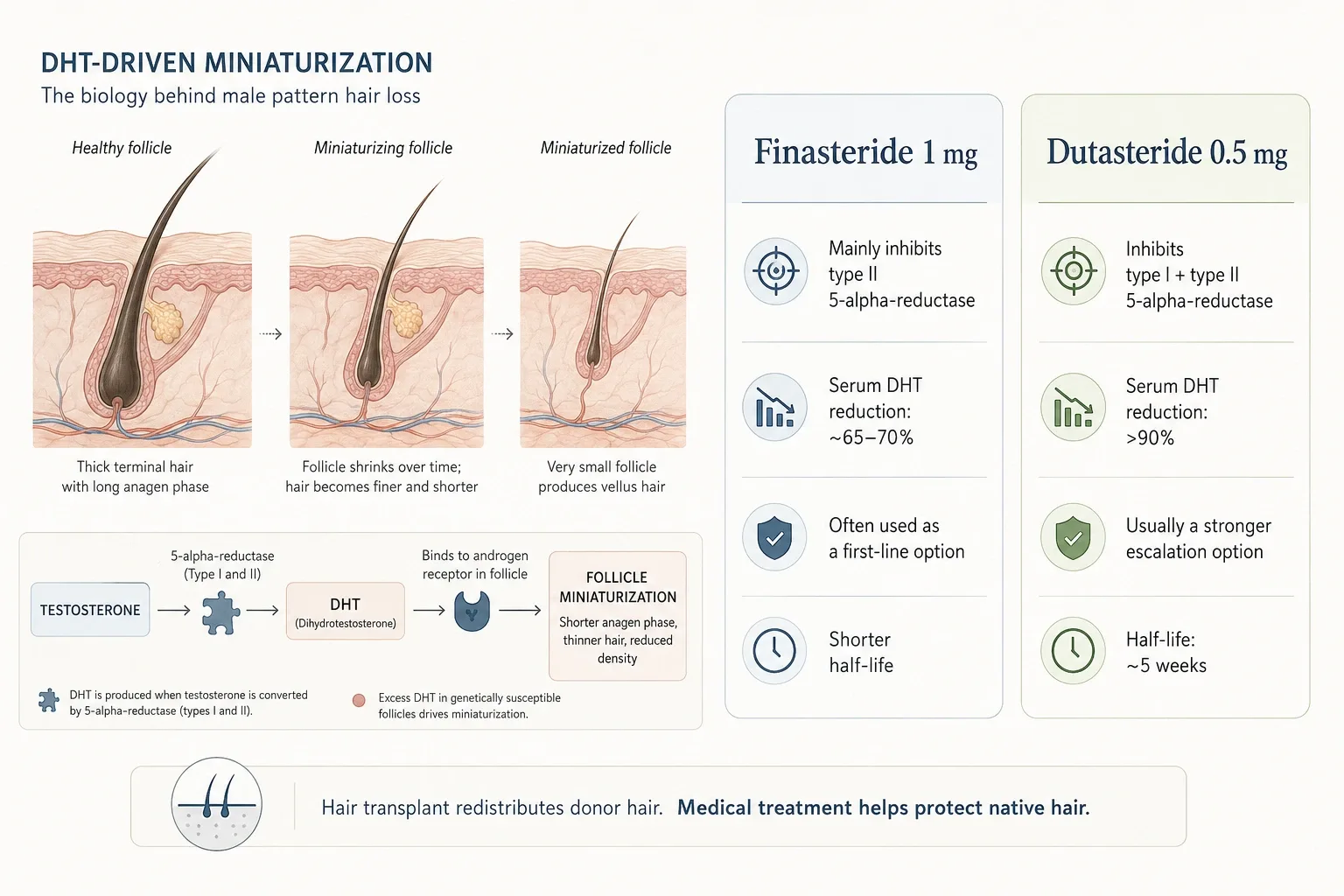
5-alpha-reductase is the enzyme that converts testosterone into dihydrotestosterone, or DHT. In men who are genetically susceptible to androgenetic alopecia, DHT gradually pushes vulnerable follicles into miniaturization. The hairs become finer. The growth phase becomes shorter. Eventually some follicles produce hairs that are barely visible at all. I have gone through that process in more detail in how finasteride works and why 1 mg is the standard dose.
Finasteride and dutasteride intervene in the same pathway. They do not do it with the same force.
Finasteride mainly inhibits type II 5-alpha-reductase, and a 1 mg oral dose reduces circulating DHT by roughly 65 to 70%. Dutasteride inhibits both type I and type II, and 0.5 mg daily reduces serum DHT by more than 90%. Its prescribing information reports a median reduction of about 90% after two weeks, and around 94% after a year of treatment.
That is a substantial difference. It is also where most of the internet stops reading.
Is Dutasteride Actually More Effective Than Finasteride?
On average, yes. This is one of the rare hair loss questions where the evidence points in a fairly consistent direction.
The most useful trial randomized 917 men with androgenetic alopecia to several doses of dutasteride, to finasteride 1 mg, or to placebo, and followed them for 24 weeks. Dutasteride 0.5 mg produced significantly greater improvements than finasteride 1 mg in target-area hair count, in hair width, and in panel assessment of frontal photographs.
That does not mean every man on dutasteride will visibly outperform every man on finasteride. Biology refuses to behave that neatly. But across groups of patients, dutasteride has the advantage.
A meta-analysis comparing the two drugs reached the same conclusion, with dutasteride performing better on total hair count and on photographic assessment of both the frontal area and the vertex. A 2024 systematic review of nine studies found it again: dutasteride 0.5 mg increased hair counts more than finasteride 1 mg.
So when a patient asks me which drug is stronger, the answer is short. Dutasteride. When he asks which drug he should start with, my answer is usually different.
Why I Still Usually Start With Finasteride
Finasteride has one advantage that is easy to overlook: we have an enormous amount of experience with it.
Oral finasteride 1 mg is FDA-approved for male androgenetic alopecia in the United States and has been studied for decades, with long-term trials showing continued benefit over five years in men who respond to it. Dutasteride is FDA-approved in the United States for benign prostatic hyperplasia, not for hair loss. It is approved for male pattern hair loss in several countries, including Japan and South Korea, and it is widely used off-label for hair loss elsewhere — but the evidence base behind it is still the smaller of the two.
More importantly for me, starting with finasteride leaves somewhere to go.
If a patient stabilizes perfectly on finasteride, I have achieved what I wanted. There is no prize for reducing his DHT another twenty or thirty percent.
If a smaller key already opens the door, I don't need to arrive with a hammer.
What This Looks Like in My Patients
A fairly common situation in our clinic goes like this.
A patient comes in with progressive androgenetic alopecia. He still has a reasonable amount of native hair, but there is clear miniaturization through the frontal area and mid-scalp. We start medical treatment. He takes finasteride consistently and tolerates it well.
Then we follow him. Not for two weeks. Not for a month. Hair grows far too slowly for that kind of impatience.
We compare standardized photographs, look at the pattern of miniaturization, and ask the only question that really matters at that stage: has the hair loss actually stabilized?
In most men I treat, finasteride is enough to control the progression. But some patients tolerate it perfectly and still keep losing ground. That is the situation in which dutasteride becomes much more interesting.
If I have confirmed that a patient is taking the medication properly, has given it enough time, and is still showing meaningful progression, I may switch him from finasteride to oral dutasteride.
Something I have found reassuring is that men who were already tolerating finasteride well have generally also tolerated that transition well. I have not seen patients suddenly develop an entirely new pattern of side effects simply because we escalated treatment. That is my own clinical experience, though, not a guarantee — and it is not what every study reports, which brings us to the next question.
Are Dutasteride Side Effects Worse Than Finasteride Side Effects?
This deserves a more careful answer than it usually gets online.
Dutasteride suppresses DHT more strongly and stays in the body far longer, so it is reasonable to be more cautious with it. But the claim that it simply causes twice as many side effects is not what the hair loss trials show.
In the 917-patient comparison, the number and severity of adverse events were similar across the treatment groups. The 2024 systematic review also found no significant difference in overall adverse events between the two drugs.
A separate meta-analysis of 15 randomized trials looked specifically at sexual adverse effects and did find an increased risk with 5-alpha-reductase inhibitors as a class — a 1.57-fold risk overall. Broken down by drug, the increase was statistically significant for finasteride and not statistically significant for dutasteride. I would not read that as proof that dutasteride is the gentler of the two. The dutasteride estimate rested on far fewer trials, so it is mostly a reflection of how much less we have studied it.
Individual studies are less comfortable reading in places. In the trial of men switched to dutasteride after an inadequate response to finasteride, transient sexual dysfunction was reported by six of the thirty-five patients.
So I do not tell patients that dutasteride is dangerous and finasteride is safe. That would be nonsense. Both are prescription medications, both can cause adverse effects, and I have written separately about how common finasteride side effects really are in the controlled trials. What I weigh instead is how much medication this particular patient actually needs.
And there is one more practical difference that matters a great deal.
Dutasteride Stays in Your Body Much Longer
Dutasteride has a terminal half-life of approximately five weeks at steady state.
Not five hours. Not five days. Five weeks.
According to the prescribing information, dutasteride can remain detectable in serum for four to six months after treatment is stopped. Finasteride, for comparison, has a plasma half-life measured in hours.
That long half-life probably contributes to how consistently dutasteride suppresses DHT. But it cuts both ways. If we want to change course — because of tolerability, because the patient's circumstances change, or for any other clinical reason — dutasteride does not leave quickly. Finasteride is far easier to adjust.
That flexibility is another reason I like starting conservatively.
When Do I Consider Switching From Finasteride to Dutasteride?
Not because a patient has taken finasteride for six weeks and thinks his crown looked better under different bathroom lighting last Tuesday.
Hair loss treatment requires patience and objective follow-up. I consider dutasteride when there is convincing evidence that androgenetic alopecia is still progressing despite adequate treatment with finasteride, particularly in a man who has tolerated finasteride without significant problems.
There is clinical evidence behind that strategy. In a study of men who had not improved adequately after at least six months of finasteride, patients were switched to dutasteride 0.5 mg daily. Among those who completed treatment, 77.4% were rated as improved on global photography after six months, with measurable gains in hair density and thickness.
It was a small study, so I would not turn 77.4% into a promise. But it matches what we see in the clinic: a man can respond poorly to finasteride and still gain from stronger 5-alpha-reductase inhibition.
Does Dutasteride Regrow Hair, or Only Stop Hair Loss?
Both drugs are primarily medications for controlling the underlying progression of androgenetic alopecia. That is how I want patients to think about them.
Regrowth does happen. Miniaturized hairs can thicken, hair counts can increase, and an area that looked thin can look noticeably fuller. What neither medication can reliably do is resurrect follicles that have been severely miniaturized, or effectively lost, for years.
This is where expectations matter. A man with early diffuse miniaturization may get a meaningful cosmetic improvement from medical treatment alone. A man with a completely bald frontal zone should not expect dutasteride to rebuild a teenage hairline.
No tablet is that talented.
Medical treatment protects what we have. A hair transplant redistributes what we have. They solve different parts of the problem.
Why Medication Still Matters After a Hair Transplant
I spend a surprising amount of time explaining this one.
A patient comes in for a hair transplant and asks the obvious question: if you are going to transplant the hair anyway, why do I still need finasteride or dutasteride?
Because a hair transplant does not stop androgenetic alopecia.
We are taking a limited supply of donor follicles and moving them into areas where more density is needed. That supply is not infinite. Once a graft has been harvested, I cannot put another one back in its place next year.
So my job when planning surgery is not simply to fill every empty millimeter I can see today. I have to think about what this scalp may look like in five, ten or fifteen years. If the native hair around a transplant keeps miniaturizing, the patient ends up with transplanted hairs sitting inside an increasingly thin scalp. That is exactly what we are trying to avoid.
For suitable patients, medication and surgery are therefore not competing options. Medication helps preserve the native hair, and surgery uses the donor supply strategically to restore density where medication cannot.
At Pure Line, this long-term stability is something I consider before deciding how aggressive to be with a hairline, or how many grafts it makes sense to use. A beautiful result at month twelve is not enough. The plan has to still make sense years later.
What About Dutasteride 0.2 mg Instead of 0.5 mg?
This has become genuinely interesting.
A 2025 randomized Phase III study run across eleven centers in Korea evaluated dutasteride 0.2 mg daily in men with androgenetic alopecia. After 24 weeks, 139 men were analyzed. The 0.2 mg group showed significantly greater improvement than placebo on investigator assessment and on independent panel review — and on every efficacy endpoint measured, 0.2 mg performed as well as 0.5 mg. Adverse events in the 0.2 mg group did not differ significantly from placebo.
It raises a question worth asking: could we eventually identify a dose that gives some patients most of the hair benefit with less systemic drug exposure?
Possibly. But I would not redesign clinical practice around a single 24-week trial of 139 men. We need more data and longer follow-up.
Still, this is exactly the sort of research worth watching, because the future of hair loss treatment may not be about finding stronger drugs. It may be about using the ones we already have more intelligently.
What About Topical Dutasteride?
This area is moving quickly.
Historically I have been cautious about topical and injected dutasteride, because the evidence was much weaker than the evidence behind oral treatment. That is beginning to change, although we are not at the finish line yet.
A study published in June 2026 tested FOL100, a 0.05% topical dutasteride lotion designed to deliver the drug into the follicle while minimizing systemic exposure. Sixty-six men used it once daily for 24 weeks, alongside a small comparison group of thirteen men taking oral finasteride 1 mg. Serum dutasteride was undetectable in the topical group at every timepoint, systemic DHT suppression was minimal, and global assessments by both investigators and patients indicated stabilization or improvement in most participants.
That sounds exciting. It is exciting. But it was an early-phase, open-label study rather than a large randomized Phase III efficacy trial.
So my reading is not that topical dutasteride has solved hair loss. My reading is that this is one of the more interesting areas to watch, much like clascoterone, the topical androgen receptor blocker now finishing its Phase 3 program. If controlled studies reproduce these results, targeted topical delivery could become genuinely useful for patients in whom we want strong activity around the follicle with less systemic exposure.
For now, oral dutasteride has far stronger clinical evidence behind it.
Dutasteride vs Finasteride: My Practical Comparison
| Finasteride | Dutasteride | |
|---|---|---|
| Typical oral dose for male hair loss | 1 mg daily | 0.5 mg daily |
| Enzyme inhibited | Mainly type II 5-alpha-reductase | Type I and type II |
| Serum DHT suppression | Around 65–70% | More than 90% |
| Evidence in male pattern hair loss | Extensive, including five-year data | Strong, but a smaller evidence base |
| FDA-approved for hair loss in the US | Yes | No — used off-label (approved for hair loss in Japan and South Korea) |
| Average hair-growth efficacy | Very good | Generally greater in head-to-head trials |
| Half-life | Hours in plasma | About five weeks; detectable four to six months after stopping |
| My usual role for it | First-line option | Escalation when appropriate |
If you want the shortest possible version: finasteride is usually my starting point, and dutasteride is usually my stronger second step.
So, Is Dutasteride Better Than Finasteride?
If "better" means stronger DHT suppression and greater average hair-growth efficacy, then yes. Dutasteride wins.
But medicine is rarely about choosing the strongest available treatment. For a man whose hair loss is well controlled on finasteride, switching to dutasteride solves a problem he does not have. For another man who keeps miniaturizing despite taking finasteride faithfully, dutasteride may be exactly the escalation he needs.
That is why I do not treat a medication name. I treat the pattern of hair loss in front of me, and the questions I am actually asking are these:
- How old is the patient?
- How aggressive is the miniaturization?
- How much native hair is still worth protecting?
- Is the donor area strong enough for surgery?
- Has treatment actually stabilized the loss?
- What will this scalp probably look like in ten years?
Those matter far more to me than which tablet suppresses the largest percentage of DHT.
Sometimes the answer is finasteride. Sometimes it is dutasteride. And sometimes medication needs to be combined with a carefully planned hair transplant.
The right answer depends on the patient, not on the league table.
Frequently Asked Questions
Is dutasteride stronger than finasteride for hair loss?
Is dutasteride better than finasteride for hair growth?
Should I start with finasteride or dutasteride?
How long should I try finasteride before considering dutasteride?
Can I switch from finasteride to dutasteride?
How long does dutasteride stay in your system?
Does dutasteride cause more side effects than finasteride?
Is 0.5 mg of dutasteride enough for hair loss?
Do I still need finasteride or dutasteride after a hair transplant?
— Dr. Mesut Demir
Not sure which treatment your hair loss actually needs?
Send us your photos, your age and what you have already tried. We will tell you honestly whether medical treatment alone is likely to hold your hair, whether surgery is worth considering, and when the right answer is simply to wait.
Request a Case Review- DailyMed. AVODART (dutasteride) soft gelatin capsules, Full Prescribing Information. U.S. National Library of Medicine. Serum DHT suppression and approximately five-week terminal half-life. dailymed.nlm.nih.gov
- DailyMed. Finasteride Tablets, Full Prescribing Information. U.S. National Library of Medicine. dailymed.nlm.nih.gov
- Gubelin Harcha W, et al. A randomized, active- and placebo-controlled study of the efficacy and safety of different doses of dutasteride versus placebo and finasteride in the treatment of male subjects with androgenetic alopecia. Journal of the American Academy of Dermatology. 2014;70(3):489–498. doi:10.1016/j.jaad.2013.10.049
- Zhou Z, Song S, Gao Z, Wu J, Ma J, Cui Y. The efficacy and safety of dutasteride compared with finasteride in treating men with androgenetic alopecia: a systematic review and meta-analysis. Clinical Interventions in Aging. 2019;14:399–406. doi:10.2147/CIA.S192435
- Almudimeegh A, et al. Comparison between dutasteride and finasteride in hair regrowth and reversal of miniaturization in male and female androgenetic alopecia: a systematic review. Dermatology Reports. 2024;16(4):9909. doi:10.4081/dr.2024.9909
- Lee S, Lee YB, Choe SJ, Lee WS. Adverse sexual effects of treatment with finasteride or dutasteride for male androgenetic alopecia: a systematic review and meta-analysis. Acta Dermato-Venereologica. 2019;99(1):12–17. doi:10.2340/00015555-3035
- Jung JY, et al. Effect of dutasteride 0.5 mg/d in men with androgenetic alopecia recalcitrant to finasteride. International Journal of Dermatology. 2014. doi:10.1111/ijd.12060
- Finasteride Male Pattern Hair Loss Study Group. Long-term (5-year) multinational experience with finasteride 1 mg in the treatment of men with androgenetic alopecia. European Journal of Dermatology. 2002. PMID 11809594
- Lee S, Kim JE, Lew BL, et al. Efficacy and Safety of Low-Dose (0.2 mg) Dutasteride for Male Androgenic Alopecia: A Multicenter, Randomized, Double-Blind, Placebo-Controlled, Parallel-Group Phase III Clinical Trial. Annals of Dermatology. 2025;37(4):e15. doi.org
- Lyakhovitsky A, et al. A Novel Topical Dutasteride Lotion (FOL100) for Male Pattern Baldness in Israeli Men: A Phase I Study of Safety, Tolerability, Usability, and Exploratory Efficacy. Dermatologic Therapy. 2026. doi.org
- Pharmaceuticals and Medical Devices Agency, Japan. Zagallo (dutasteride) capsules — approval for male pattern hair loss. 2015.
Medical note. Finasteride and dutasteride are prescription medications and are not appropriate for every patient. Dutasteride is used off-label for androgenetic alopecia in some countries, including the United States. Treatment should be selected after an appropriate medical assessment.