
Quick answer
Clascoterone (Breezula) is an investigational topical androgen receptor inhibitor for male androgenetic alopecia. Two Phase 3 trials in 1,465 men met their target-area hair-count endpoint, and 12-month company data suggest continued gains while treatment is maintained. The widely quoted 539% figure is a relative improvement over the vehicle solution, not a 539% increase in total hair density, and the full dataset has not yet been peer-reviewed. It is not approved anywhere, with regulatory submissions planned for 2027.
A patient sent me a screenshot of a news headline recently, with a single question written above it:
"Should I cancel my surgery and wait for this?"
The headline was hard to ignore. A new topical treatment had reportedly produced a 539% improvement in hair count.
That number created a great deal of excitement around clascoterone, the medication being developed for male pattern hair loss under the name Breezula. Some people are already calling it a replacement for finasteride. Others describe it as the first real breakthrough in hair loss treatment for decades.
I think both reactions are premature.
Clascoterone is genuinely interesting. Its mechanism makes sense, the Phase 3 program was large, and the 12-month data are encouraging. But a large percentage in a press release does not necessarily mean a dramatic change when a patient looks in the mirror.
So let us look at what we actually know, what remains unpublished, and where clascoterone may realistically fit into the treatment of male pattern hair loss.
The short answer
Clascoterone is a topical androgen receptor inhibitor being developed for male androgenetic alopecia.
Two large Phase 3 studies reported statistically significant improvements in target-area hair count after six months. The company later announced that patients who continued treatment for 12 months kept gaining hair, while some of the improvement was lost in patients who stopped active treatment.
That is promising. But three things are worth holding onto:
- Clascoterone is not yet approved as a hair loss treatment anywhere.
- The complete Phase 3 dataset has not yet been published in a peer-reviewed medical journal.
- The widely reported 539% figure is a relative comparison against the vehicle solution, not a 539% increase in the patient's total hair density.
My current view is straightforward. Clascoterone may become an important new treatment for preserving hair and slowing androgen-driven miniaturization. It is too early to call it a miracle regrowth treatment or a proven replacement for finasteride.
What is clascoterone?
Clascoterone is a medication that blocks androgen receptors locally.
Androgenetic alopecia develops when genetically susceptible hair follicles respond to androgen signaling, particularly dihydrotestosterone, or DHT. Over time, affected follicles become smaller. The growing phase shortens, the hair shaft becomes finer, and visible scalp coverage gradually decreases.
Finasteride approaches this process by reducing the conversion of testosterone into DHT.
Clascoterone takes a different route. Instead of substantially lowering the production of DHT, it is designed to compete with DHT at the androgen receptor in the skin and hair follicle. In simple terms, it attempts to prevent DHT from delivering its message to the follicle.
That distinction matters:
- Finasteride reduces DHT production.
- Clascoterone attempts to block DHT signaling at the receptor.
- Minoxidil works through a different pathway again, supporting the hair-growth cycle rather than directly blocking androgen signaling.
Clascoterone is not an entirely new substance. A 1% cream formulation is already approved in the United States under the brand name Winlevi for acne, with an initial US approval dating to 2020. The hair loss product being studied is a different formulation: a 5% topical scalp solution developed specifically for androgenetic alopecia.
Using Winlevi acne cream on the scalp is not the same as using the investigational Breezula scalp solution. Same active ingredient, different concentration, different formulation, different evidence.
Why is clascoterone attracting so much attention?
The appeal is not difficult to understand.
Many men are concerned about the possible systemic effects of oral anti-androgen treatments. Some tolerate finasteride very well. Others prefer not to use it, or stop because of side effects, or because of anxiety about side effects.
A topical medication that acts primarily at the scalp androgen receptor could potentially offer another option. Clascoterone is also rapidly converted into less active metabolites after entering the body, so earlier studies have raised the possibility of reducing androgen activity in the scalp while limiting systemic exposure.
That is the theory.
The real test is not whether the mechanism sounds elegant. The real test is whether the treatment preserves or improves enough hair to produce a meaningful cosmetic difference, while remaining safe during years of use.
Hair loss is not treated for six weeks. Androgenetic alopecia is progressive, and treatment may need to continue for many years.
What were the SCALP 1 and SCALP 2 studies?
Clascoterone 5% solution was evaluated in two similarly designed Phase 3 clinical trials called SCALP 1 and SCALP 2.
Together, the studies enrolled 1,465 adult men with mild-to-moderate androgenetic alopecia across 51 centers in the United States and Europe.
During the first six months, participants were assigned to use either clascoterone 5% topical solution or a vehicle solution containing the formulation without the active medication. The solution was applied twice daily to the affected areas of the scalp. The studies measured changes in non-vellus target-area hair count and included patient-reported assessments of scalp coverage and treatment satisfaction.
A vehicle is not simply water. It contains the delivery ingredients used in the treatment but excludes the active drug. Comparing the medication with its vehicle helps researchers determine whether any benefit comes from clascoterone itself, rather than from the base formulation or from the simple act of regularly applying a product to the scalp.
What did the six-month Phase 3 results show?
In December 2025, Cosmo Pharmaceuticals announced topline results from both Phase 3 studies. According to the company:
- Both studies achieved statistically significant improvements in target-area hair count.
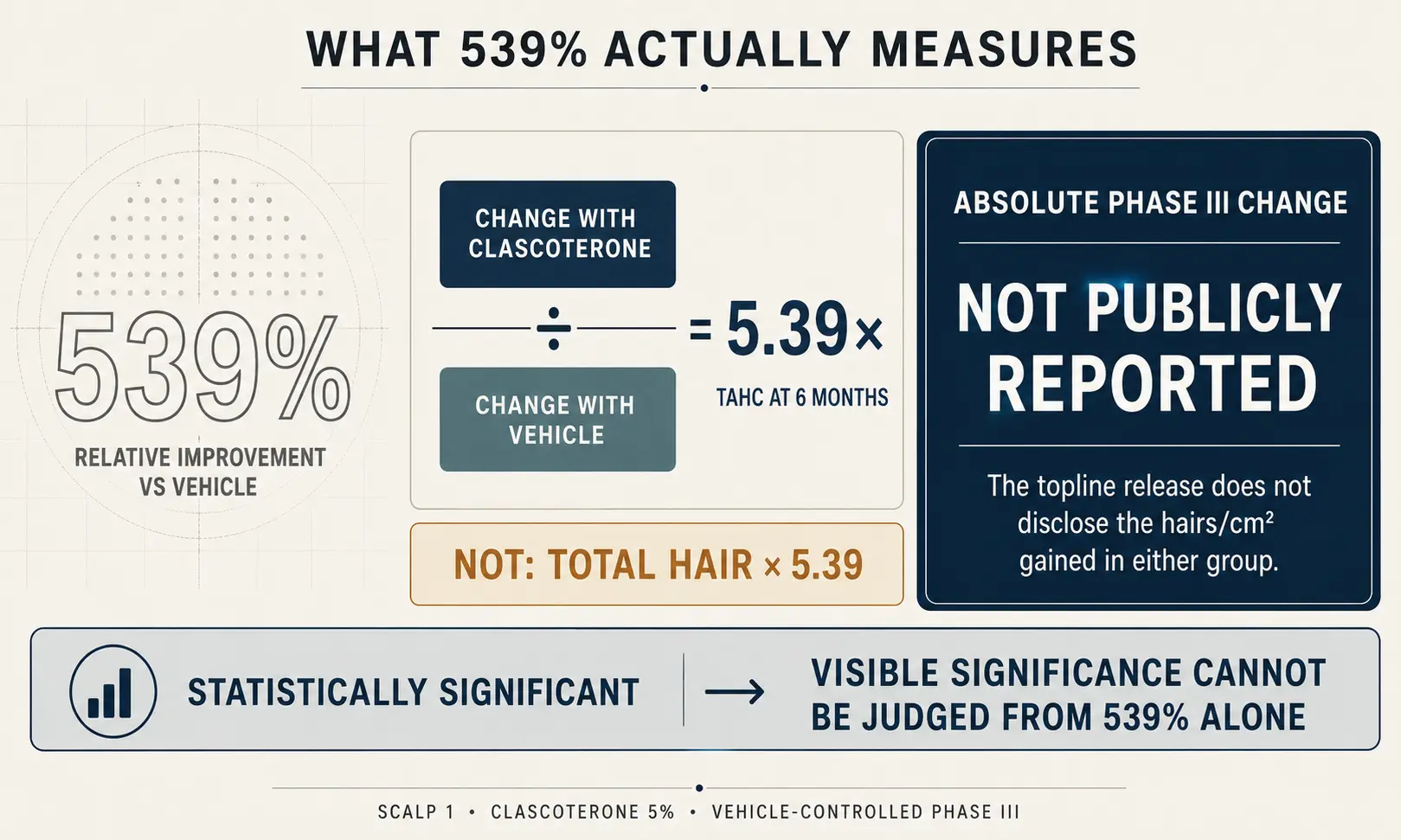
- One trial showed a 5.39-fold, or 539%, relative improvement versus vehicle.
- The other showed a 1.68-fold, or 168%, relative improvement versus vehicle.
- Treatment-emergent adverse events were reportedly similar between clascoterone and vehicle.
- The combined patient-reported outcome analysis was statistically significant.
These findings are encouraging, especially because both independently conducted studies reached the objective hair-count endpoint.
This is also the point where the interpretation becomes more complicated.
Does 539% mean five times more hair?
No.
It does not mean that patients increased their total amount of hair by 539%. It does not mean that a visibly bald area became five times denser. It also does not mean the treatment was 539% as effective as finasteride or minoxidil.
The number describes a relative difference between clascoterone and the vehicle group. A relative percentage can look enormous when the change in the comparison group is small.
Imagine the vehicle group gained an average of one hair in a measured area while the treatment group gained around six. The treatment result could then be described as several hundred percent greater than vehicle, even though the absolute difference was only about five hairs.
Those numbers are only an illustration, not the actual Phase 3 results. The problem is that detailed absolute hair-count changes for each group have not yet been fully published in a peer-reviewed paper. Without those figures, it is difficult to judge how large the cosmetic improvement really was.
This does not mean the result is false. It means the headline gives us only one part of the result.
Statistical significance is not the same as visible significance
Hair-count studies need numerical endpoints. Researchers require an objective method of comparing one treatment with another, and a fixed target area measured under standardized conditions is the accepted way to do it.
Patients, however, do not examine their scalp through a small fixed target area. They look at:
- How much scalp is visible under normal lighting
- Whether the frontal area frames the face better
- Whether styling has become easier
- Whether the crown still appears open in photographs
- Whether the progression of hair loss has stopped
A treatment can produce a statistically significant improvement without creating a dramatic visual transformation. The opposite occasionally happens as well: a relatively modest numerical change may look better than expected if hairs become thicker, darker or easier to style.
This is why I prefer to evaluate hair loss treatments using several forms of evidence together: absolute change in hair count, change in hair shaft caliber, standardized clinical photography, patient-reported improvement, long-term preservation of existing hair, and safety and treatment adherence.
A single relative percentage cannot answer all six questions.
What did the new 12-month data show?
In April 2026, Cosmo announced the 12-month extension results from the Phase 3 program.
The extension included patients who had responded during the first six months. These participants were reassigned either to continue clascoterone or to switch from clascoterone to the vehicle solution.
Patients who remained on clascoterone for the full 12 months reportedly achieved a statistically significant 2.39-fold improvement in target-area hair count compared with patients who used clascoterone for six months and then switched to vehicle. The continuous-treatment group continued gaining hair between months 3 and 12. Patients who stopped active treatment after month 6 lost some of the hair-count benefit. Treatment satisfaction was also reported to be 24.5% better on a relative basis in the continuous-treatment group.
This is useful for two reasons.
First, it suggests that the effect may continue beyond six months. That matters, because hair treatments often require patience and six months may not reveal their complete benefit.
Second, the decline after treatment was stopped suggests that clascoterone will probably need to be used continuously. That would not make it unusual. The benefits of finasteride and minoxidil also depend on continued treatment. Genetic hair loss does not disappear because a medication worked for several months.
There is an important detail in the extension design, though: only patients classified as responders during the first part were eligible for this stage. The 12-month findings therefore tell us about the durability of treatment among selected responders. They do not mean that every person starting clascoterone will continue improving for a full year.
How safe does clascoterone appear?
The reported safety results are one of the most interesting parts of the program.
According to the company, the 12-month safety and tolerability profile was comparable with vehicle, and no significant systemic hormonal side effects were observed. The company also described systemic absorption as negligible based on earlier clinical work.
That is encouraging, but some caution is still necessary. At the time of writing, the complete Phase 3 adverse-event tables have not been published in a peer-reviewed medical journal. Cosmo has stated that it intends to submit the full dataset for publication.
We therefore still need to see:
- The exact frequency of local irritation
- Discontinuation rates
- Laboratory and hormonal findings
- Whether any adverse effects differed according to age or treatment duration
- How the 5% scalp solution compares with existing therapies in routine use
Topical does not automatically mean free of systemic exposure. It usually means the treatment is designed to act locally and may reduce systemic exposure. Those are not the same statement.
Is clascoterone better than finasteride?
We do not know.
The Phase 3 studies compared clascoterone with its vehicle, not with oral finasteride, topical finasteride, dutasteride or minoxidil.
It is therefore not scientifically accurate to say that clascoterone is more effective than finasteride, as effective as finasteride, safer than finasteride in every respect, or a direct replacement for finasteride.
Those questions require head-to-head clinical studies, or at minimum detailed comparative evidence using similar endpoints and treatment periods.
Clascoterone may eventually prove particularly valuable for men who do not want to use an oral anti-androgen. It may also have a future role in combination treatment. But these possibilities should not be presented as established facts before the evidence exists.
Could clascoterone be combined with minoxidil?
From a biological perspective, combining them may make sense. Clascoterone aims to reduce androgen signaling at the follicle. Minoxidil supports the growth cycle through a different mechanism. One treatment could potentially help protect the follicle from further androgen-driven miniaturization while the other supports growth.
We still need clinical evidence showing whether the combination works better than either treatment alone, whether applying both products increases irritation, what the best order and timing of application is, and whether long-term adherence is realistic with twice-daily treatment.
A treatment can work very well in a controlled clinical trial and still struggle in daily life if it is inconvenient, expensive, greasy or irritating.
Adherence is not a minor issue in hair loss. A medication that stays in the bathroom cabinet produces an impressively consistent 0% improvement.
Could women use clascoterone for hair loss?
The major Phase 3 SCALP trials were conducted in men. We cannot automatically apply the same efficacy and safety conclusions to female pattern hair loss.
Androgen signaling plays a clear role in male androgenetic alopecia. In women, the biology can be more complex, and diffuse thinning may also relate to iron deficiency, thyroid problems, hormonal changes, nutritional deficiencies, medication, chronic telogen effluvium or other medical conditions.
Topical anti-androgen treatments may eventually prove useful for selected female patients, but dedicated studies are needed before firm conclusions can be drawn. A 2025 clinical review similarly described topical anti-androgens as an emerging area rather than an established replacement for currently approved treatment.
Can clascoterone replace a hair transplant?
Not in areas where the follicles have already been permanently lost.
Medication and hair transplantation solve different parts of the problem.
Medical treatment is most useful for:
- Protecting existing hair
- Slowing further miniaturization
- Thickening follicles that are still alive but weakened
- Reducing future progression
- Supporting the long-term stability of a hair transplant result
Hair transplantation moves healthy follicular units from a suitable donor area to areas where natural coverage is no longer sufficient.
If an area has been bald for many years and viable follicles are no longer present, even a strong medical response is unlikely to recreate the density that can be achieved by transplanting appropriate grafts.
The best long-term plans often use both approaches intelligently. Surgery restores selected areas, while medical treatment protects as much of the patient's original hair as possible. A hair transplant does not stop the biological process of androgenetic alopecia.
Could clascoterone be useful after a hair transplant?
Potentially, yes.
One of the most important parts of hair transplant planning is not simply deciding how many grafts can be placed today. We also need to consider what the patient's untreated hair may look like five or ten years later.
A transplant can remain technically successful while the surrounding native hair continues to thin. That is why stabilizing progressive hair loss matters.
If clascoterone is eventually approved and proves effective in ordinary clinical use, it may become another option for preserving non-transplanted hair before or after surgery. At present, however, this remains a potential future use. Clascoterone 5% solution is still investigational for androgenetic alopecia.
When could Breezula become available?
Cosmo confirmed in July 2026 that the Phase 3 clinical program had been completed and that regulatory preparations were continuing.
The company currently expects to submit its US application in the first quarter of 2027 and its European application in the second quarter of 2027. Those are planned submission dates, not approval dates. Regulators must still review the full efficacy, safety, manufacturing and labeling data.
As of August 2026:
- Breezula is not approved for male pattern hair loss.
- There is no confirmed commercial launch date.
- The final price has not been announced.
- The complete Phase 3 paper has not yet been published.
Any website already selling "approved Breezula hair loss treatment" should be approached very carefully.
My honest assessment
I do not think clascoterone should be dismissed.
Its mechanism is relevant, the Phase 3 program included a large number of men, both pivotal trials reached their objective hair-count endpoints, and the 12-month extension suggests continued activity when treatment is maintained. Those are meaningful achievements.
At the same time, I would not describe it as the end of male pattern baldness based on the information currently available.
The 539% headline is much more dramatic than the data we have actually been shown. We still need the absolute changes in hair count, the full standardized photographs, detailed safety tables and independent peer-reviewed analysis.
Most importantly, we need to understand where clascoterone sits beside treatments already used in clinical practice. Is it as effective as finasteride? Does it work better when combined with minoxidil? Will patients realistically apply it twice every day for years? Will its price allow long-term use?
These questions will determine its real value more than a press-release percentage.
The point we often miss in hair loss treatment
Patients naturally focus on regrowth. They want to know how many new hairs a treatment can produce.
But in androgenetic alopecia, preservation is often just as important.
A treatment that helps a 25-year-old keep his existing hair for the next decade may have enormous value, even if his six-month before-and-after photograph does not look dramatic.
Once a follicle has miniaturized beyond recovery, medication becomes much less useful. Preventing that loss is usually easier than trying to reverse it later.
Clascoterone may ultimately prove more valuable as a long-term follicle-protection treatment than as a spectacular regrowth treatment.
That is not a disappointing outcome. It may be the most realistic and clinically useful role the drug could have.
Frequently Asked Questions
What is clascoterone?
Is Breezula approved for hair loss?
Does clascoterone regrow hair?
What does the reported 539% improvement mean?
Is clascoterone better than finasteride?
Does clascoterone have sexual side effects?
Can clascoterone and minoxidil be used together?
Can women use clascoterone?
Will clascoterone work on completely bald areas?
When will Breezula be available?
My final view
Clascoterone is one of the most credible emerging treatments for male androgenetic alopecia.
Its local androgen receptor-blocking mechanism is different from the way finasteride reduces DHT production, and the latest Phase 3 announcements suggest measurable hair-count improvement, continued benefit through 12 months and a safety profile similar to vehicle.
The evidence still needs to be read carefully. The widely quoted 539% figure is a relative improvement against vehicle, not a 539% increase in total hair density. The full Phase 3 results have not yet appeared in a peer-reviewed publication, and clascoterone has not been directly shown to outperform finasteride or minoxidil.
For now, I would describe Breezula as promising, scientifically credible and worth following closely, but not yet proven to be the revolutionary treatment suggested by some headlines.
So, to answer the patient who sent me that screenshot: no, I would not cancel a well-planned procedure to wait for a medication that is still at least a year away from a regulatory decision, and which was never designed to restore hair that has already been lost.
New treatments are welcome in hair restoration. But patients deserve the complete picture, not simply the largest number in the press release.
— Dr. Mesut Demir
Not sure whether to treat now or wait?
Send us your photos and hair loss history. We will tell you honestly what stage you are at, whether medical treatment alone could hold your hair for now, and whether surgery is worth considering at all — without pushing you toward a procedure you do not need.
Request a Case Review- A study to evaluate the efficacy and safety of clascoterone solution in treatment of male pattern hair loss (SCALP 1). ClinicalTrials.gov, identifier NCT05910450. Sponsor: Cassiopea SpA. Phase 3, multicentre, randomised, double-blind, vehicle-controlled study; 703 participants. NCT05910450
- A study to evaluate the efficacy and safety of clascoterone solution in treatment of male pattern hair loss (SCALP 2). ClinicalTrials.gov, identifier NCT05914805. Sponsor: Cassiopea SpA. Phase 3, multicentre, randomised, double-blind, vehicle-controlled study; 762 participants. NCT05914805
- Cosmo Pharmaceuticals N.V. Cosmo announces breakthrough Phase III topline results from SCALP 1 and SCALP 2 for clascoterone 5% solution in male hair loss. Company press release. December 2025.
- Cosmo Pharmaceuticals N.V. Phase III 12-month data for clascoterone 5% topical solution confirm positive safety for chronic use and continued hair growth. Company press release. April 2026.
- Cosmo Pharmaceuticals N.V. Half-year update: clascoterone 5% topical solution advances toward regulatory submission. Company update. July 2026.
- Winlevi (clascoterone) cream, 1%: US prescribing information. US Food and Drug Administration, NDA 213433. Initial US approval 2020. accessdata.fda.gov
- Rosette C, Rosette N, Mazzetti A, et al. Cortexolone 17α-propionate (clascoterone) is an androgen receptor antagonist in dermal papilla cells in vitro. Journal of Drugs in Dermatology. 2019;18(2):197–201. PMID 30811143
- Marks DH, Prasad S, De Souza B, et al. Topical antiandrogen therapies for androgenetic alopecia and acne vulgaris. American Journal of Clinical Dermatology. 2020;21(2):245–254. doi:10.1007/s40257-019-00493-z
- Sun HY, Sebaratnam DF. Clascoterone as a novel treatment for androgenetic alopecia. Clinical and Experimental Dermatology. 2020;45(7):913–914. doi:10.1111/ced.14292
- Chen S, Li L, Ding W, Zhu Y, Zhou N. Androgenetic alopecia: an update on pathogenesis and pharmacological treatment. Drug Design, Development and Therapy. 2025;19:7349–7363. doi:10.2147/DDDT.S542000
- Ong MM, Avram M, McMichael A, Tosti A, Lipner SR. Antiandrogen therapy for the treatment of female pattern hair loss: a clinical review of current and emerging therapies. Journal of the American Academy of Dermatology. 2025;93(3):749–760. doi:10.1016/j.jaad.2025.04.074
Evidence note. As of August 2026, the complete numerical results from the SCALP 1 and SCALP 2 Phase 3 trials have not been published in a peer-reviewed medical journal or posted as full study results on ClinicalTrials.gov. The 539%, 168%, 2.39-fold and 24.5% figures quoted in this article originate from sponsor-issued company announcements and should be read as topline results until the complete dataset has undergone independent peer review.