
Quick answer
Regenera Activa uses autologous micrografts from the patient’s own scalp to support follicles that are miniaturizing but still present. Pooled evidence shows a statistically significant yet modest improvement in hair count, so it disappoints most often when the diagnosis is not androgenetic alopecia, when too few viable follicles remain, or when it is expected to deliver transplantation-level coverage or a new hairline.
One of the comments I hear surprisingly often is:
"I had Regenera Activa, but I did not see the result I expected."
Sometimes the patient genuinely had very little improvement. In other cases, there has been some reduction in shedding or thickening of existing hair, but the treatment had been presented as something much more dramatic.
When we look more closely, the reason is rarely that Regenera Activa simply "does not work."
More often, the wrong condition was treated, the patient was not a good candidate, the procedure was carried out without a clear protocol, or the treatment was expected to achieve something it was never designed to do.
Regenera Activa can be useful in selected patients with male or female pattern hair loss. But it is not a universal treatment for every person experiencing shedding, and it cannot create new follicles in an area where the hair has already been permanently lost.
That distinction matters.
The short answer
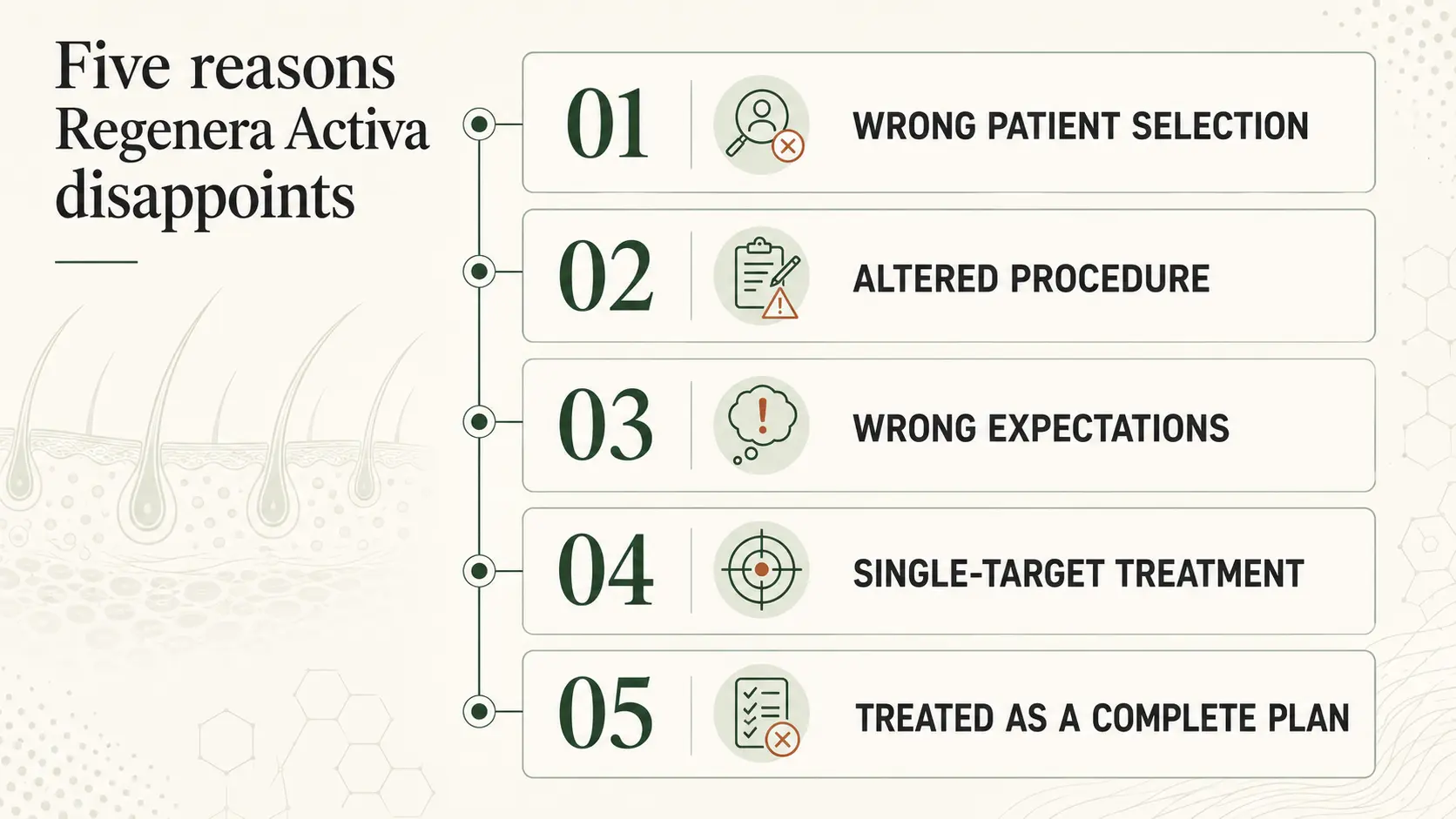
Regenera Activa is most likely to disappoint when:
- The patient does not actually have androgenetic alopecia.
- There are too few viable miniaturized follicles left to support.
- The procedure is altered without a clear medical reason.
- The patient expects transplantation-level coverage.
- The underlying causes of progressive hair loss are not managed.
Before explaining these five points, let us first clarify what the treatment actually is.
What is Regenera Activa?
Regenera Activa is an autologous micrograft treatment used primarily for androgenetic alopecia, more commonly known as male or female pattern hair loss.
"Autologous" means the biological material comes from the same patient who will receive it.
During the procedure, small scalp tissue samples are usually taken from an area containing healthy, androgen-resistant follicles. The tissue is mechanically processed using the Rigenera system to produce a suspension containing very small tissue fragments, cells and biological signals derived from the patient's own scalp.
This suspension is then injected into areas affected by follicular miniaturization.
It is worth being precise about the terminology.
Regenera Activa is sometimes casually called a "stem-cell treatment." The processed suspension may contain progenitor and hair-follicle-associated cell populations, but it is not the same as laboratory-expanded stem-cell therapy. Nothing is cultured for weeks, and no donor cells are introduced.
The treatment uses mechanically prepared autologous micrografts from the patient's own tissue. Published studies have described these micrografts as containing follicular progenitor cells, dermal papilla-related cells, extracellular vesicles and growth-related biological signals.
What is Regenera Activa supposed to do?
In androgenetic alopecia, affected follicles gradually become smaller.
A thick terminal hair becomes finer. Its growth phase shortens, and with time it may begin producing a thin, almost invisible hair. This is what we mean by follicular miniaturization.
Regenera Activa is intended to support follicles that are still present but becoming weaker.
It may help improve:
- Hair-shaft thickness
- The proportion of thicker hairs
- Visible scalp coverage
- Hair density in responsive areas
- The quality of existing miniaturized follicles
It does not move follicles from one area to another.
It does not construct a new hairline.
It does not fill completely bald skin in the same way that a hair transplant can.
The distinction between a weakened follicle and an absent follicle is one of the most important parts of patient selection.
Does Regenera Activa actually work?
The available evidence is encouraging, but it is not yet perfect.
In a retrospective study involving 140 men and women with confirmed androgenetic alopecia, a single autologous cellular micrograft session was associated with average increases of approximately 4.5 to 7.12 hairs per square centimeter, depending on the scalp area. Hair thickness and the proportion of thicker hairs also improved, while approximately two-thirds of participants showed a favorable response in the frontal region.
A systematic review and meta-analysis published in 2026 found that autologous micrograft technology produced a statistically significant but relatively small pooled improvement in hair count. The authors considered the treatment promising, while also acknowledging that many available studies involve small samples and that larger comprehensive trials are still needed.
This is why I would be cautious with universal claims such as:
- "Everybody gains 30% or 40% more density."
- "This treatment works in 80% of patients."
The published literature does not support one exact percentage that can honestly be promised to every patient.
Some patients respond clearly. Some notice a more modest improvement. Some do not respond in a way they can appreciate visually.
Regenerative medicine is still biology, not a preset filter applied to every scalp.
1. The diagnosis or patient selection was wrong
The most important step happens before the Regenera device is even opened.
We need to establish why the patient is losing hair.
Not every person with diffuse thinning has androgenetic alopecia.
Hair shedding may also be related to:
- Acute or chronic telogen effluvium
- Iron or other nutritional deficiencies
- Thyroid disorders
- Recent illness, surgery or rapid weight loss
- Medication-related shedding
- Hormonal disturbances
- Alopecia areata
- Inflammatory scalp disease
- Scarring alopecia
Regenera Activa is primarily intended to support miniaturized follicles in androgenetic alopecia. If the main problem is a nutritional deficiency or an ongoing telogen effluvium, injecting micrografts without addressing the underlying trigger is unlikely to solve the problem.
This is why I do not assess suitability by simply looking at the patient from across the room.
At Pure Line®, the assessment may include a detailed history, scalp examination, standardized photographs and video trichoscopy.
Trichoscopy allows us to examine variation in hair-shaft diameter, the presence of miniaturized hairs and other features that support or challenge a diagnosis of androgenetic alopecia. A 2024 systematic review confirmed that hair-diameter diversity and other trichoscopic signs are important in evaluating pattern hair loss, particularly in women whose hair loss can appear more diffuse.
Blood tests may also be appropriate when the history or shedding pattern suggests another contributing cause.
The objective is not to find a reason to perform Regenera. It is to find out whether Regenera makes sense for that patient.
The other end of poor patient selection
Regenera Activa may also be offered too late.
If an area is smooth, completely bald and no longer contains functioning miniaturized follicles, regenerative treatment cannot create an entirely new population of hair follicles.
At that point, FUE hair transplantation may be the more appropriate discussion, provided that the donor area is suitable.
Regenera is generally more logical when follicles are weakening but still biologically present.
It is not a substitute for moving permanent donor follicles into a bald area.
2. The procedure was changed without a convincing reason
Regenera Activa involves several technical steps:
- Choosing an appropriate donor site
- Taking scalp tissue samples
- Preparing the samples correctly
- Processing them with the correct sterile device
- Collecting the suspension
- Distributing it through the intended treatment area
- Maintaining sterility throughout the procedure
Each step matters.
I have met patients who were told that more advanced hair loss required far more tissue samples because "more samples mean more cells and a stronger result."
That may sound logical, but it has not been demonstrated as a simple dose-response relationship.
Published Regenera-related hair studies do not even use one universal number of biopsies. A large retrospective cohort used three 2.5 mm scalp specimens, while another study involving women used five 2.5 mm samples.
The useful conclusion is not that three is always correct or five is always correct.
The conclusion is that more tissue is not automatically evidence of a better procedure.
Every additional punch creates another small donor wound. The number and size of samples should therefore have a medical and procedural reason, not be used as an upgrade that can be sold to the patient.
The quality of the procedure depends on whether suitable tissue is obtained and processed correctly, not on turning the number of biopsies into a competition.
Sterility still matters
Regenera Activa is minimally invasive, but it still involves punch biopsies and multiple scalp injections.
It should be performed in a controlled medical environment using proper sterile technique.
Taking tissue and injecting it back into the scalp is not comparable to applying a cosmetic serum. Poor sterile practice can increase the risk of infection, inflammation and problems at the biopsy or injection sites.
A regenerative label does not make the procedure less medical.
3. The patient was promised the wrong kind of result
Some disappointing Regenera Activa experiences are not truly treatment failures.
They are communication failures.
A patient may experience less shedding or some thickening of miniaturized hairs and still feel disappointed because he was expecting his scalp to look as though he had undergone a hair transplant.
Regenera Activa is not designed to:
- Lower a naturally high hairline
- Rebuild deeply receded frontal corners
- Fill a completely bald crown
- Produce thousands of new follicles
- Give transplantation-level density
- Restore a teenage hairline
I have also heard of micrografts being injected very far forward into bare forehead skin with the suggestion that this could lower the hairline.
That is not a realistic expectation.
A hairline is lowered by transplanting follicles into a carefully designed recipient area. Regenerative injections cannot replace the surgical movement and placement of actual follicular units.
What should patients realistically expect?
A suitable patient may notice:
- Reduced shedding
- An improvement in hair quality
- Better hair caliber
- Slightly improved coverage
- A fuller appearance in areas containing miniaturized hair
These changes are usually gradual.
Most clinical assessments evaluate results over several months rather than several days. The 140-patient study followed participants for up to approximately six months, while other published studies have also used six-month or longer assessment periods.
Before treatment, the patient should understand:
- What part of the scalp may respond
- Which hairs are likely to benefit
- What the treatment cannot achieve
- When the result should be evaluated
- What other treatment may still be required
A conservative promise followed by a visible improvement creates satisfaction. An extraordinary promise followed by the same improvement creates disappointment.
4. The treatment is aimed at only one part of a complex biological process
Androgenetic alopecia is not caused by one isolated biological event.
In genetically sensitive follicles, androgen signaling, particularly the effects of dihydrotestosterone in susceptible men, contributes to progressive follicular miniaturization.
Other biological pathways are also involved, including Wnt/β-catenin signaling, transforming growth factor pathways, apoptosis, inflammation and growth-cycle regulation. Research has shown that androgen-receptor activity and Wnt-related signaling interact in the biology of androgenetic alopecia.
Autologous micrografts may support regenerative signaling around the follicle.
But they do not necessarily address every mechanism causing the patient's hair loss.
This explains why a patient may receive a technically correct Regenera procedure and still continue to lose untreated native hair.
The micrografts may support the follicle. The genetic and hormonal process may still be working against it.
For appropriate male patients, treatments that reduce androgen-related follicular miniaturization may therefore remain important. Minoxidil may be used to stimulate hair growth, while other options can be considered according to sex, medical history, diagnosis and tolerance. We answer the most common questions about hair-loss medication separately.
Regenera Activa should not automatically be presented as a replacement for these treatments.
It works through a different part of the overall process.
5. Regenera Activa was treated as a complete hair-loss plan
This follows naturally from the previous point.
Regenera Activa may be part of a treatment plan.
It is rarely the entire plan.
Depending on the patient, a broader approach may include:
- Topical or oral minoxidil
- Finasteride or another anti-androgen strategy in appropriate patients
- Correction of a documented nutritional deficiency
- Treatment of an inflammatory scalp condition
- Low-level light therapy
- PRP
- Hair transplantation
- Long-term photographic or trichoscopic monitoring
This does not mean every patient needs every treatment.
Adding more procedures without a reason is no better than relying on one procedure for everything.
The treatment plan should be built around the diagnosis.
A young man with early miniaturization does not necessarily need the same approach as a woman with diffuse pattern hair loss.
A patient with a stable transplanted hairline but ongoing miniaturization behind it has a different problem from somebody with a completely bald frontal area.
Combination therapy should mean combining the right treatments for the right biological problems. It should not mean placing every treatment on the clinic's price list into one package.
Who may be a suitable candidate for Regenera Activa?
A potentially suitable patient will generally have:
- A diagnosis of male or female pattern hair loss
- Existing follicles showing miniaturization
- Early or moderate thinning rather than completely bald skin
- A healthy donor area from which small tissue samples can be obtained
- No untreated infection or active inflammatory scalp condition
- Realistic expectations
- An understanding that other hair-loss treatment may still be required
The best candidates are not necessarily those with the most severe loss.
They are often patients who still have weakened follicles worth supporting.
Who may be less likely to benefit?
Regenera Activa may be less suitable when:
- The diagnosis has not been established
- Hair shedding is mainly caused by an untreated deficiency or illness
- The patient has active scarring alopecia
- The scalp contains very few remaining miniaturized follicles
- The treatment area is already smooth and bald
- The patient expects a new or lower hairline
- Hair loss is progressing rapidly without a broader treatment plan
- The patient expects one session to permanently stop hereditary hair loss
The decision should be made after examining the scalp, not after reading a package description.
Regenera Activa, PRP or hair transplantation?
These treatments are often grouped together, even though they do different things.
Regenera Activa uses small samples of the patient's own scalp tissue to create an autologous micrograft suspension. It is intended to support existing miniaturized follicles.
PRP uses a concentrated platelet preparation obtained from the patient's blood. It is usually administered over a series of sessions and is intended to provide platelet-derived signals around existing follicles.
Hair transplantation moves follicular units from a stable donor region into areas where follicles have been permanently lost. You can see how that difference looks in practice in our patient results.
Regenera Activa and PRP attempt to improve the performance of follicles that are already there. Hair transplantation redistributes actual follicles.
One cannot automatically replace the other.
Can Regenera Activa be combined with a hair transplant?
It can be considered as part of the wider treatment plan in selected patients.
However, the purpose should be clear.
The hair transplant creates coverage by moving follicles from the donor area. Regenera Activa may be considered to support existing miniaturized native hair or as an adjunct within a broader regenerative plan.
It does not increase the number of transplanted grafts, repair a poorly designed hairline or compensate for weak donor management.
The quality of a hair transplant still depends on:
- Patient selection
- Donor management
- Hairline design
- Recipient-site planning
- Graft handling
- Implantation
- Long-term management of native hair
Regenerative treatment should complement good surgery, not be used to market around bad surgery.
How we assess Regenera Activa patients at Pure Line®
When somebody contacts Pure Line® about Regenera Activa, I do not begin by asking when they want to book the treatment.
I first want to know:
- When did the hair loss begin?
- Is the patient shedding or gradually thinning?
- Is there a family history of pattern hair loss?
- Which areas are changing?
- Is the progression stable or rapid?
- Are there symptoms such as itching, redness or scaling?
- Is the patient using minoxidil, finasteride or another treatment?
- Are there medical or nutritional factors that should be investigated?
- Are there enough miniaturized follicles to justify treatment?
We then examine the scalp and, where appropriate, use video trichoscopy to assess follicular miniaturization and variation in hair-shaft diameter.
Sometimes the conclusion is that Regenera Activa is reasonable. Sometimes another treatment should come first. Sometimes the patient is better suited to hair transplantation.
And occasionally the honest answer is that Regenera Activa is unlikely to provide enough visible improvement to justify the procedure.
A consultation should not exist to confirm the treatment the patient has already selected. It should determine whether that treatment is actually suitable.
Frequently Asked Questions
What is Regenera Activa?
Does Regenera Activa regrow hair?
Why did my Regenera Activa treatment not work?
Is Regenera Activa a stem-cell treatment?
How long does Regenera Activa take to work?
Can Regenera Activa lower the hairline?
Can Regenera Activa fill a bald crown?
Is one Regenera Activa session enough?
Does Regenera Activa replace minoxidil or finasteride?
Can women have Regenera Activa?
Is Regenera Activa guaranteed to work?
My final view
Regenera Activa is not a miracle treatment.
It is also not an empty treatment.
In the right patient, it may improve the quality and visible coverage of miniaturized hair. In the wrong patient, it may achieve very little regardless of how well the procedure is performed.
That is why the consultation matters so much.
A good result begins by identifying the correct type of hair loss, confirming that viable miniaturized follicles remain and explaining what the treatment can realistically achieve.
The procedure must then be performed correctly, in a sterile medical setting, and placed within a sensible long-term hair-loss plan.
If somebody promises that Regenera Activa will create a new hairline, replace a transplant or guarantee a fixed percentage of new density, I would be cautious.
Regenerative medicine can support biology. It cannot negotiate with it.
— Dr. Mesut Demir
Wondering whether Regenera Activa is right for you?
Send us your photos and hair loss history. We will start with the diagnosis and tell you honestly whether there are enough miniaturized follicles left for this treatment to be worth it — or whether something else suits your case better.
Request a Case Review- Ellerby A, Knudsen R. Autologous micrograft technology (AMT) and finasteride for the management of androgenic alopecia: a systematic review and meta-analysis of their efficacy and safety. Dermatology Practical & Conceptual. 2026. doi:10.5826/dpc.1602a6211
- Zari S. Short-term efficacy of autologous cellular micrografts in male and female androgenetic alopecia: a retrospective cohort study. Clinical, Cosmetic and Investigational Dermatology. 2021. doi:10.2147/CCID.S334807
- Krefft-Trzciniecka K, Piętowska Z, Pakiet A, et al. Short-term clinical assessment of treating female androgenetic alopecia with autologous stem cells derived from human hair follicles. Biomedicines. 2024;12(1):153. doi:10.3390/biomedicines12010153
- Gentile P, et al. Autologous micrografts from scalp tissue: trichoscopic and long-term clinical evaluation in male and female androgenetic alopecia. BioMed Research International. 2020. doi:10.1155/2020/7397162
- Gentile P, et al. Autologous cellular method using micrografts of human adipose tissue derived follicle stem cells in androgenic alopecia. International Journal of Molecular Sciences. 2019. doi:10.3390/ijms20143446
- Kuczara A, Waśkiel-Burnat A, Rakowska A, Olszewska M, Rudnicka L. Trichoscopy of androgenetic alopecia: a systematic review. Journal of Clinical Medicine. 2024. pmc.ncbi.nlm.nih.gov