Quick answer
An eyebrow hair transplant moves selected follicles — most often single-hair grafts from the scalp — into a thin, scarred or absent part of the brow. The procedure can produce long-lasting growing hair, but the result depends on diagnosis, design, donor-hair caliber and curl, and extremely shallow placement. Shedding during the first few weeks is expected. Early growth often appears around months three or four, and maturation can continue for 12 months. Scalp-derived hairs usually need regular trimming, and Dr. Mesut Demir treats a stable diagnosis as the precondition for surgery: sudden loss, active skin disease, alopecia areata and frontal fibrosing alopecia are assessed medically before any graft is planned.
An eyebrow transplant occupies a very small area of the face, but a few millimeters can change a person's expression. I plan each case around the cause of the hair loss, the patient's own anatomy and the way every transplanted hair will leave the skin.
Key takeaways
- Stable over-plucking, naturally sparse brows and selected mature scars are common reasons to consider surgery.
- Sudden loss, active skin disease, alopecia areata and frontal fibrosing alopecia need medical assessment first.
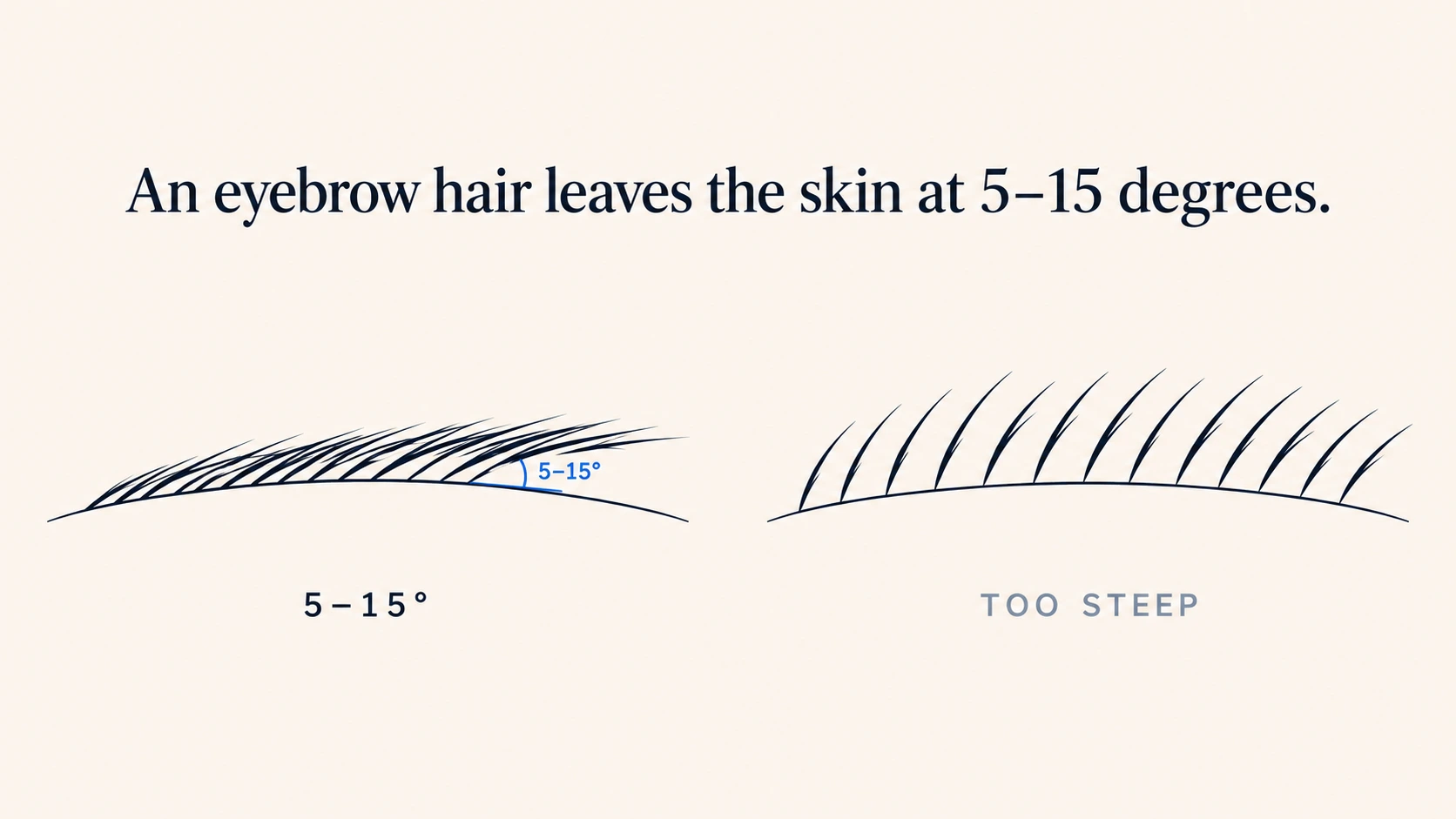
- Across much of the brow, recipient sites may sit roughly 5–15 degrees from the skin; the exact angle changes by segment, skin and scar.
- A broad cosmetic case may involve about 200–500 single-hair grafts per brow, while a small gap can need far fewer.
- The implanted shafts commonly shed before new growth begins.
- Transplanted scalp hair keeps many scalp-hair characteristics, so trimming remains part of the result.
On this page
What is an eyebrow hair transplant?
An eyebrow hair transplant is a surgical procedure in which follicular units are removed from a donor area and placed into the brow under local anesthesia. At Pure Line, the working material is usually carefully selected single-hair scalp grafts.
After the expected shedding phase, surviving follicles begin to produce new hair and can continue doing so for many years. The original diagnosis still matters, and scalp follicles retain characteristics that require long-term grooming.
Our eyebrow transplant service page covers the consultation pathway. This guide explains how I think through the medical and technical decisions behind it.
Why did the eyebrow become thin?
I start with the cause. Adding follicles to an area that is still losing hair can turn a cosmetic concern into a harder medical and surgical problem.
Years of over-plucking are common. Some people simply have sparse brows. Burns, cuts, direct brow lifts and other operations can leave stable gaps. Eczema, psoriasis, contact dermatitis and chronic irritation may also affect the brow. A sudden change, itching, scale, redness or recession of the frontal hairline deserves investigation.
Loss of the outer third of the brow is classically associated with hypothyroidism, sometimes called the Queen Anne sign. It is uncommon and non-specific, so the pattern alone does not diagnose thyroid disease. History, examination and appropriate laboratory work come first. A reversible or uncontrolled medical cause should be treated before surgery.
Alopecia areata requires individual assessment. A published case report describes successful transplantation in carefully selected, treatment-resistant eyebrow alopecia areata after stability, while also stressing the controversy and the need for trimming scalp-derived hairs. It offers limited evidence about predictability.
Frontal fibrosing alopecia is an even stronger warning. In a ten-patient series, initial growth was often encouraging, yet most patients began losing transplanted eyebrow hair after three to four years. Suspected FFA needs dermatologic evaluation and a direct discussion about recurrence. Active disease is a reason to postpone cosmetic transplantation.
Occasionally my useful contribution in consultation is to say, “Let's leave the transplant aside for now.” The next step may be treatment, observation, blood tests or a dermatology referral.
Who is a good candidate for eyebrow transplantation?
The clearest candidates have a stable reason for the loss, healthy recipient skin, usable donor hair and realistic expectations about density and grooming.
| More favorable for transplantation | Reason to pause and investigate |
|---|---|
| Naturally sparse or incomplete brows | Sudden, unexplained or ongoing eyebrow loss |
| Stable loss after years of over-plucking | Active eczema, psoriasis, infection or persistent irritation |
| A mature, soft and well-healed scar | A raised, tight, inflamed or recent scar |
| A stable congenital gap or asymmetry | Active or recently active alopecia areata |
| Acceptance of gradual growth and regular trimming | Suspected frontal fibrosing alopecia |
| Donor hair with a workable caliber and curl | Donor hair that would remain coarse or strongly curved in the brow |
Scar quality, skin movement, circulation, previous tattooing or microblading, medication and the direction of the remaining brow hairs all alter the decision. Photographs are useful for an initial review. The final assessment still requires examination.
Is there a minimum age?
For a routine cosmetic eyebrow transplant, 18 is the practical minimum. A younger patient with eyebrow loss needs a clear medical or reconstructive reason, assessment of the underlying diagnosis and appropriate parental or guardian involvement. That is a different pathway from elective cosmetic reshaping.
How I design an eyebrow
I assess the design with the patient sitting upright, so posture, muscle movement and existing asymmetry stay visible.
The inner head generally begins with more upright hairs. Moving laterally, the upper and lower rows turn toward one another and flatten. The tail becomes lighter, finer and almost parallel to the skin. A believable border has small irregularities; a uniformly packed outline reads like makeup even when every graft grows.
I look at the orbital rim, nasal bridge, eye position, muscle movement, existing asymmetry and the patient's usual expression. We discuss the drawing together. Perfect mirror symmetry is rarely the right target because human faces are not perfectly symmetrical.
Eyebrow transplant for men
Many male patients prefer a fuller central body, a straighter overall line and less elevation at the arch. That preference guides the conversation without becoming a template. I have seen naturally arched male brows and naturally straight female brows; anatomy wins over a gendered diagram.
The tail deserves restraint in men. A dense, sharply outlined tail can feminize or simply advertise the surgery. Single hairs, lower density and a soft taper usually integrate better with the native brow.
Microblading pigment is useful background information, but I do not trace it automatically. Pigment can fade, spread or preserve a shape the patient no longer likes. Native hair direction and facial structure give me a safer starting point.
How I choose donor hair
Scalp and eyebrow hair differ in growth length, caliber, curl and cycle. I usually search within a stable occipital donor zone, then choose individual follicles whose visible shafts offer a workable match. The FUE technique allows those follicular units to be removed one at a time.
Fine hair is helpful only when the follicle also comes from a dependable area. The finest fringe or nape hairs may look attractive today but can be less stable over time. Periauricular hair has been described as an alternative source for finer eyebrow grafts, yet the trade-off includes a different donor site and the possibility of visible marks.
I reserve body hair for unusual circumstances, especially when scalp donor supply is limited. Its growth cycle, curl, caliber and length can differ enough to make the final brow less predictable. A donor source should be chosen for the face it must serve, not simply because hair is available there.
Why I keep the shafts long
The visible shaft tells me how a graft curves. Cutting every hair to a short stub removes that information and leaves us to discover the curl months later. Keeping the shaft long can slow the work because the hairs obstruct a small recipient field, but it allows the curve to be assessed during placement. Long-hair FUE literature describes the same practical advantage.
What happens to the donor area?
The trimmed donor window is usually small enough for surrounding hair to cover it. Tiny crusts form at the extraction points, and redness varies with skin type and healing. FUE avoids a linear strip scar, but it is not scarless; each extraction leaves a minute healing point. Punch size, spacing, skin response and overharvesting all influence visibility. Our FUE donor-area scarring guide explains this in more detail.
How I place eyebrow grafts
For brow work, I prefer fine-needle stick-and-place: I create a recipient opening and the graft is placed immediately. This lets the team follow the design in small sections and adjust spacing, direction and angle as the native pattern changes.
Across much of the eyebrow, sites may be made at roughly 5–15 degrees from the skin surface. Published scar reconstruction has described 5–10-degree placement in a herringbone pattern. Skin thickness, scar resistance, location within the brow and shaft curl change the working angle.
I do not routinely choose a classic pre-made-slit workflow or standard DHI implantation for eyebrow cases. Both can be used in hair restoration. My preference for the brow is fine-needle stick-and-place because it gives me direct control while moving through a small, constantly changing direction map. Our DHI and FUE comparison explains the broader differences between those terms.
Grafts must be held without crushing the follicle or forcing it into an opening. I lead the design and the recipient-site plan, and a fixed clinical team works with me through the day. At Pure Line, we reserve that day for one patient.
How many grafts are needed for an eyebrow transplant?
A small scar can need fewer than 100 single hairs. A thin tail may require only a limited addition. A broadly sparse or nearly absent brow can require several hundred.
Many full cosmetic restorations use about 200–500 single-hair grafts per eyebrow. Existing density, brow dimensions, hair caliber, scar quality and the patient's goal determine the final number.
We have not audited our eyebrow records as a formal cohort, so I will not present a clinic median, survival percentage or revision rate as though we had. If we publish our own numbers later, they should come with a defined sample, follow-up period, method and exclusions.
Published series also vary by diagnosis. The FFA series cited earlier used 120–270 single-hair follicles per eyebrow, a useful reminder that a number cannot be separated from the condition being treated.
Why can the procedure take seven to nine hours?
A few hundred eyebrow grafts may take almost as long as a much larger scalp session. Selection is slower, the shafts need to remain visible, the recipient map changes every few millimeters and existing brow hairs must be protected.
At Pure Line, an eyebrow transplant commonly takes around seven to nine hours, with variation by case. A narrow scar may be shorter. Bilateral reconstruction with little native hair can take longer.
Speed becomes less impressive when the face has to live with every shortcut.
Case example: planning a direct brow-lift scar
A man recently came to consultation with healthy native eyebrows and a narrow scar from a direct brow lift. He had used microblading to soften the line. The skin was quiet, and he reported no continuing loss or inflammatory symptoms.
He did not need a new eyebrow. He needed the eye to stop catching the scar.
I examined whether the scar was mature and soft, how the native hairs crossed its upper and lower edges, and whether the pigment distorted the apparent border. The proposed plan was conservative: place selected single hairs through the line, copy the direction immediately around it and leave the rest of the brow alone. Scar tissue can have less predictable circulation and resistance, so density would be built cautiously. A second small session might be necessary after the first growth pattern became clear.
This is the plan discussed in consultation, not a published outcome. Reconstructive literature likewise treats scarred eyebrows as a distinct planning problem.
How should I prepare before eyebrow transplant surgery?
Tell the clinic about prescription medicines, over-the-counter drugs, vitamins and supplements. Aspirin, anticoagulants and antiplatelet medicines can affect bleeding, but never stop them on your own. The prescribing doctor and surgical team must decide whether any change is safe.
We give patient-specific instructions about alcohol and medicines before surgery. Patients should also disclose smoking, vaping, nicotine pouches and nicotine replacement. Nicotine causes vasoconstriction, and smoking is associated with delayed wound healing and wound complications in surgical literature. It is reasonable to be particularly cautious when grafting into scar tissue, where circulation may already be less predictable. That is an inference from general wound-healing biology; I cannot quote a reliable eyebrow-specific graft-survival percentage.
Arrive with clean skin and no brow makeup unless the clinic gives different instructions. Tell us about recent microblading, tattooing, lasers, peels, injectables or surgery around the brow. Active irritation or infection changes the timing.
Is an eyebrow transplant painful?
The procedure is performed under local anesthesia. The first injections can sting and create a brief feeling of pressure. Once the area is numb, patients usually notice touch, movement or pressure rather than sharp pain. If discomfort returns during a seven-to-nine-hour session, the team should pause, reassess the area and supplement the anesthesia when clinically appropriate.
Hair-transplant guidelines discuss local infiltration and tumescent anesthesia as established parts of hair-restoration surgery, while emphasizing dose calculation, monitoring and readiness for complications.
What is eyebrow transplant recovery really like?
The first days are visible. Tiny crusts, redness and swelling are expected, and bruising can move into the eyelids or upper cheeks because the surrounding tissue is loose.
| Time | What you may notice | Practical point |
|---|---|---|
| Days 0–3 | Visible grafts, redness, early crusting, tenderness and possible swelling | Avoid rubbing and direct shower pressure; follow the clinic's spray and cleaning instructions |
| Days 4–10 | Crusts look more obvious, then begin to clear; bruising should improve | Do not pick crusts or try to make the brow socially invisible too early |
| Weeks 2–4 | Many implanted shafts shed | Shedding of the shaft does not automatically mean loss of the follicle |
| Months 3–4 | Early hairs may appear fine, sparse and uneven | It is too early to judge final density |
| Months 6–9 | More growth appears and grooming becomes easier | Direction, texture and gaps can be assessed more meaningfully |
| Months 9–12 | The result continues to mature | Final review and any revision discussion belong here |
For the first three days, I do not want a strong shower stream hitting the grafts. Patients use the spray and washing plan provided by the clinic. Increasing pain, warmth, spreading redness, pus, fever, worsening general condition or any visual disturbance needs prompt medical assessment. Our swelling guide covers routine swelling and warning signs, and the redness guide explains how to tell ordinary healing from a warning pattern.
What should I avoid after eyebrow transplant surgery?
The brow may be a small recipient area, but the early graft-care rules still matter. At Pure Line, our general instructions are:
- avoid strenuous exercise and heavy sweating for two to three weeks;
- avoid pools, the sea, sauna and steam rooms for one month;
- keep the brow out of direct sun for the first month and continue careful sun protection for three months;
- avoid rubbing, tight eye masks, helmets or anything else that presses across the grafts while the skin is healing.
An international expert consensus on hair-transplant aftercare likewise recommends a gradual return to normal care, avoiding direct sun for at least one month and waiting between two weeks and one month before swimming.
When can I wear eyebrow makeup again?
Wait one month before applying pencil, powder or other makeup directly over the transplanted brow. Start with clean products and a light touch. Microblading, permanent makeup and other procedures that break or heat the skin should wait at least two to three months and require clinical clearance.
How many days should I stay in Istanbul?
International patients should plan for a minimum of two nights in Istanbul: arrive before the procedure, stay on the operation night and attend the first wash or clinical check the following day. Three nights is more comfortable. It leaves room for rest and the early review without arranging a flight immediately after a long surgical day.
Flight times and medical history can change the schedule, so travel should be confirmed with the clinic before tickets become non-changeable.
How long does an eyebrow transplant last?
In a well-selected patient, surviving donor follicles can keep producing hair for many years. Longevity depends on graft survival, donor stability and the original diagnosis. FFA shows why a transplanted follicle should never be discussed as immune to the disease environment.
The result also changes with age, surrounding native-hair loss and grooming. Scalp-derived hairs usually grow longer than native brow hair. Some patients trim weekly; others need it every few weeks. Brushing and a small amount of brow gel can help with a gentle curve, but grooming cannot flatten a follicle that was implanted too upright.
When is a second eyebrow transplant session considered?
I do not decide on a second session while the first result is still developing. Growth, direction and scar response should be assessed after at least 12 months. If a smaller follow-up session is useful, it can then target the remaining gaps instead of guessing where the first operation will finish.
Eyebrow transplant gone wrong: what can make it look unnatural?
The most visible disappointments often come from several small errors rather than one dramatic complication:
- hairs that leave the skin too steeply;
- curl rotating away from the face;
- coarse grafts along a delicate upper or lower border;
- a square, heavily packed inner brow;
- an arch or tail that changes the expression;
- rows that look drawn instead of interlaced;
- poor growth, pitting, cobblestoning or visible scarring;
- density that ignores existing asymmetry.
Medical risks include bleeding, infection, swelling, bruising, folliculitis, cysts, temporary numbness, pigment change, temporary shedding of native brow hair and incomplete graft survival.
People sometimes use “trichiasis” for any hair pointing toward the eye. Strictly, trichiasis refers to misdirected eyelashes. A misdirected transplanted eyebrow hair can still touch the eyelid or ocular surface and cause irritation. Persistent eye discomfort, redness or visual symptoms need assessment rather than repeated home trimming alone.
Can I reverse an eyebrow transplant if I regret it?
Only partly, and often with another procedure. Depending on the problem, options may include electrolysis, laser hair removal, selective graft extraction or camouflage with further transplantation. Each can leave color change, textural change, a small scar or incomplete clearance.
Laser response depends on hair and skin color. Electrolysis takes repeated sessions. Extraction creates another wound. A design can therefore be modified, but nobody should enter surgery assuming the brow can be returned perfectly to its original state.
Eyebrow transplant or microblading?
Microblading creates the appearance of hair with pigment. It avoids follicular surgery and may suit someone seeking an optical shape correction, but pigment fades or changes and cannot provide growing hair.
Transplantation adds real texture and growth, with surgery, a long maturation period and ongoing trimming. Previous microblading does not automatically prevent a transplant. I need to examine its shape, color, depth and effect on the skin.
What if I want laser removal of old brow pigment?
Complete any planned laser pigment removal before the transplant. Surgery should wait until the treated skin has fully healed and any redness, crusting or inflammation has settled. I do not use one calendar interval for every laser because the device, number of sessions and skin response change the recovery time. Laser treatment over newly transplanted follicles can damage them, so the order of treatment needs to be agreed before either procedure begins.
Mini glossary
| Term | Meaning |
|---|---|
| Follicular unit | A naturally occurring group of one or more hairs. Eyebrow work usually relies on selected single-hair units. |
| Hair caliber | The thickness of the hair shaft. Caliber affects how soft or heavy a transplanted brow appears. |
| Curl | The direction and degree of the shaft's curve. Its rotation during placement influences whether the hair settles toward the skin. |
| FUE | Follicular unit excision: individual units are removed with small punches rather than a strip incision. |
| DHI | A marketing and workflow term commonly used for implantation with a pen-like implanter. It does not identify one universal surgical protocol. |
| Stick-and-place | A workflow in which a small recipient opening is created and a graft is placed immediately. |
Frequently Asked Questions
Does an eyebrow hair transplant look natural?
When will transplanted eyebrow hairs grow?
Will transplanted eyebrow hair need trimming?
Can an eyebrow transplant cover a scar?
Can I have an eyebrow transplant with alopecia areata?
Is an eyebrow transplant reversible?
Is an eyebrow transplant painful?
How long should I stay in Istanbul for an eyebrow transplant?
What I need before recommending surgery
For an initial review, I ask for front-facing and close-up photographs in natural light without makeup or brow gel. A scar also needs angled views showing its surface and the hairs around it.
The history is more important than a perfect photograph:
- when the thinning began and whether it is changing;
- plucking, trauma, brow lift, microblading or other procedures;
- itching, burning, scale, redness or spots;
- thyroid disease, alopecia areata, FFA, eczema, psoriasis or autoimmune disease;
- medication, supplements, smoking and nicotine;
- the patient's actual goal: scar camouflage, density, contour change or reconstruction.
The final drawing and medical decision happen in person with the patient upright. If the cause remains uncertain, I wait.
— Dr. Mesut Demir
Considering an eyebrow transplant?
Send front-facing and close-up photographs in natural light, without makeup or brow gel, along with when the thinning began and any treatments the brow has already had. We will come back with a preliminary view on the likely cause, whether surgery is the right step and what a realistic design would involve.
Request a Pure Line case review- Park JH, Kim NR, Manonukul K. Eyebrow transplantation using long hair follicular unit excision technique. Plastic and Reconstructive Surgery — Global Open. 2021;9(5):e3598. doi:10.1097/GOX.0000000000003598
- Chen J, Zhang Y, Wang J, et al. Natural reconstruction: a comprehensive standardized operating procedure for restoring eyebrow loss due to scarring. Plastic and Reconstructive Surgery. 2022;150(4):815e–824e. doi:10.1097/PRS.0000000000009564
- Audickaite A, Alam M, Jimenez F. Eyebrow hair transplantation in frontal fibrosing alopecia: pitfalls of short- and long-term results. Dermatologic Surgery. 2020;46(7):922–925. doi:10.1097/DSS.0000000000002207
- Civaş E, Aksoy B, Aksoy HM, Eski M, Yucel K. Hair transplantation for therapy-resistant alopecia areata of the eyebrows: is it the right choice? The Journal of Dermatology. 2010;37(9):823–826. doi:10.1111/j.1346-8138.2010.00872.x
- Taguchi H, Nishioka H. Eyebrow loss and the Queen Anne sign in hypothyroidism. QJM. 2023;116(12):1029–1030. doi:10.1093/qjmed/hcad170
- Chauhan S, Sharma A, Kumar P, et al. Eyebrow restoration using follicular unit extraction in a post-traumatic scar. Cosmoderma. 2023;3:34.
- Cheng J, Zhang J, Wang X, et al. Periauricular hair transplantation enhances the cosmetic results of eyebrow transplantation: a retrospective study in Chinese recipients. Journal of Plastic, Reconstructive & Aesthetic Surgery. 2024;98:377–384. doi:10.1016/j.bjps.2024.09.008
- Mysore V, Kumaresan M, Garg A, et al. Hair transplant practice guidelines. Journal of Cutaneous and Aesthetic Surgery. 2021;14(3):265–284. doi:10.4103/JCAS.JCAS_104_20
- Sørensen LT. Wound healing and infection in surgery: the pathophysiological impact of smoking, smoking cessation, and nicotine replacement therapy. Annals of Surgery. 2012;255(6):1069–1079. doi:10.1097/SLA.0b013e31824f632d
- Vañó-Galván S, Bisanga CN, Bouhanna P, et al. An international expert consensus statement focusing on pre and post hair transplantation care. Journal of Dermatological Treatment. 2023;34(1):2232065. doi:10.1080/09546634.2023.2232065