
Quick answer
A transgender hair transplant uses the same surgical techniques as any other hair restoration; what differs is the planning. Hairline feminization is often less about lowering the front than about softening deep frontotemporal recession, and published work ranks hairline pattern as the second most important gender-identifying feature of the upper face after the forehead itself. For trans men, testosterone can trigger androgenetic alopecia — documented in 3.1% of one 988-patient cohort over a median 3.4 years, at a median 2.8 years from starting therapy — so a fast-moving scalp is usually better understood before an aggressive frontal hairline is committed. Donor hair is finite, and Dr. Mesut Demir treats it as a lifetime budget rather than a supply to be spent in one operation.
There is no special follicle for a transgender hair transplant.
A graft does not behave differently because the person receiving it is transgender. We still have to extract it safely, protect it, place it at the correct angle, and respect the donor area while we do it.
What changes, sometimes dramatically, is what we are asking those grafts to accomplish.
In one patient I may be softening two temporal corners. In another I am trying to build a feminine frontal frame while also dealing with years of advanced androgenetic alopecia sitting behind it. For a trans man the problem can run in the opposite direction entirely: someone with excellent hair for most of their life starts testosterone and discovers they are genetically very susceptible to pattern loss.
Those are not the same problem, and they should not get the same plan.
When someone sends photographs and asks how many grafts they need, I can usually give an estimate. But an estimate is not a treatment plan. I want to know where the hair has been, where it is going, what the donor can realistically support, and what kind of face we are framing.
Transgender hair restoration should start with planning, not with a graft number.
- What Is Actually Different?
- Hairline Feminization Is Not Simply Lowering the Hairline
- There Is No Single Female Hairline
- The Hairline Is Three-Dimensional
- What Hormones Can and Cannot Undo
- Sometimes the Final Hairline Should Not Be the First One
- Facial Feminization Surgery Changes My Plan
- When Advanced Hair Loss Is Also in the Picture
- When Donor Is Limited, I Protect the Front
- Beard Donor: Useful, but Not Interchangeable
- When Surgery Alone Is Not the Answer
- The Second Timeline Nobody Mentions: Length
- Trans Men and Testosterone: A Moving Target
- Early Recognition Beats Late Rescue
- How Much Recession Would Actually Bother You?
- A Masculine Hairline Still Has to Age
- There Is No "Transgender FUE" or "Transgender DHI"
- Donor Hair Is a Lifetime Budget
- What I Want to Know in the Consultation
- The Best Result Should Not Look Like a Transgender Hair Transplant
- Frequently Asked Questions
What Is Actually Different?
The surgical principles are largely the same as any other modern hair transplant. The strategy is where things diverge.
For a trans woman, hair transplantation may be used to soften a previously masculine hairline, fill deep frontotemporal recession, change how the forehead is framed, restore hair lost before or during transition, add density through the frontal scalp, or refine a hairline after facial feminization surgery.
For a trans man, we are more often dealing with androgenetic alopecia that appeared after starting testosterone, a progressively receding hairline, thinning behind the frontal area — or a patient who wants a more masculine hairline that still has to make sense twenty years from now.
The literature reflects that split. Feminizing hormone therapy may stabilize or improve androgen-related scalp loss in some trans women, while masculinizing testosterone therapy can induce or accelerate it in susceptible trans men.
| Transfeminine | Transmasculine | |
|---|---|---|
| Hormones do what | May stabilize or improve androgen-related loss | May induce or accelerate pattern loss |
| Main design task | Soften frontotemporal corners, reshape the frame | Build a masculine hairline that ages well |
| Timing driven by | Planned facial surgery, final forehead anatomy | How fast the loss is currently moving |
| Main risk | Spending donor on an aggressively low hairline | Transplanting before the pattern has revealed itself |
| Extra donor option | Beard follicles, where facial hair reduction is also wanted | Usually scalp only; beard is generally being kept |
A general orientation, not a rule. Non-binary patients and individual goals routinely sit somewhere between these two columns, and the plan should follow the person rather than the category.
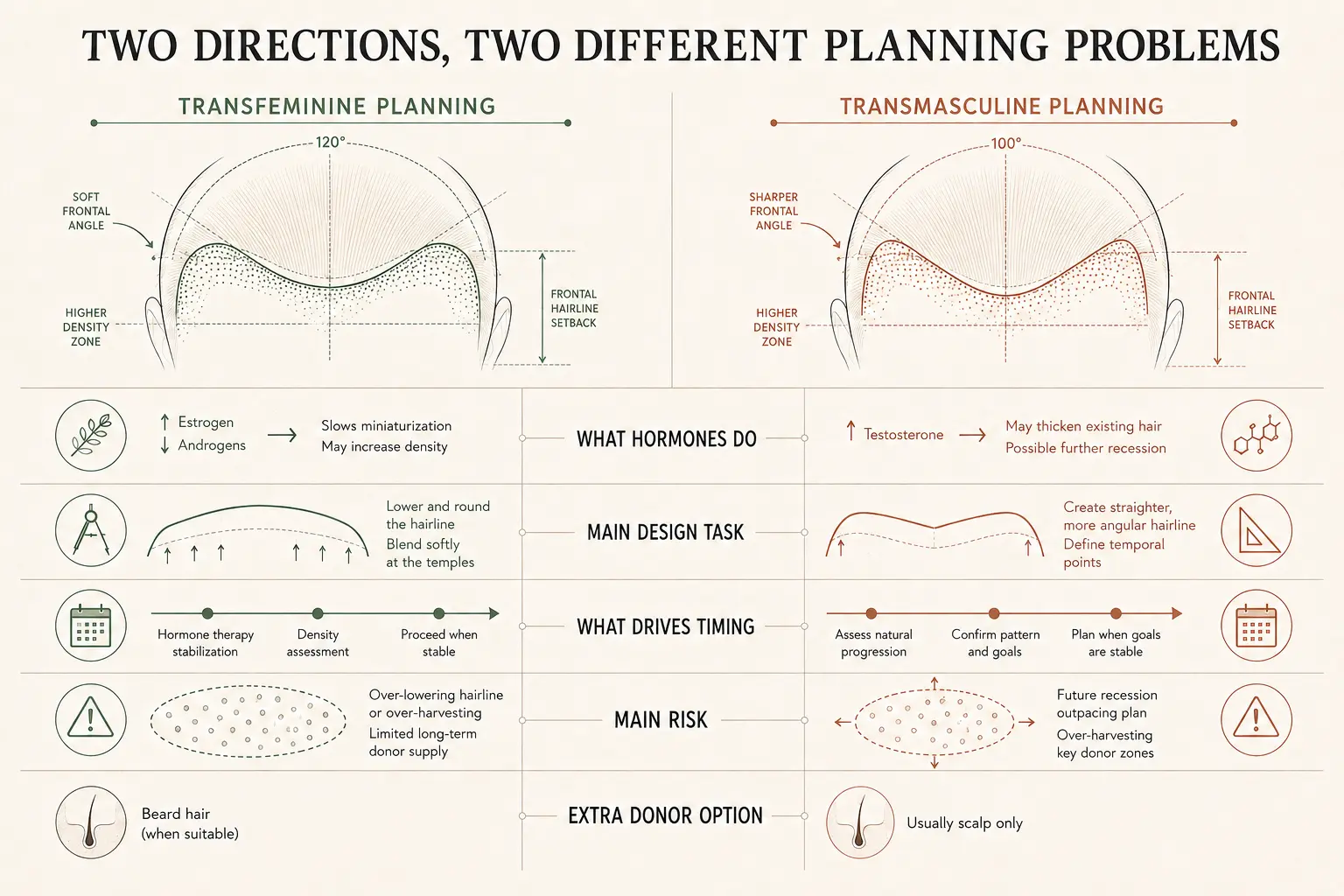
Hairline Feminization Is Not Simply Lowering the Hairline
This is the first misconception I would like to get rid of. A feminine hairline is not a masculine hairline moved two centimeters down.
If I only concentrate on lowering the center, I can miss the feature that is actually creating the masculine impression — which is very often the frontotemporal corners. Deep temporal recession creates an M-shaped frame. Softening those corners changes how the whole forehead relates to the rest of the face, and it frequently matters more than the central height.
So when we are drawing a hairline together, I usually find myself looking sideways while the patient is looking at the middle.
Everybody wants to measure the central point. Six and a half centimeters. Seven. Another three millimeters down. Those measurements have their uses, but faces are not built with rulers. What interests me more is how the central hairline travels into the corners and then into the temporal region. A small change there alters the character of the upper face far more than a few millimeters in the middle.
The published work on facial feminization supports treating this as a primary concern rather than a finishing touch. In a series of 65 patients undergoing forehead reconstruction, the authors describe the hairline pattern as the second most important feature for gender identification in the upper third of the face, after the forehead itself.
There Is No Single Female Hairline
The second mistake would be assuming every trans woman should receive the same low, perfectly rounded hairline.
Women do not all have the same hairline. Some have a subtle widow's peak, some more oval contours, some relatively high foreheads. There are natural asymmetries between the two temporal sides. The goal is not to erase every feature that could conceivably read as masculine — it is to build a hairline that belongs to that particular face.
I sometimes disagree with the first hairline a patient draws for herself, and that is completely normal. She may have spent years disliking a high or recessed hairline and understandably wants it as far forward as possible.
My job is to look past the first postoperative year. Lowering a hairline aggressively spends more follicles, enlarges the recipient area, and can create proportions that will not age naturally. There are times I would rather leave a few millimeters of forehead than spend several hundred extra grafts simply because we technically can — the same argument I make to cisgender men who want their hairline brought down as far as possible.
The lowest hairline I can create is not necessarily the best hairline I can create.
The Hairline Is Three-Dimensional
A line drawn on skin is only the beginning. What decides whether a transplant looks natural is how the hair leaves that skin.
The temporal regions are particularly unforgiving. Natural temporal hair exits at a very acute angle, and the direction shifts gradually as you move toward the frontal scalp. I can create exactly the right shape and still produce an obviously transplanted result if those hairs are implanted too vertically. The drawing was beautiful, the growth was excellent, and the outcome still reads as surgery.
Graft selection matters for the same reason. At the leading edge I want appropriate single-hair follicular units and a gradual transition. Thick multi-hair grafts announcing exactly where the hairline begins is the single most recognizable mistake in this work. Density should build as you move backward.
A natural hairline does not start like a fence.
This matters even more in feminization, because the temporal transitions are usually one of the areas we are deliberately changing.
What Hormones Can and Cannot Undo
When a transfeminine patient has recently started estrogen and anti-androgen therapy, I want to know what the hair has been doing — not just what it looks like today.
Whenever possible I ask for older photographs, usually covering the previous twelve to eighteen months. Not because eighteen months is a universal rule, but because one photograph tells me where the hair is, and several photographs tell me whether it is moving. That difference matters before we commit donor grafts.
There is reasonable evidence that feminizing hormone therapy helps. A 2025 study of transfeminine patients found that lateral forehead length was predicted to decrease by about 0.07 cm for each year of feminizing hormone therapy in patients over thirty — in other words, the lateral hairline tended to stabilize, and to a small degree recover, with longer treatment.
That is useful. It is not a promise that estrogen will rebuild temples that have been completely bald for many years.
If miniaturized follicles are still present, medical treatment may have something to work with. An area that has been fully bald for a long time is a different biological situation. That is why I sometimes suggest allowing time to see what medical treatment can preserve before finalizing a surgical plan — and other times I do not think waiting will change the surgical problem at all.
The scalp decides that, not the calendar.
Sometimes the Final Hairline Should Not Be the First One
Transition is not necessarily a single event. People transition socially, professionally, medically and surgically at different times.
Some patients I meet are already living entirely as women in every part of their lives. Others are earlier in the process, perhaps presenting differently at work than at home, or with other facial procedures still planned.
Where the patient prefers it, there are situations where I think about the hairline in stages. A first transplant restores recession and moves the shape toward something more neutral. Later, once plans and facial proportions have settled, we refine or feminize further.
I am not suggesting every transgender patient needs staged surgery — far from it. The point is that the option exists. Hair transplantation is permanent, and there is no reason to compress an entire aesthetic journey into one operation just because the grafts are technically available.
Sometimes the timing of surgery is part of the design.
Facial Feminization Surgery Changes My Plan
If facial feminization surgery is planned, I want to know before I draw anything.
Forehead reconstruction, hairline advancement, brow surgery and facelift procedures can all change either the position of the hairline or the tissue around it. Hair transplantation has been performed successfully at the same time as forehead reconstruction — the 65-patient series I mentioned earlier did exactly that, combining frontonaso-orbital reconstruction with hairline redefinition in a single operation.
Whether to combine or stage is an individual decision. Where substantial facial surgery is planned, there are many cases where I would rather know the final anatomy first: where the forehead now ends, where the hairline actually sits, and whether previous surgery has left scars that transplantation could soften. That is considerably easier than designing a definitive hairline around anatomy we already know is going to change.
For me, hair transplantation is often one of the last framing tools. Not the first.
When Advanced Hair Loss Is Also in the Picture
Now the harder cases.
A trans woman with a good donor area and little previous loss may need relatively modest work around the frontal and temporal hairline. But consider someone who lived with advanced androgenetic alopecia for years before transitioning. The frontal scalp is gone. The midscalp is thin or bald. The crown is open. And we still want a feminine frontal frame.
This is no longer hairline feminization. It is two problems competing for the same follicles: we need hair for the face, and we need hair for a very large scalp.
Donor hair is finite. Transplantation moves follicles; it does not manufacture them.
This is where honesty matters more than enthusiasm. If someone has donor resources that can realistically cover 80 cm², I cannot promise full density across 160 cm² because the patient wants it badly enough. I understand entirely why they want it. It does not change the arithmetic.
Spreading a limited donor across an enormous recipient area produces weak density everywhere and risks damaging the donor by pushing extraction too far. Then we have created two thin areas instead of one.
When Donor Is Limited, I Protect the Front
Not every part of the scalp carries the same visual value. The crown can consume an extraordinary number of grafts. The frontal hairline sits directly around the face.
So when donor is limited I build the strongest possible frontal framework first, then decide how far back we can responsibly continue. In feminizing work especially, a convincing frontal and temporal frame has an enormous visual effect, and a slightly denser crown cannot compensate for an underpowered front.
That may mean accepting lower density further back. It may mean planning a second operation. And occasionally it means concluding that transplantation alone is not the right way to solve every square centimeter of that scalp.
Beard Donor: Useful, but Not Interchangeable
Where the scalp donor is inadequate, beard follicles can supplement it. This is not experimental — published work describes body and beard hair as an additional donor resource in patients with extensive alopecia and insufficient scalp reserves.
But beard hair and scalp hair are not the same material, and that is the part people gloss over. The same work is explicit about it: transplanted body and beard hairs do not change their color, curl or shaft caliber. Donor dominance means a follicle largely keeps the characteristics of the area it came from.
So in a transfeminine patient I do not want a row of coarse beard grafts along a delicate frontal edge. My approach is simpler than it sounds: use the best scalp grafts to build the frame, then use beard follicles where appropriate to add visual mass behind it — parts of the midscalp or crown, sometimes blended with scalp follicles depending on the individual's hair characteristics.
Two thousand well-distributed follicles can be worth considerably more than three thousand placed in the wrong areas.
There is a second reason beard donor is interesting in this group. Many trans women already want less facial hair. Where a patient genuinely needs additional follicles for the scalp and wants reduced beard density, the two goals overlap usefully.
I want to be careful about how that is described, though. Beard FUE is not a replacement for laser hair removal or electrolysis. And extraction still has to leave a natural-looking donor area — I cannot empty sections of a beard simply because the patient would prefer less of it. The pattern and distribution rules still apply.
But it is one of the few situations in hair restoration where the extra donor happens to sit in an area the patient wanted thinned anyway.
When Surgery Alone Is Not the Answer
Surgeons do not particularly enjoy saying this. We are surgeons; we like solving things surgically.
But sometimes the donor simply is not enough. I have seen patients whose loss was extensive enough that producing the appearance of full female density through transplantation alone would have been unrealistic.
In those cases there is another option worth discussing openly: use transplantation to establish a strong, natural frontal hairline, and a high-quality hair system behind it. A hybrid approach.
The reason this works is that the hardest part of any hairpiece to reproduce convincingly is the exposed frontal hairline. If the patient's own transplanted hair creates that front, styling becomes far more forgiving, and the system can supply volume that a limited donor never physically could.
It is not right for everybody. But I would rather explain an honest hybrid than spend every available graft, deliver insufficient density and leave someone disappointed.
Surgery is a tool. It is not an obligation.
The Second Timeline Nobody Mentions: Length
Clinics talk endlessly about growth. Three months. Six months. Twelve months.
For many transfeminine patients there is a second timeline that matters just as much: how long is the hair?
Transplanted follicles eventually grow, but they start from essentially zero length. If the native hair is already thirty or forty centimeters, the transplant cannot catch up quickly. Even once the new hairs are growing perfectly well, they still have to physically become long enough to blend with everything around them.
That creates an awkward stage patients do not always anticipate. The transplant is doing exactly what it should biologically, while the new frontal hairs are still much shorter than the rest of the style. That is not poor growth. That is length.
Styling options improve over time — hairbands, clips, shorter transitional cuts, a hairstylist who understands what is happening. But there is no medical trick that makes a new hair shoulder-length in six months.
Hair keeps its own schedule. It has never shown much interest in ours.
Trans Men and Testosterone: A Moving Target
For trans men the challenge inverts. Someone may have had excellent scalp hair for decades, then start testosterone. If that person carries a strong genetic susceptibility to androgenetic alopecia, the pattern can begin to change.
The evidence here is worth stating precisely, because it is more moderate than the internet suggests. In a cohort of 988 patients starting masculinizing hormone therapy, documented androgenetic alopecia rose from 0.4% before treatment to 3.1% during a median 3.4 years of follow-up. The median time to diagnosis was 2.8 years, and the median age at diagnosis was 26.
So this is not something that happens to everyone, and where it does happen it usually is not immediate. Longer-term work tells the other half of the story: studies following trans men on testosterone for around a decade have documented progressive frontal and patterned loss in a proportion of patients.
Two things follow from that. Most trans men will not develop significant hair loss in the first couple of years. And you cannot reliably tell in advance which ones will.
A median of nearly three years before diagnosis is exactly why I treat an early, fast-moving scalp as a moving target rather than a surgical case.
If I transplant too early without understanding the direction of travel, I may create a beautiful frontal hairline while the native hair immediately behind it keeps disappearing. The grafts survive. The plan fails.
Early Recognition Beats Late Rescue
This is something hair medicine learned long before anyone was writing specifically about transgender restoration: our treatments are much better at preserving vulnerable hair than at rebuilding areas that have already miniaturized extensively.
So if a trans man notices clear progressive shedding, temporal recession or thinning after starting testosterone, ignoring it until transplantation becomes unavoidable is the worst available strategy. The earlier we understand what is happening, the more options remain.
Medical management has to be individualized and coordinated with whoever is managing the gender-affirming hormone therapy. Finasteride, dutasteride and minoxidil may all come up in those conversations, but I do not hand the same plan to every trans man.
The evidence base here is genuinely thin, and I would rather say so than imply otherwise. A 2025 case series of just three trans men taking finasteride for androgenetic alopecia reported improvement while explicitly flagging the need for further investigation into possible effects on some outcomes of testosterone therapy. Three patients is a signal, not a guideline.
Hair matters. But it is not my place to casually interfere with someone's broader gender-affirming treatment because I happen to be looking at their scalp. That is exactly why coordination matters.
How Much Recession Would Actually Bother You?
This is one of my more useful consultation questions, and no Norwood chart can answer it for me.
A trans man in his forties may look around, see plenty of men his age with moderate temporal recession, and find it completely unremarkable — even supportive of the appearance he wants. Another patient finds the same degree of recession deeply uncomfortable. Neither is wrong.
So I ask what he is actually prepared to live with. Not "what Norwood stage would you accept" — nobody talks like that outside a hair clinic. I mean visually. How much temple recession still feels like you? How important is crown coverage? Would you rather have a stronger front with less behind it? Do you want a distinctly masculine contour, or simply to keep the hair you are losing?
The same biological pattern can therefore justify two different, equally good designs.
A Masculine Hairline Still Has to Age
There is a related consultation issue I find genuinely interesting.
Imagine looking in the mirror for twenty-five or forty years at a relatively low hairline with little temporal recession, and then watching it mature after starting testosterone. Even if that degree of recession would look entirely ordinary on another man the same age, it can feel dramatic, because it is so unlike the face you have always known.
That deserves to be taken seriously. It does not automatically mean the right surgical response is to recreate exactly where the previous hairline sat.
A natural masculine hairline can include some frontotemporal recession, and age matters. The hairline I would design for a 22-year-old is not the one I would design for a 45-year-old. This is the same conversation I have with cisgender men: I do not want to give someone an eighteen-year-old's hairline that we then have to defend for the next forty years.
And if testosterone-related loss is progressing quickly, I become more conservative with the frontal design, not less. Committing hundreds of grafts to the lowest possible position today means those grafts are unavailable to follow the loss backward later. If extensive balding does develop, the same donor logic applies as anywhere else — I would rather build a strong frontal half and make deliberate compromises than spread everything thin and make accidental ones.
There Is No "Transgender FUE" or "Transgender DHI"
People search for these terms, so let me be direct: being transgender does not dictate the harvesting or implantation method.
FUE is a way of obtaining follicular units from the donor area. DHI generally describes implantation using implanter devices. Neither one determines whether a hairline should be masculine, feminine, neutral, higher, lower or more curved. That decision comes first — which is the same point I make about the DHI versus FUE marketing debate generally.
My order is: understand the hair loss, understand the donor, understand the patient's goal, design the hairline, then choose the tools that best execute that plan.
Doing it the other way round is marketing, not planning.
Donor Hair Is a Lifetime Budget
I say some version of this every week. The donor area is finite, and a graft moved today cannot be used again in five years.
So when someone asks whether we can "just add another 500 grafts," I am not only asking whether I can physically extract them. I am asking whether we will regret spending them.
A trans woman with extensive previous androgenetic alopecia may need midscalp or crown work later. A trans man with progressive testosterone-related loss may keep losing native hair behind the transplant. Younger patients in particular have decades of change ahead of them.
So yes, sometimes I deliberately leave good follicles in the donor.
The donor area is not a warehouse that has to be emptied during surgery. It is a lifetime reserve.
What I Want to Know in the Consultation
Before deciding whether someone is a good candidate, I want the whole picture:
- The current pattern of loss, and how quickly it has changed
- Older photographs wherever they exist
- Miniaturization in the native hair
- Scalp donor density, hair caliber and texture
- Beard characteristics, if beard donor is relevant
- Current gender-affirming hormone therapy and any other hair-loss medication
- Previous hair transplantation, and previous facial or forehead surgery
- Facial surgery still planned
- Preferred hairstyle and expected hair length
- The actual aesthetic goal — in the patient's own words
That last one matters most, and I want to hear it from them rather than assume it.
A trans woman may not want a traditionally feminine hairline. A trans man may not want a visibly mature masculine one. A non-binary patient may deliberately want something between the two. All of that is fine. It is not my job to decide what somebody's gender is supposed to look like. My job is to explain what the scalp can realistically do, and then translate their goal into a hairline that looks natural.
The Best Result Should Not Look Like a Transgender Hair Transplant
It should simply look like hair.
That sounds obvious, but it is worth saying, because the objective is not the most dramatic before-and-after photograph. I do not want people looking at a hairline and thinking "that is an impressive transplant." I would rather they never think about the transplant at all.
Maybe we filled deep temporal recession. Maybe we softened a frontal contour, or built a mature masculine hairline, or used scalp and beard donor in the same patient. Maybe the procedure was one stage in a much longer plan. None of that should be visible to someone meeting the patient later.
The hairline should simply make sense with the face.
Which is why I do not think this work needs a separate set of surgical tricks. It needs something harder to package and advertise: judgment.
Frequently Asked Questions
What is a transgender hair transplant?
Is an MTF hair transplant different from a normal hair transplant?
Does every trans woman need her hairline lowered?
What makes a hairline look more feminine?
Can estrogen regrow a receding hairline?
Should I wait after starting estrogen before having a hair transplant?
Can beard hair be used for a transgender hair transplant?
Can beard hair be used in a feminine frontal hairline?
Does beard FUE reduce facial hair?
Can a hair transplant be combined with facial feminization surgery?
Can testosterone cause hair loss in trans men?
How quickly does hair loss develop after starting testosterone?
Should a trans man have a hair transplant as soon as recession begins?
Should a trans man's hairline go where his original hairline was?
Can trans men take finasteride?
Do transgender patients need DHI instead of FUE?
What happens if there is not enough donor hair?
How many surgeries does it take?
How long before transplanted hair blends with long hair?
— Dr. Mesut Demir
Planning a transgender hair transplant?
Send us photographs of your hairline and donor area, tell us where you are with hormone therapy and any facial surgery you have had or are planning. We will tell you honestly what your donor can support, whether now is the right time, and when waiting would serve you better.
Request a Case Review- Thoreson N, Grasso C, Potter J, et al. Incidence and factors associated with androgenetic alopecia among transgender and gender-diverse patients treated with masculinizing hormone therapy. JAMA Dermatology. 2021;157(3):348–349. Cohort of 988 patients; AGA 0.4% before to 3.1% after, median 2.8 years to diagnosis. doi:10.1001/jamadermatol.2020.5475
- Nguyen NH, Taylor JM, Huang KX, Lee JC. Estrogen hormone therapy stabilizes lateral hairline in transfeminine patients: implications for facial feminization surgery. Journal of Plastic, Reconstructive & Aesthetic Surgery. 2025. doi:10.1016/j.bjps.2024.07.044
- Wierckx K, Van de Peer F, Verhaeghe E, et al. Short- and long-term clinical skin effects of testosterone treatment in trans men. The Journal of Sexual Medicine. 2014;11(1):222–229. doi:10.1111/jsm.12366
- Tominaga Y, et al. The safety and efficacy of finasteride for transgender men with androgenetic alopecia: a case series. 2025. Three patients. doi:10.1186/s13256-025-05562-y
- Capitán L, Simon D, Kaye K, Tenorio T. Facial feminization surgery: simultaneous hair transplant during forehead reconstruction. Plastic and Reconstructive Surgery. 2017;139(3):573–584. Series of 65 patients. doi:10.1097/PRS.0000000000003149
- Poswal A. Use of body and beard donor hair in surgical treatment of androgenic alopecia. Indian Journal of Plastic Surgery. 2013;46(1):117–120. doi:10.4103/0970-0358.113728
- Hair Transplantation. StatPearls, NCBI Bookshelf. Updated 2025. NBK547740
Note on the evidence. Research specific to hair restoration in transgender patients is still limited, and some of the work cited here involves small numbers — the finasteride report is a three-patient case series. Where the evidence is thin, this article says so rather than rounding it up. Surgical and medical decisions should be made individually, and in coordination with the clinician managing your gender-affirming hormone therapy.