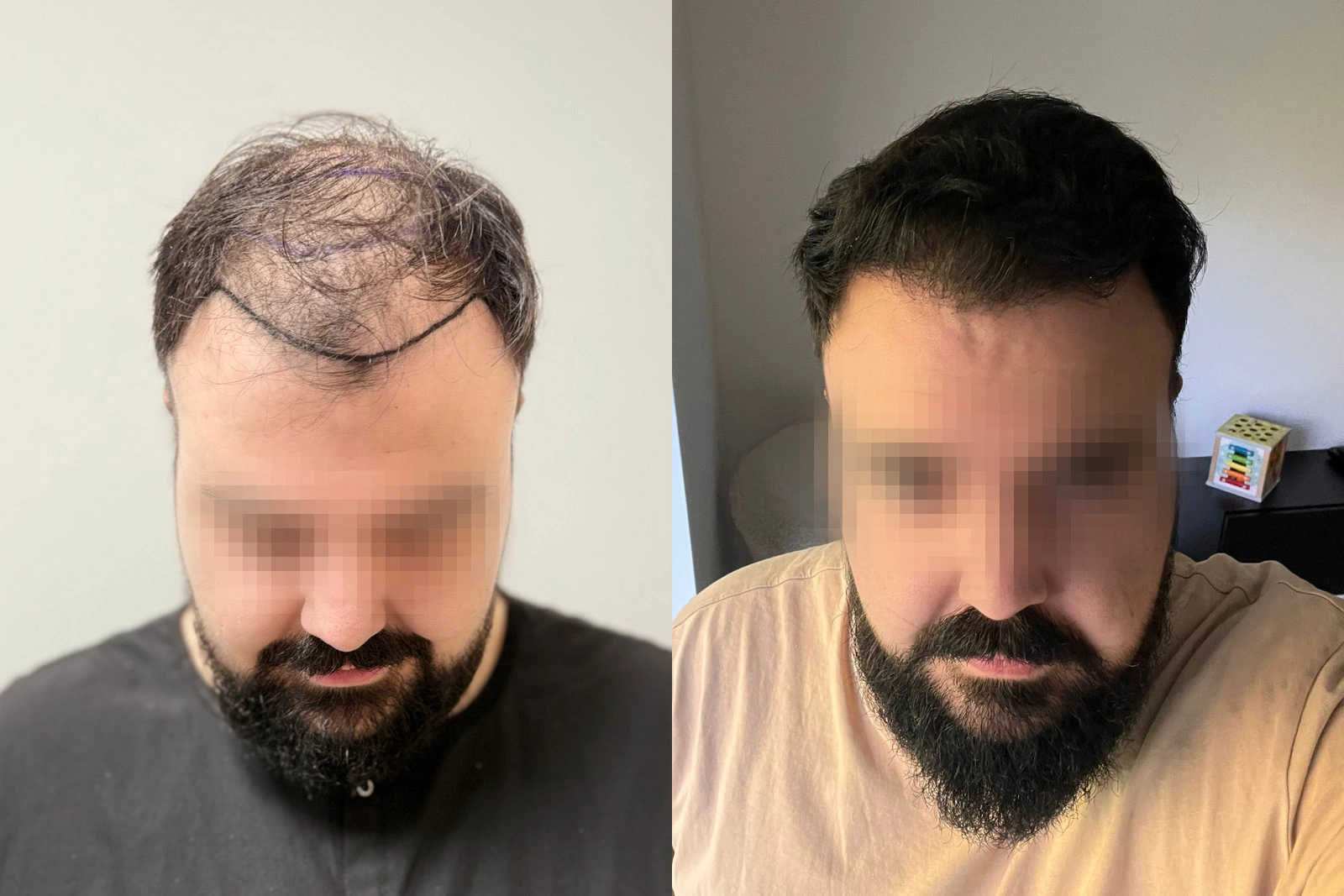
 Before
After
Before
After
The patient still had hair throughout the frontal region and mid-scalp before surgery, but much of it had become thin and widely spaced enough for the scalp to show through.
The patient did not start with an empty frontal scalp. He started with a see-through one.
The procedure was planned to strengthen that weakened frontal and mid-scalp area. The patient had not previously used finasteride or minoxidil and began both after surgery.
Case summary
| Clinical detail | This case |
|---|---|
| Norwood stage before surgery | Norwood V |
| Technique | FUE |
| Total grafts | 3,804 |
| Transplanted hair count | At least 8,407 |
| Single-hair grafts | 688 |
| Double-hair grafts | 1,629 |
| Multi-hair grafts | 1,487 |
| Treatment areas | Frontal region and mid-scalp |
| Crown transplanted | No |
| Follow-up shown | 11 months |
| Previous finasteride/minoxidil use | No |
| Finasteride after surgery | Yes |
| Minoxidil after surgery | Yes |
Across our case library, follicular units containing three or more hairs are described as multi-hair grafts.
Treatment planning
Before surgery, the hair loss was classified as Norwood V.
The frontal region and mid-scalp were treated as a continuous area of thinning.
Pre-operative donor assessment did not identify diffuse donor miniaturization that would have changed the surgical plan.
The plan took both the remaining native hair and the areas of visible scalp into account, with the aim of improving overall coverage through the front and mid-scalp.
What does “see-through thinning” mean in this case?
Hair was still present across much of the treatment area, but the spacing and thinning of those hairs had reduced their cosmetic value. From above, scalp visibility had become one of the most noticeable features of the patient’s hair loss.
This differs from our 3,078-graft case transplanted between existing hair. In that patient, the remaining native hair still provided a useful framework, and grafts were added carefully between follicles worth preserving.
Here, existing hair was also present, but much of it no longer provided reliable coverage on its own. The transplant therefore had to strengthen a broader thinning zone.
Graft composition
The 3,804 transplanted grafts consisted of 688 single-hair grafts, 1,629 double-hair grafts and 1,487 multi-hair grafts.
Based on the recorded composition, the procedure involved at least 8,407 individual hairs:
- 688 single-hair grafts contributed 688 hairs
- 1,629 double-hair grafts contributed 3,258 hairs
- 1,487 multi-hair grafts contributed at least 4,461 hairs
The true number may have been higher because our multi-hair category includes follicular units containing three or more hairs.
Across our case library, we do not assign exact retrospective graft counts to the frontal region, mid-scalp or crown when treatment-zone boundaries overlap. Doing so would imply a level of precision that the surgical distribution does not support.
Was the crown transplanted?
No. The crown also showed thinning but was not grafted in this session; all 3,804 grafts went to the frontal region and mid-scalp, the zone of see-through thinning.
The 11-month result
At 11 months, the follow-up photograph shows much greater visible frontal coverage.
The two photographs are not equivalent views. The pre-operative image was taken with the head tilted forward and from a higher angle, exposing more of the top of the scalp and making the see-through thinning particularly easy to see.
The follow-up photograph is a more frontal selfie and does not reproduce that same overhead view.
The pre-operative hair also appears flatter and more separated. From the photograph alone, we cannot reliably determine whether it was damp, styled differently or simply affected by the lighting, so we do not assign a cause.
The follow-up hair is longer and styled differently as well.
Because the most revealing pre-operative angle was not repeated at 11 months, these photographs support a cosmetic improvement in frontal coverage, but they cannot provide a controlled comparison of the full mid-scalp or an exact measurement of density or graft survival.
Finasteride and minoxidil after surgery
The patient had not used finasteride or minoxidil before surgery and started both afterward.
Medical treatment is relevant when interpreting the follow-up because native hair remained throughout the treated regions.
For a more detailed discussion of how post-operative finasteride and minoxidil can affect the interpretation of existing native hair, see our 3,853-graft FUE case with post-operative medical treatment.
How can two almost identical graft counts describe different cases?
This patient received 3,804 grafts, almost exactly the same number as our 3,802-graft FUE case with at least 8,672 hairs.
The similarity ends quickly once the case details are examined.
In the 3,802-graft case, the donor area naturally contained a particularly high proportion of multi-hair follicular units, and miniaturized crown hair was managed medically.
Here, the defining problem was broad see-through thinning across the frontal region and mid-scalp. Hair remained across the area, but much of it had lost enough caliber and coverage for the scalp to remain clearly visible.
Nearly identical graft totals can therefore represent very different starting conditions, donor characteristics and treatment plans.
What this case shows
The patient had hair across the whole treatment area before surgery, just not enough of it to hide the scalp. The transplant used 3,804 grafts, carrying at least 8,407 hairs (688 single, 1,629 double and 1,487 multi-hair units), to thicken that zone as one continuous area.
Set beside the 3,802-graft case, it shows how little a graft total says on its own. The two numbers are almost identical, and the starting points were very different. Finasteride and minoxidil were started after surgery, so the native hair’s response is part of what the 11-month photograph shows.
Dr. Mesut Demir’s note
“There was still a lot of hair in the frontal region and mid-scalp, but much of it had become too thin to give useful coverage.
We needed to strengthen the thinning area as a whole and work around the native follicles that were still present. The donor assessment was also important because with this type of thinning we want to be sure the donor itself is suitable before planning surgery.
He started finasteride and minoxidil after the transplant to support the native hair that remained.”
Dr. Mesut Demir · Pure Line, Istanbul
About this result
This page documents an individual patient’s result at 11 months.
Individual results vary with donor capacity, hair characteristics, hair loss progression, healing and treatment.
The photographs document this patient’s outcome and should not be interpreted as a guarantee that another patient will achieve the same result.
The patient gave written consent for these photographs to be published.
Information about medication on this page describes this individual’s treatment history and is not a recommendation or prescription for another patient. Medication decisions should be made individually with an appropriate clinician.
Medically reviewed by Dr. Mesut Demir, M.D. ·
What is realistic for your case?
Send clear photos of your hairline, crown, and donor area. We will review what can be planned safely and whether surgery makes sense at this stage.
Review My Case