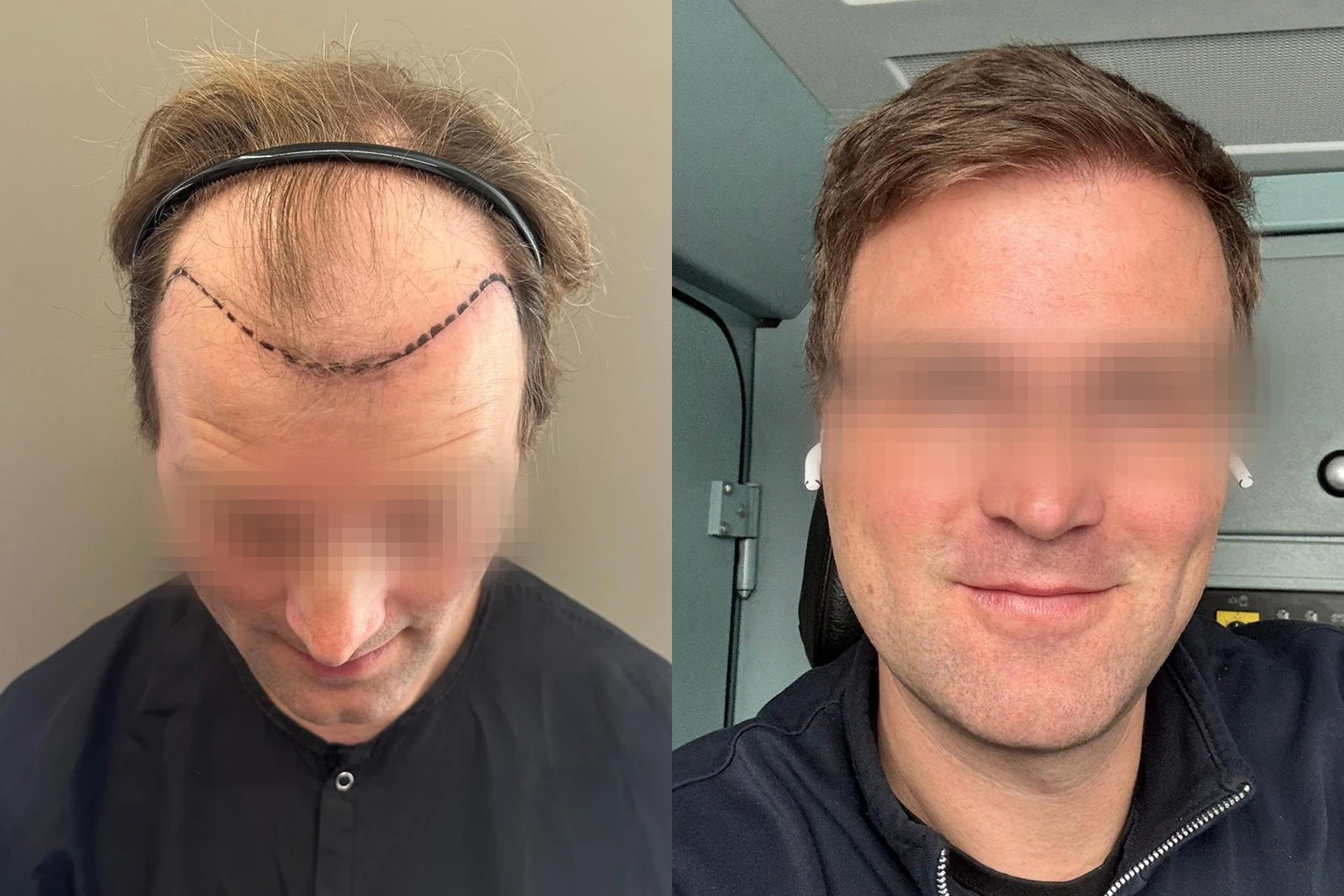
 Before
After
Before
After
The procedure focused on the frontal region and mid-scalp. According to the operative record, the 4,450 transplanted follicular units contained exactly 9,201 individual hairs.
After surgery, finasteride and minoxidil were discussed with the patient. He chose not to use either treatment and preferred PRP as his adjunctive treatment.
Case summary
| Clinical detail | This case |
|---|---|
| Norwood stage before surgery | Norwood V |
| Technique | FUE |
| Total grafts | 4,450 |
| Transplanted hair count | 9,201 |
| Single-hair grafts | 600 |
| Double-hair grafts | 2,949 |
| Multi-hair grafts | 901 |
| Treatment areas | Frontal region and mid-scalp |
| Crown transplanted | No |
| Follow-up shown | 12 months |
| Finasteride after surgery | No |
| Minoxidil after surgery | No |
Across our case library, follicular units containing three or more hairs are described as multi-hair grafts. All 901 multi-hair grafts in this case were recorded as triple-hair units.
Treatment planning
Before surgery, the hair loss was classified as Norwood V.
The pre-operative photograph shows frontal recession with thinning continuing behind the hairline into the mid-scalp.
The treatment was therefore planned across the frontal region and mid-scalp. The pre-operative drawing shows the intended frontal position and shape before graft placement.
The graft composition provided a large number of double- and triple-hair follicular units for areas where greater hair mass was needed behind the leading edge, while single-hair units were available for the softer frontal transition.
Graft composition: what did 4,450 grafts contain?
The operative record gives us an unusually precise hair count because the multi-hair units in this procedure were all recorded as triples.
The 4,450 transplanted grafts consisted of 600 single-hair grafts, 2,949 double-hair grafts and 901 triple-hair grafts, which together contained exactly 9,201 individual hairs:
- 600 single-hair grafts contributed 600 hairs
- 2,949 double-hair grafts contributed 5,898 hairs
- 901 triple-hair grafts contributed 2,703 hairs
The 9,201 transplanted hairs can therefore be calculated directly from the recorded graft composition.
This differs from cases where the multi-hair category contains an unknown mixture of follicular units with three or more hairs. In those cases, we report a calculated minimum rather than an exact figure.
For broader comparisons of graft totals, transplanted hair counts, treatment areas and follow-up periods, see our hair transplant results library.
Across our case library, we do not assign exact retrospective graft counts to the frontal region, mid-scalp or crown when treatment-zone boundaries overlap. Doing so would imply a level of precision that the surgical distribution does not support.
Was the crown transplanted?
No. The crown also showed thinning but was not grafted in this session; all 4,450 grafts went to the frontal region and mid-scalp.
The 12-month result
At 12 months, the follow-up photograph shows substantially greater visible frontal coverage.
The photographs were taken under quite different conditions.
In the pre-operative image, the patient’s hair is held back with a headband, leaving the frontal hairline and scalp fully exposed. His head is also tilted forward and the photograph is taken from a higher angle. These conditions make the extent of the original recession and thinning particularly easy to see.
The follow-up photograph is more frontal, without the headband, and the hair is longer and styled differently. The frontal hairline remains visible, but the image does not reproduce the same degree of scalp exposure as the pre-operative photograph.
Lighting, hair position and camera angle also differ. The photographs therefore document the cosmetic change in the frontal region but cannot provide an exact measurement of density gain or graft survival. The full mid-scalp also cannot be compared under identical photographic conditions.
No finasteride or minoxidil
The patient chose not to use finasteride or minoxidil after surgery and preferred PRP as his adjunctive treatment.
The photograph documents his appearance at 12 months under those treatment choices. It does not tell us how his remaining native hair will behave over a longer period.
For a fuller discussion of longer-term considerations when finasteride or minoxidil are not used, see our 4,610-graft FUE case without finasteride or minoxidil.
Where does PRP fit into this case?
PRP was the adjunctive treatment chosen by this patient.
This individual result cannot show how much, if anything, PRP contributed to the appearance at 12 months. There is no untreated comparison within the same patient that would allow the effects of transplanted growth, normal healing, native-hair changes and PRP to be separated.
A 2025 systematic review evaluated three controlled prospective studies involving 217 participants, including two randomized controlled trials and one non-randomized controlled study. All three reported better outcomes when PRP was added to hair transplantation, including findings related to hair density, follicle survival and earlier growth. However, the studies used substantially different PRP preparation methods, treatment protocols and outcome measures, and none used standardized evaluation tools or trichoscopic analysis. The authors concluded that the evidence is promising but that better-standardized randomized trials with longer follow-up are still needed.
Reference: Sindhusen S, Tawanwongsri W, Eden C. Efficacy of platelet-rich plasma as an adjunct to hair transplantation: a systematic review. Cureus. 2025;17(10):e94116. doi:10.7759/cureus.94116
What this case shows
Most of our case pages give a minimum hair count. This one can give an exact figure, 9,201, because the operative record lists every multi-hair graft as a triple: 600 single, 2,949 double and 901 triple-hair units across 4,450 grafts.
The patient went with PRP after surgery and left finasteride and minoxidil aside. The 12-month photograph records his result under those choices; it cannot say what PRP added, or how his native hair will behave over the coming years.
Dr. Mesut Demir’s note
“This patient preferred PRP and chose not to use finasteride or minoxidil after surgery. At the 12-month follow-up, he was satisfied with his result.
We also continue to follow the patient’s existing native hair over time, because the appearance of the transplant and the future progression of the remaining hair are separate parts of long-term follow-up.”
Dr. Mesut Demir · Pure Line, Istanbul
About this result
This page documents an individual patient’s result at 12 months.
Individual results vary with donor capacity, hair characteristics, hair loss progression, healing and treatment.
The photographs document this patient’s outcome and should not be interpreted as a guarantee that another patient will achieve the same result.
The patient gave written consent for these photographs to be published.
Information about medication on this page describes this individual’s treatment history and is not a recommendation or prescription for another patient. Medication decisions should be made individually with an appropriate clinician.
Medically reviewed by Dr. Mesut Demir, M.D. ·
What is realistic for your case?
Send clear photos of your hairline, crown, and donor area. We will review what can be planned safely and whether surgery makes sense at this stage.
Review My Case