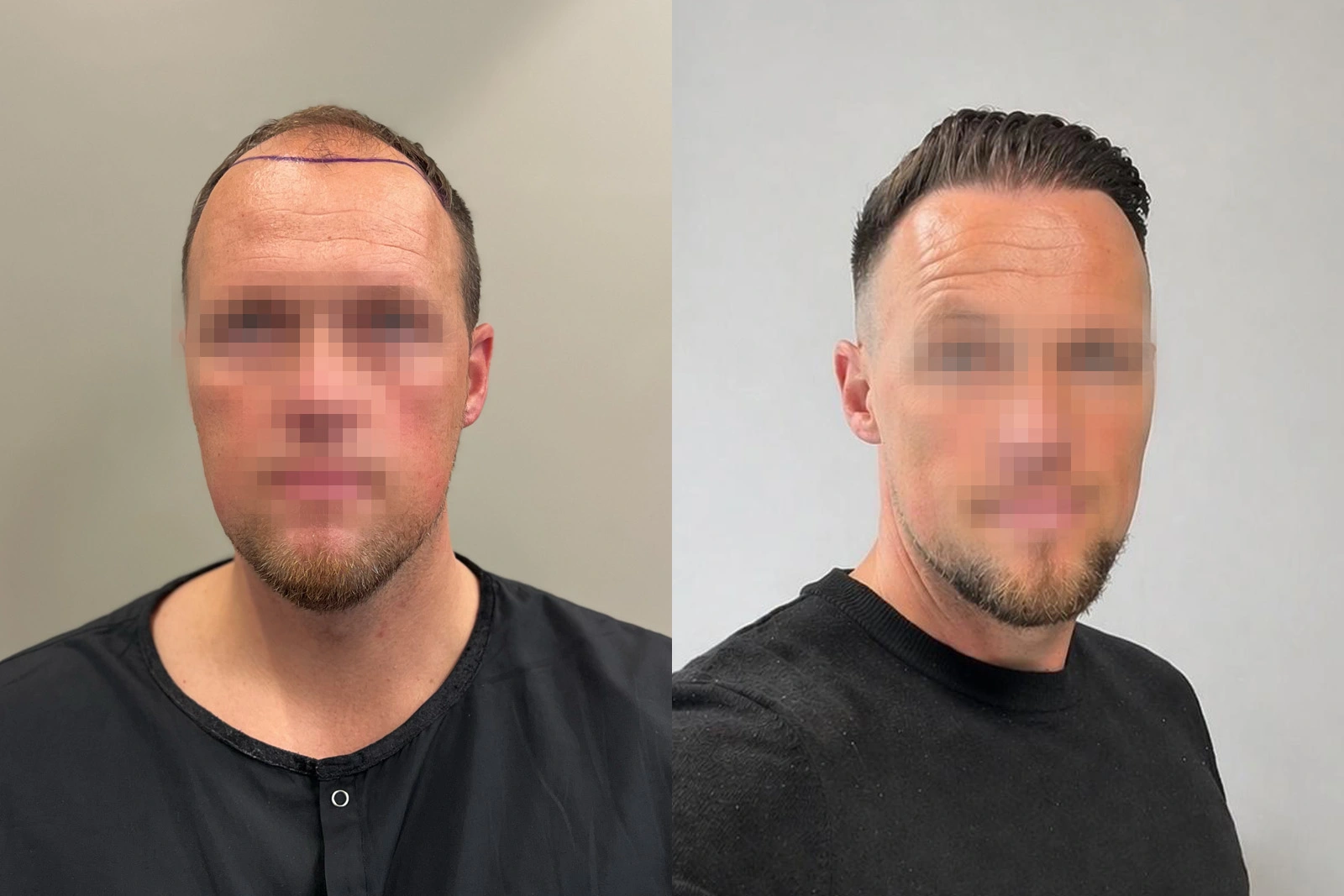
 Before
After
Before
After
The line visible in the pre-operative photograph is the hairline design drawn before surgery. It shows the planned position of the new frontal frame rather than a scar or skin change.
The patient had not previously used finasteride or minoxidil. Both treatments were introduced after the procedure as part of the plan to support his remaining native hair.
Case summary
| Clinical detail | This case |
|---|---|
| Norwood stage before surgery | Norwood IIIA |
| Technique | FUE |
| Total grafts | 3,853 |
| Transplanted hair count | At least 8,095 |
| Single-hair grafts | 752 |
| Double-hair grafts | 1,960 |
| Multi-hair grafts | 1,141 |
| Treatment areas | Frontal region and mid-scalp |
| Crown transplanted | No |
| Follow-up shown | 12 months |
| Finasteride after surgery | Yes |
| Minoxidil after surgery | Yes |
| Previous finasteride/minoxidil use | No |
Across our case library, follicular units containing three or more hairs are described as multi-hair grafts.
Treatment planning
Before surgery, the hair loss was classified as Norwood IIIA.
The patient’s hair loss was not limited to the leading edge of the hairline.
There was frontal recession together with reduced coverage extending behind it. Reconstructing only the hairline could therefore have created a stronger frontal edge while leaving a visibly weaker area immediately behind it.
The surgical plan treated the frontal region and mid-scalp as a connected restoration zone, rather than approaching the hairline as an isolated line.
The photograph on this page primarily demonstrates the frontal change. The mid-scalp was also transplanted during the procedure, although it is not fully visible from this photographic angle.
Graft composition
A total of 3,853 follicular-unit grafts were transplanted: 752 single-hair grafts, 1,960 double-hair grafts and 1,141 multi-hair grafts.
This breakdown provides more useful information than the total graft count alone. Two procedures using a similar number of grafts may contain very different numbers of individual hairs depending on the patient’s follicular-unit composition.
Single-hair grafts are particularly useful around the leading edge of a hairline, where a softer transition is required, while follicular units containing more hairs can contribute greater hair mass further behind the frontal edge.
Was the crown transplanted?
No. No grafts were transplanted into the crown during this procedure.
The patient still had a substantial amount of native hair in the crown, so donor grafts were prioritized for the frontal and mid-scalp regions.
After surgery, the patient started finasteride and minoxidil for the first time. At the 12-month follow-up, the crown appeared stronger despite receiving no transplanted grafts. This change is consistent with an improvement in existing native hair rather than transplanted growth.
The same distinction also matters in the transplanted areas. Native hair remained within parts of the mid-scalp, so the appearance at 12 months may reflect both transplanted growth and changes in the patient’s pre-existing hair after starting medical treatment. It is not possible to separate those contributions precisely from photographs alone.
The patient did not report medication-related side effects during the follow-up period. This is an observation from this individual case and should not be interpreted as meaning that finasteride or minoxidil are free of potential side effects. Medical treatment should be discussed with an appropriate physician.
The 12-month result
At 12 months, the most obvious visible change is the restoration of the frontal frame.
Before surgery, recession had substantially weakened the frontal hairline. At follow-up, there is considerably greater coverage across the treated frontal region, allowing the patient to wear the hair directed backward without relying on a forward hairstyle to conceal the recession.
The pre-operative hairline drawing also provides a useful reference for comparing the planned frontal position with the position of the transplanted hair at 12 months.
Because the before and after photographs were taken from somewhat different angles and with different hairstyles, they should be interpreted as documentation of the overall cosmetic change rather than as a method for calculating an exact percentage increase in density or graft survival.
What this case shows
This case illustrates why a hair transplant result should not be judged by graft count alone.
The procedure used 3,853 grafts: 752 single-hair, 1,960 double-hair and 1,141 multi-hair follicular units. These grafts were directed to the frontal and mid-scalp regions, while the crown was left surgically untreated because a substantial amount of native hair remained.
It also demonstrates an important limitation when interpreting before-and-after photographs: when a patient begins medical treatment around the same time as surgery, changes in existing native hair can contribute to the final appearance alongside transplanted growth.
Dr. Mesut Demir’s note
“The crown still contained a good amount of native hair, so we did not need to use donor grafts there at this stage. The priority was the frontal area and the thinning behind it.
We also wanted to preserve the patient’s existing hair rather than treating every area surgically. This is an important part of planning because transplantation and preservation of native hair should be considered together.”
Dr. Mesut Demir · Pure Line, Istanbul
About this result
This page documents an individual patient’s result at 12 months.
Individual results vary with donor capacity, hair characteristics, hair loss progression, healing and treatment.
The photographs document this patient’s individual outcome and should not be interpreted as a guarantee that another patient will achieve the same result.
The patient gave written consent for these photographs to be published.
Information about medication on this page describes this individual’s treatment history and is not a recommendation or prescription for another patient. Medication decisions should be made individually with an appropriate clinician.
Medically reviewed by Dr. Mesut Demir, M.D. ·
What is realistic for your case?
Send clear photos of your hairline, crown, and donor area. We will review what can be planned safely and whether surgery makes sense at this stage.
Review My Case