
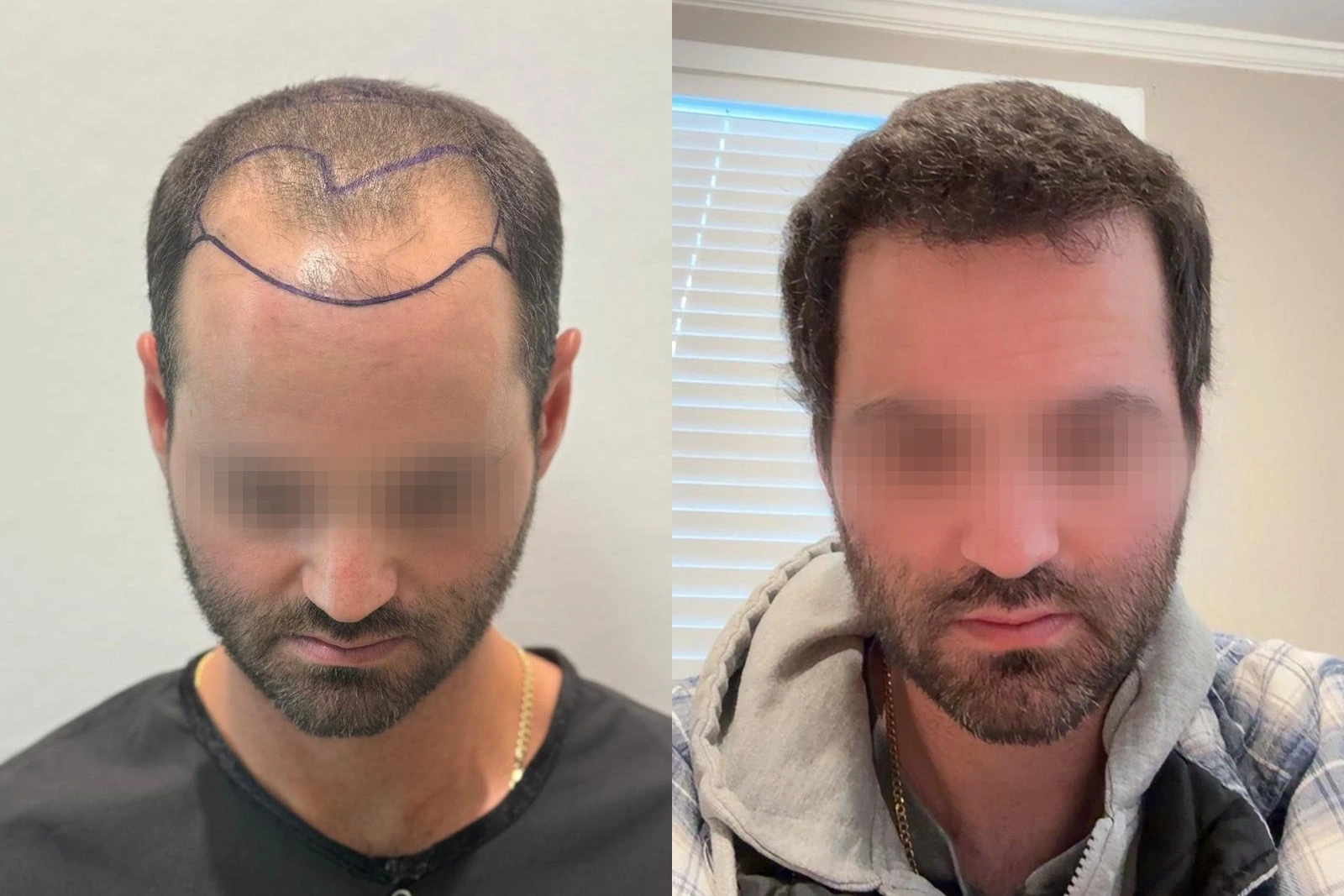
 Before
After
Before
After
The procedure was planned across the frontal region and mid-scalp, rather than as a limited temple-filling procedure. The pre-operative photograph shows the hairline design drawn before surgery.
The patient had not used finasteride or minoxidil before the transplant. Both were discussed after surgery, but he chose not to use either treatment.
Case summary
| Clinical detail | This case |
|---|---|
| Norwood stage before surgery | Norwood IV |
| Technique | FUE |
| Total grafts | 4,065 |
| Transplanted hair count | At least 8,915 |
| Single-hair grafts | 660 |
| Double-hair grafts | 1,960 |
| Multi-hair grafts | 1,445 |
| Treatment areas | Frontal region and mid-scalp |
| Crown transplanted | No |
| Follow-up shown | 8 months |
| Previous finasteride/minoxidil use | No |
| Finasteride after surgery | No |
| Minoxidil after surgery | No |
Across our case library, follicular units containing three or more hairs are described as multi-hair grafts.
Treatment planning
Before surgery, the hair loss was classified as Norwood IV.
The recession extended beyond the temporal corners into the central frontal region, with thinning continuing further back.
The treatment was therefore planned as a broader frontal and mid-scalp restoration rather than simply filling the corners.
Graft composition
The 4,065 transplanted grafts consisted of 660 single-hair grafts, 1,960 double-hair grafts and 1,445 multi-hair grafts.
Based on the recorded composition, those grafts contained at least 8,915 individual hairs:
- 660 single-hair grafts contributed 660 hairs
- 1,960 double-hair grafts contributed 3,920 hairs
- 1,445 multi-hair grafts contributed at least 4,335 hairs
The true number may have been higher because our multi-hair category includes follicular units containing three or more hairs.
Around 35.5% of the transplanted grafts were multi-hair units. The final coverage produced by those hairs also depends on factors such as hair caliber, placement, survival and the characteristics of the recipient area.
Across our case library, we do not assign exact retrospective graft counts to the frontal region, mid-scalp or crown when treatment-zone boundaries overlap.
Was the crown transplanted?
No. The crown was not grafted; all 4,065 grafts went to the frontal region and mid-scalp, which the plan treated as one restoration rather than a corner fill.
The 8-month result
At eight months, the follow-up photograph already shows a substantial increase in visible frontal coverage.
This patient developed a strong cosmetic change relatively early, but the timing should be read as an individual result rather than an eight-month benchmark. Other patients may still be developing at the same stage and continue to gain coverage and hair-shaft maturity over the following months.
The follow-up hair is considerably longer and falls forward over the forehead. This adds to the appearance of coverage while also concealing much of the final hairline. The pre-operative hairline drawing and the final hairline therefore cannot be compared directly from these two photographs.
The published image is also primarily a frontal view. Although the mid-scalp was treated surgically, this photograph does not provide a complete view of that area.
Differences in hair length, styling, head position and lighting mean that the photographs cannot be used to calculate an exact increase in density or graft-survival percentage.
The photograph documents the patient’s progress at 8 months, with further maturation still possible.
No finasteride or minoxidil
The patient had not used finasteride or minoxidil before surgery and chose not to begin either treatment afterward, despite medical treatment being discussed with him.
That matters when reading this result because the visible eight-month change was not accompanied by newly introduced finasteride or minoxidil.
For a more detailed example of a patient who also chose not to use either treatment, see our 4,610-graft FUE case without finasteride or minoxidil, where we discuss the longer-term implications for native hair in more detail.
What this case shows
The photograph shows the cosmetic change at eight months. The surgical record adds the numbers behind it: 4,065 grafts containing at least 8,915 individual hairs, made up of 660 single-hair, 1,960 double-hair and 1,445 multi-hair follicular units.
That information gives more context than the graft count alone and allows this result to be compared more meaningfully with other documented cases in the library.
No finasteride or minoxidil was started after surgery, so the frontal change seen at eight months came without new medical treatment. The pace was this patient’s own; others may still be filling in at the same stage.
Dr. Mesut Demir’s note
“This patient showed strong visible development by the eighth month, but patients do not all mature at the same speed. Some look very developed at this stage, while others need several more months.
The recession also involved more than the corners, so the procedure was planned across the frontal region and mid-scalp rather than as a limited hairline treatment.”
Dr. Mesut Demir · Pure Line, Istanbul
About this result
This page documents an individual patient’s result at 8 months.
Individual results vary with donor capacity, hair characteristics, hair loss progression, healing and treatment.
The photographs document this patient’s outcome and should not be interpreted as a guarantee that another patient will achieve the same result.
The patient gave written consent for these photographs to be published.
Information about medication on this page describes this individual’s treatment history and is not a recommendation or prescription for another patient. Medication decisions should be made individually with an appropriate clinician.
Medically reviewed by Dr. Mesut Demir, M.D. ·
What is realistic for your case?
Send clear photos of your hairline, crown, and donor area. We will review what can be planned safely and whether surgery makes sense at this stage.
Review My Case