Quick answer
Sapphire FUE is conventional follicular unit excision (FUE) combined with sapphire blades for creating recipient sites. Sapphire is an exceptionally hard material, but current clinical evidence does not establish that it consistently produces better hair growth, faster healing, or more natural results than appropriately used stainless steel blades. At Pure Line, we used sapphire blades routinely for years but did not observe a consistent clinical advantage that we could attribute specifically to the material. We now generally prefer custom-cut stainless steel blades. For us, the greater priority is how recipient sites are planned: their angle, direction, distribution, and contribution to natural-looking coverage.
When patients research hair transplantation, they often encounter the term Sapphire FUE long before they understand what FUE actually means.
Some clinics describe sapphire as a major surgical advancement, claiming smaller wounds, faster recovery, higher graft survival, and greater density. Others dismiss it as little more than a marketing invention.
I don't think either position tells the whole story.
Sapphire is a genuine surgical material with physical properties that distinguish it from stainless steel. Different blade designs can influence the way recipient sites are created, and those differences deserve consideration.
But a material having certain advantages is not the same as demonstrating that it produces a better hair transplant.
We have used both sapphire and stainless steel blades at Pure Line. Our current preference developed through years of practical experience, not a belief that one material is inherently superior in every situation.
There is also a question I consider more important than the choice of blade: How effectively are the available grafts arranged to create natural-looking coverage?
Two patients can receive similar numbers of grafts and achieve very different cosmetic results. Hair caliber, follicular-unit composition, angles, directions, and graft distribution all contribute to that difference.
Understanding these factors is much more useful than choosing a procedure based on the name of its instrument.
1. What Is Sapphire FUE?
Sapphire FUE refers to an FUE hair transplant in which sapphire-tipped blades are used to create openings in the recipient scalp.
These openings, called recipient sites, determine where the transplanted follicular units will be placed.
A conventional FUE procedure generally involves three stages:
- Donor harvesting: Individual follicular units are removed from the donor area using small FUE punches.
- Recipient-site creation: Openings are made in the areas requiring restoration using appropriately selected blades or other instruments.
- Graft implantation: The harvested follicular units are placed into the recipient sites according to the surgical design.
The word sapphire describes the material used for creating recipient sites. It does not describe how follicles are extracted from the donor area.
This distinction matters.
In its article Why FUE Is So Confusing, the International Society of Hair Restoration Surgery (ISHRS) describes FUE as a donor-harvesting method and DHI as an implantation technique using sharp implanters, not a different method of extracting follicles.[1]
The article was originally published on July 7, 2019, and updated on January 18, 2024. It discusses confusing terminology in hair transplantation but does not specifically evaluate sapphire blades.
A procedure using sapphire and one using stainless steel may therefore involve the same FUE harvesting process, graft preparation, and transplantation principles.
The distinction lies primarily in the instrument used to create the recipient sites.
For a more detailed explanation of harvesting and implantation techniques, see our articles on FUE hair transplantation and DHI vs. FUE.
2. Sapphire vs. Stainless Steel: What Actually Changes?
Synthetic sapphire is crystalline aluminum oxide. It is exceptionally hard and resistant to wear.
Stainless steel is generally less hard, but it can be manufactured into very thin blades with different widths and cutting geometries. Steel blades are also relatively inexpensive and can be replaced whenever their cutting edges become less effective.
Both materials can be used to create recipient sites. Their physical characteristics differ, but those differences do not automatically translate into different clinical outcomes.
Hardness is not the same as precision
Sapphire's resistance to wear may help maintain its cutting characteristics during repeated use. Stainless steel edges can dull more readily, depending on the blade and the tissue being treated.
However, steel microblades can be replaced throughout a procedure. A fresh, appropriately sized steel blade may perform very differently from one that has become blunt.
The condition, dimensions, and design of the actual instrument matter more than a simple comparison of material hardness.
Blade geometry matters
Two blades may have the same nominal cutting width but differ in thickness, tip shape, bevel, and overall geometry.
These differences can influence the shape of an incision and how the blade interacts with the surrounding tissue. Depth and insertion angle are equally important.
A blade entering unnecessarily deeply may create avoidable injury regardless of its material. Conversely, a properly selected instrument used at an appropriate angle can help create a recipient site suited to the graft.
In 2021, Ahmad and Ismail published a mathematical investigation examining how different microblade shapes and insertion angles affected calculated wound surface area.[2]
The researchers compared several blade configurations, including rectangular, angled, and sapphire-labeled designs. In their model, the 30-degree sapphire blade produced the smallest calculated wound area among the configurations tested.
That finding is worth considering, but it needs to be interpreted correctly.
The study examined geometric configurations, not the independent biological effect of sapphire versus steel as materials. Material was not isolated as a variable while blade shape and dimensions were held constant.
It was also a mathematical model, not a clinical trial measuring healing, graft survival, or cosmetic outcomes.
The study supports the importance of instrument design and incision geometry. It does not establish that sapphire material is universally superior.
3. What Does the Clinical Evidence Show?
Direct clinical research comparing sapphire and steel recipient-site instruments remains relatively limited.
Two studies are particularly relevant, although their findings are not entirely consistent.
Balik, 2023: More favorable tissue-related findings with handmade steel blades
In a study published in the Journal of Craniofacial Surgery, Ozan Balik compared sapphire percutaneous blades with handmade razor blades in 12 male patients.[3]
Each patient's recipient area was divided into two sides. Sapphire blades were used on one side and handmade razor blades on the other.
The author assessed scalp vascularity using laser Doppler flowmetry, a technique that measures blood-flow-related parameters.
The study reported significantly less tissue damage with the handmade razor-blade technique.
This challenges the assumption that sapphire necessarily creates less tissue trauma.
However, the study has limitations. The sample included only 12 patients, and the instruments differed in design as well as material. It is therefore difficult to determine which specific instrument characteristics accounted for the observed differences.
The study also did not establish whether one technique produced better hair growth or cosmetic coverage after twelve months.
Its findings question the claimed universal advantage of sapphire, but they do not prove that steel is superior in every situation.
Saket, 2025/2026: Higher reported graft survival with sapphire
Kumar Saket conducted a prospective observational study involving 1,000 patients undergoing hair restoration between January 2024 and March 2025.[4]
The article was first published online on December 24, 2025, and subsequently appeared in the August 2026 issue of the Journal of Maxillofacial and Oral Surgery.
The published abstract reports graft survival rates of 94.7% in the sapphire group and 88.9% in the steel group.
These findings favor sapphire and should not be dismissed.
However, the study compared several surgical variables, including blade type, implantation technique, treatment area, and procedure duration.
Because the research was observational rather than randomized specifically to isolate blade material, the reported difference cannot confidently be attributed to sapphire alone.
The abstract does not state how patients were assigned to the sapphire and steel groups.
What can we conclude?
| Study | Main finding | Important limitation |
|---|---|---|
| Ahmad & Ismail, 2021 | Blade configuration and insertion angle affected calculated wound area | Mathematical model; material not isolated |
| Balik, 2023 | Handmade steel blades produced more favorable measured tissue responses | Small study; different instrument designs |
| Saket, 2025/2026 | Higher graft survival reported in the sapphire group | Prospective observational study; potential confounding |
The evidence suggests that recipient-site instruments and their design can influence surgical variables.
What remains uncertain is whether sapphire itself consistently improves long-term graft survival, healing, naturalness, or coverage when compared with appropriately used steel blades under otherwise similar conditions.
Sapphire may be an effective instrument. Its clinical superiority has not been conclusively established.
That is the distinction I believe patients should understand.
4. Why We Prefer Custom-Cut Steel Blades at Pure Line
Our preference for custom-cut stainless steel blades developed through clinical experience.
We used sapphire blades routinely for years. During that time, we became familiar with their handling characteristics and the results achieved with them.
However, we did not observe a consistent, meaningful advantage in our routine clinical practice that we could specifically attribute to sapphire.
We eventually moved toward custom-cut stainless steel microblades as our preferred instruments for creating recipient sites.
The main practical reason is flexibility.
We can select blade dimensions according to the characteristics of the follicular units and the anatomical requirements of the recipient area. A fine single-hair graft intended for the leading edge of the hairline may require a different site dimension from a larger follicular unit placed farther behind it.
The aim is to accommodate each graft appropriately while avoiding unnecessary tissue disruption.
However, blade selection is only one part of creating a recipient site. Its depth, orientation, angle, and position must also be controlled.
Our experience is not a controlled comparison and should not be interpreted as proof that stainless steel is clinically superior.
It is simply why we no longer consider sapphire necessary as our default choice.
We still keep sapphire blades in stock for patients who specifically request them and can use them when clinically appropriate.
I have no objection to sapphire. My objection is to the assumption that the blade material, by itself, determines the quality of the result.
5. Graft Density vs. Visual Coverage: Why the Numbers Don't Tell the Whole Story
Hair transplantation is frequently presented as a numbers game.
Patients compare graft counts, follicles per square centimeter, and claims about maximum density.
These measurements have clinical value, but they do not fully describe how a hair transplant will look.
A patient looking in the mirror does not see a numerical graft-density measurement. He sees how much scalp is visible through his hair, how naturally the strands fall, and whether the restored area blends with the surrounding hair.
Those observations relate to visual coverage.
Numerical density and visual coverage are different measurements
Numerical density describes how many follicular units or individual hairs occupy a particular area of the scalp.
Visual coverage describes how effectively those hairs conceal the underlying scalp and create the appearance of fullness.
The two are related, but they are not interchangeable.
Coverage is influenced by hair shaft diameter, the number of hairs within each follicular unit, hair length and curl, hair-to-scalp contrast, exit angle, and distribution.
Consider two patients who receive the same number of grafts, with comparable graft survival.
One has thick, slightly wavy hair with relatively low contrast against the scalp. The other has fine, straight hair with strong hair-to-scalp contrast.
Their results may look substantially different despite having the same numerical graft density.
This does not mean that density is unimportant. Without enough surviving hairs, even an excellent arrangement cannot create adequate coverage.
It means the number of grafts is only one part of the equation.
Graft composition changes the result
Follicular units do not all contain the same number of hairs.
Some contain one hair, while others contain two, three, or occasionally more.
Their cosmetic roles are different.
Single-hair follicular units are especially valuable near the leading edge of the frontal hairline, where softness and naturalness matter.
Multi-hair follicular units can contribute more visual volume behind that transition.
This is why I do not believe the goal should be to distribute grafts uniformly simply to achieve a particular number per square centimeter.
Different regions require different graft characteristics and placement decisions.
6. Hair Angle and Direction: The Geometry of Coverage
Hair angle is one of the most important and frequently underestimated aspects of recipient-site design.
Every hair emerges from the scalp at a particular angle and follows a growth direction. These characteristics vary across the frontal hairline, temples, mid-scalp, and crown.
Reproducing those patterns is important for naturalness. It can also influence the appearance of coverage.
How orientation affects the visible scalp
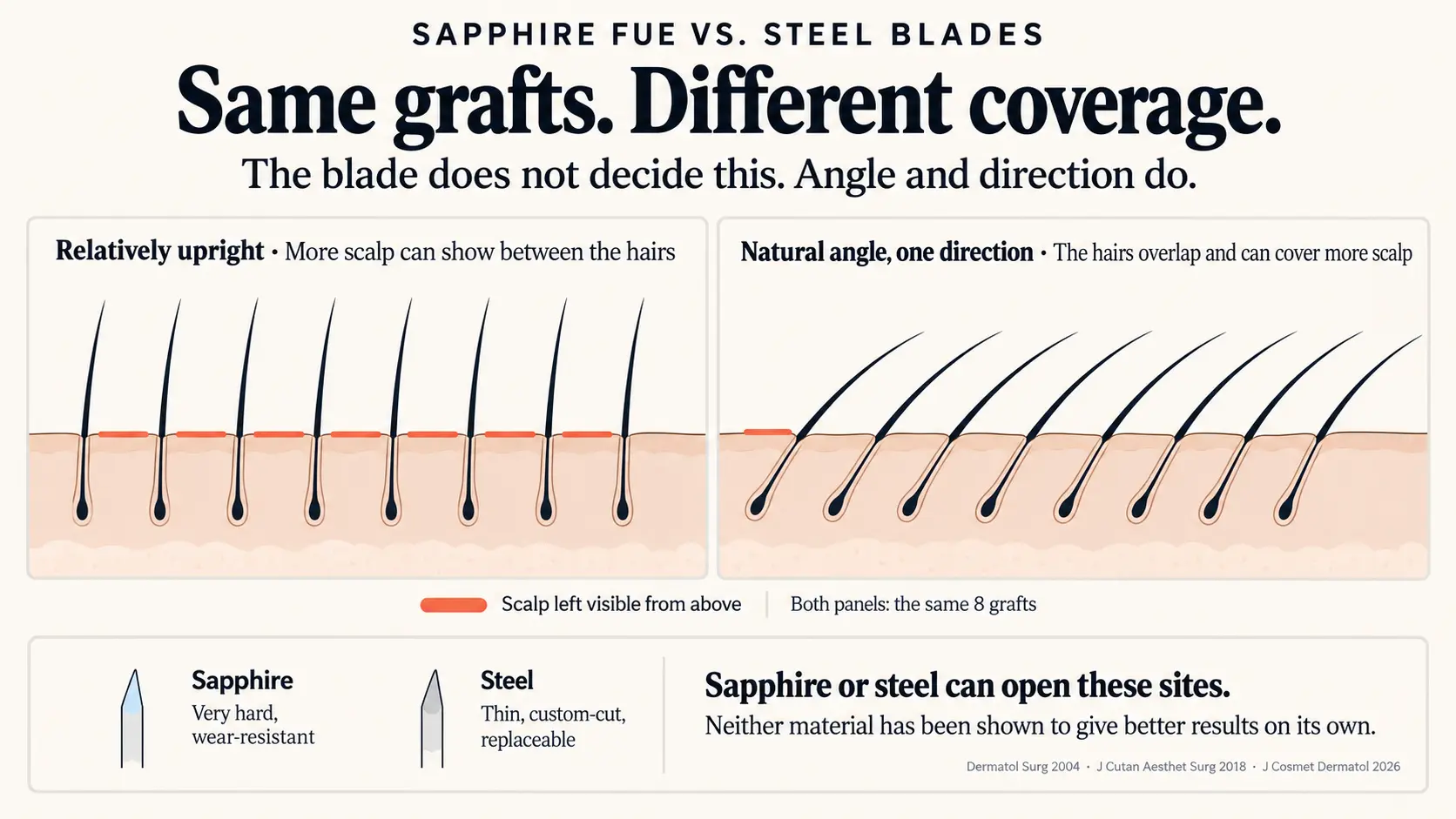
Imagine two areas containing the same number of surviving hairs with similar shaft characteristics.
In one, the hairs emerge relatively upright.
In the other, the hairs emerge at an anatomically appropriate, more acute angle and follow a coordinated growth pattern.
As the strands grow, their orientation affects how they overlap and how much underlying scalp remains visible.
Hairs that project across the scalp may create more layering than hairs that stand relatively upright.
However, this does not mean every transplanted hair should be implanted as flat as possible. Angles that are excessively acute or inconsistent with the patient's natural pattern can create technical problems and unnatural growth.
The correct angle depends on the anatomical region, the surrounding native hair, and the intended hairstyle.
In a 2004 publication, Walter Unger described methods for establishing natural recipient-area hair direction and angulation.[5]
Marwah and Mysore's 2018 review of recipient-area planning likewise identifies angulation and direction among the key considerations in achieving an aesthetically appropriate result.[6]
These principles provide the surgical foundation for treating recipient-site design as more than a question of density.
What a 2026 geometric model tells us
On September 1, 2026, Zontos and colleagues published A Geometric Framework for Predicting Donor Area Thinning After Follicular Unit Excision in the Journal of Cosmetic Dermatology.[7]
The researchers developed a mathematical model incorporating hair shaft diameter, length, density, and exit angle to estimate visual coverage in the donor area.
Their model predicted that areas with identical numerical hair density could have substantially different apparent coverage because of differences in hair characteristics and orientation.
The work illustrates an important optical principle: hair shafts that project across a larger area of scalp can contribute differently to visual coverage than hairs emerging more vertically.
But the study has an essential limitation.
It concerns donor-area coverage after FUE extraction, not the long-term outcomes of recipient-site design. The model has not been prospectively validated, and it was not designed to guide recipient-site angles.
It would therefore be incorrect to claim that the study proves a particular transplantation angle allows a certain percentage reduction in graft numbers.
What it supports is the broader principle that density alone cannot fully describe the appearance of hair coverage.
For me, that is an important distinction when planning how to use a limited donor supply.
7. Why Recipient-Site Arrangement Matters
Creating recipient sites is not simply the process of making as many openings as possible within a defined area.
Each site belongs to a larger design.
Its position, angle, and direction should make sense in relation to the surrounding hair and the patient's natural growth pattern.
This is where an appropriate graft count can be used effectively, or poorly.
The hairline: Creating a believable transition
A natural hairline is rarely a perfectly straight, uniformly dense row of thick hairs.
It usually has a softer leading edge, subtle irregularities, and a gradual increase in visual weight behind the front.
Fine single-hair follicular units are generally preferred at the beginning of this transition.
Larger follicular units can then be distributed farther behind, where they contribute to volume without creating an abrupt, artificial border.
Ronald Shapiro discussed these principles in his 2004 review of natural hairline restoration, emphasizing follicular-unit selection, artistic planning, and the illusion of density.[8]
An artificially low or excessively dense hairline can also consume valuable donor grafts.
For that reason, the position should be appropriate for the patient's age, facial proportions, and likely future hair loss.
We discuss these decisions further in What Makes a Hair Transplant Look Natural? and Why I Usually Advise Men Against Lowering Their Hairline.
The frontal third: Prioritizing visual impact
The frontal third often has a disproportionate influence on the overall appearance of a hair transplant.
It frames the face and is visible during most everyday interactions.
For some patients, concentrating an appropriate proportion of the available grafts in this region provides a greater cosmetic benefit than spreading them evenly over the entire area of hair loss.
This is particularly relevant when donor resources are limited.
The aim is not to maximize density everywhere, but to allocate grafts where they can make a meaningful contribution to the patient's appearance while preserving future treatment options.
The mid-scalp: Continuity and natural layering
The mid-scalp connects the frontal region to the hair farther back.
Recipient-site planning here needs to account for the patient's existing growth direction and habitual parting pattern.
A coordinated arrangement can allow strands to overlap naturally and contribute to apparent fullness.
Poor orientation may create visible separation or unnatural changes in growth direction even when the transplanted grafts survive.
The aim is a continuous result rather than a series of separately reconstructed areas.
The temples: Precision is particularly important
The temporal areas require careful angulation.
Natural temporal hairs often emerge at very acute angles and follow downward or backward growth patterns that vary across the region.
If transplanted hairs emerge too upright, the result may appear unnatural, even when the graft count and survival are satisfactory.
This is a clear example of a problem that additional density cannot solve.
A graft growing successfully in the wrong direction may still be cosmetically undesirable.
The crown: Following the whorl
The crown has a different anatomical pattern.
Hair commonly radiates around a central whorl, changing direction throughout the region.
Recipient sites should follow this natural arrangement rather than forcing the grafts into a uniform direction.
Because crown hairs diverge around the whorl, achieving convincing coverage can require substantial donor resources.
For patients with extensive hair loss, aggressively filling the crown may consume grafts that could provide greater visual benefit elsewhere.
A conservative crown plan may therefore be more appropriate in some cases.
These decisions are especially important in male hair transplantation, where progressive androgenetic hair loss can change the relationship between transplanted and native hair over time.
8. Can Sapphire Blades Create Higher Density?
Sapphire blades can be used to make closely spaced recipient sites, but this capability is not unique to sapphire.
Appropriately sized stainless steel microblades and other instruments can also be used for dense transplantation.
The medically relevant question is whether the chosen instrument allows sites to be created at suitable dimensions, angles, depths, and distances without unnecessarily compromising the surrounding tissue.
In 2021, Atodaria and colleagues published Optimal Hair Transplant Recipient Site Slit Design: Minimizing Vascular Damage.[9]
The paper examined how recipient-site geometry, orientation, and depth may influence vascular injury.
Its recommendations were based substantially on anatomical and geometric reasoning rather than definitive randomized comparisons, but the underlying concern is important.
Every recipient site is a controlled surgical wound.
Increasing the number of sites in a limited area may increase potential hair density, but it also increases the number of incisions made within that tissue.
Excessive incision density or depth, particularly when combined with compromised circulation or other risk factors, may contribute to ischemic complications.
A 2026 review by Romera de Blas and colleagues discusses complications of FUE transplantation, including recipient-site necrosis, donor depletion, and the influence of technical and patient-related factors.[10]
Such complications are uncommon in properly selected and managed patients, but they reinforce the importance of balancing density with tissue safety.
This does not mean high-density transplantation is inherently unsafe or undesirable. Appropriate density is essential for successful coverage.
It means that the highest density technically achievable is not necessarily the density that should be created.
Our objective should be enough healthy, surviving hair to produce effective coverage, arranged in the correct pattern and within the patient's biological limits.
9. Other Common Sapphire FUE Claims
Several claims about sapphire are repeated so frequently that patients may reasonably assume they have been firmly established.
The available evidence supports a more cautious interpretation.
| Claim | What the evidence supports |
|---|---|
| Sapphire causes less tissue damage. | Blade geometry, sharpness, incision depth, and surgical technique influence tissue injury. Current evidence does not establish that sapphire always causes less damage than steel. |
| Sapphire heals faster. | There is insufficient high-quality comparative evidence to promise consistently faster healing solely because sapphire is used. |
| Sapphire is antibacterial. | Ordinary, uncoated sapphire recipient-site blades have not been shown through adequate comparative clinical evidence to prevent postoperative infections. Sterilization and infection-control protocols remain essential. |
| Sapphire protects existing follicles. | No cutting instrument can guarantee protection of neighboring follicles. The risk of injury depends on anatomy, visibility, incision placement, depth, and operator technique. |
| Sapphire prevents scarring. | FUE harvesting still creates small donor extraction wounds that heal with scars. The recipient-site blade material does not eliminate donor scarring. |
| Sapphire eliminates the need for tumescence. | This has not been established. Tumescence is part of anesthesia and tissue preparation, and its use depends on surgical requirements rather than blade material alone. |
A note on tumescence
Tumescence is sometimes described inaccurately as simply injecting salt water into the scalp.
In practice, tumescent solutions may contain saline, local anesthetic, and a vasoconstrictor such as epinephrine. Their purpose can include improving the operating conditions, reducing bleeding, and modifying tissue firmness.
A 2026 comparative observational study by Akpınar and Çelik examined the relationship between infiltration depth and intraoperative bleeding during recipient-site creation.[11]
The researchers found differences in bleeding according to infiltration depth, suggesting that this aspect of tissue preparation deserves attention independently of the blade selected.
The study did not compare sapphire with steel, nor does it establish a universal tumescence protocol.
The relevant point is that blade material should not be used as a reason to disregard proper tissue preparation.
10. Our Approach to Hair Transplant Planning
At Pure Line, the first decision is not which blade to use.
It is whether transplantation is appropriate for the patient and, if so, what a responsible long-term plan should look like.
Before planning graft numbers or recipient sites, we assess the pattern of hair loss, donor characteristics, existing hair, medical history, and likely future progression.
We consider the patient's hair caliber, follicular-unit composition, scalp characteristics, and expectations.
The amount of donor hair available is finite. A graft used today is not available for another procedure in the future.
For that reason, an impressive graft count does not automatically represent a good surgical plan.
My responsibilities include establishing the overall medical and aesthetic plan, determining the hairline design, choosing the punch size and the number of grafts to be harvested, selecting grafts under the microscope, and planning graft distribution.
Each operation is carried out under my medical direction and supervision. On the day of surgery, FUE Specialist Canan Yaylacı, co-founder of Pure Line, and our fixed clinical team carry that plan through under one protocol, with the graft-care discipline and procedural consistency it depends on.
We schedule one hair transplant per operating day to support continuity and careful execution of the plan. This approach is explained in Why We Perform Only One Hair Transplant a Day.
The scheduling model does not guarantee a result, just as a particular blade cannot guarantee a result. Its purpose is to provide the time and consistency needed for individualized surgical decisions.
Ultimately, we want the transplanted hair to look natural, provide useful coverage, and remain compatible with the patient's future hair-loss pattern.
Sometimes this means recommending fewer grafts than the patient expected. In other cases, it means concentrating more of the available grafts in a particular region or preserving the crown for a later procedure.
And sometimes the appropriate recommendation is to postpone surgery.
The quality of a hair transplant should not be judged by the number of grafts transferred alone.
It should be judged by the outcome those grafts produce and the condition in which the donor area is left.
11. What Should Patients Ask a Clinic Offering Sapphire FUE?
Rather than asking only whether a clinic uses sapphire, I encourage patients to ask questions that reveal how the procedure is planned.
Who will determine the hairline and recipient-site angles?
The answer should identify the people responsible for the design and explain how regional growth patterns are considered.
How will the grafts be distributed?
A thoughtful plan should distinguish the frontal transition, frontal third, mid-scalp, and crown instead of promising identical density everywhere.
How are single-hair and multi-hair follicular units selected?
The leading edge of the hairline generally requires different graft characteristics from areas where additional volume is needed.
How will the donor area be protected?
The clinic should be able to explain its extraction strategy and how future donor resources are considered.
Can I see mature results in patients with hair characteristics similar to mine?
Photographs should ideally show consistent lighting, angles, hair length, and follow-up information.
Our documented patient results provide examples of individual outcomes, although no patient's result can guarantee another person's experience.
An instrument can be useful without being the most important part of the procedure.
Understanding how a team plans and executes the transplant tells you considerably more than the name of its blade.
Frequently Asked Questions
Is Sapphire FUE better than regular FUE?
Is sapphire better than stainless steel for hair transplantation?
Why does Pure Line prefer custom-cut steel blades?
Does Sapphire FUE provide greater hair density?
Can fewer grafts sometimes produce better-looking coverage?
What matters most for a natural hair transplant?
Final Thoughts: The Blade Is a Tool. The Result Is a Design.
I don't believe sapphire blades are bad instruments, and I don't believe steel blades are automatically superior.
Both can be useful when appropriately selected and handled.
The available research suggests that blade design and incision characteristics deserve attention. But it does not establish that choosing a particular material will, by itself, produce a better hair transplant.
A blade cannot decide where a patient's hairline should begin or how the hair should fall across the forehead. It cannot determine which follicular units belong at the front, how the crown should be reconstructed, or how much donor hair should remain available for the future.
Those are surgical planning decisions.
Hair transplantation is not simply about placing as many follicles as possible into an area of thinning scalp. It is about using a limited supply of living hair to reconstruct a natural growth pattern and create convincing coverage.
There is an important difference between achieving high numerical density and using the available hair effectively.
My priority is not the maximum number of grafts per square centimeter. It is the most natural, balanced, and effective coverage we can responsibly achieve while preserving the patient's long-term options.
That is the standard by which I believe a hair transplant should be judged.
— Dr. Mesut Demir
Planning your hair transplant?
Send us photos of your hairline, crown and donor area. We will explain how we would plan your hairline, graft distribution and recipient sites, or whether it would be better to wait.
Request a Case Review- International Society of Hair Restoration Surgery (ISHRS). Why FUE Is So Confusing. Originally published July 7, 2019; updated January 18, 2024. ISHRS article.
- Ahmad M, Ismail M. Effect of different shapes of recipient site creation micro-blades at varying angles and wound injury. Journal of Cosmetic Dermatology. 2021;20(11):3610–3615. DOI: 10.1111/jocd.14006. PMID: 33599101.
- Balik O. Determination of Scalp Vascular Topography by Laser Doppler Flowmetry and Comparison of Vascular Damage by Different Blades in Hair Transplantation. Journal of Craniofacial Surgery. 2023;34(8):e803–e806. DOI: 10.1097/SCS.0000000000009765. PMID: 37811982.
- Saket K. Accuracy in Hair Repair: Assessing Sapphire FUE, Forceps Methods, and Treatment Times in Contemporary Hair Transplantation. Journal of Maxillofacial and Oral Surgery. 2026;25(4):1155–1165. First published online December 24, 2025. DOI: 10.1007/s12663-025-02874-w. PMID: 42528810.
- Unger WP. Recipient area hair direction and angle in hair transplanting. Dermatologic Surgery. 2004;30(6):829–836. DOI: 10.1111/j.1524-4725.2004.30250.x. PMID: 15171759.
- Marwah MK, Mysore V. Recipient Area. Journal of Cutaneous and Aesthetic Surgery. 2018;11(4):202–210. DOI: 10.4103/JCAS.JCAS_124_18. PMID: 30886474.
- Zontos G, Gupta AK, Economopoulos V, Rose PT, Talukder M. A Geometric Framework for Predicting Donor Area Thinning After Follicular Unit Excision. Journal of Cosmetic Dermatology. 2026;25(9). Published September 1, 2026. DOI: 10.1111/jocd.71156.
- Shapiro R. Principles and techniques used to create a natural hairline in surgical hair restoration. Facial Plastic Surgery Clinics of North America. 2004;12(2):201–217. DOI: 10.1016/j.fsc.2003.12.004. PMID: 15135130.
- Atodaria PR, Venkataram A, Mysore V, Atodaria KP. Optimal Hair Transplant Recipient Site Slit Design: Minimizing Vascular Damage. Indian Journal of Plastic Surgery. 2021;54(4):471–476. DOI: 10.1055/s-0041-1739251. PMID: 34984087.
- Romera de Blas C, Vega Díez D, Ricart Vayá JM, Gómez Zubiaur A. Complications in follicular unit excision hair transplantation: current evidence and practical approaches. Frontiers in Medicine. 2026;13:1750989. DOI: 10.3389/fmed.2026.1750989. PMID: 41709896.
- Akpınar Ü, Çelik MS. Optimizing Intraoperative Hemostasis in Hair Transplantation: A Follicle-Based Tumescent Infiltration Approach. Dermatologic Surgery. 2026;52(9):880–883. DOI: 10.1097/DSS.0000000000005126. PMID: 41990232.